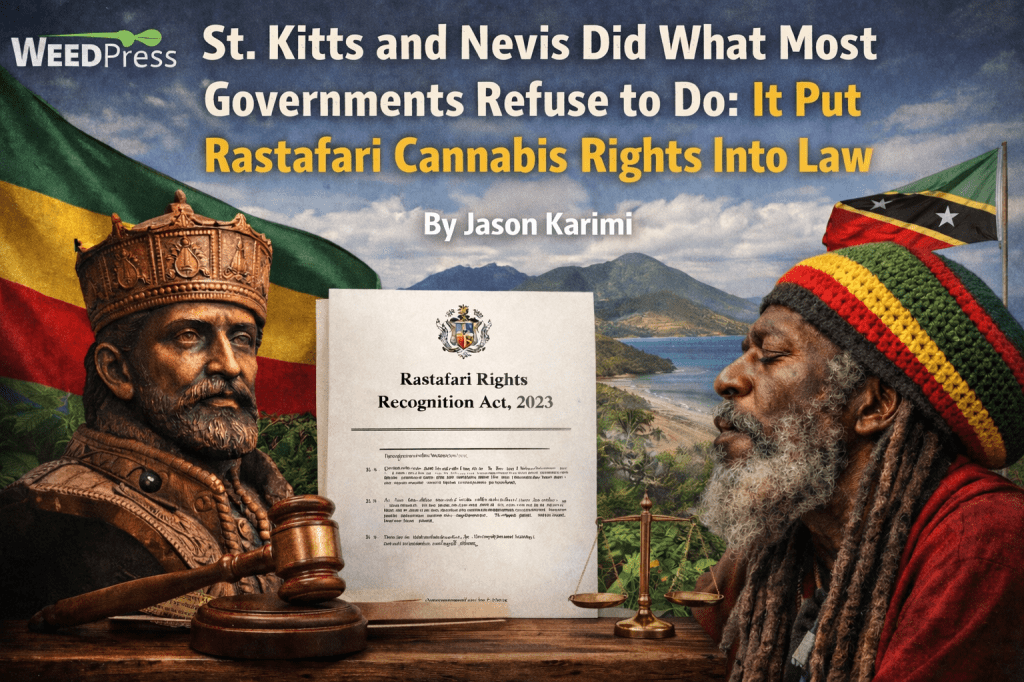
St. Kitts and Nevis Did What Most Governments Refuse to Do: It Put Rastafari Cannabis Rights Into Law
By Jason Karimi | WeedPress
April 10, 2026
For years, governments across the Caribbean and beyond have tried to posture as enlightened on cannabis while ducking the harder question: what happens when cannabis use is not merely recreational, commercial, or medical, but religious?
St. Kitts and Nevis gave an answer in 2023. It passed the Rastafari Rights Recognition Act, 2023, a statute expressly designed to create a registration process for Rastafari groups and to recognize rights tied to cannabis use by registered Rastafari groups. That is not symbolism. That is black-letter law.
The act does something many reform jurisdictions still will not do: it recognizes Rastafari communities as communities. The statute defines a “Rastafari group” as a tribe, community, order, or other group of citizens or lawful residents of Saint Christopher and Nevis who believe in the Rastafari movement and adhere to Rastafari principles and practices. It also defines a “place of assembly” as a place where Rastafari groups gather to practice Rastafari tenets.
That matters because prohibition culture has long depended on reducing Rastafari faith to stereotype, nuisance, or criminal pretext. This act moves in the opposite direction. It says: register the group, register the place of assembly, and deal with the faith as a legal reality instead of pretending it does not exist. Sections 3 and 4 create those registration pathways through the ministry responsible for faith-based affairs.
Then comes the part that should get the attention of every lawyer, legislator, and religious-liberty advocate watching cannabis law. Section 8 provides that at a registered place of assembly, cannabis material may be grown, harvested, dried, trimmed, cured, or possessed by adult members of a registered Rastafari group “as a sacrament for upliftment or edification.” The act also says a registered Rastafari group may be licensed under the country’s Cannabis Act, 2020. In plain English: St. Kitts and Nevis did not merely decriminalize around Rastafari people. It recognized sacramental cannabis practice inside a statutory framework.
And the law does not stop at worship-space tolerance. Section 5 allows registered Rastafari groups to apply through the ministry to the Cabinet for a serious package of waivers and concessions, including cannabis licence-fee waivers, business-licence waivers, income-tax concessions, customs-duty concessions, property-tax waivers, and concessionary purchase or lease terms for Crown land. That is bigger than a narrow religious-use carveout. It is an institutional recognition model.
That is exactly why this law is worth studying. Critics of religious cannabis accommodation often pretend there are only two options: absolute prohibition or ungovernable chaos. St. Kitts and Nevis chose a third path — registration, adult limits, recognized places of assembly, statutory rights, and penalties for fraud. Sections 6 and 7 make registration free but require renewal every two years, while section 9 imposes fines, imprisonment, and even forfeiture or repayment consequences for fraudulent misrepresentation used to obtain benefits under the act.
That last part matters too. This was not written as a sentimental gesture. It was written as law. The statute includes administrative structure, formal applications, renewal rules, and enforcement provisions. It assumes the state can recognize Rastafari rights without surrendering the ability to police fraud. That is what serious legislation looks like.
And this is not just a dead letter sitting in a gazette archive. On April 2, 2026, the St. Kitts and Nevis Information Service announced that application forms were available for permits, licences, and related registrations under both the Rastafari Rights Recognition Act, 2023 and the Freedom of Conscience (Cannabis) Act, 2023, with collection points identified on Saint Kitts. That suggests the government is moving from enactment to administration.
The broader lesson is uncomfortable for a lot of politicians in a lot of places. If a jurisdiction is willing to legalize commercial cannabis, tolerate medical cannabis, or tax cannabis, but still refuses to confront religious cannabis rights, then its reform story is incomplete. It may be profitable. It may be politically marketable. But it is incomplete. St. Kitts and Nevis, whatever else one may say, chose to confront the harder question directly in statute.
That does not mean the federation has solved everything. It does mean it crossed a line most governments still refuse to cross. It put Rastafari recognition, sacramental cannabis use, and institutional accommodation into written law instead of leaving Rastafari people to beg for tolerance from the same systems that criminalized them in the first place.
That is why this act deserves attention far beyond Basseterre. It is not just another cannabis reform measure. It is a challenge to every jurisdiction that talks about equity, faith, liberty, and post-prohibition justice while quietly avoiding the one community that forced many of these issues into public view long before cannabis became respectable.
St. Kitts and Nevis did not apologize for Rastafari faith. It legislated around it. And that is more than many louder, richer, and more self-congratulatory governments have been willing to do.
 WeedPress: The Paper Trail
Leave a comment