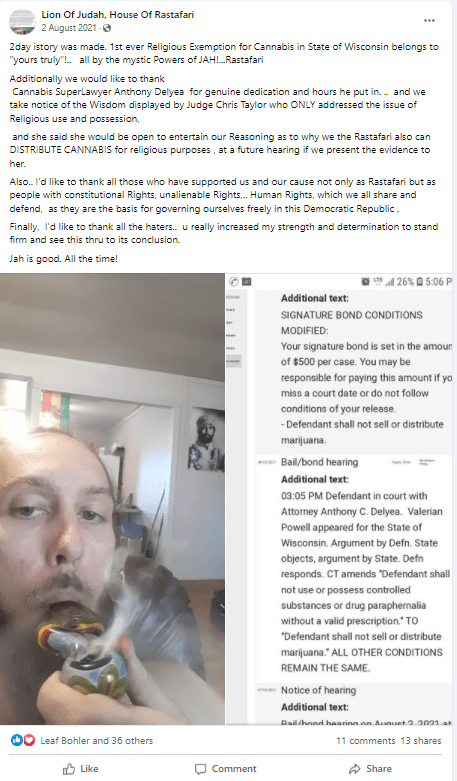
Last August, a judge in Wisconsin allowed Ras Jesse Schworck, a Rastafarian, to use marijuana within the parameters of his religious beliefs. (court case number 2019cf001228 dane county circuit)
Following the August ruling, Ras Schworck then made this statement on Facebook, and supplied a screenshot of the judge’s modification order amending the terms of probation:
https://www.facebook.com/230714517672280/posts/1024796271597430/
Lion Of Judah, House Of Rastafari
2day istory was made. 1st ever Religious Exemption for Cannabis in State of Wisconsin belongs to “yours truly”!.. all by the mystic Powers of JAH!…Rastafari
Additionally we would like to thank
Cannabis Super Lawyer Anthony Delyea for genuine dedication and hours he put in. .. and we take notice of the Wisdom displayed by Judge Chris Taylor who ONLY addressed the issue of Religious use and possession,
and she said she would be open to entertain our Reasoning as to why we the Rastafari also can DISTRIBUTE CANNABIS for religious purposes , at a future hearing if we present the evidence to her.
Also.. I’d like to thank all those who have supported us and our cause not only as Rastafari but as people with constitutional Rights, unalienable Rights,.. Human Rights, which we all share and defend, as they are the basis for governing ourselves freely in this Democratic Republic .
Finally, I’d like to thank all the haters.. u really increased my strength and determination to stand firm and see this thru to its conclusion.
Jah is good. All the time!
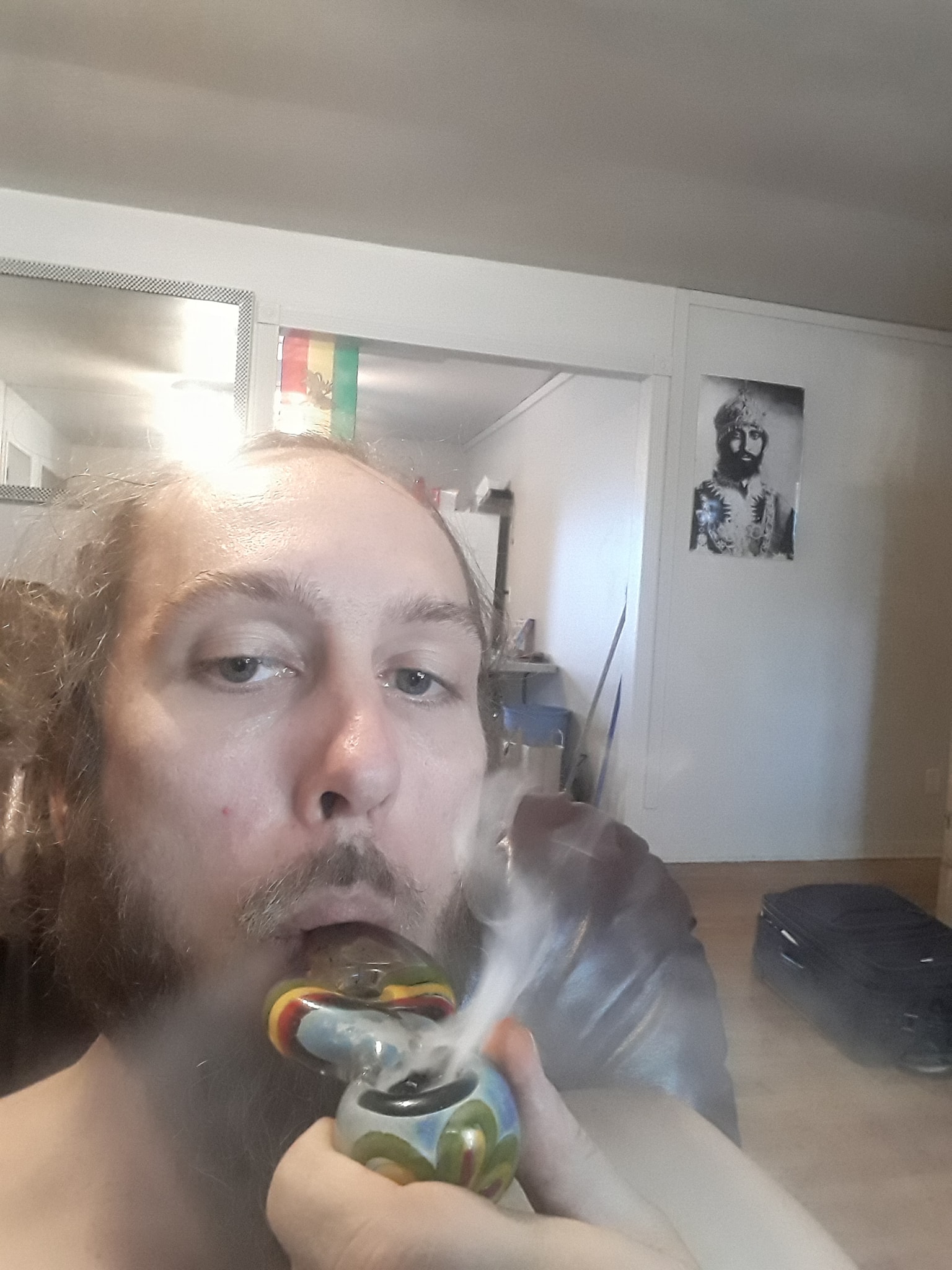
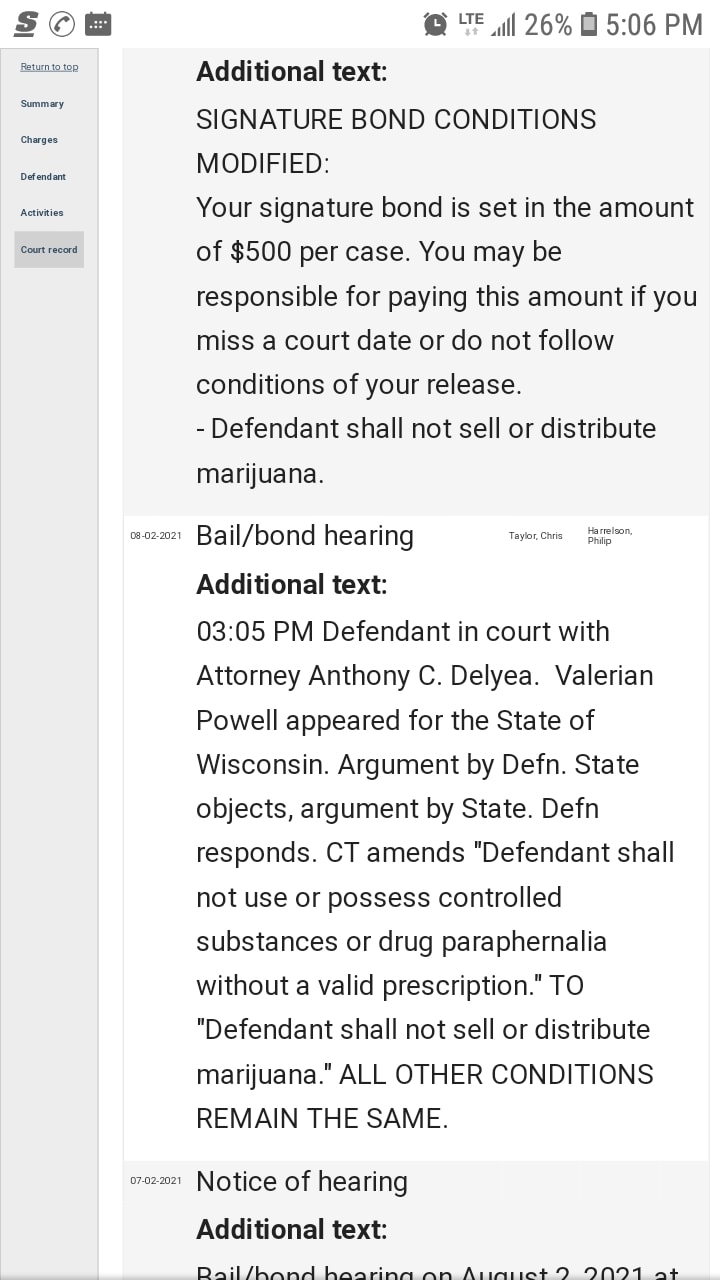
Judges in Pennsylvania and Colorado are also amending probationers terms on a case-by-case basis as reported by Marijuana Moment. Pennsylvania’s Supreme Court even ruled that medical marijuana use is protected for probationers. As legalization to enhance public safety sweeps the nation, drug dealers and drug cartels are being displaced by law abiding citizens through proper regulations, thereby increasing public safety, and restoring fairness and equality under the law to religious and medical users of lawful constitutionally protected cannabis sacrament. Federal cases of trafficking are plummeting as incentives for criminality are replaced by regulations, and society is safer as a result. And, people who previously worried teen usage would increase following common-sense pro-public safety regulations are now admitting teen use concerns have been disproven. (“I think we’ve proven and demonstrated that there is no increase in experimentation among teenagers. There is no change in frequency of use, no change in driving while high—all the things we most worried about didn’t come to pass,” Hickenlooper said.)
Ras Jesse Schworck’s motion to modify conditions of pre-trial supervision are below. Follow WeedPress on Facebook
Download the ruling for original formatting by clicking the “sc-je-bail-motion-special” link above.
| STATE OF WISCONSIN | CIRCUIT COURT BRANCH 12 | DANE COUNTY |
| STATE OF WISCONSIN | ||
| PLAINTIFF, | ||
| VS. | CASE NO. 19CF1228 | |
| JESSE R. SCHWORCK, | ||
| DEFENDANT. | ||
DEFENDANT’S NOTICE OF MOTION AND MOTION TO MODIFY CONDITIONS OF BOND |
To: Mr. Valerian Powell
Dane County District Attorney’s Office
Dane County Courthouse
215 S. Hamilton St. #3000
Madison WI 53703-3297
NOTICE
The defendant, appearing specially by his attorney and reserving his right to challenge the court’s jurisdiction, hereby provides notice that on a date and at a time and place to be designated by the court, the defendant will move the court for an order granting the motion(s) attached to this notice.
MOTION
The defendant, appearing specially by his attorney and reserving his right to challenge the court’s jurisdiction, moves the Court to modify the conditions of the defendant’s bail. This motion is brought pursuant to the 8th and 14th Amendments to the United States Constitution; article I, sections 6 and 8 of the Wisconsin Constitution; and Wisconsin Statutes, Chapter 969 Bail and Other Conditions of Release.
More specifically, this motion addresses the United States Constitution’s guarantee that:
Congress shall make no law respecting an establishment of religion, or prohibiting the free exercise thereof; or abridging the freedom of speech, or of the press; or the right of the people peaceably to assemble, and to petition the Government for a redress of …
As well as Wisconsin’s, Article I, Declaration of Rights, Section 18 – Freedom of worship; liberty of conscience; state religion; public funds, which provides in pertinent part:
The right of every person to worship Almighty God according to the dictates of conscience shall never be infringed; nor shall any person be compelled to attend, erect or support any place of worship, or to maintain any ministry, without consent; nor shall any control of, or interference with, the rights of conscience be permitted, or any preference be given by law to any religious establishments or modes of worship; nor shall any money be drawn from the treasury for the benefit of religious societies, or religious or theological seminaries.
AS GROUNDS, the defendant asserts:
I. LEGAL AUTHORITY
1. Mr. Schworck is presumed innocent of the pending charges.
2. The Constitution of the State of Wisconsin provides its citizens the absolute right to bail:
(2) All persons, before conviction, shall be eligible for release under reasonable conditions designed to assure their appearance in court, protect members of the community from serious bodily harm or prevent the intimidation of witnesses. Monetary conditions of release may be imposed at or after the initial appearance only upon a finding that there is a reasonable basis to believe that the conditions are necessary to assure appearance in court. WI Const. art I, § 8, cl. 2.
3. Mr. Schworck is a citizen of Wisconsin.
4. Mr. Schworck was released on a signature bond which was later amended and continues to subject him to the following special conditions:
– Defendant shall not use or possess controlled substances or drug paraphernalia without a valid prescription
5. On June 28, 2019, Mr. Schworck objected to all the conditions imposed because they violate the “Free Exercise Clause” of the first amendment to the Constitution which proscribes laws prohibiting the free exercise of religion.
6. This Court is fortunate that it can address an issue that Supreme Court Justice Thomas could not. Justice Thomas published a statement United States Supreme Court’s June 17, 2021, denial of a writ of certiorari in STANDING AKIMBO, LLC, ET AL., v. UNITED STATES. Justice Thomas began with the case that enshrined the Government’s compelling interest in prohibiting marijuana:
Sixteen years ago, this Court held that Congress’ power to regulate interstate commerce authorized it “to prohibit the local cultivation and use of marijuana.” Gonzales v. Raich, 545 U. S. 1, 5 (2005). The reason, the Court explained, was that Congress had “enacted comprehensive legislation to regulate the interstate market in a fungible commodity” and that “exemption[s]” for local use could undermine this “comprehensive” regime. Id., at 22–29. The Court stressed that Congress had decided “to prohibit entirely the possession or use of [marijuana]” and had “designate[d] marijuana as contraband for any purpose.” Id., at 24–27 (first emphasis added). Prohibiting any intrastate use was thus, according to the Court, “‘necessary and proper’” to avoid a “gaping hole” in Congress’ “closed regulatory system.” Id., at 13, 22 (citing U. S. Const., Art. I, §8). Whatever the merits of Raich when it was decided, federal policies of the past 16 years have greatly undermined its reasoning. Once comprehensive, the Federal Government’s current approach is a half-in, half-out regime that simultaneously tolerates and forbids local use of marijuana. This contradictory and unstable state of affairs strains basic principles of federalism and conceals traps for the unwary.
In addition to expressing his concerns regarding the “…disjuncture between the Government’s recent laissez-faire policies on marijuana and the actual operation of specific laws…” Justice Thomas also addressed equal justice. His statement touched on the injustices that result from our incoherent policies in relation to our Fourteenth Amendments Equal Protection guarantee.
Yet, as petitioners recently discovered, legality under state law and the absence of federal criminal enforcement do not ensure equal treatment.
CITATION TO THOMAS
6. Against this background, and subsequent to the United States Supreme Court’s reaffirmation of the law in Fulton v. City of Philadelphia, Mr. Schworck renews his objections to his special bond condition.
In Fulton v. City of Philadelphia, the Court held that rather than examining the validity of its holding in Smith, the case could be decided on the narrower issue of the applicability of Smith. The Fulton Court began with the holding in Smith:
Smith held that laws incidentally burdening religion are ordinarily not subject to strict scrutiny under the Free Exercise Clause so long as they are neutral and generally applicable. 494 U. S., at 878-882.”
The Fulton Court found that Smith, by its own terms was inapplicable to the controversy before this Court:
As the plurality pointed out in Bowen v. Roy, supra, 476 U.S., at 708, 106 S.Ct., at 2156-57, our decisions in the unemployment cases stand for the proposition that where the State has in place a system of individual exemptions, it may not refuse to extend that system to cases of “religious hardship” without compelling reason.
(emphasis added) Smith at 884
Just as Justice Thomas explains infra, the government’s enforcement of marijuana laws has undermined the reasoning in Smith, over the years. Likewise, the reasoning in Smith is inapplicable to the case before this Court.
The DEA provides, “Guidance Regarding Petitions for Religious Exemption from the Controlled Substances Act Pursuant to the Religious Freedom Restoration Act” (Attachment “A”) which clearly indicates that the government continues to exercise the discretion to grant religious exemptions regarding controlled substances.
Whether or not the decisions are that limited, they at least have nothing to do with an across-the-board criminal prohibition on a particular form of conduct.
Id.
Clearly there is no across the board prohibition on marijuana under federal law. Likewise, there are exemptions under Wisconsin law, see Wis. Stat. § 961.115 “Native American Church Exemption. Defending a similar statute the DEA explained in its page addressing “Peyote Exemption for Native American Church.”
A statutory exemption limited to the NAC, to the exclusion of other religions whose use of peyote is central to established religious beliefs or practices, would be unconstitutional under the Establishment Clause if it discriminated among otherwise equally situated religions. No different conclusion would be required because the “preferred” religion is composed of American Indians, since the special treatment of Indians under our law is grounded in their unique status as political entities, not in their religion or culture. On the other hand, since no group other than the NAC is likely to be able to establish its entitlement to the exemption, the DEA would be justified in adopting procedures designed to minimize the administrative burdens of extending the exemption to other groups.
Wisconsin also asserts a non-discriminatory basis exists to exempt indigenous religions and deny all others. Wisconsin’s like the United States’ assertion that the law was not discriminatory is as amusing as it is false. The truth was laid bare in United States v. Boyll:
The United States adopts a racially restrictive reading of 21 C.F.R. 1307.31, arguing that the protection contained therein applies only to members of the Native American Church who are American Indians. It claims that Mr. Boyll cannot be a member of the Native American Church because “membership is limited to persons who [sic] ethnic descent is at least twenty-five percent derived from American Indian stock, and to the spouses of such persons“; that, therefore, Mr. Boyll cannot be a member of the Native American Church since neither he nor his spouse is twenty-five percent American Indian.
The Boyll court having addressed the government’s twenty-five percent truthful position also addressed Constitutional concerns and their individual importance:
THERE is a genius to our Constitution. Its genius is that it speaks to the freedoms of the individual. It is this genius that brings the present matter before the Court. More specifically, this matter concerns a freedom that was a natural idea whose genesis was in the Plymouth Charter, and finds its present form in the First Amendment to the United States Constitution — the freedom of religion.
CITATION
The Government’s “war on drugs” has become a wildfire that threatens to consume those fundamental rights of the individual deliberately enshrined in our Constitution. Ironically, as we celebrate the 200th anniversary of the Bill of Rights, the tattered Fourth Amendment right to be free from unreasonable searches and seizures and the now frail Fifth Amendment right against self-incrimination or deprivation of liberty without due process have fallen as casualties in this “war on drugs.” It was naive of this Court to hope that this erosion of constitutional protections would stop at the Fourth and Fifth Amendments. But today, the “war” targets one of the most deeply held fundamental rights — the First Amendment right to freely exercise one’s religion.
As Justice Thomas noted, the “Once comprehensive, the Federal Government’s current approach is a half-in, half-out regime that simultaneously tolerates and forbids local use of marijuana.” (QUOTE)(CITE).
In 2009 and 2013, the Department of Justice issued memorandums outlining a policy against intruding on state legalization schemes or prosecuting certain individuals who comply with state law. In 2009, Congress enabled Washington D. C.’s government to decriminalize medical marijuana under local ordinance. Moreover, in every fiscal year since 2015, Congress has prohibited the Department of Justice from “spending funds to prevent states’ implementation of their own medical marijuana laws.” United States v. McIntosh, 833 F. 3d 1163, 1168, 1175–1177 (CA9 2016) (interpreting the rider to prevent expenditures on the prosecution of individuals who comply with state law)
Wisconsin has made more exemptions, consider Wis. Stat. § 961.32(b)(3) entitled, “Possession authorization,” provides in pertinent part:
(b)(3) An ultimate user or a person in possession of any controlled substance pursuant to a lawful order of a practitioner or in lawful possession of a schedule V substance.
No honest argument can be made to refute the reasoning of the Fulton Court’s applies here, as the law is not applied “across the board” CITE THOMAS. Not in Madison, not in the State of Wisconsin, and not in the United States. There is no jurisdiction where the prohibition against marijuana is “a law of general application.” When a statute infringes on free exercise, both the Wisconsin Constitution and United States Constitution demand strict scrutiny. Again this very point was addressed just days ago Employment Div., Dept. of Human Resources of Ore. v. Smith, 494 U. S. 872, was reiterated in Fulton:
… where such a law is not neutral or not of general application, it must undergo the most rigorous of scrutiny: It must be justified by a compelling governmental interest and must be narrowly tailored to advance that interest. Neutrality and general applicability are interrelated, and failure to satisfy one requirement is a likely indication that the other has not been satisfied. Pp.531-532.
When the question is correctly stated, it cannot be answered by saying the State of Wisconsin or the United States has a compelling interest in enforcing drug laws. The correct question requires that the court weigh whether the government has a compelling an interest that would justify denying an exception to the law. Clearly exemptions are possible as the “Guidance Regarding Petitions for Religious Exemption from the Controlled Substances Act Pursuant to the Religious Freedom Restoration Act” is promulgated by the Drug Enforcement Agency.
Another change that supports Mr. Schworck’s position is the weakened state of the compelling government interest in the regulation of marijuana. The Fulton Court explains that when strict scrutiny is employed this is a distinction that makes a difference:
A government policy can survive strict scrutiny only if it advances “interests of the highest order” and is narrowly tailored to achieve those interests. Lukumi, 508 U. S., at 546 (internal quotation marks omitted). Put another way, so long as the government can achieve its interests in a manner that does not burden religion, it must do so.
Fulton v. City of Phila. (2021).
The City of Madison Police Department was the driving force behind the investigation of the church. The City of Madison has since enacted MGO 23.20 – REGULATIONS CONCERNING CANNABIS. The most pertinent language of the ordinance is:
(2) Possession . A person who is eighteen (18) years of age or older may possess cannabis or cannabis or cannabis derivatives in an amount not to exceed twenty-eight (28) grams on public property with the permission of the property owner, landlord or tenant or on private property. Exceptions:
It is difficult to understand how the State could argue that marijuana prohibition advances “interests of the highest order,” when it must make that argument in the middle of the City of Madison which by ordinance allows possession and recreational use of the exact same substance as the sacrament shared by members at Lion of Judah House of Rastafari Church.
Mr Schworck is aware of the distinction between a bail condition and a law. Nevertheless, the special condition of his bail prohibits Mr. Schworck from using his sacrament entheogen central to his religion, while secular use is not prohibited in any way. Permitting secular conduct while prohibiting simlar religious conduct underminds the state’s assertion of a compelling interest. Again, this settled law is restated in Fulton:
A law also lacks general applicability if it prohibits religious conduct while permitting secular conduct that undermines the government’s asserted interests in a similar way. See id., at 542-546. In Church of Lukumi Babalu Aye, Inc. v. Hialeah,…”
Fulton v. City of Phila. (2021)
The discrimination in Wisconsin law is best illustrated by Wis. Stat. 302.375(2m) which reads in pertinent part:
A member of the clergy may possess no more than 2 ounces of wine in a prison, jail, or house of correction if he or she intends to use it in a religious service. A member of the clergy may give or deliver a reasonable amount of wine to an inmate and an inmate may consume that wine as part of a religious service. The department is not required to purchase or store wine for an inmate, a chaplain, or any other member of the clergy who is acting under this subsection.
So, if Mr. Schworck were a Catholic in prison for his 10th OWI conviction he would be able to partake in the sacrament of his communion. Yet, Mr. Schworck who “acting according to the dictates of his conscience,” lawfully opened a Church and made no effort to conceal his Rastafarian ministry, is denied the sacrament of his religion in the City of Madison. A city where secular use is permitted by a lawfully enacted ordinance.
8. Mr. Schworck asserts that like the original bond condition prohibiting his entering the church, this special condition is subject to the same statutory test (1) The burden is in furtherance of a compelling governmental interest. (2) The burden is the least restrictive means of furthering that compelling interest. This test is the minimum protection of his inalienable and constitutional rights.
9. There is no compelling interest that justifies the burden placed on the constitutionally guaranteed right to Free Exercise under the state and federal Constitutions, not because of a law of general application, clearly not when secular entities are allowed to undertake the same activities.
10. Mr. Schworck submits to this Court that this special condition interferes with the protections afforded by 42 USC 2000bb-1 Free exercise of religion protected which provides in pertinent part:
(a) In general
Government shall not substantially burden a person’s exercise of religion even if the burden results from a rule of general applicability, except as provided in subsection (b).
(b) Exception
Government may substantially burden a person’s exercise of religion only if it demonstrates that application of the burden to the person-
(1) is in furtherance of a compelling governmental interest; and
(2) is the least restrictive means of furthering that compelling governmental interest.
(c) Judicial relief
A person whose religious exercise has been burdened in violation of this section may assert that violation as a claim or defense in a judicial proceeding and obtain appropriate relief against a government. Standing to assert a claim or defense under this section shall be governed by the general rules of standing under article III of the Constitution.
7. Mr. Schworck MOVES this Court to remove the special condition of his bond.
CONCLUSION
This Court must apply Strict Scrutiny for the following reasons. Secular use and possession of cannabis is permitted by a lawfully enacted ordinance but prohibited for Mr. Schworck’s religious use. The exemptions under state and federal law undermine the assertion that the prohibition is generally applicable. The state and federal governments have made discriminatory exemptions for other religions.
Strict Scrutiny requires this Court to weigh whether the State’s can meet its burden (1) to show it is acting in furtherance of a compelling governmental interest that would justify denying a religious use exception to the law. (2) that it is using the least restrictive means of furthering that compelling governmental interest.
REQUESTED RELIEF
Mr. Schworck requests that his bail conditions be amended to remove the special condition, leaving only the standard conditions.
Submitted this 30 day of June, 2021 .

___________________________________ Anthony C. Delyea, State Bar No. 1036436 Delyea Law Office Attorney for Jesse R. Schworck |
4560 Kennedy Road
Cottage Grove, WI 53527
Office (608) 251-2324
Fax (608) 251-2384
Anthony@Delyea.com
It is true that Employment Division, Department of Human Resources of Oregon v. Smith, 494 U.S. 872, 110 S.Ct. 1595, 108 L.Ed.2d 876 (1990) stands for the proposition that:
The state now has the burden of proving a compelling government interest and should it be able to meet that burden, that the compelling interest cannot be met in a less restrictive manner. Obviously that State deserves an opportunity to prove its case; however, given the fact that the Dane County Courthouse is located in the middles of the City of Madison which has passed an ordinance to allow recreational use and of marijuana, the argument would
, given that the State has not met its burden of showing a compelling government interest. Even if the State were able to fashion such an argument, the interference would be unconstitutional given plethora of less intrusive means to
with, the rights of conscience that all charges related to controlled substances are subject to strict scrutiny. The Fulton Court explains that this is a distinction that makes a difference:
There is no factual basis to support the State’s assertions that there is a compelling interest in the enforcement of all drug laws, given the various exemptions.
The evidence is overwhelming, the State cannot in good faith assert that the law is a law of general application. Nevertheless, Mr. Schwork anticipates that the State will argue that it has an interest in enforcing state laws. However, the question before the Court, “…whether it has such an interest in denying an exception to [Mr. Schworck].” (CITE) Mr. Schworck again asserts that interference with his right to worship according to the dictates of his conscience is unconstitutional as applied to him. The Constitution requires courts to “scrutinize[] the asserted harm of granting specific exemptions to particular religious claimants.” O Centro, 546 U. S., at 431. (emphasis added).
 WeedPress: The Paper Trail
Leave a comment