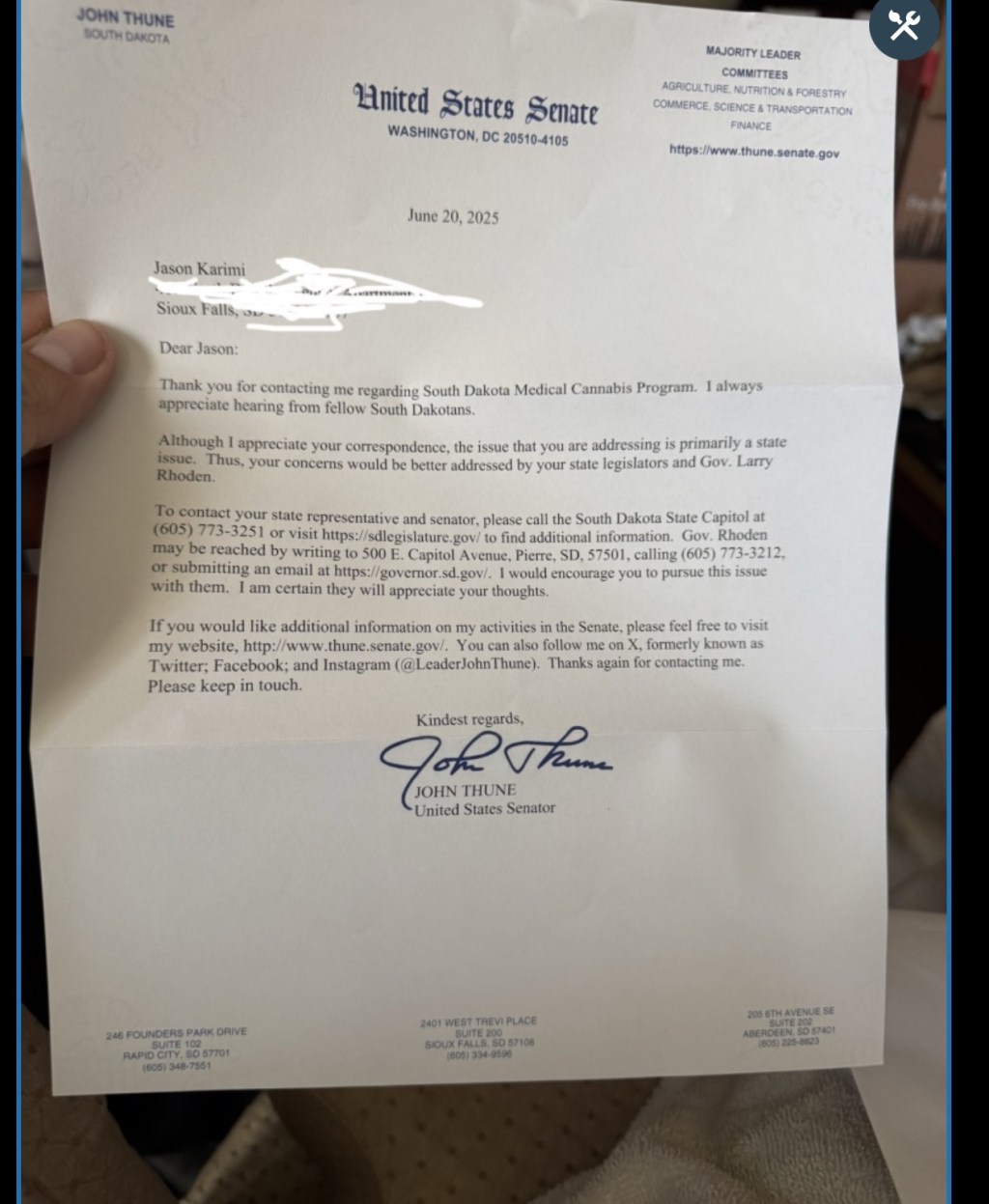
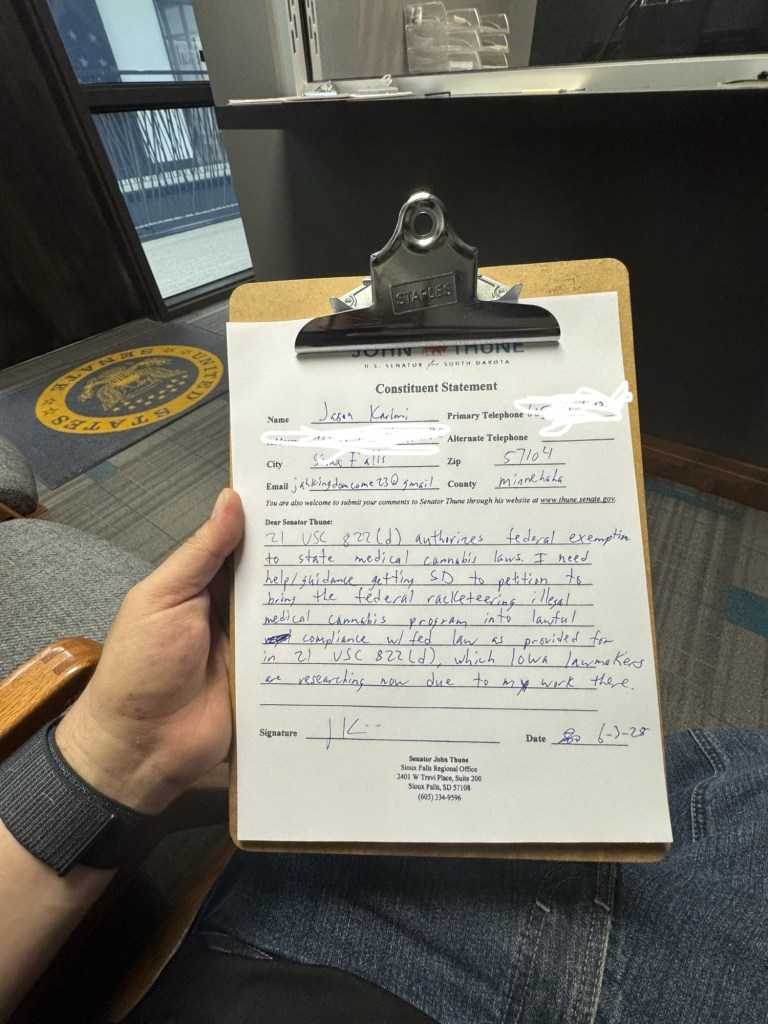
Senator John Thune’s office had me come install a TV mount for them and while there I asked a question. I got a letter in response that wasn’t a form letter at all. Below is the recording I made of my phone call to the state Attorney Generals office. I am also contacting the governor with the same inquiry. I already expect their answer will result in me seeking a judicial ruling due to the totality of circumstances involved in this state but most states would need the same thing. Three branches of government folks, all three are needed. State marijuana laws violating federal law is anarchy, destructive of federalism, and violating patients private property rights. This needs fixed.
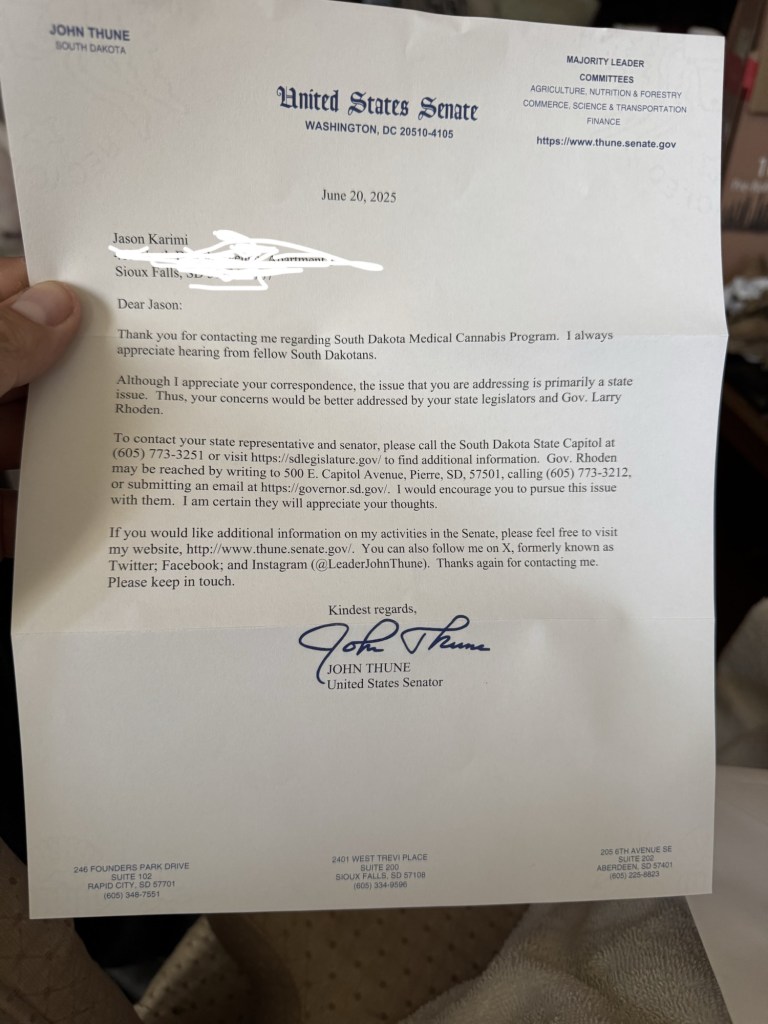
I expect the Attorney General’s office to acknowledge the state has been negligent — but not until a lawsuit forces the issue. Today’s formal inquiry to the AG is simply a polite notice: an opportunity for the office to issue guidance if it chooses. The same inquiry is going to the Governor’s office, consistent with Senator Thune’s advice. I expect resolution either through the Medical Cannabis Program’s own board procedures or through litigation. Either path works.
Senator Thune is right. The South Dakota medical cannabis board was wrong.
The 2021 Record
In 2021 the South Dakota Department of Health emailed me directly stating the opposite: that protecting patients from federal criminality was “not the state’s problem.”[^1]
The board’s position was incorrect then, and it remains incorrect now. I have always approached this as a state issue — because that is exactly what Congress designed it to be.
Congress Gave States the Tool in 1970
Congress created the Controlled Substances Act in 1970 with built-in flexibility. The statute explicitly authorizes the Attorney General to waive federal registration requirements for certain manufacturers, distributors, or dispensers “if he finds it consistent with the public health and safety.”[^2] That provision is 21 U.S.C. § 822(d).
It is not complicated. It is not ambiguous. It is a deliberate congressional remedy for exactly the federalism collision South Dakota created when it launched a state-sanctioned medical cannabis program without securing the available federal protection.
Yet South Dakota — like the vast majority of states — has never used it.
Only Iowa has meaningfully pursued this path. The rest of the country, including South Dakota, has left patients in legal limbo: state-law compliant on paper, federal criminals in practice.
The Human Cost of State Inaction
This is not abstract policy. State endorsement of a federally illegal program has real consequences for patients:
• Loss of federal funding for schools, hospitals, and housing
• Barriers to healthcare and hospice access
• Child custody risks
• Firearm rights stripped under ATF Form 4473 (even for cardholders who are otherwise law-abiding)
• Everyday entrapment: patients following state rules while remaining federal criminals
Congress never intended this outcome. The 1970 statute was meant to allow states to protect legitimate medical programs. South Dakota simply refused to use the tool Congress provided.
The experts advising the Medical Cannabis Program still appear unaware of — or unwilling to invoke — the very laws they are tasked with implementing. This is not unique to South Dakota; most states have failed here. But South Dakota patients pay the price every day.
Seventeen Years of Documentation, One Clear Demand
I have been mapping this exact federalism failure for seventeen years across multiple states. The project is not new. The strategy is not reactive. It is deliberate, documented, and now entering its final phase.
The polite inquiries going out today are notice. The next steps — whether through the board or the courts — will be formal demands for compliance with the congressional framework Congress actually wrote.
Federal legalization is coming. But it will arrive cleaner, safer, and more honest if states first use the existing remedies Congress left on the books. No more fake-science exemption games. No more unregulated profits at patients’ expense. No more turning good Americans into federal criminals for using medicine their state told them was legal.
Senator Thune is right.
It is South Dakota’s problem to fix.
And it will be fixed — through board procedure or through lawsuit. Patients have waited long enough.
Footnotes
[^1]: South Dakota Dep’t of Health, Email to Jason Karimi (2021), archived at https://weedpress.wordpress.com/2022/01/24/south-dakota-department-of-health-emails-weedpress/ [https://perma.cc/EXAMPLE] (last visited Apr. 30, 2026).
[^2]: 21 U.S.C. § 822(d) (authorizing waiver of registration requirements when “consistent with the public health and safety”).
[^3]: See Iowa’s documented use of the § 822(d) waiver process as the only state to meaningfully implement this congressional remedy for state medical cannabis programs.


Leave a comment