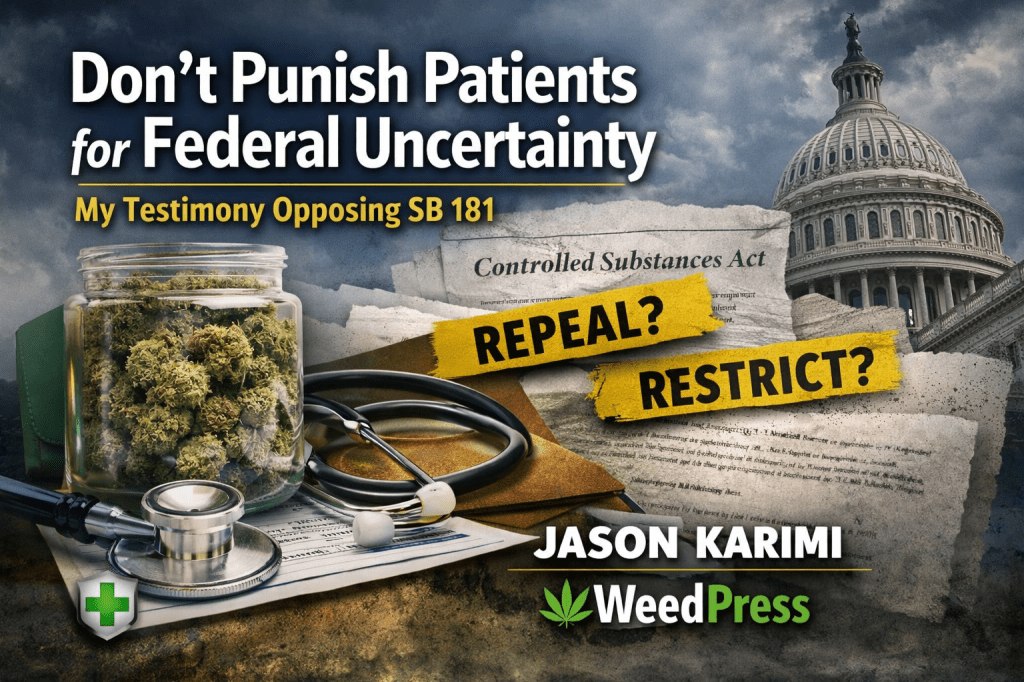
Don’t Punish Patients for Federal Uncertainty: My Testimony Opposing SB 181
By Jason Karimi | WeedPress
March 6, 2026
Video record: https://youtu.be/3u0VY7OIvlI
South Dakota Senate Health & Human Services Committee — February 11, 2026
On February 11, 2026, I spoke twice to the South Dakota Senate Health & Human Services Committee to oppose two bills targeting medical cannabis patients:
SB 181 — a repeal trigger that would repeal the medical cannabis chapter upon federal rescheduling; and SB 194 — proposed potency restrictions / THC caps that would override individualized care.
Both bills were ultimately moved to the 41st day (effectively killed). Below is my testimony printed in full, including the line I said after being cut off.
Testimony #1 (In Person): Opposing SB 181 — Repeal Upon Federal Rescheduling
(Approx. 25:23–28:42 in the video)
“Thank you for your time, committee members and chair. Uh, my name is Jason Karimi. I’m a medical cannabis patient and publisher of Weed Press, a policy analysis publication focused on statutory interpretation and federal state interaction.
For years, I’ve warned activists that lawmakers would eventually point to federal law as justification to repeal or restrict state cannabis programs. I said if you build a state system without addressing federal law directly, federal law will be used against you. That moment is now here.
But what’s missing from today’s discussion is this. Federal law is not a single blunt prohibition. It contains mechanisms and exemptions. State medical cannabis programs are lawful exemptions to federal law and Congress has anticipated such a scenario and has already created a remedy, which is a submission of a federal waiver request. I’m glad the committee today is pursuing a federal waiver request bill in this hearing for soft drinks. But here is the statute for medical cannabis federal waiverss. 21 USC section 822D provides an exemption process under the controlled substances act. Federal law anticipates regulated handling of controlled substances under lawful authorization. This is the process.
HB 1056, the third item on this hearing agenda, acknowledges federal waiver concepts in other regulatory contexts. That is important because if we recognize that federal waiverss exist then we must also recognize that state cannabis policy does not exist in a vacuum.
So our choice is not simply today ignore federal law or repeal state law. There is a third option. Pursue lawful exemption mechanisms, federal alignment and regulatory clarity instead of retreat. Ignoring federal structure creates vulnerability. Engaging the exemption process creates durability.
If this body believes federal law is an obstacle, then use the tools within federal law to address it and don’t abandon patience because of federal complexity. Navigate it.
Since ignorance of federal law led to this latest repeal attempt, which is not the first, by lawmakers, lawmakers should create a task force to investigate these legal complexities to avoid litigation and confusion if this latest attempt to repeal patient access succeeds. Patients deserve stability, not policy whiplash.
Uh furthermore, a final point, if this rescheduling goes through, schedule one will be null and void in South Dakota. As South Dakota’s state controlled substance acts is a derivative and originates from and follows the lead of federal scheduling. The lawmakaker’s task force should focus on legislation to protect state sovereignty and fixed state schedule one before those marijuana laws are no longer enforceable in South Dakota once the federal government removes schedule one. Defense attorneys will be advised to review my motion to dismiss marijuana charges for failure to follow schedule one removal at the federal level. I’ve made that available for free at my policy blog weedpress.org. Thank you for your due diligence on this topic.”
Testimony #2 (Online): Opposing SB 194 — Potency Restrictions / THC Caps
(Approx. 1:03:51 in the video; remarks cut off by the chair near the end)
“It’s largely me, too. Everyone actually covered about everything I was going to say, but I want to say what I had to say because I have a couple things. mostly stop picking on people. Um, a one-sizefits-all approach takes nuance and options from the doctor patient relationship.
Uh, in response to the earlier presentation, cannabis medicine is an exemption to standard pharmaceuticals. Plant medicine is different biologically. It balances the body into homeostasis as opposed to pharmaceuticals. Uh, plants, for example, can help both constipation and diarrhea. Whereas to do the same mode of uh help for patients requires multiple pharmaceuticals. So pharmaceuticals need multiple harmful versions with severe side effects for pain patients that doctors who are supervising those individuals should be determining the dosage level.
For lawmakers to ask for a one-sizefits-all blanket restriction on private doctor scientific determinations while claiming to represent patients might be why the public records show the MMOC board has very limited input from the public as the board is seen by many patients to disingenuously misrepresent patient views such as today’s claim that we as patients somehow universally are in unity that rescheduling is good. Many in the patient community argue against rescheduling. They claim that it will be used to outlaw state businesses for a corporate takeover by big pharma profiteers.
Thank you all for denying the prior nonsensical bill. This bill like that insults and dehumanizes patients and doctors privacy and the will of the voters.
And finally, the reason why the potency rose after the 1980s was government was doing what this bill attempts to do, increasing enforcement against cannabis. This drove the plant to the underground and was documented in the 1992 book, The Economics of Prohibition, which logically deduces, written by Mark Thornton, that the black markets increased potency of drugs to make them easier to smuggle. Gallons of beer is harder to smuggle than bottles of moonshine.
So what that would happen if you passed this bill, you would return power to the unregulated black market while the government would take away their power to effectively regulate products that patients demand. Let doctors and patients decide their own dosing. Government must be cautious trying to practice medicine and overstep. There’s already safeguards in place. Uh doctors supervise the dosing. No reports have been made of patients abusing South Dakota’s medical cannabis program.
This bill is an insult to patients. Anyone supporting this bill cannot claim to speak on the many various perspectives and concerns patients have. And it’s no wonder patients do not feel safe publicly speaking to the MMOC board when this is the way patients get treated and dehumanized publicly. This bill is a shameful exercise in government overreach. It disrespects…”
Addendum (spoken after I was cut off)
“These are our grandparents and loved ones—stop picking on people.”
Closing Note
This post is published as a statement for the record and a reminder of the central issue: patients deserve stability, individualized medical discretion, and respect for what voters approved — not annual efforts to claw access back through repeal triggers and potency caps.
If lawmakers believe federal law creates complexity, the answer is not retreat. The answer is to navigate the legal structure honestly and stop treating sick people like an inconvenience.
— Jason Karimi
WeedPress.org
 WeedPress: The Paper Trail
Leave a comment