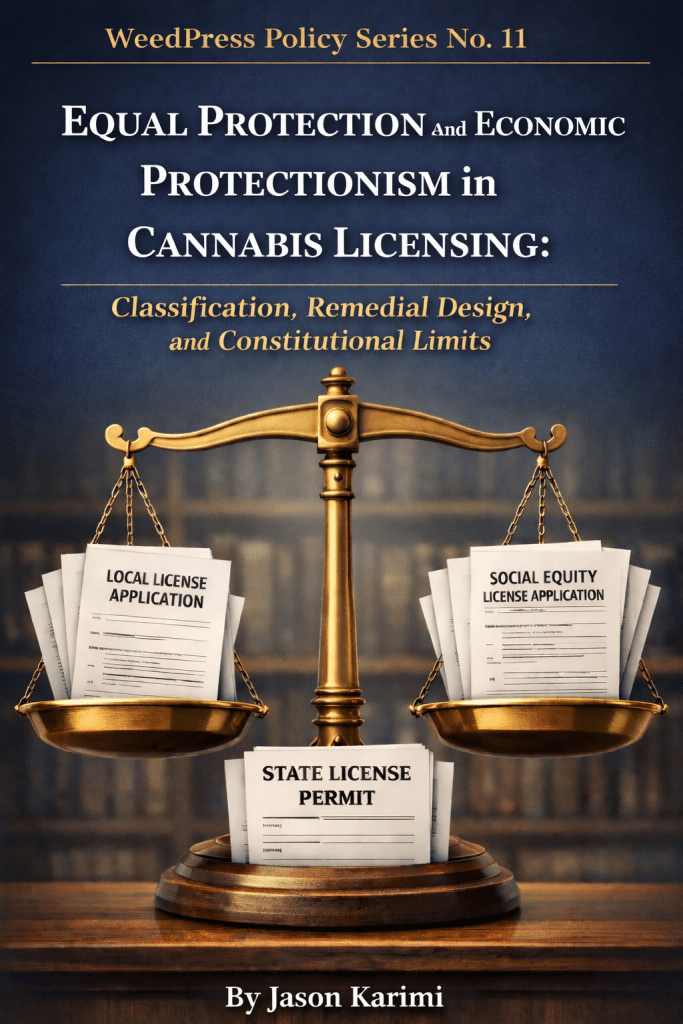
Equal Protection and Economic Protectionism in Cannabis Licensing: Classification, Remedial Design, and Constitutional Limits
By Jason Karimi | WeedPress Policy Series No. 11
March 3 2026
The prior essays examined how cannabis rescheduling may trigger Dormant Commerce Clause challenges and Supremacy Clause preemption disputes.
But constitutional scrutiny does not arise only from interstate commerce or federal conflict.
State cannabis licensing structures themselves may invite Equal Protection challenges — particularly where regulatory frameworks draw economic distinctions among classes of applicants.
The question is not whether states may regulate cannabis. They plainly may.
The question is whether particular classifications embedded within licensing schemes withstand constitutional review.
⸻
I. The Equal Protection Clause
The Fourteenth Amendment provides:
“No State shall… deny to any person within its jurisdiction the equal protection of the laws.”¹
Equal Protection does not prohibit classification. It prohibits unjustified classification.
As the Supreme Court has explained:
“The Equal Protection Clause does not deny to States the power to treat different classes of persons in different ways.”²
But classifications must bear an adequate relationship to legitimate governmental objectives.
⸻
II. The Standard of Review: Rational Basis
Most economic regulations — including licensing systems — are reviewed under the rational basis standard.
Under that framework:
“Legislative classifications are valid unless they bear no rational relationship to a legitimate governmental purpose.”³
The Court in Williamson v. Lee Optical famously held:
“The day is gone when this Court uses the Due Process Clause… to strike down state laws… because they may be unwise.”⁴
Under rational basis review:
- The burden is on the challenger;
- The state need not articulate its purpose precisely;
- Courts defer substantially to legislative judgment.
This is a forgiving standard.
But it is not meaningless.
⸻
III. Economic Protectionism and Its Limits
The Supreme Court has repeatedly held that mere economic protectionism, without a legitimate public purpose, may not suffice.
In City of Cleburne v. Cleburne Living Center, the Court stated:
“The Equal Protection Clause requires that classifications… be rationally related to a legitimate state interest.”⁵
More directly relevant are cases addressing economic favoritism.
In Metropolitan Life Insurance Co. v. Ward, the Court struck down a state tax scheme that discriminated against out-of-state insurers, holding:
“Promotion of domestic business by discriminating against nonresident competitors is not a legitimate state purpose.”⁶
Although Ward arose in an interstate context, its reasoning reflects a broader constitutional principle: naked protectionism is not itself a legitimate governmental objective.
Lower courts have likewise invalidated licensing classifications where distinctions lacked rational connection to public safety or welfare.⁷
⸻
IV. Cannabis Licensing Classifications
Modern state cannabis regimes often include:
- Residency requirements
- Ownership caps
- Social equity carve-outs
- Prior-conviction eligibility criteria
- Vertical integration mandates
- License caps tied to geographic distribution
Each of these creates classifications among economic actors.
Under rational basis review, the state need only show that these classifications serve a legitimate purpose such as:
- Remediation of past criminalization harms
- Ensuring local accountability
- Preventing monopolization
- Protecting public health and safety
But the classification must be rationally related to that purpose.
⸻
V. Remedial Classifications and Constitutional Boundaries
States frequently justify social equity programs as remedial.
Courts generally afford deference to remedial programs that target documented harms from past enforcement — for example, disproportionate criminalization in particular communities — provided the classifications avoid suspect categories triggering strict scrutiny and maintain a rational nexus to those harms.⁸
Where classifications are explicitly race-based, strict scrutiny applies.⁹
Where classifications are geographic, residency-based, or economic, rational basis typically governs.
Recent litigation reflects this evolving boundary.
Emerging challenges to geographic “disproportionately impacted area” qualifiers illustrate how courts may probe whether such criteria are genuinely remedial or risk arbitrary exclusion — though rational basis deference remains the baseline.¹⁰
In Jensen v. Rhode Island Cannabis Control Commission, the First Circuit revived Equal Protection claims challenging Rhode Island’s licensing structure, allowing plaintiffs to proceed past dismissal where they plausibly alleged arbitrary geographic discrimination.¹⁰
Other jurisdictions have upheld social equity geographic frameworks under rational basis review where legislatures documented enforcement disparities and articulated a remedial connection.¹¹
The constitutional inquiry is not whether remediation is permissible.
It is whether the classification rationally advances the remedial objective rather than serving as economic gatekeeping.
⸻
VI. Interaction with Dormant Commerce Clause Doctrine
Equal Protection and Dormant Commerce Clause doctrines may overlap but are distinct.
- The Dormant Commerce Clause addresses interstate discrimination.
- Equal Protection addresses unjustified classification among persons.
A residency requirement may violate the Dormant Commerce Clause even if it survives rational basis review.
Conversely, a classification that does not discriminate against interstate commerce could still be challenged under Equal Protection if it lacks rational connection to legitimate objectives.
The doctrines operate on separate constitutional foundations.
⸻
VII. Federal Recognition and Structural Shifts
If marijuana is rescheduled under 21 U.S.C. § 811 and recognized as having “a currently accepted medical use in treatment in the United States” under 21 U.S.C. § 812(b)(3),¹² the federal posture toward cannabis changes.
Although rescheduling does not eliminate state regulatory authority, it alters the broader legal landscape in which state classifications operate.
As federal recognition of medical utility evolves (for example, through potential Schedule III placement), courts may more closely examine whether highly restrictive classifications genuinely advance safety objectives or inadvertently shield incumbents from broader market participation.
Federal power remains plenary under the Commerce Clause.¹³
Rescheduling would not diminish that authority — but it may alter the conflict and classification analysis where Congress formally recognizes medical utility.
⸻
VIII. What Equal Protection Does — and Does Not — Require
Equal Protection does not demand identical outcomes.
It does not require states to open markets entirely.
It does require that classifications:
- Be rationally related to legitimate objectives;
- Not rest solely on naked economic favoritism;
- Be defensible as regulatory rather than protectionist.
Under rational basis review, most licensing schemes survive.
But survival is not automatic.
Where statutory design reveals structural favoritism untethered from public health or safety rationales, litigation risk increases.
⸻
IX. Litigation Pathways
Equal Protection challenges to cannabis licensing schemes would proceed in federal district court under 42 U.S.C. § 1983.
Plaintiffs might include:
- Rejected applicants;
- Out-of-state investors;
- Economic competitors;
- Individuals excluded by conviction-based criteria.
Recent appellate activity suggests that courts are willing to allow Equal Protection claims in cannabis licensing contexts to proceed beyond dismissal when plaintiffs plausibly allege arbitrary or insufficiently justified classifications.¹⁴
Courts will examine:
- The statutory classification;
- The asserted state interest;
- The rational relationship between them.
Deference remains substantial.
But deference is not abdication.
⸻
Conclusion
State cannabis regulation exists within constitutional boundaries.
The Equal Protection Clause does not prohibit regulation. It prohibits arbitrary classification.
As cannabis markets mature and federal posture shifts, courts may increasingly evaluate whether licensing structures reflect public-health objectives or economic protectionism.
Delegation shaped federal reform.
Commerce Clause doctrine shapes interstate markets.
Preemption governs federal–state conflict.
Equal Protection tests the fairness of internal market design.
The constitutional architecture surrounding cannabis policy is no longer hypothetical.
It is active, layered, and increasingly litigated.
⸻
Footnotes
1. U.S. Const. amend. XIV, § 1.
2. Reed v. Reed, 404 U.S. 71, 75 (1971).
3. FCC v. Beach Communications, Inc., 508 U.S. 307, 313 (1993).
4. Williamson v. Lee Optical of Okla., Inc., 348 U.S. 483, 488 (1955).
5. City of Cleburne v. Cleburne Living Center, 473 U.S. 432, 440 (1985).
6. Metropolitan Life Ins. Co. v. Ward, 470 U.S. 869, 882 (1985).
7. Merrifield v. Lockyer, 547 F.3d 978, 991 (9th Cir. 2008) (invalidating irrational occupational licensing distinction); see also cannabis licensing challenges raising parallel Equal Protection arguments in conjunction with Dormant Commerce Clause claims.
8. City of Richmond v. J.A. Croson Co., 488 U.S. 469 (1989).
9. Id.
10. Jensen v. Rhode Island Cannabis Control Commission, No. 25-1132 (1st Cir. Nov. 25, 2025).
11. See, e.g., Maryland appellate decisions in 2025 upholding geographic social equity licensing criteria under rational basis review where tied to documented enforcement disparities.
12. 21 U.S.C. § 812(b)(3).
13. Gonzales v. Raich, 545 U.S. 1, 22 (2005).
14. Jensen v. Rhode Island Cannabis Control Commission, No. 25-1132 (1st Cir. Nov. 25, 2025).
WeedPress Policy Series
No. 1 — Legal Memorandum: Common Misconceptions in Cannabis Activism Regarding Federal Drug Law (January 25, 2026)
No. 2 — The Path to a Religious Cannabis Exemption: How Medical Cannabis Systems Change the RFRA Equation (January 27, 2026)
No. 3 — Structural Contradictions and Prospective Litigation Risk in Post-Rescheduling Cannabis Policy (February 6, 2026)
No. 4 — The Controlled Substances Act Is Not a Blunt Instrument — It Is an Architecture of Exceptions (February 13, 2026)
No. 5 — The Limits of § 822(d): What It Does — and Does Not — Authorize (February 13, 2026)
No. 6 — The Major Questions Doctrine and Cannabis Reform: Delegation, Scale, and Judicial Review (February 14, 2026)
No. 7 — Chevron’s Collapse and Cannabis Regulation: Judicial Review After Loper Bright (February 17, 2026)
No. 8 — Administrative Procedure Act Vulnerabilities in DEA Rescheduling (February 20, 2026)
No. 9 – No. 9 — Dormant Commerce Clause, Circuit Splits, and Cannabis Federalism (February 23, 2026)
No. 10 — Federal Preemption After Rescheduling: Conflict, Obstacle, and Cannabis Federalism (February 27, 2026)
No. 11 — Equal Protection and Economic Protectionism in Cannabis Licensing: Classification, Remedial Design, and Constitutional Limits (March 3, 2026)
About Weedpress Policy Series
The Weedpress Policy Series publishes in-depth, citation-supported analysis of federal cannabis law, regulatory policy, and enforcement practices. The series is designed to provide lawmakers, attorneys, journalists, and stakeholders with legally grounded, non-activist, non-promotional analysis focused on statutory reality and institutional accountability.
Weedpress Policy Series emphasizes:
• Federal statutory interpretation
• Congressional intent and legislative history
• Treaty and international law implications
• Administrative law and agency authority
• Oversight of enforcement discretion and regulatory gaps


Leave a Reply