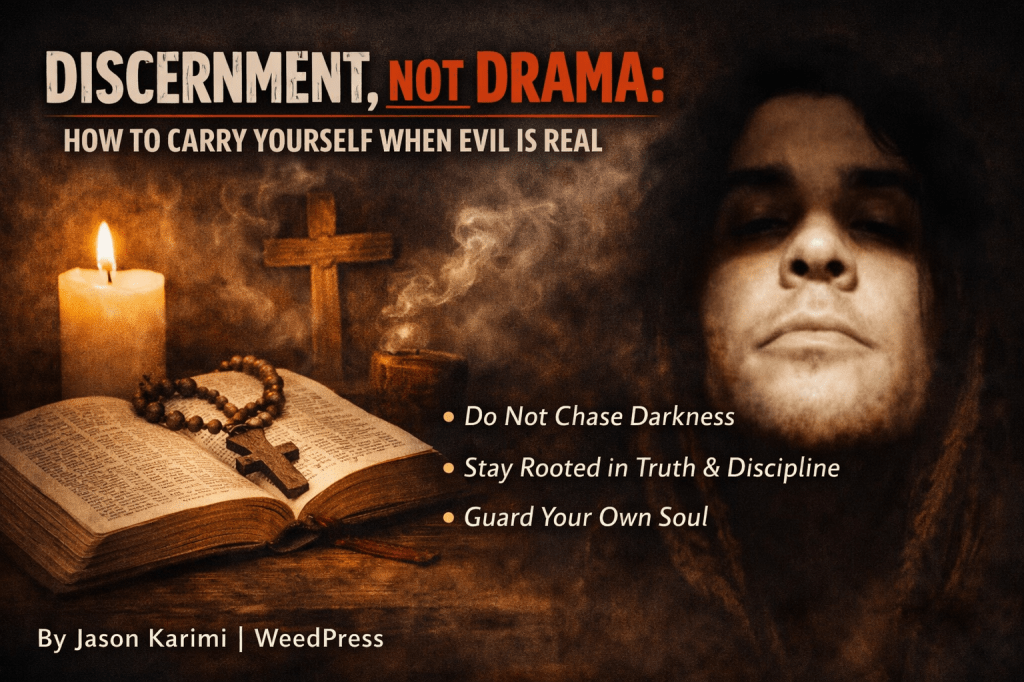
Discernment, Not Drama: How to Carry Yourself When Evil Is Real
By Jason Karimi | WeedPress
April 3, 2026
There are some subjects polite society would rather mock than confront. Spiritual darkness is one of them.
Many modern people are willing to speak of “energy,” “trauma,” “vibes,” and “mental health,” but the moment anyone raises the possibility of genuine spiritual evil, the discussion is dismissed as primitive, embarrassing, or unstable. That reflexive dismissal is not wisdom. It is often just another form of blindness.
At the same time, there is a second error equal to the first: sensationalism. Some people become fascinated with darkness. They want to label every disturbing event a possession, every manipulative person a demon, every ritual a doorway, every strange look a supernatural sign. That path is not wisdom either. It is vanity, fear, and loss of discipline.
So what is the right posture?
For people who take the spiritual world seriously, the real question is not how to become a self-appointed investigator of evil. It is how to conduct oneself rightly in a world where corruption, confusion, moral disorder, manipulation, and spiritual pollution seem increasingly common.
The answer begins with restraint.
A serious spiritual life does not chase darkness. It does not obsess over it. It does not build an identity around proximity to it. A disciplined person can acknowledge that some things feel wrong, spiritually polluted, manipulative, ritualized, or deeply disordered without turning every disturbing experience into a theater of certainty. Not every dark thing must be fully explained before it can be rejected.
There is a difference between discernment and obsession. Discernment notices. Obsession fixates. Discernment keeps a man calm. Obsession makes him dramatic. Discernment protects the soul. Obsession weakens it.
If you believe evil is real, then you should know that fascination with evil is not strength. It is vulnerability.
The first rule, then, is simple: do not chase darkness for meaning.
Observe carefully. Take note. If something seems deeply wrong, say so in plain language. But do not let darkness become mentally magnetic. Do not stare at it until it colonizes your inner life. Do not feed it with constant rumination, compulsive media consumption, or endless internet rabbit holes. You do not become spiritually stronger by letting every dark possibility live rent-free in your head.
The second rule is equally important: keep your own life in order.
Whatever one’s theology, spiritual vulnerability often travels with disorder. Exhaustion, chaos, isolation, compulsive habits, dishonesty, unclean living, unstable relationships, and constant agitation weaken judgment. A man who wants clarity should guard his clarity. Sleep matters. Food matters. Routine matters. Company matters. Prayer matters. Silence matters. What you consume with your eyes, ears, and mind matters.
This is not glamorous advice, but it is real. The strongest spiritual defense is often not spectacle. It is discipline.
That means choosing truth over exaggeration. It means not speaking with certainty beyond what you know. It means refusing to put on a show for yourself or anyone else. It means keeping your body regulated, your mind sober, your words measured, and your conscience clean. It means knowing that peace is not passivity; it is strength under control.
A third rule follows naturally: seek wisdom, not status.
There is always a temptation, especially in spiritually charged subjects, to see oneself as uniquely perceptive, uniquely chosen, uniquely burdened with secret knowledge about what others cannot see. That temptation is dangerous. It flatters the ego while pretending to serve truth.
A wiser path is humbler. Speak to grounded clergy. Speak to a trusted elder. Speak to people who are calm, sober, experienced, and uninterested in drama. The goal is not to collect thrilling confirmations. The goal is to stay rightly ordered. If you have had experiences you cannot explain, the mature response is not public performance. It is careful discernment.
That also means accepting limits. Some events remain unresolved. Some memories remain difficult to classify. Some experiences can be spiritually significant without being reducible to a slogan. Maturity includes learning to say: I know what I saw disturbed me. I know it felt wrong. I know I do not need to become consumed by proving more than that.
That sentence contains more wisdom than most online arguments.
A fourth principle is this: do not confuse vigilance with fear.
There is a kind of spiritual fearfulness that disguises itself as seriousness. Everything becomes a threat. Every social trend becomes a portal. Every damaged person becomes an omen. Every anxiety becomes revelation. But fear erodes judgment. A fearful mind is easy to manipulate, and a fearful spirit cannot offer steadiness to anyone.
Better to remain rooted.
For a believer, that means returning to prayer, scripture, disciplined conduct, honest speech, and righteous company. It means refusing contamination without building your whole identity around contamination. It means keeping your spirit aligned with what is good rather than endlessly narrating what is evil.
In practical terms, that might look very ordinary. Pray before and after unsettling encounters. Step away from what feels polluting. Keep a journal rather than spiraling aloud. Refuse gossip, occult curiosity, and performative spirituality. Spend time outside. Re-enter daily life. Stay useful. Stay grounded. Stay clean in mind and conduct.
There is also an important moral point here: you are not required to explain everything in order to reject it.
If something is corrupting, manipulative, degrading, or spiritually filthy, you do not need a perfect metaphysical theory before deciding to avoid it. Sometimes the soul knows enough before the intellect catches up. Prudence does not require omniscience.
And yet prudence also refuses recklessness. You do not accuse strangers. You do not appoint yourself judge over every strange behavior. You do not imagine that intensity is insight. You do not confuse your private interpretations with public proof. You remain careful because truth deserves care.
We live in an age that laughs at evil while rewarding corruption. It mocks spiritual seriousness, then acts shocked when people feel morally exhausted, psychologically fragmented, and cut off from any sense of order. But darkness does not become less real because fashionable people sneer at the subject. It becomes easier to ignore, easier to normalize, and easier to excuse.
That is why personal conduct matters.
In the end, the issue is not whether modernity is dark. Of course it is. The issue is whether a person living in such a time can remain inwardly ordered.
Can you resist both mockery and hysteria?
Can you take the spiritual seriously without becoming theatrical?
Can you reject corruption without becoming consumed by it?
Can you remain humble, prayerful, observant, and disciplined?
That is the real test.
The strongest people in a dark age are not always the loudest. They are the ones who refuse defilement, refuse obsession, refuse vanity, and refuse fear. They do not chase darkness. They do not serve it with attention. They stay rooted in truth, prayer, discipline, and peace.
That is how to conduct yourself.
Not with spectacle.
Not with panic.
Not with self-importance.
With discernment.
With restraint.
With spiritual cleanliness.
With a mind that remains your own.


Leave a Reply