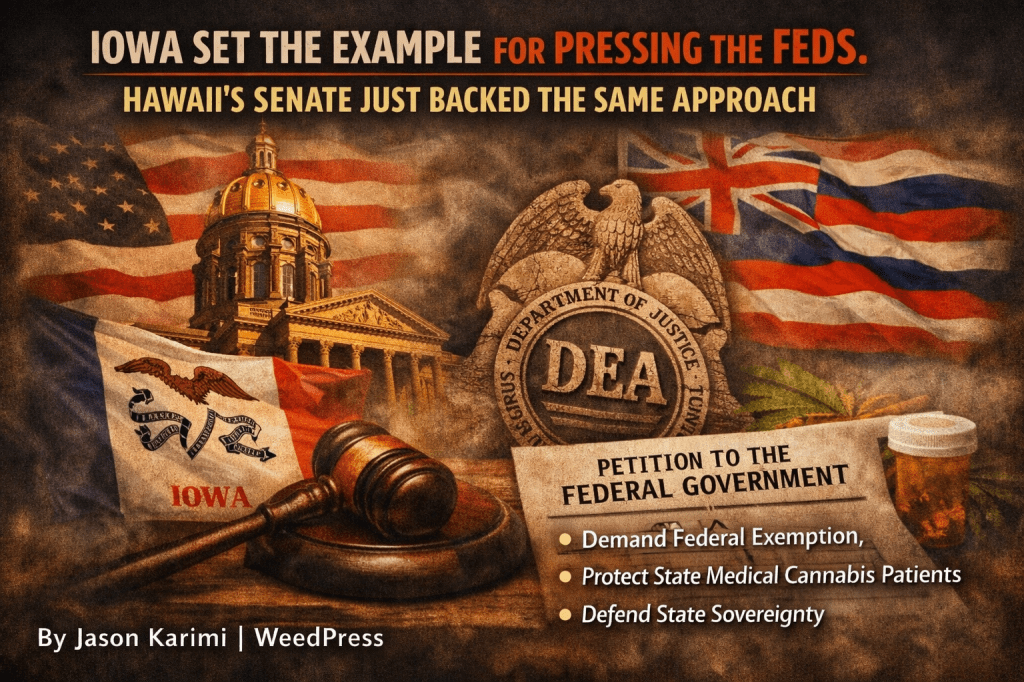
Iowa Set The Example For Pressing The Feds. Hawaii’s Senate Just Backed The Same Approach
By Jason Karimi | WeedPress
April 4, 2026
For years, too many states have talked big about medical cannabis while acting like helpless subsidiaries of federal drug policy. Iowa challenged that weakness. Hawaii is challenging it again now.
Hawaii senators have passed resolutions calling on state officials to seek a DEA exemption for registered medical cannabis patients and registration waivers for state-licensed dispensaries. The point is straightforward: if Hawaii has chosen to protect medical cannabis patients under state law, those patients should not still be trapped in a federal gray zone that threatens their jobs, housing, travel, firearm status, hospice access, and basic legal security. Marijuana Moment reports the resolutions and also notes Hawaii issued a similar directive in 2021 and state officials still failed to act.
That is exactly why this 2026 Senate resolution vote matters.
A state medical cannabis law is not worth much if the state refuses to defend the people it claims to protect. It is not enough to set up a registry, hand out cards, collect fees, and declare victory. If patients remain exposed to federal punishment and federal discrimination for conduct the state itself has authorized, then the program is only half real.
Iowa understood this years ago. The push there was not timid, and it was not symbolic. As Marijuana Moment reported in 2021, Sen. Chuck Grassley said he would press DEA about a federal exemption for Iowa’s medical cannabis program after activists and state-level advocates raised the issue directly. Reporting tied to Iowa’s fight also described earlier recommendations that the state pursue a federal exemption instead of pretending the conflict with federal law would solve itself.
That is what real state courage looks like.
Not endless task forces.
Not empty patient outreach.
Not carefully managed press releases celebrating “access” while patients still live under the shadow of federal prohibition.
Real courage means telling Washington: our patients are lawful under our laws, and we are not going to leave them stranded.
Hawaii deserves credit for refusing to back down. Its lawmakers are not merely complaining about the federal-state contradiction. They are naming the actual injuries that contradiction causes. According to Marijuana Moment, the resolutions point to concrete harms involving employment, firearms registration, inter-island transport, housing, hospice care, and safe, affordable access for patients. That is how this issue should be argued: not as an abstract culture-war slogan, but as a sovereignty and patient-protection problem with real consequences.
More states should take the hint.
If a state has the authority to legalize medical cannabis, regulate dispensaries, and define lawful patient conduct within its own borders, then it should also have the backbone to fight for the full legal dignity of that choice. Anything less is managed surrender. States keep asking patients to trust the law while refusing to confront the federal machinery that still treats those same patients like tolerated offenders.
That contradiction is disgraceful.
State sovereignty is not supposed to mean “we’ll regulate what we can until the feds glare at us.” It means states exercise their own police powers, make their own public-health judgments, and defend the legal systems they create. A medical cannabis program should not be a decorative statement of values. It should be a defended policy position.
And that defense should not wait on Congress, the White House, or the DEA to suddenly develop moral clarity.
States can petition now.
States can demand answers now.
States can build records now.
States can force the question now.
Iowa showed that the exemption argument could be made. Hawaii is showing that the issue is still alive and still worth pressing. The states that claim to care about medical patients should stop hiding behind process and start acting like sovereigns.
Because this is the real question: if a state will not defend its own lawful patients from federal overreach, what exactly is its medical cannabis law worth?
Our patients are not criminals.
Our medical laws are not symbolic.
And our sovereignty is not optional.
 WeedPress: The Paper Trail
Leave a comment