April 16, 2026
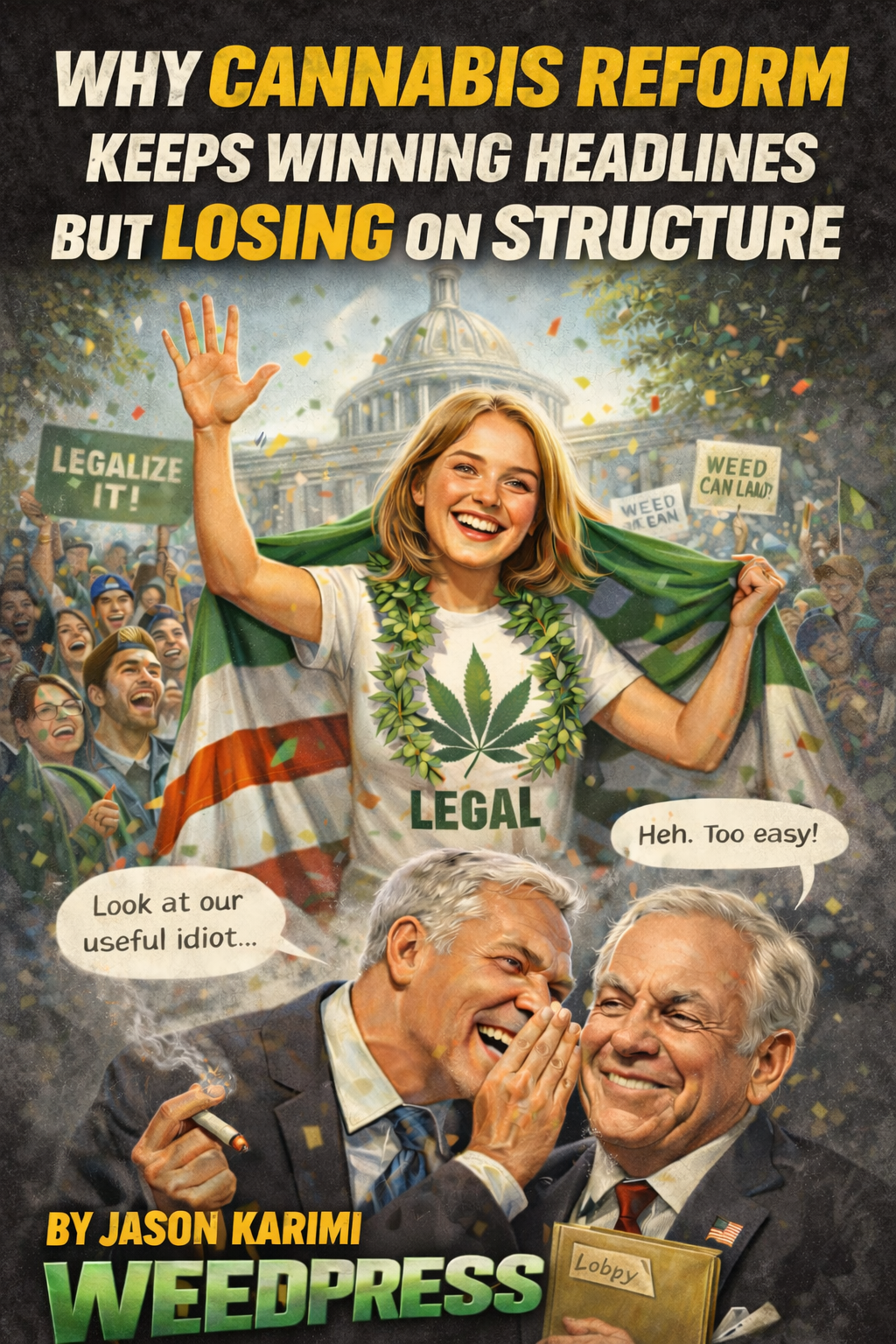
Cannabis reform has spent years winning the visible fight while losing too many of the structural ones:
That is the contradiction at the heart of the modern marijuana debate. The headlines look triumphant. More states legalize. More politicians soften. More investors return every election cycle to promise that normalization is just around the corner. Cultural stigma has weakened. Public support is broader than ever. To casual observers, the battle appears nearly over.
It is not.
Because reform in America has often advanced faster as branding than as architecture.
That distinction matters. A movement can win attention without winning durability. It can generate headlines without building protections. It can celebrate symbolic victories while leaving the underlying machinery of the state, the market, and the courts largely intact. When that happens, reform looks real from a distance but remains fragile when tested by probation conditions, employment rules, custody disputes, licensing boards, police discretion, administrative hostility, federal illegality, or judicial indifference.
That is where cannabis still lives: in the gap between cultural victory and structural weakness.

The illusion of progress
For more than a decade, cannabis reform has benefited from a favorable public narrative. The old politics of panic have weakened. Politicians who once ran from the issue now seek credit for being “forward-thinking.” Corporate players wrap themselves in the language of equity, medicine, innovation, and social justice. Media coverage often treats each new legalization bill or rescheduling rumor as proof that the old order is collapsing for good.
But progress measured by atmosphere is not the same as progress measured by power.
A state can legalize marijuana and still leave ordinary people exposed to a maze of contradictions. A patient can be lawful under one regime and vulnerable under another. A religious claimant can advance a serious freedom argument and still face a system structurally built to dismiss him. A small business can win a license and still be crushed by capital constraints, regulatory complexity, and bigger competitors with better political access. An activist can be praised in public rhetoric while being marginalized in the institutional rooms where rules are actually written.
This is the problem with confusing movement aesthetics for movement success. Cannabis reform has become good at producing the appearance of momentum. It has been less successful at securing the sort of deep legal, administrative, and constitutional settlement that makes gains hard to reverse and difficult to selectively deny.
That is why so many people feel, correctly, that reform is both real and incomplete at the same time.
Who benefits from half-reform
Half-reform is not neutral. It creates winners.
When a substance moves from total prohibition to partial normalization, the benefits do not automatically flow to those who bore the risk during prohibition. They flow first to those best positioned to navigate complexity. That means lawyers, consultants, politically connected operators, institutional investors, well-capitalized multi-state firms, and professional managers who know how to turn messy transitional regimes into business advantages.
That is not an accident. It is how immature reform systems work.
A fully criminalized market is chaotic. A fully normalized market is broadly accessible. But an in-between market — one full of carveouts, licensing bottlenecks, banking problems, interstate restrictions, uneven enforcement, and legal ambiguity — rewards scale, sophistication, and insider access. It punishes the undercapitalized, the ideologically driven, the regionally trapped, and the less institutionally fluent.
That is why so many early cannabis spaces filled with passion, improvisation, and anti-establishment energy eventually became vulnerable to a different class of actor: people with operational discipline, political intelligence, compliance capacity, and capital. The movement helped open the door. Then structure decided who walked through it successfully.
The same thing has happened on the advocacy side. Public-facing cannabis politics often elevates personalities, slogans, and visibility. But the durable gains usually come from people who understand statutes, administrative law, constitutional posture, evidentiary framing, and long-term institutional sequencing. That work is slower, less glamorous, and often less rewarded. It is also the work that determines whether change survives contact with hostile power.
Federalism has not solved the problem
One of the central myths of the reform era is that federalism alone would be enough.
Let the states experiment, reformers said. Let local politics move faster than Washington. Let democratic diversity produce a mosaic of change that eventually forces national alignment.
There was truth in that strategy. State-level reform broke the old consensus. It created facts on the ground. It exposed the gap between federal rhetoric and local reality. It gave voters and patients visible examples of alternatives to prohibition.
But federalism is not the same thing as liberty. It is merely a jurisdictional arrangement. And when federalism is not paired with strong rights-protective doctrine, administrative restraint, and meaningful judicial review, it can simply produce a patchwork where relief depends on geography, local culture, prosecutorial discretion, and bureaucratic mood.
That is not stable freedom. That is negotiated tolerance.
The cannabis question has exposed this again and again. A person can be effectively protected in one state and highly vulnerable in another. A state can tolerate commercial cannabis while refusing serious accommodation arguments in adjacent legal contexts. Legislatures can celebrate reform while courts continue to treat cannabis claims as presumptively unserious when raised in criminal, probationary, family, housing, or religious settings. Public officials can praise compassionate policy while preserving coercive discretion whenever a claimant falls outside the preferred script.
This is why federalism without doctrinal depth often produces inconsistent reform rather than principled reform. It decentralizes conflict, but it does not resolve it.
Culture moved faster than doctrine
Cannabis reform won broad cultural ground before it secured enough legal doctrine to support that cultural change.
That sequence has produced recurring weakness.
Culture can make something seem normal without generating enforceable rules. It can reduce shame without reducing legal exposure. It can create sympathy without creating remedy. It can pressure politicians while leaving judges unconvinced and agencies untouched.
That is why so much cannabis reform still collapses when it reaches the harder institutional settings. Employers invoke safety and policy. Courts invoke deference. Agencies invoke compliance. Probation systems invoke standardization. Opponents invoke federal illegality when convenient and ignore it when inconvenient. The result is that legalization in one register coexists with stigma and coercion in another.
A mature reform movement would understand this not as a temporary annoyance, but as the central challenge.
The real question is never whether the culture has moved. The real question is whether the movement has translated that cultural movement into rights, standards, precedent, procedures, and limits on official discretion.
Too often, the answer is not yet.
Why litigation matters more than slogans
Movements like slogans because slogans travel.
Institutions, however, respond to pressure differently. Courts respond to records, claims, preservation, posture, doctrinal framing, and strategic persistence. Agencies respond to petitions, process, political exposure, and legal vulnerability. Opponents are not defeated by vibes; they are defeated by arguments that can survive review and force decisions.
That is why litigation and legal architecture matter so much in cannabis reform, especially now.
The next phase of the movement is not simply about convincing more people that prohibition was foolish. Most people who matter already know the old regime was overbroad, wasteful, and often unjust. The harder question is what legal tools will convert that broad intuition into durable constraints on state power.

That means serious attention to constitutional sequencing, federal-question preservation, administrative petitions, statutory claims, religious-liberty theories, equal-protection logic, due-process vulnerabilities, licensing discrimination, and the practical mechanics of forcing courts to confront contradictions they would rather ignore.
This is also where many reform discussions become shallow. A movement that treats litigation as secondary and messaging as primary risks becoming narratively successful while institutionally weak. It may dominate online discourse while losing where it counts: in courtrooms, hearing rooms, agencies, and the procedural chokepoints where power defends itself.
The long fight was never only about making cannabis popular. It was about making coercive treatment of cannabis legally unstable.
That work remains unfinished.
The capital question
Another structural blind spot in cannabis reform has been capital.
For years, parts of the industry operated as though culture and demand alone would be enough. But no significant market transition is governed only by consumer enthusiasm. It is governed by infrastructure, compliance, finance, logistics, risk pricing, and the ability to survive long enough to consolidate advantage.
That means the future of cannabis will not be shaped only by activists or legacy operators. It will also be shaped by those who can build regulated supply chains, withstand legal uncertainty, secure institutional money when conditions improve, and translate policy shifts into durable market position.
This is one reason so many romantic narratives about cannabis entrepreneurship have struggled. Good intentions, movement credentials, and scene legitimacy do not substitute for business competence. In transitional markets, amateurs can be culturally central and structurally disposable at the same time.

That pattern is not unique to cannabis. It is common in sectors moving from outlaw status to regulated incorporation. The first wave creates possibility. The next wave professionalizes. The third consolidates.
The danger is that a movement can spend years talking as though reform belongs to the people while quietly building a market that belongs to the most sophisticated operators. If activists fail to think structurally, they may wake up inside an industry built from their labor but controlled by others.
What real reform would look like
Real reform would not mean merely more permissive headlines. It would mean a stronger structural settlement.
It would mean serious banking normalization so businesses are not trapped in artificially dangerous and inefficient conditions. It would mean clearer interstate-commerce logic rather than endless territorial fragmentation. It would mean more coherent treatment of patients, users, and claimants across employment, supervision, housing, and family-law settings. It would mean legal doctrines that do not pretend cannabis remains a moral outlier whenever the state wants to deny relief.
It would also mean stronger rights consciousness.
A mature cannabis reform order would have to wrestle honestly with religious accommodation, equal treatment, administrative fairness, and the constitutional implications of selective tolerance. It would have to answer why massive commercial exceptions can coexist with rigid hostility in individualized claims. It would have to confront whether the state’s asserted interests are truly compelling in every setting where it continues to demand categorical obedience. And it would have to do more than celebrate reform for some while preserving burden for others.
Most of all, real reform would narrow the zone of arbitrary power.
That is the underlying issue. Not whether cannabis is trendy. Not whether politicians can recite the latest polling. Not whether another panel discussion declares the stigma dead. The real issue is whether officials still retain broad discretion to punish, deny, exclude, or marginalize when a claimant falls outside the state’s preferred box.
As long as that discretion remains strong, reform remains partial.

Reform is not mature until it survives contact with power
Cannabis reform has accomplished a great deal. It would be foolish to deny that. Public attitudes changed. Criminal penalties weakened in many places. New legal regimes emerged. Old assumptions lost force.
But mature reform is not measured by applause lines or map-color changes alone.
It is measured by what happens when reform collides with institutions that do not want to surrender control. It is measured by what happens in courts, agencies, probation offices, licensing systems, workplaces, family disputes, and administrative hearings. It is measured by whether the legal order can still selectively humiliate people while claiming the reform era has arrived.
That is the unresolved truth of this movement.
Cannabis reform keeps winning headlines because cultural legitimacy is easier to achieve than structural settlement. It keeps losing on structure because institutions defend themselves more effectively than movements often prepare for. And until reformers understand that the central battle is not only over persuasion but over architecture, they will continue to mistake visibility for victory.
A reform movement that cannot survive contact with courts, agencies, capital, and hostile discretion is not yet fully reformed.
It is still in transition.
And transition is where power decides who was serious.
 WeedPress: The Paper Trail
Leave a comment