April 23, 2026
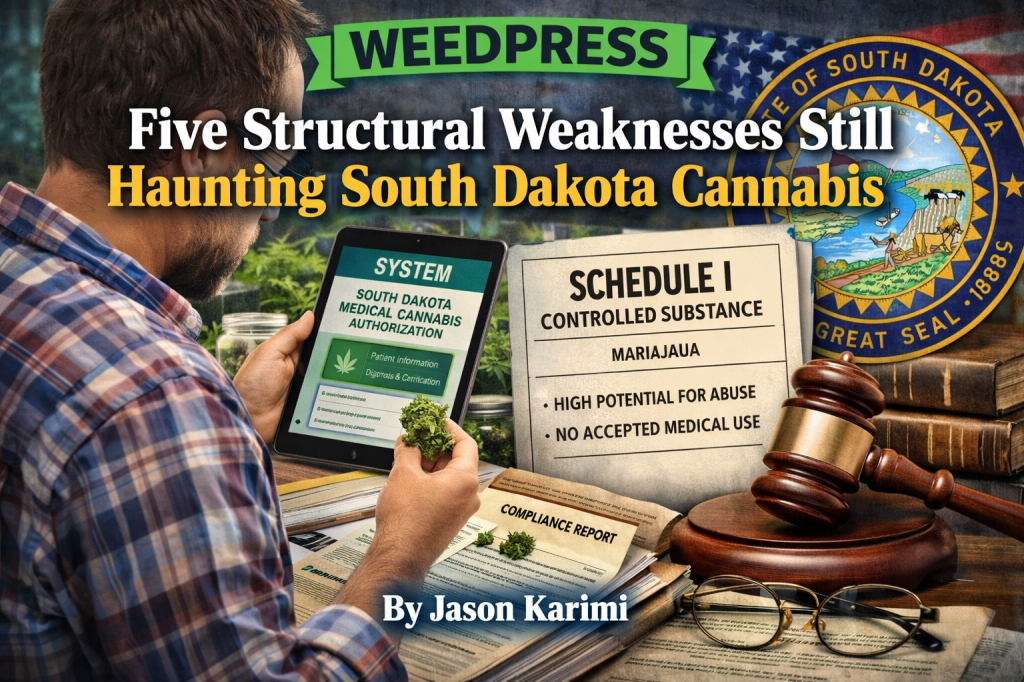
South Dakota’s medical-cannabis program is no longer a novelty. It is a real system with real patients, real establishments, real regulators, and real consequences. By April 2026, the state program had approved 18,759 patient cards.² That is large enough that the old excuses no longer work. We are past the stage where every failure can be blamed on youth, transition, or administrative growing pains. If a program serving that many people still has structural weak points, those are not temporary glitches. They are design problems.³
And South Dakota still has them.
The first weakness is provider fragility. Even as patient enrollment kept climbing, the practitioner side of the system showed instability. The Department of Health’s 2025 annual report said the number of practitioners authorized to certify patients had fallen to 145 by the end of FY25, attributing the drop to system safeguards and login requirements.⁴ Meanwhile, the state’s public data page showed 219 approved practitioners by April 2026.⁵ That rebound is good news, but it also proves the point: access can hinge on administrative bottlenecks, compliance workflows, and professional participation in ways that make the system more brittle than it should be. A patient program is only as real as the practitioner network that can actually activate it.⁴ ⁵
The second weakness is an enforcement architecture that keeps getting more elaborate before the larger legitimacy questions are resolved. In 2024, South Dakota enacted Senate Bill 43, which expressly authorized procedures for fines and probation against medical-cannabis establishments, increased the allowable registration-certificate fee, and directed the Department of Health to promulgate additional rules.⁶ By FY25, the Department reported 112 routine inspections across licensed establishments and emphasized that the addition of a second inspector positioned the program to complete annual inspections for all establishments.⁷ Oversight matters. Nobody serious wants a lawless market. But a movement that spent years fighting for access should notice when the machinery of punishment and surveillance becomes more developed, more predictable, and more institutionalized than the broader policy vision itself.⁶ ⁷
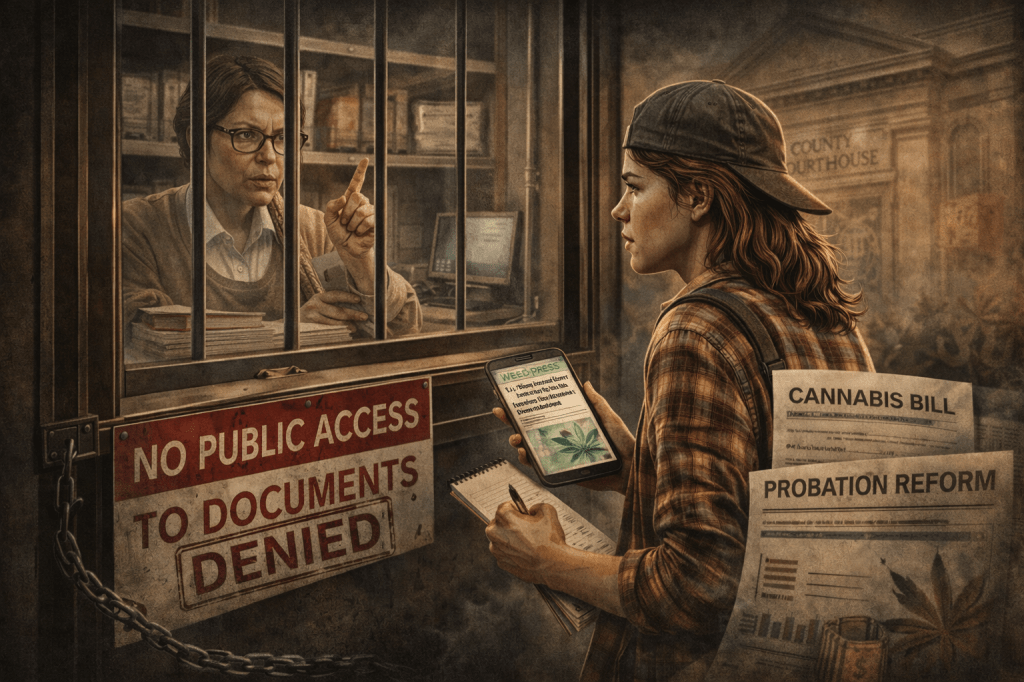
The third weakness is thin-state capacity trying to manage a complicated market. In late 2025, the Medical Marijuana Oversight Committee was told that the Department was administering the program with seven staff members while overseeing tens of thousands of patient interactions, dozens of dispensaries, cultivation sites, manufacturers, testing facilities, rule changes, and inspection duties.⁸ A small staff can work hard. That is not the issue. The issue is structural load. A program this politically sensitive and operationally complex needs enough administrative depth to inspire confidence, answer questions quickly, inspect consistently, and avoid needless opacity. When a controversial statewide market rests on thin staffing, every delay, inconsistency, or communication failure gets magnified.⁸
The fourth weakness is product-law confusion at the border between medical cannabis, hemp-derived THC, and broader cannabinoid commerce. South Dakota’s own Attorney General acknowledged in a 2025 official opinion that the legality of THC-infused and hemp-derived products is highly fact-specific and that state law currently makes it illegal to sell synthetic cannabinoids, to sell naturally occurring cannabinoids above 0.3% Delta-9 THC, and to sell hemp products containing chemically derived, chemically modified, or chemically converted cannabinoids.⁹ That is not a stable public-understanding environment. It is a compliance trap. Patients, consumers, businesses, and even political advocates are forced to navigate a system where “cannabis,” “hemp,” “medical cannabis,” and “THC products” are often collapsed into one public conversation while the law treats them very differently.⁹

The fifth weakness is an access-and-legitimacy gap hiding inside the numbers. The Department’s FY25 annual report showed that 92% of patients were classified as not low income, while only 8% were classified as low income.¹⁰ It also showed that 81.88% of registered patients identified as white, while 6.42% identified as American Indian.¹⁰ Those figures do not prove discrimination by themselves. But they do raise a serious structural question: is South Dakota building a medical-cannabis system that is genuinely accessible to the full range of patients who need it, or one that is easier to navigate for the better-resourced, the better-connected, and the administratively fluent?¹⁰ When a legal program exists on paper but skews heavily toward those most able to clear its bureaucratic hurdles, that is not just a demographic curiosity. It is a policy warning.
And there is a sixth weakness implied by all the others: South Dakota still has not decided whether it wants a program, a compliance machine, or a political truce. The state’s own data show steady patient growth.² The oversight committee has discussed rule changes, staffing, probation-screen questions in the certification workflow, and enforcement developments.⁸ ¹¹ Lawmakers have continued filing bills to revise certification rules, modify establishment rules, and even require terminal care facilities to allow terminally ill patients to use medical cannabis.¹² That is not what a settled system looks like. It is what an unfinished system looks like.
None of this means the program has failed. It means the program remains vulnerable in ways the movement should stop romanticizing.
South Dakota cannabis does not need more shallow optimism. It needs stronger architecture.
It needs a broader and more resilient practitioner pipeline. It needs an enforcement structure that does not outpace public legitimacy. It needs administrative capacity that matches program size. It needs cleaner product-law lines. It needs patient access that does not quietly tilt toward the already advantaged. And above all, it needs leaders willing to treat structure as the story, not a distraction from it.
Because in South Dakota, the next cannabis fight is not just over whether patients can buy medicine. It is over whether the system built around that medicine can survive scrutiny, scale honestly, and earn trust.
Footnotes
¹ See South Dakota Department of Health, Medical Cannabis in South Dakota. (program overview) (showing statewide patient, caregiver, practitioner, and establishment framework).
² South Dakota Department of Health, Data & Statistics, Medical Cannabis Program (Apr. 1, 2026). (data point showing 18,759 approved patient cards and 219 approved practitioners).
³ See South Dakota Department of Health, 2025 Annual Report. 50–55 (showing the program’s growth, staffing, inspections, and oversight demands).
⁴ South Dakota Department of Health, 2025 Annual Report, at 52–53 (reporting that 145 practitioners were authorized to certify patients by the end of FY25 and attributing the decline to system safeguards requiring licensure-expiration data on login).
⁵ South Dakota Department of Health, Data & Statistics, Medical Cannabis Program (Apr. 1, 2026 data point showing 219 approved practitioners).
⁶ S.B. 43, 99th Leg., Reg. Sess. (S.D. 2024), available at South Dakota Legislature bill materials (authorizing procedures for fines and probation against medical-cannabis establishments, increasing allowable registration-certificate fees, and directing rulemaking).
⁷ South Dakota Department of Health, 2025 Annual Report, at 53–54 (reporting that licensed establishments declined from 124 in FY24 to 118 in FY25 and that the program conducted 112 routine inspections).
⁸ South Dakota Medical Marijuana Oversight Committee, 2025 Final Report at 1–2 (Nov. 19, 2025) (reporting 13,453 registered patients, 66 dispensaries, 33 cultivation establishments, 17 manufacturing establishments, 2 testing facilities, and a seven-person administrative staff).
⁹ S.D. Att’y Gen. Off. Op. 25-04, Legality of Selling THC-Infused and Hemp-Derived Products (Nov. 3, 2025) (explaining that legality is fact-specific and that South Dakota law currently prohibits sales of certain synthetic, high-Delta-9, and chemically derived or converted cannabinoid products).
¹⁰ South Dakota Department of Health, 2025 Annual Report, at 50–52 (reporting that 92% of patients were not low income, 8% were low income, and 81.88% identified as white while 6.42% identified as American Indian).
¹¹ S.D. Medical Marijuana Oversight Committee Minutes, Aug. 19, 2025, available via South Dakota Legislature document set at 2 (noting practitioner concern that the certification portal asks whether a patient is on probation and that the question may introduce bias).
¹² See, e.g., H.B. 1053, 101st Leg., Reg. Sess. (S.D. 2026), available at South Dakota Legislature bill page. bill to require terminal care facilities to allow terminally ill patients to use medical cannabis); H.B. 1055, 101st Leg., Reg. Sess. (S.D. 2025) (bill to modify certification requirements); S.B. 42, 99th Leg., Reg. Sess. (S.D. 2024) (bill modifying medical-cannabis provisions).


Leave a Reply