Summary:
This article examines how Massachusetts and Arizona are responding to the federal government’s April 2026 partial move of state-licensed medical marijuana into Schedule III. It argues that mature cannabis states are now entering a post-announcement phase in which the central question is not whether federal policy changed, but how states must adjust licensing, compliance, tax treatment, and controlled-substances law in response. Massachusetts is confronting the issue through its medical versus adult-use regulatory structure and ongoing Cannabis Control Commission reform, while Arizona faces a more direct schedule-conformity and statutory-consistency problem because its medical and adult-use systems still sit beside a traditional controlled-substances framework. The broader point is that federal rescheduling is now pushing states from political debate into technical legal and administrative recalibration.
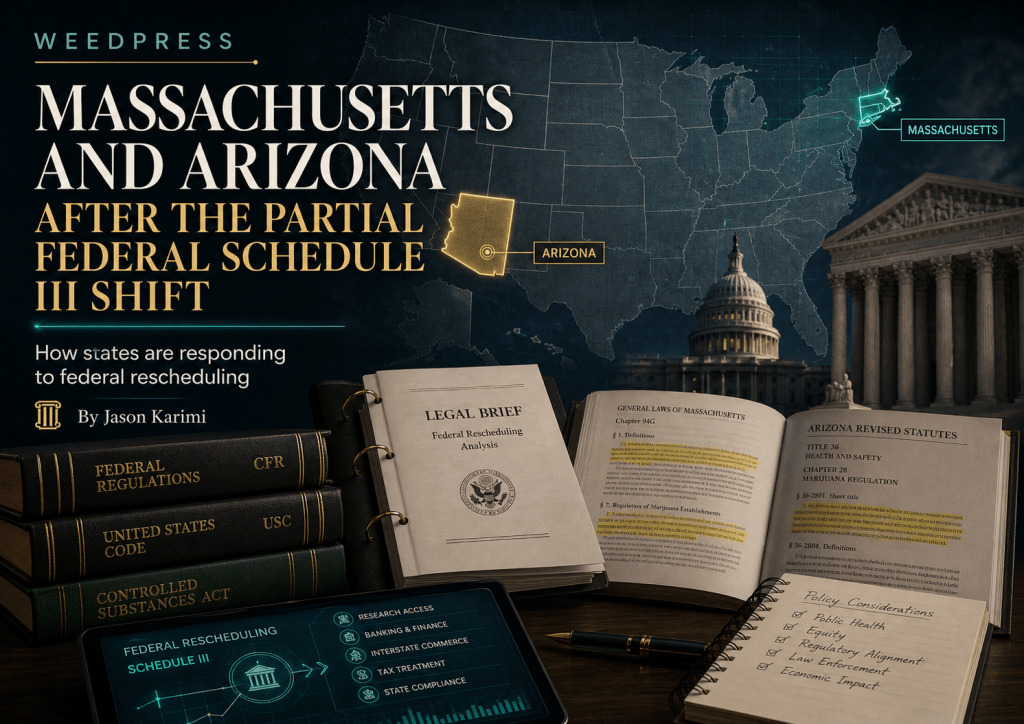
The most revealing state-law questions after the federal government’s April 2026 marijuana move are no longer abstract questions about whether cannabis policy is “changing.” The more important questions are administrative and structural: which states now have to revisit their controlled-substances schedules, licensing categories, tax assumptions, and compliance architecture, and which states can continue operating as though the federal shift were merely symbolic.¹ The answer is that not every state faces the same post-announcement problem. Massachusetts and Arizona, in particular, illustrate two different versions of the same federalism challenge.²
Massachusetts is a mature cannabis state with a deeply institutionalized dual-market structure: a statutory adult-use regime under chapter 94G, a medical-use regime under chapter 94I, and a Cannabis Control Commission that administers both worlds under one umbrella.³ Arizona is a mature cannabis state too, but its legal architecture is different. It combines a voter-enacted medical marijuana system, a voter-enacted adult-use system, and a controlled-substances code that still centers the Arizona State Board of Pharmacy in the scheduling framework.⁴ Both states now have to reckon with the same federal event—the partial placement of state-licensed medical marijuana into Schedule III—but the legal pressure points are not identical.⁵
That federal event matters because the April 2026 final rule did not move all marijuana into Schedule III. It moved only two categories: certain FDA-approved drug products containing marijuana and marijuana subject to a state medical marijuana license.⁶ The same federal materials make clear that marijuana outside those categories remains in Schedule I, and that a broader hearing on full marijuana rescheduling will begin on June 29, 2026.⁷ In other words, the federal government has now created a bifurcated system under which medical marijuana and adult-use marijuana no longer occupy the same immediate federal posture.⁸ That single choice is enough to destabilize the assumptions embedded in many state codes.⁹
I. Why Massachusetts Matters
Massachusetts matters because it already has one of the clearest statutory separations between non-medical marijuana and medical marijuana, while simultaneously regulating both markets through the same statewide commission.¹⁰ Chapter 94G is expressly titled the “Regulation of the Use and Distribution of Marijuana Not Medically Prescribed,” and it contains the core adult-use licensing and operations framework for marijuana establishments.¹¹ Chapter 94I, by contrast, is titled “Medical Use of Marijuana” and creates a separate protected medical-use system under which qualifying patients, caregivers, and medical marijuana establishments are regulated under distinct statutory rules and immunities.¹²
That distinction was already important before April 2026. It is more important now. The federal final rule expressly recognizes marijuana subject to a state medical marijuana license as eligible for Schedule III treatment, not marijuana sold generally through adult-use channels.¹³ So when a state like Massachusetts already has separate medical and adult-use statutory frameworks, the federal change raises a practical question: does the Commonwealth now need to sharpen the legal and operational distinction between those two markets even further?¹⁴
That question is not theoretical. The Massachusetts Cannabis Control Commission has already issued bulletins explaining that the newly enacted Chapter 65 of the Acts of 2026 changes the ownership-and-control thresholds applicable to both Marijuana Establishments and Medical Marijuana Establishments, formerly Medical Marijuana Treatment Centers.¹⁵ In its May 1, 2026 bulletin, the Commission told licensees and applicants that the 2026 act requires the Commission to open a regulatory process and begin accepting applications in accordance with the new statutory changes within two months of the act’s effective date.¹⁶ That means Massachusetts is already in an active rule-adjustment period even before one layers in the consequences of the federal partial rescheduling.¹⁷
The 2026 Massachusetts act matters for another reason too: it demonstrates that the Commonwealth is already restructuring cannabis governance at the institutional level. The act rewrites the Cannabis Control Commission itself, terminates the terms of sitting commissioners, and replaces the prior appointment structure with a new governor-centered system.¹⁸ That governance overhaul is not itself a Schedule III response, but it means Massachusetts is entering the federal medical-rescheduling era while simultaneously reorganizing the body that must manage the state’s dual-market cannabis framework.¹⁹ For policy researchers and lawmakers, that combination—federal bifurcation plus state governance restructuring—is a major signal that Massachusetts could become a bellwether for how sophisticated states adapt their cannabis codes.²⁰
The dual-system tension is especially acute in Massachusetts because the state has long treated Medical Marijuana Treatment Centers and adult-use Marijuana Establishments as distinct legal entities, even though the same Commission oversees both.²¹ Chapter 94I defines the key medical terms, protects qualifying patients from arrest or prosecution for authorized medical use, and grants confidentiality protections to medical records and communications.²² Chapter 94G separately licenses non-medical establishments and codifies the general adult-use market.²³ Once federal law now recognizes the state-licensed medical side differently from the adult-use side, Massachusetts cannot simply say that both markets remain functionally identical for all legal purposes.²⁴
The practical consequences are obvious. If federal Schedule III treatment now attaches to state-licensed medical marijuana but not adult-use marijuana, the Commonwealth may need to evaluate whether the licensing categories, tracking rules, tax assumptions, and regulatory compliance obligations that currently sit side by side under state law remain calibrated to the new federal split.²⁵ That does not necessarily mean Massachusetts must immediately rewrite chapters 94G and 94I from top to bottom. It does mean that the state’s next round of rulemaking cannot treat the federal medical shift as legally irrelevant.²⁶
II. Why Arizona Matters
Arizona matters for a different reason. Its post-announcement problem is less about a single commission managing two overlapping markets and more about how medical, adult-use, and controlled-substances scheduling fit together in one statutory landscape.²⁷ Arizona’s medical marijuana regime remains codified in Title 36, chapter 28.1, where § 36-2801 defines the medical system’s core terms and allowable amounts for qualifying patients and caregivers.²⁸ Arizona’s adult-use system is separately codified in Title 36, chapter 28.2, and the Department of Revenue still describes Proposition 207 as the legalization measure that authorizes adult possession, purchase, and processing under that statutory chapter.²⁹
But Arizona also has a traditional controlled-substances act in Title 36, chapter 27, where the Arizona State Board of Pharmacy remains the central scheduling authority.³⁰ Section 36-2501 defines “Board” to mean the Arizona State Board of Pharmacy and defines “cannabis” to include marijuana.³¹ Arizona’s official statutory index shows the relevant schedule provisions in the same chapter, including § 36-2512 for Schedule I and § 36-2514 for Schedule III.³² Historical and current Arizona legislative materials likewise show that § 36-2512 continues to function as the state’s Schedule I provision and that the Board adopts the federal Schedule I substances listed in 21 C.F.R. § 1308.11 by rule, subject to Arizona’s statutory framework.³³
That architecture creates a different conformity problem than Massachusetts has. In Massachusetts, the state already has a clearly separated medical and non-medical statutory framework administered by the same commission. In Arizona, the issue is whether a state that has both a medical marijuana system and an adult-use marijuana system can continue to rely on a controlled-substances schedule structure that still centers Schedule I while federal law now treats state-licensed medical marijuana differently.³⁴
Arizona’s adult-use definition underscores the tension. Section 36-2850 defines marijuana for purposes of the adult-use chapter and expressly excludes industrial hemp and certain non-marijuana materials, showing that Arizona has built an adult-use framework that is analytically separate from hemp and from some older controlled-substances assumptions.³⁵ Meanwhile, the criminal-code definition in A.R.S. § 13-3401 separately defines “marijuana” and “cannabis,” with marijuana covering all parts of the plant except the mature stalks and sterilized seed, and cannabis covering resin and derivatives.³⁶ That kind of layered definitional architecture can work while all marijuana is treated the same at the federal level. It becomes more complicated once state-licensed medical marijuana enters a different federal schedule than adult-use marijuana.³⁷
Arizona’s legal system has already shown that it sometimes addresses cannabis issues by creating targeted exceptions rather than wholesale schedule reform. The medical marijuana chapter exists as a voter-enacted carveout that protects qualifying patients and caregivers notwithstanding the broader criminal and controlled-substances structure.³⁸ Adult-use legalization followed the same pattern by creating a separate statutory system rather than erasing all older cannabis law.³⁹ That means Arizona may be institutionally inclined to handle the federal medical Schedule III shift through technical accommodation, rule interpretation, or targeted amendment rather than through a dramatic declaration that marijuana is no longer Schedule I under state law in every respect.⁴⁰
That possibility is reinforced by 2026 Arizona legislative materials showing that lawmakers and staff are already working through technical consequences of federal scheduling changes. A March 2026 House caucus packet, for example, discussed a proposal stating that an FDA-approved compound, mixture, or preparation that is scheduled or rescheduled by DEA to a schedule other than Schedule I would be a controlled substance under Arizona law and could be prescribed.⁴¹ That is not a marijuana-rescheduling bill by itself. But it shows that the legislature is actively aware of how federal scheduling decisions ripple through Arizona’s statutory system.⁴²
For Arizona, then, the post-announcement question is not merely “should marijuana be moved to Schedule III?” The harder question is: which part of Arizona law would actually need amendment, and for what purpose?⁴³ Would the Board of Pharmacy need to revise scheduling rules? Would the medical chapter need clarification on how federally recognized state-licensed medical marijuana interacts with state-authorized dispensaries? Would the adult-use chapter need insulation from any inference that federal medical recognition narrows or destabilizes Arizona’s adult-use market? None of those questions are rhetorical anymore.⁴⁴
III. The Real Difference Between Massachusetts and Arizona
Massachusetts and Arizona are both mature cannabis states, but they are not similarly situated. Massachusetts has a highly institutionalized commission model and a very explicit split between chapter 94G and chapter 94I.⁴⁵ Arizona has separate medical and adult-use frameworks too, but it also still visibly routes schedule logic through the Board of Pharmacy and a classic controlled-substances chapter.⁴⁶ Massachusetts’ conformity problem is therefore likely to be a problem of regulatory refinement within a mature licensing regime. Arizona’s conformity problem is more likely to be a problem of statutory layering and schedule logic.⁴⁷
That is why these states are so useful analytically. Massachusetts shows what happens when a sophisticated cannabis state must decide whether a federal medical-only shift requires sharper partitioning between two already-distinct state markets.⁴⁸ Arizona shows what happens when a state that legalized both medical and adult-use cannabis must decide whether to preserve an older Schedule I structure, reinterpret it, or amend it to avoid obvious contradiction.⁴⁹
IV. Why Lawyers and Lawmakers Should Care
For lawyers, the importance of these two states is doctrinal. The April 2026 federal rule expressly says that marijuana subject to a state medical marijuana license is in Schedule III for federal purposes.⁵⁰ That means litigation over taxes, licensing status, controlled-substances compliance, and even contractual disputes will increasingly turn on whether a party is operating in a medical lane or an adult-use lane.⁵¹ In Massachusetts, where the statutory categories already map that distinction cleanly, that could sharpen compliance and enforcement arguments. In Arizona, where the schedule architecture remains more visibly tied to the controlled-substances code and Board rules, litigants may have more room to argue about inconsistency or statutory mismatch.⁵²
For lawmakers, the importance is institutional. States now have at least four possible responses to the federal medical Schedule III shift:
(1) explicit schedule conformity legislation;
(2) contingent-trigger legislation;
(3) rulemaking and guidance without immediate statutory amendment; or
(4) deliberate nonconformity while existing programs continue to operate.⁵³ Massachusetts seems positioned for the third path first, because the Commission is already opening a fresh rulemaking process under the 2026 state act.⁵⁴ Arizona may be pushed toward the second or third path unless it decides the controlled-substances code itself has become too unstable to leave untouched.⁵⁵
For policy researchers, the lesson is that “legalization” is too blunt a category now. The more relevant categories are:
• medical program with separate licensing;
• adult-use program with separate licensing;
• medical-plus-adult-use under one regulator;
• and schedule structure that either conforms to federal law, diverges from it, or adapts around it.⁵⁶ Massachusetts and Arizona each illuminate a different point in that matrix.⁵⁷
V. What to Watch Next
In Massachusetts, the most important thing to watch is the Cannabis Control Commission’s promised rulemaking calendar and whether it uses the Chapter 65 process to sharpen the legal boundary between Medical Marijuana Establishments and adult-use establishments even more clearly than before.⁵⁸ Because the Commission has publicly said that it intends to initiate rulemaking promptly after new appointments arrive, Massachusetts could move relatively quickly from statutory modernization to regulatory adjustment.⁵⁹
In Arizona, the key thing to watch is whether the state treats the federal medical Schedule III development as requiring:
• a Board of Pharmacy scheduling review,
• a technical amendment to Title 36,
• or no immediate change at all beyond internal legal analysis.⁶⁰ Arizona’s existing statutory structure makes that choice unusually important, because the coexistence of medical authorization, adult-use legalization, and a still-operative schedule framework is now harder to ignore.⁶¹
Conclusion
The post-announcement phase of rescheduling is where real law happens. Massachusetts and Arizona show that clearly. Massachusetts is confronting how a sophisticated dual-market system should respond when federal law now distinguishes state-licensed medical marijuana from the adult-use market.⁶² Arizona is confronting whether a state with both medical and adult-use legalization can continue to rely on an older Schedule I-centered controlled-substances framework without amendment or reinterpretation.⁶³
Those are not the same problem. But they are both conformity problems, and they are both likely to matter more after April 2026 than they did before it.⁶⁴ For researchers, lawmakers, and lawyers, that is the real story: the federal government’s medical-only Schedule III move did not end the marijuana classification fight. It redistributed it into state statutes, state agencies, and state compliance systems.⁶⁵
Footnotes
1 Press Release, U.S. Dep’t of Just., Justice Department Places FDA-Approved Marijuana Products and Products Containing Marijuana Subject to a Qualifying State-Issued License in Schedule III, Strengthening Medical Research While Maintaining Strict Federal Controls (Apr. 24, 2026), https://www.justice.gov/opa/pr/justice-department-places-fda-approved-marijuana-products-and-products-containing-marijuana.
2 Schedules of Controlled Substances: Rescheduling of Food and Drug Administration Approved Products Containing Marijuana and Products Containing Marijuana Subject to a Qualifying State-Issued License, 91 Fed. Reg. ___, 22717–19 (Apr. 28, 2026), https://www.federalregister.gov/documents/2026/04/28/2026-08176/schedules-of-controlled-substances-rescheduling-of-food-and-drug-administration-approved-products.
3 Mass. Gen. Laws ch. 94G (2026), https://malegislature.gov/Laws/GeneralLaws/PartI/TitleXV/Chapter94G; Mass. Gen. Laws ch. 94I (2026), https://malegislature.gov/Laws/GeneralLaws/PartI/TitleXV/Chapter94i.
4 Ariz. Rev. Stat. § 36-2801 (2026), https://www.azleg.gov/ars/36/02801.htm; Ariz. Rev. Stat. § 36-2850 (2026), https://www.azleg.gov/ars/36/02850.htm; Ariz. Rev. Stat. §§ 36-2501, -2512, -2514 (2026), https://www.azleg.gov/arsDetail/?title=36.
5 Press Release, U.S. Dep’t of Just., supra note 1.
6 Schedules of Controlled Substances: Rescheduling of Food and Drug Administration Approved Products Containing Marijuana and Products Containing Marijuana Subject to a Qualifying State-Issued License, supra note 2, at 22717.
7 Schedules of Controlled Substances: Rescheduling of Marijuana, 91 Fed. Reg. ___ (Apr. 28, 2026), https://www.justice.gov/opa/pr/justice-department-places-fda-approved-marijuana-products-and-products-containing-marijuana (notice discussed therein); see also Press Release, U.S. Dep’t of Just., supra note 1.
8 The Guardian, Trump Administration Cannabis Rescheduling Sparks Confusion (Apr. 30, 2026), summarized in search results, discussing bifurcated treatment between medical and adult-use markets, https://www.theguardian.com/us-news/2026/apr/30/trump-administration-cannabis-rescheduling-confusing.
9 Schedules of Controlled Substances: Rescheduling of Food and Drug Administration Approved Products Containing Marijuana and Products Containing Marijuana Subject to a Qualifying State-Issued License, supra note 2, at 22717–19.
10 Mass. Gen. Laws ch. 94G, § 4 (2026); Mass. Gen. Laws ch. 94I, § 1 (2026).
11 Mass. Gen. Laws ch. 94G (2026).
12 Mass. Gen. Laws ch. 94I, §§ 1–3 (2026); Mass. Gen. Laws ch. 94I, § 2, https://malegislature.gov/Laws/GeneralLaws/PartI/TitleXV/Chapter94I/Section2; Mass. Gen. Laws ch. 94I, § 3, https://malegislature.gov/Laws/GeneralLaws/PartI/TitleXV/Chapter94I/Section3.
13 Schedules of Controlled Substances: Rescheduling of Food and Drug Administration Approved Products Containing Marijuana and Products Containing Marijuana Subject to a Qualifying State-Issued License, supra note 2, at 22717.
14 Id.
15 Cannabis Control Comm’n, Bulletin No. 3 | An Act Modernizing the Commonwealth’s Cannabis Laws (May 1, 2026), https://masscannabiscontrol.com/2026/05/bulletin-3-an-act-modernizing-the-commonwealths-cannabis-laws/.
16 Id.
17 Id.
18 2026 Mass. Acts ch. 65, §§ 223, 62, https://malegislature.gov/Laws/SessionLaws/Acts/2026/Chapter65.
19 Id.
20 Cannabis Control Comm’n, Bulletin No. 3, supra note 15.
21 Mass. Gen. Laws ch. 94G, § 5 (2026); Mass. Gen. Laws ch. 94I, § 1 (2026).
22 Mass. Gen. Laws ch. 94I, §§ 1–3 (2026).
23 Mass. Gen. Laws ch. 94G, §§ 5, 9, 12 (2026).
24 Schedules of Controlled Substances: Rescheduling of Food and Drug Administration Approved Products Containing Marijuana and Products Containing Marijuana Subject to a Qualifying State-Issued License, supra note 2.
25 26 U.S.C. § 280E (2024), https://www.law.cornell.edu/uscode/text/26/280E; see also Reuters, U.S. DEA Medical Marijuana Registration Portal to Launch Wednesday (Apr. 27, 2026), https://www.reuters.com/legal/litigation/us-dea-medical-marijuana-registration-portal-launch-wednesday-2026-04-27/.
26 Cannabis Control Comm’n, Bulletin No. 3, supra note 15.
27 Ariz. Rev. Stat. §§ 36-2801, 36-2850, 36-2501 to -2514 (2026).
28 Ariz. Rev. Stat. § 36-2801 (2026).
29 Arizona Dep’t of Revenue, Adult Use Marijuana, https://azdor.gov/business/transaction-privilege-tax/adult-use-marijuana.
30 Ariz. Rev. Stat. §§ 36-2501 to -2552 (2026), https://www.azleg.gov/arsDetail/?title=36.
31 Ariz. Rev. Stat. § 36-2501 (2026).
32 Ariz. Rev. Stat. §§ 36-2512, -2514 (2026), https://www.azleg.gov/arsDetail/?title=36.
33 S.B. 1095, 54th Leg., 2d Reg. Sess. (Ariz. 2020), https://www.azleg.gov/legtext/54leg/2r/bills/sb1095s.htm; S.B. 1088, 55th Leg., 1st Reg. Sess. (Ariz. 2021), https://www.azleg.gov/legtext/55leg/1r/laws/0061.htm.
34 Ariz. Rev. Stat. §§ 36-2801, 36-2850, 36-2512, 36-2514 (2026).
35 Ariz. Rev. Stat. § 36-2850 (2026).
36 Ariz. Rev. Stat. § 13-3401(4), (19) (2026), https://www.azleg.gov/ars/13/03401.htm.
37 Id.; Schedules of Controlled Substances: Rescheduling of Food and Drug Administration Approved Products Containing Marijuana and Products Containing Marijuana Subject to a Qualifying State-Issued License, supra note 2.
38 Ariz. Rev. Stat. § 36-2801 (2026); see also Arizona Proposition 105 Requirements (Legislative Council), https://www.azleg.gov/alisPDFs/council/Proposition%20105%20Requirements%20-%20November%202013.pdf.
39 Arizona Dep’t of Revenue, Adult Use Marijuana, supra note 29; Arizona Courts, Prop. 207 Timeline, https://www.azcourts.gov/prop207/Timeline.
40 Ariz. Rev. Stat. §§ 36-2501, -2512, -2514, -2801, -2850 (2026).
41 Arizona House of Representatives, Majority Research Staff, Caucus Packet 12 45 (Mar. 17, 2026), https://www.azleg.gov/Caucus%20Packet/57LEG/2R/House/CAUCUS%20PACKET%2012.PDF.
42 Id.
43 Ariz. Rev. Stat. §§ 36-2501, -2512, -2514, -2801, -2850 (2026).
44 Id.
45 Mass. Gen. Laws chs. 94G, 94I (2026); 2026 Mass. Acts ch. 65, supra note 18.
46 Ariz. Rev. Stat. §§ 36-2501, -2512, -2514, -2801, -2850 (2026).
47 Compare Cannabis Control Comm’n, Bulletin No. 3, supra note 15, with Ariz. Rev. Stat. ch. 27 and chs. 28.1–28.2 (2026).
48 Mass. Gen. Laws chs. 94G, 94I (2026); Bulletin No. 3, supra note 15.
49 Ariz. Rev. Stat. §§ 36-2501, -2512, -2514, -2801, -2850 (2026).
50 Schedules of Controlled Substances: Rescheduling of Food and Drug Administration Approved Products Containing Marijuana and Products Containing Marijuana Subject to a Qualifying State-Issued License, supra note 2, at 22717.
51 26 U.S.C. § 280E (2024); Reuters, U.S. DEA Medical Marijuana Registration Portal to Launch Wednesday, supra note 25.
52 Compare Mass. Gen. Laws chs. 94G, 94I (2026), with Ariz. Rev. Stat. §§ 36-2501, -2512, -2514, -2801, -2850 (2026).
53 See, e.g., 2026 Mass. Acts ch. 65, supra note 18; Ariz. House Caucus Packet, supra note 41.
54 Cannabis Control Comm’n, Bulletin No. 3, supra note 15.
55 Ariz. Rev. Stat. §§ 36-2501, -2512, -2514 (2026); Ariz. House Caucus Packet, supra note 41.
56 Press Release, U.S. Dep’t of Just., supra note 1; Mass. Gen. Laws chs. 94G, 94I (2026); Ariz. Rev. Stat. §§ 36-2801, -2850 (2026).
57 Id.
58 Cannabis Control Comm’n, Bulletin No. 3, supra note 15.
59 Id.
60 Ariz. Rev. Stat. §§ 36-2501, -2512, -2514 (2026); Ariz. House Caucus Packet, supra note 41.
61 Ariz. Rev. Stat. §§ 36-2801, -2850, -2512, -2514 (2026).
62 Mass. Gen. Laws chs. 94G, 94I (2026); Bulletin No. 3, supra note 15.
63 Ariz. Rev. Stat. §§ 36-2501, -2512, -2514, -2801, -2850 (2026).
64 Press Release, U.S. Dep’t of Just., supra note 1; Schedules of Controlled Substances: Rescheduling of Food and Drug Administration Approved Products Containing Marijuana and Products Containing Marijuana Subject to a Qualifying State-Issued License, supra note 2.
65 Id..


Leave a Reply