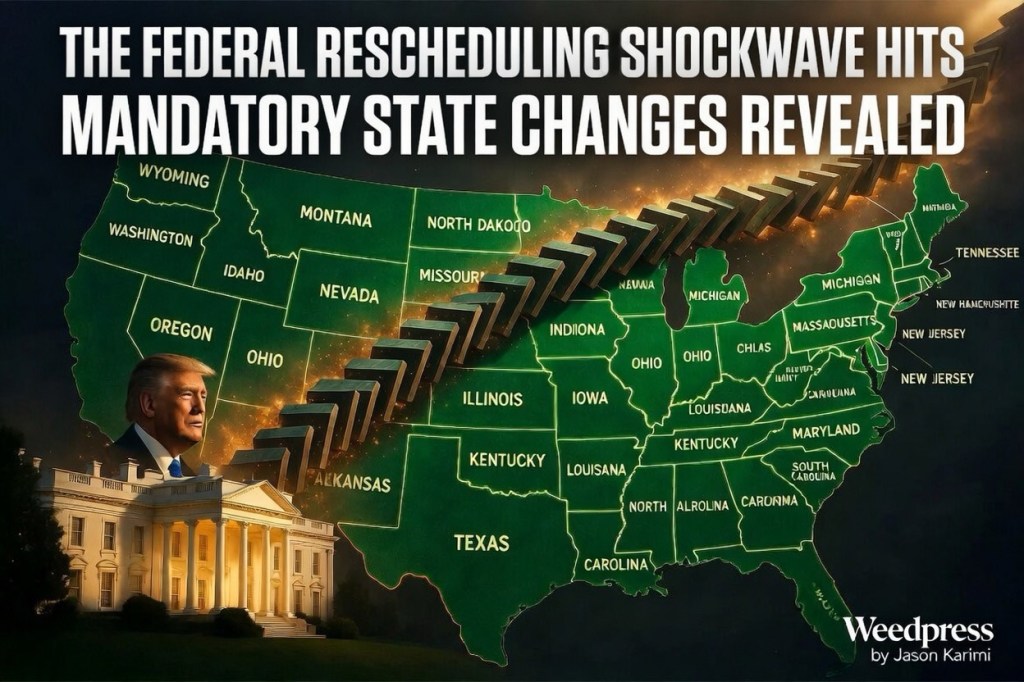
Suggested citation: Karimi, Jason, The Federal Rescheduling Shockwave Hits: South Carolina and 26 Other States Appear to Have Automatic or Mandatory Conformity Mechanisms for Federal Marijuana Scheduling Changes (May 05, 2026). Available at SSRN: https://ssrn.com/abstract=6726361
In late April 2026, the Trump administration’s Department of Justice and DEA issued a final order moving FDA-approved drug products containing marijuana, as well as marijuana subject to a qualifying state-issued medical license, from Schedule I to Schedule III of the federal Controlled Substances Act.¹ Almost immediately, South Carolina found itself at the center of a national conversation. State Senator Tom Davis (R) declared that medical marijuana is now effectively legal in the Palmetto State under existing law, while Governor Henry McMaster’s office confirmed that § 44-53-160(C) of the South Carolina Code requires the Department of Public Health to mirror the federal change.² Agencies are still assessing implementation, and litigation is likely if delays continue.
South Carolina’s statute is crystal clear and mandatory: “If a substance is added, deleted, or rescheduled as a controlled substance pursuant to federal law or regulation, the department shall, at the first regular or special meeting of the South Carolina Board of Health and Environmental Control within thirty days after publication in the Federal Register of the final order … add, delete, or reschedule the substance in the appropriate schedule. The addition, deletion, or rescheduling of a substance by the department pursuant to this subsection has the full force of law unless overturned by the General Assembly.” The change must be “in substance identical” with the federal order, and the department is required to post the updated schedules on its website with an effective date.³
This is not a discretionary policy choice. It is a “shall” command baked into the state’s Controlled Substances Act decades ago precisely to keep South Carolina’s schedules in lockstep with federal law. The state’s dormant 1980 Controlled Substances Therapeutic Research Act (§§ 44-53-610 et seq.) further obligates the health department director to obtain marijuana “through whatever means he deems most appropriate consistent with federal law” for qualified patients once rescheduling occurs.⁴
As explained by Weedpress last summer, this exact scenario was predictable—and potentially disruptive for states without proactive legislative fixes. In its January 8, 2026, white paper “THE FEDERAL MARIJUANA RESCHEDULING SHOCKWAVE,” Weedpress mapped the 50-state controlled-substances landscape and warned of an impending disruption in enforcement architectures that rely on automatic federal conformity. The piece detailed how most states had deliberately tethered their CSA schedules to federal changes to avoid duplicative rulemaking, creating a built-in “shockwave” the moment marijuana left Schedule I.⁵
Weedpress has also pointed out that South Carolina is far from alone. The same automatic-alignment mechanism exists in 27 states total—all categorized as “Green” in the Vicente Sederberg LLP memorandum on state CSA exemptions and regulatory mechanisms (the document on file with the author).⁶
Many do not appear to require new legislation, though agency implementation, objection procedures, emergency rules, or state-specific marijuana carveouts may affect timing and scope. The controlling authority—typically a Department of Health, Board of Pharmacy, or equivalent—must act unless an objection is filed (which can trigger a hearing) or the legislature overrides. Below is the full list drawn directly from the memorandum, with the operative statutory language summarized for each:
South Carolina (as detailed above): S.C. Code Ann. § 44-53-160(C) – mandatory 30-day Board action; full force of law unless overturned by the General Assembly.⁷
Alabama: Ala. Code § 20-2-2 et seq. – State Board of Health must similarly schedule after 30 days from Federal Register publication unless it objects.⁸
Arkansas: Ark. Code Ann. § 5-64-201 et seq. – Secretary of the Department of Public Health shall control the substance after 30 days unless objection; special process for FDA-approved marijuana-derived medications.⁹
Idaho: Idaho Code § 37-2702 et seq. – Board shall promulgate temporary rule or propose statutory amendment within 30 days unless objection.¹⁰
Illinois: 720 Ill. Comp. Stat. 570/201 et seq. – Department shall similarly control after 30 days unless Department or interested party objects (with hearing).¹¹
Indiana: Ind. Code § 35-48-1-1 et seq. – Automatic rescheduling/deletion for less restrictive federal changes; Board must notify legislative council if objecting.¹² Indiana maintains a federal-conformity mechanism for certain scheduling changes, but marijuana remains separately treated as Schedule I under current Indiana practice pending legislative or administrative action.
Iowa: Iowa Code § 124.201 et seq. – Specific automatic provision for FDA-approved cannabidiol products; general alignment for other substances.¹³
Kentucky: Ky. Rev. Stat. Ann. § 218A.020 et seq. – “Each substance that is scheduled or descheduled under 21 CFR 1308.11–1308.15 shall be scheduled or descheduled at the state level.”¹⁴
Louisiana: La. Rev. Stat. Ann. § 40:961 et seq. – Express incorporation of federal CSA schedules (21 CFR 1308.11–1308.15); hemp/CBD already exempted.¹⁵
Maryland: Md. Code Ann., Crim. Law § 5-201 et seq. – New federally designated substance is automatically controlled unless Department objects.¹⁶
Massachusetts: Mass. Gen. Laws ch. 94C, § 1 et seq. & regulations – State schedules mirror federal; Commissioner shall issue regulation within 30 days of federal action.¹⁷
Michigan: Mich. Comp. Laws § 333.7201 et seq. – Board of Pharmacy must act within 91 days unless it holds a meeting to determine otherwise.¹⁸
Missouri: Mo. Rev. Stat. § 195.017 et seq. – Department must similarly schedule unless it objects within 30 days (with hearing process).¹⁹
Montana: Mont. Code Ann. § 50-32-101 et seq. – Automatic adoption unless State Board of Pharmacy objects; special automatic rescheduling for tetrahydrocannabinols under federal Food, Drug & Cosmetic Act.²⁰
Nevada: Nev. Rev. Stat. § 453.011 et seq. – Board shall treat the substance identically after 60 days unless objection by Board or interested party.²¹
New Hampshire: N.H. Rev. Stat. Ann. § 318-B:1 et seq. – Commissioner shall control after 30 days unless objection.²²
New Jersey: N.J. Stat. Ann. § 24:21-1 et seq. – Automatic effect unless Commissioner objects within 30 days.²³
North Carolina: N.C. Gen. Stat. § 90-87 et seq. – Commission shall similarly control unless it objects (with rulemaking if objection).²⁴
North Dakota: N.D. Cent. Code § 19-03.1-02 et seq. – Board shall similarly control after 30 days unless objection.²⁵
Ohio: Ohio Rev. Code § 3719.41 et seq. – Automatic incorporation of federal additions, transfers, or removals; Board incorporates into next schedule update.²⁶
Oregon: Or. Rev. Stat. § 475.005 et seq. – Schedules expressly incorporate federal; Board reviews and adopts changes within 30 days.²⁷
Rhode Island: R.I. Gen. Laws § 21-28-1.01 et seq. – Director of health shall similarly control after 60 days unless objection.²⁸
Tennessee: Tenn. Code Ann. § 39-17-403 et seq. – Automatic conformity after 30 days unless commissioners object.²⁹
Texas: Tex. Health & Safety Code § 481.002 et seq. – Commissioner shall similarly designate/reschedule/delete after 30 days unless objection.³⁰
Washington: Wash. Rev. Code § 69.50.201 et seq. – Board must control after 30 days unless Board or interested party objects.³¹
Wisconsin: Wis. Stat. § 961.11 et seq. – Board shall treat the substance after 30 days (with specific fast-track for cannabidiol); objection stays action.³²
Wyoming: Wyo. Stat. Ann. § 35-7-1001 et seq. – Commissioner shall control in same manner as federal law within 30 days (emergency rule + permanent).³³
These 27 jurisdictions represent a majority of the country’s CSA frameworks. As Weedpress emphasized in its January 2026 shockwave analysis, these statutes were written to prevent states from falling out of sync with federal scheduling decisions. The statutes were not written with a major Schedule I-to-III shift for marijuana itself in mind, but the language is broad, mandatory, and self-executing in the absence of objection.³⁴
The practical consequences are significant but not automatic legalization. In these Green states, once the federal order is final and published, the state controlling authority has a non-discretionary duty to act. Actual changes in the legal status of medical marijuana possession, distribution, or patient access still depend on state implementation, existing program rules, registration requirements, DEA compliance where applicable, and enforcement interpretation. South Carolina is simply the first state where the issue has surfaced publicly. The others are already subject to these conformity mechanisms.
Policymakers, regulators, and cannabis stakeholders in every Green state should treat the federal rescheduling as an immediate trigger for review and action. The shockwave is here. The only question left is how quickly each state’s health or pharmacy board will comply with the “shall” provisions already on the books—and whether any will object or face legislative override.
Footnotes
¹ U.S. Dep’t of Justice, Justice Department Places FDA-Approved Marijuana Products and Products Containing Marijuana Subject to a Qualifying State-issued License in Schedule III (Apr. 24, 2026), https://www.justice.gov/opa/pr/justice-department-places-fda-approved-marijuana-products-and-products-containing-marijuana.
² Medical Marijuana Is Now Legal in South Carolina, GOP Senator Declares, as Republican Governor Candidate Calls It a ‘Gateway Drug’, Marijuana Moment (May 5, 2026), https://www.marijuanamoment.net/medical-marijuana-is-now-legal-in-south-carolina-gop-senator-declares-as-republican-governor-candidate-calls-it-a-gateway-drug/.
³ S.C. Code Ann. § 44-53-160(C) (2023), https://www.scstatehouse.gov/code/t44c053.php.
⁴ S.C. Code Ann. §§ 44-53-610 et seq. (1980 Therapeutic Research Act).
⁵ Jason Karimi, THE FEDERAL MARIJUANA RESCHEDULING SHOCKWAVE, WeedPress: ThePaper Trail (Jan. 8, 2026), https://weedpress.org/2026/01/08/the-federal-marijuana-rescheduling-shockwave/.
⁶ Memorandum, State Controlled Substances Acts: Exemptions and Regulatory Mechanisms for Schedule Changes (Vicente Sederberg LLP, 2020; updated chart current as of 2026) [hereinafter Vicente Sederberg Memo] (on file with the author), at 4–22 (Green states section).
⁷ S.C. Code Ann. § 44-53-160(C).
⁸ Ala. Code § 20-2-2 et seq.
⁹ Ark. Code Ann. § 5-64-201 et seq.
¹⁰ Idaho Code § 37-2702 et seq.
¹¹ 720 Ill. Comp. Stat. 570/201 et seq.
¹² Ind. Code § 35-48-1-1 et seq.
¹³ Iowa Code § 124.201 et seq.
¹⁴ Ky. Rev. Stat. Ann. § 218A.020 et seq.
¹⁵ La. Rev. Stat. Ann. § 40:961 et seq.
¹⁶ Md. Code Ann., Crim. Law § 5-201 et seq.
¹⁷ Mass. Gen. Laws ch. 94C, § 1 et seq. & 105 Mass. Code Regs. 700.000 et seq.
¹⁸ Mich. Comp. Laws § 333.7201 et seq.
¹⁹ Mo. Rev. Stat. § 195.017 et seq.
²⁰ Mont. Code Ann. § 50-32-101 et seq.
²¹ Nev. Rev. Stat. § 453.011 et seq.
²² N.H. Rev. Stat. Ann. § 318-B:1 et seq.
²³ N.J. Stat. Ann. § 24:21-1 et seq.
²⁴ N.C. Gen. Stat. § 90-87 et seq.
²⁵ N.D. Cent. Code § 19-03.1-02 et seq.
²⁶ Ohio Rev. Code § 3719.41 et seq.
²⁷ Or. Rev. Stat. § 475.005 et seq.
²⁸ R.I. Gen. Laws § 21-28-1.01 et seq.
²⁹ Tenn. Code Ann. § 39-17-403 et seq.
³⁰ Tex. Health & Safety Code § 481.002 et seq.
³¹ Wash. Rev. Code § 69.50.201 et seq.
³² Wis. Stat. § 961.11 et seq.
³³ Wyo. Stat. Ann. § 35-7-1001 et seq.
³⁴ Karimi, supra note 5.
 WeedPress: The Paper Trail
Leave a comment