The June marijuana rescheduling hearing is not a guaranteed win for reform. But it is hard to deny that the current process looks more favorable to rescheduling than the federal government has looked in years. The reason is not secrecy or corruption. It is that the same administration that already moved FDA-approved marijuana products and marijuana subject to a qualifying state-issued medical marijuana license into Schedule III is now overseeing the next phase of the broader marijuana scheduling fight.¹ ²
That matters because the key decision-makers are no longer approaching the issue with abstract neutrality. Acting Attorney General Todd Blanche already signed off on the partial April move, and DEA Administrator Terry Cole publicly said the agency is “expeditiously moving forward” under Blanche’s lead.³ The Federal Register notice also sets a compressed hearing schedule, beginning June 29, 2026 and concluding no later than July 15, 2026.⁴ Taken together, those signals do not prove the final outcome. But they do suggest that the federal government is not approaching this hearing as a slow-roll exercise designed to bury reform in procedure.⁵
That is why the hearing feels different. For years, cannabis reformers were conditioned to expect delay, administrative drift, and hostile gatekeeping. The current setup looks more like an administration trying to finish a project it has already begun. DOJ did not merely reopen a theoretical debate. It partially rescheduled a defined medical category immediately and then scheduled broader proceedings on the remaining marijuana question.⁶ In practical terms, that means the administration has already shown its hand: it is willing to move marijuana policy through the Controlled Substances Act process rather than treat reform as politically untouchable.⁷
None of that means the hearing is fake or that opponents will be silenced. They will appear, testify, and make their record. The hearing still matters because administrative law matters. Evidence matters. Recommendations matter. But there is a difference between a hearing conducted by an administration that wants the process to reach a result and a hearing conducted by one that wants the process to consume itself. This one looks much more like the former.⁸
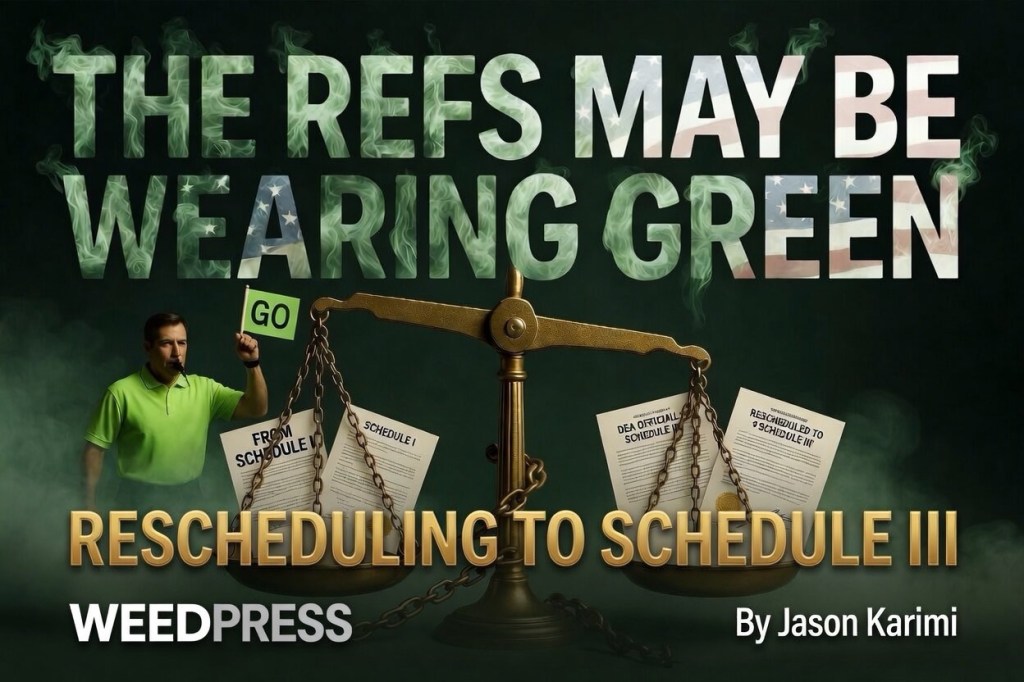
That is also why the sports metaphor lands. The “refs” are not literally rigging the game. The better way to say it is that the officials in charge no longer appear invested in keeping the game frozen at 0–0 forever. Cole’s public comments, Blanche’s April order, and the accelerated timetable all point in the same direction: forward motion.⁹ For operators, patients, and advocates who have spent years watching federal agencies stall, that alone is a major change in atmosphere.
The business stakes make the posture even more important. The April order already created a split federal framework in which state-licensed medical marijuana occupies a better position than adult-use marijuana.¹⁰ That means the next hearing is not just symbolic. It will help determine whether the federal government extends the logic of that partial move to marijuana more broadly or traps the industry in a half-built system where one side gets relief and the other stays buried.¹¹
Critics will say the current administration is biased toward reform. Maybe it is. But administrative law is always shaped by the policy choices of the people running the executive branch. The relevant question is not whether the hearing officers are robots. It is whether the process is being pushed toward a conclusion or away from one. Right now, the evidence suggests momentum, not sabotage.¹²
That is the real meaning of saying the refs may be wearing green. Not that the hearing is predetermined, but that the people controlling the pace and posture of the process appear more interested in finishing the rescheduling debate than postponing it yet again. After decades of bureaucratic hesitation, that may be the most important change of all.¹³
For cannabis operators, patients, and advocates, the takeaway is simple: this is not the moment to assume the process will stall out on its own. The June hearing looks like a live opening, not another dead end. The administration has already moved once. It has scheduled the next phase tightly. Its public statements point toward continued action. That does not guarantee victory, but it does mean reform now has something it has often lacked at the federal level — real procedural momentum.¹⁴
Footnotes
¹ Press Release, U.S. Dep’t of Just., Justice Department Places FDA-Approved Marijuana Products and Products Containing Marijuana Subject to a Qualifying State-Issued License in Schedule III (Apr. 24, 2026), https://www.justice.gov/opa/pr/justice-department-places-fda-approved-marijuana-products-and-products-containing-marijuana.
² Schedules of Controlled Substances: Rescheduling of Food and Drug Administration Approved Products Containing Marijuana and Products Containing Marijuana Subject to a Qualifying State-Issued License, 91 Fed. Reg. ___ (Apr. 28, 2026), https://www.federalregister.gov/documents/2026/04/28/2026-08176/schedules-of-controlled-substances-rescheduling-of-food-and-drug-administration-approved-products.
³ Press Release, U.S. Dep’t of Just., supra note 1 (quoting DEA Administrator Terry Cole).
⁴ Schedules of Controlled Substances: Rescheduling of Marijuana, 91 Fed. Reg. ___ (Apr. 28, 2026) (notice of hearing), https://www.federalregister.gov/documents/2026/04/28/2026-08177/schedules-of-controlled-substances-rescheduling-of-marijuana.
⁵ Id.; Press Release, U.S. Dep’t of Just., supra note 1.
⁶ Press Release, U.S. Dep’t of Just., supra note 1.
⁷ Id.
⁸ Schedules of Controlled Substances: Rescheduling of Marijuana, supra note 4.
⁹ Press Release, U.S. Dep’t of Just., supra note 1.
¹⁰ Schedules of Controlled Substances: Rescheduling of Food and Drug Administration Approved Products Containing Marijuana and Products Containing Marijuana Subject to a Qualifying State-Issued License, supra note 2.
¹¹ Id.; Schedules of Controlled Substances: Rescheduling of Marijuana, supra note 4.
¹² Press Release, U.S. Dep’t of Just., supra note 1.
¹³ Id.; Schedules of Controlled Substances: Rescheduling of Marijuana, supra note 4.
¹⁴ Press Release, U.S. Dep’t of Just., supra note 1; Schedules of Controlled Substances: Rescheduling of Marijuana, supra note 4.


Leave a Reply