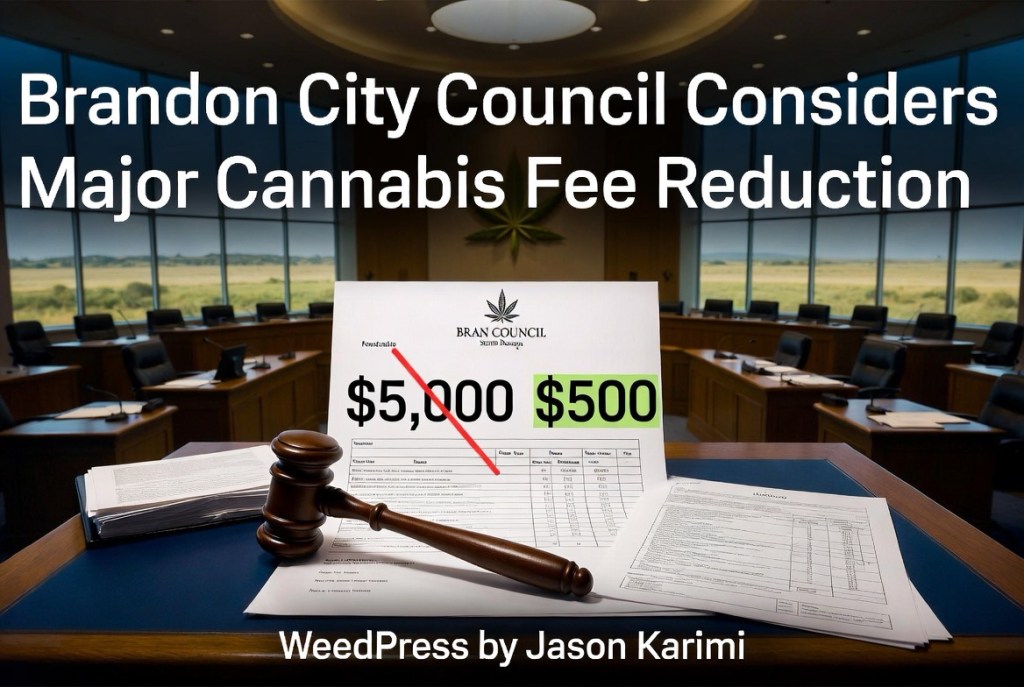
On June 1, 2026, the Brandon City Council took up a proposal to significantly lower annual renewal fees for medical cannabis businesses operating inside city limits.¹ The measure, requested by local cultivator Cannanaut, would reduce the renewal application fee from $5,000 to $500.² While the council discussed the change and appeared supportive of advancing it, no final vote occurred at the June 1 meeting.³
The central rationale presented to the council was straightforward: a $5,000 renewal fee may be defensible for new applicants, which require extensive initial review, background checks, site inspections, and compliance verification. Renewals, however, involve substantially less administrative work once a business has already demonstrated compliance.⁴ City resources are not consumed at the same level for a renewal as they are for an original application. Adjusting the fee to reflect that difference represents a more precise alignment between regulatory costs and the fees charged to operators.
Current Fee Structure and Proposed Changes
Brandon currently charges medical cannabis businesses a combination of application, renewal, and other annual fees that can total more than $16,000 per year for some licensees.⁵ The proposed reduction targets only the renewal application component. The council also considered related changes to insurance requirements under Ordinance No. 761 on first reading.⁶
Proponents argue that excessively high renewal fees function as a de facto tax on ongoing, compliant operations rather than a genuine cost-recovery mechanism. For smaller cultivators and retailers already navigating federal Schedule III transition issues, state testing requirements, and 280E tax exposure, every unnecessary local cost adds pressure that ultimately affects patient pricing and product availability.⁷
Why This Matters
Local fee structures directly influence whether small and independent operators can remain viable. When renewal fees are set without regard to the actual marginal cost of processing a renewal versus a new application, the result is often higher barriers for businesses that have already proven they can operate safely and legally.⁸
Brandon’s discussion on June 1 reflects a growing recognition in some South Dakota communities that medical cannabis regulation should be calibrated to real administrative burdens rather than treated as a general revenue tool. Other cities in the state have adopted more modest renewal fees; Brandon’s current $5,000 figure stood out as unusually high for a renewal.⁹
The council’s decision to discuss the reduction publicly and move the matter forward (even without a final vote on June 1) is a positive signal that local officials are willing to revisit fee schedules when operators present evidence that current rates exceed the city’s actual costs.¹⁰
Next Steps
The proposal is expected to return for further consideration, likely including a second reading and potential final vote at a future council meeting. Operators and patients in the Brandon area should monitor the city’s agenda postings and consider submitting public comment if they wish to support or modify the changes.
Reasonable, evidence-based local regulation supports both public safety and patient access. Brandon’s June 1 discussion shows at least one South Dakota community is willing to examine whether its fee structure still makes sense after several years of program operation.
Footnotes
¹ City of Brandon, South Dakota, Regular City Council Meeting Agenda (June 1, 2026), Item under Administration (Resolution #09-26 – Setting Fees for Cannabis License Renewals), https://cityofbrandon.org/agendas (last visited June 3, 2026).
² Id. (proposal to reduce renewal application fee from $5,000 to $500 at the request of local cultivator Cannanaut).
³ Id. (matter discussed on first reading / advanced without final vote on June 1, 2026).
⁴ Discussion at Brandon City Council meeting (June 1, 2026) (argument that renewal applications require significantly fewer city resources than new applications, which involve initial due diligence, site review, and compliance verification).
⁵ Brandon City Code provisions governing annual cannabis business fees and licensing costs (current structure can exceed $16,000 annually when combining application, renewal, and related fees).
⁶ City of Brandon, Ordinance No. 761 (first reading June 1, 2026) (amending insurance requirements for cannabis licensees, including proposed reduction of general liability coverage from $2 million).
⁷ See generally Schedules of Controlled Substances: Rescheduling of Food and Drug Administration Approved Products Containing Marijuana From Schedule I to Schedule III, 91 Fed. Reg. 22714 (Apr. 28, 2026) (2026-08176) (federal changes creating new compliance pathways while leaving state and local regulatory costs intact).
⁸ Local fee structures that fail to distinguish between new applications and renewals can function as ongoing barriers to small-operator viability even after initial licensing. See also Headset and Vangst operator impact modeling widely cited in post-April 2026 commentary (compliance and operating costs remain significant factors in market consolidation).
⁹ Comparison of South Dakota municipal cannabis licensing fees (Brandon’s $5,000 renewal application fee has been noted as higher than several peer communities for renewal activity).
¹⁰ Public discussion and advancement of Resolution #09-26 at the June 1, 2026 Brandon City Council meeting (indicating willingness to recalibrate fees based on actual administrative burden).
 WeedPress: The Paper Trail
Leave a comment