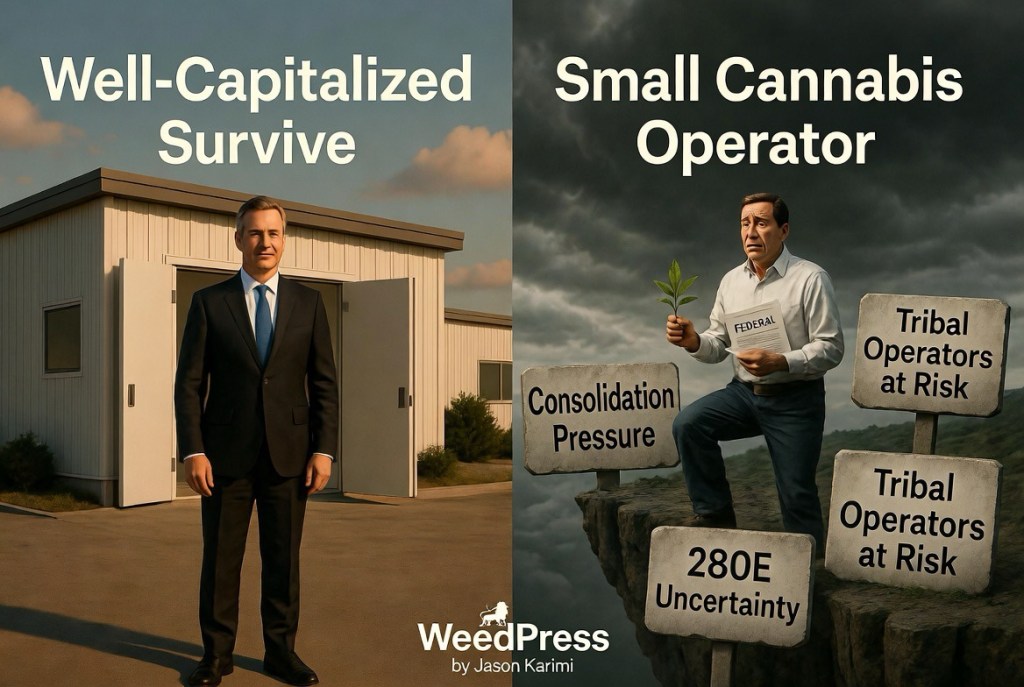
Check out the warnings for small operators from this webinar:
Core Warnings for Small Operators
1. Compliance Costs & DEA Registration Burdens Are Real and Disproportionate
• Small operators face significant new costs for legal counsel, application preparation, security upgrades, recordkeeping systems, and compliance infrastructure that many legacy businesses were never built to handle.
• Amber Lengacher repeatedly stressed that businesses “really do need to be consulting with legal counsel” and highlighted the 60-day expedited application window. Missing it removes prioritization and increases risk.
• Disclosing prior handling of cannabis without a federal license is described as “super sketch” and a major psychological/financial burden for many small operators.
2. Consolidation Pressure Is Explicitly Acknowledged
• Major MSOs (multi-state operators) are already submitting DEA applications, while small operators often lack the capital, legal resources, and professional infrastructure to do the same.
• Panelists noted that the order favors operators with scale and resources, accelerating market concentration. Small, diversely-owned, and legacy businesses face higher barriers and are more vulnerable to being left behind or forced into consolidation/mergers.
3. 280E Tax Relief Is Limited and Uncertain for Small Operators
• While rescheduling opens a pathway to 280E relief for qualifying medical operations, the practical benefit is gated behind successful DEA registration and ongoing federal compliance.
• Uncertainty around IRS guidance and retrospective relief means many small operators may not see meaningful tax savings in the near term, while still facing new compliance costs.
4. Instability and “Overnight” Risk
• Amber Lengacher warned that the current AG order is unprecedented and “could be undone overnight with the stroke of a pen” by a future administration. This creates ongoing instability that hits smaller operators harder because they have less capital cushion.
5. Tribal / Equity / Small Legacy Operators Especially at Risk
• Mary Jane Oatman emphasized that many tribal and Indigenous operators were not clearly included in the order’s protections, warning of exclusion and economic harm.
• The panel highlighted that small, justice-impacted, and equity operators face extra disclosure risks that could lead to denial or closure.
Direct Quotes from the Webinar
• Amber Lengacher: “Disclosing to the DEA that you may have previously handled controlled substances without a license is super sketch… I don’t know anyone that’s super comfortable with doing that.”
• Amber Lengacher: “The AG order placed medical marijuana… as defined in schedule three… but another AG could undo it overnight with the stroke of a pen.”
• Amber Lengacher (on small operators needing counsel): “This isn’t legal advice… businesses really do need to be consulting with legal counsel… there’s a lot of risk there for sure.”
• Panel discussion noted that MSOs are moving forward with applications while small operators may lack the resources, leading to consolidation pressure.
Larger, well-capitalized players are better positioned to survive. Smaller operators need to be aware.
From the 29 to 32 minute mark discussion over homegrown not being protected under federal law is discussed. This was because an Iowa activist who was invited to take part in this podcast was asking in the comments about homegrown inclusion under the federal exemption laws. Turns out Colorado marijuana enforcement division folks issued a statement saying homegrown is not protected.
 WeedPress: The Paper Trail
Leave a comment