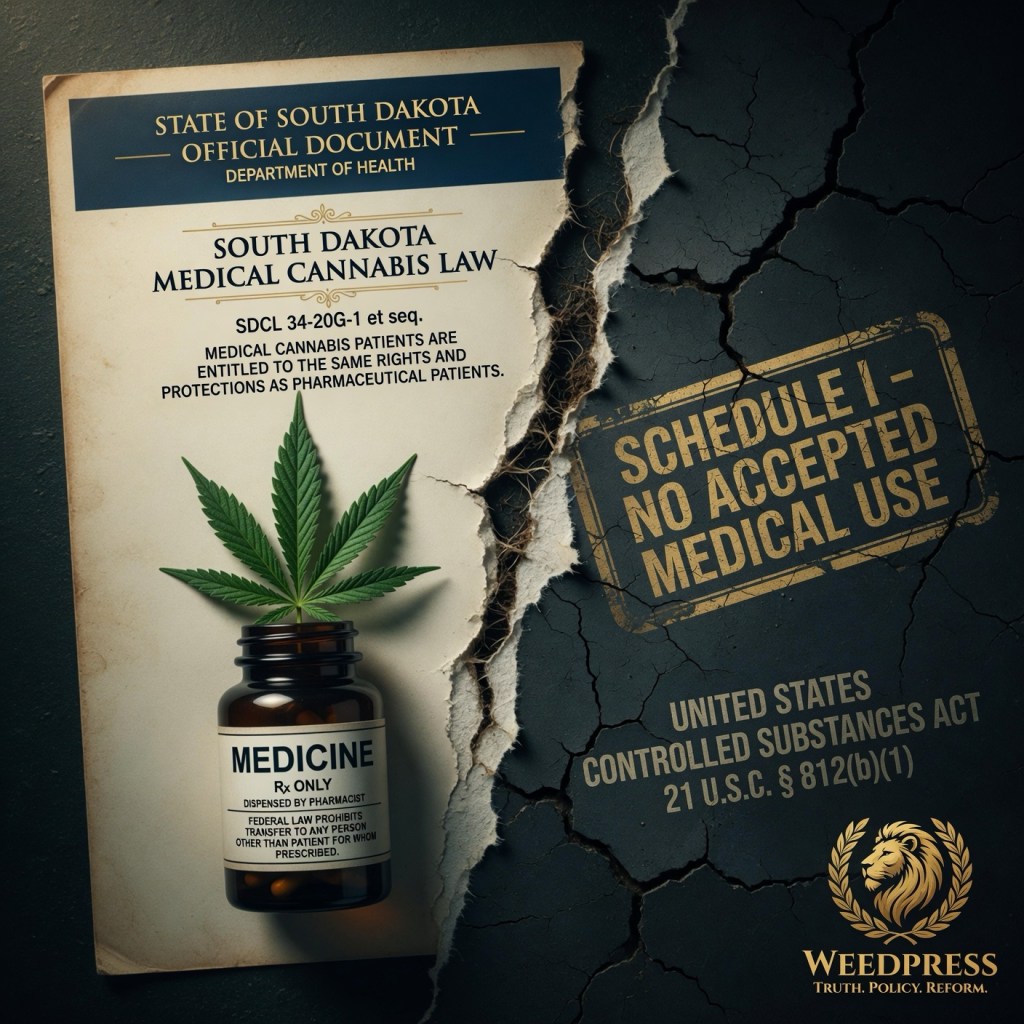
South Dakota did not create an ordinary medical cannabis program. When voters passed Initiated Measure 26 and the Legislature enacted the Medical Cannabis Act, the state deliberately chose to treat registered patients’ use of cannabis as the legal equivalent of pharmaceutical medication in key areas of life. This was not symbolic language. It was written into the statutes with clear, enforceable text.
Under SDCL 34-20G-22, the law provides:
“Except as otherwise provided in this chapter, a registered qualifying patient who uses cannabis for a medical purpose must be afforded the same rights under state and local law, as the person would be afforded if the person were solely prescribed a pharmaceutical medication, as it pertains to: (1) Any interaction with a person’s employer; (2) Drug testing by a person’s employer; or (3) Drug testing required by any state or local law, agency, or government official.”¹
The statute does not grant “similar” rights or “comparable” protections. It requires that registered patients receive the same rights they would have if their medicine had come from a pharmacy. This is a deliberate legislative decision to place medical cannabis on equal legal footing with FDA-approved medications for employment and drug-testing purposes.
This pharmaceutical-equivalence standard extends into medical care itself. The Medical Cannabis Act further provides that a registered qualifying patient’s use of cannabis in accordance with the chapter “is considered the equivalent of the authorized use of any other medication used at the discretion of a practitioner” and does not constitute the use of an illicit substance or otherwise disqualify the patient from needed medical care.² This language directly protects patients from discrimination in organ transplants, tissue donations, and other medical decisions by forcing providers to treat their cannabis use the same as any other prescribed medication.
These provisions are not isolated. They reflect a broader statutory framework in which South Dakota chose to define and regulate medical cannabis as medicine rather than as a purely criminal or recreational substance. The definitions in SDCL 34-20G-1 tie “medical cannabis” to marijuana as defined in SDCL 22-42-1, but the operational sections of the chapter then override that baseline by granting patients pharmaceutical-style legal protections.³ The state did not create a program that merely decriminalizes cannabis for certain patients. It created a program that affirmatively reclassifies their use as medicine for important legal purposes.
This framework now directly conflicts with the state’s continued placement of marijuana in Schedule I of the South Dakota controlled substances act.
In April 2026, the U.S. Department of Justice moved marijuana products produced and distributed under state medical cannabis programs out of Schedule I and into Schedule III.⁴ The federal government has effectively acknowledged that marijuana has accepted medical use when it is regulated through state medical programs. The old federal Schedule I rationale — that marijuana has “no currently accepted medical use in treatment in the United States” — no longer applies to state-regulated medical cannabis in the same way it once did.
South Dakota law went further than most states by statutorily equating medical cannabis with pharmaceutical medications. Now that the federal government has moved marijuana out of Schedule I for state medical programs, the state’s own unreviewed Schedule I classification creates a clear internal contradiction. The state is simultaneously telling patients, employers, healthcare providers, and the public that medical cannabis is medicine entitled to pharmaceutical-style protections under SDCL 34-20G-22 and related sections, while maintaining a Schedule I listing that declares the substance has no accepted medical use and a high potential for abuse.
This is not a minor or technical inconsistency. It is a structural conflict that will generate litigation if left unaddressed by the Department of Health.
Registered patients will have strong arguments that the state cannot grant them pharmaceutical-equivalent rights under one chapter of state law while maintaining a Schedule I classification under another chapter that treats their medicine as having no accepted medical value. Employers and drug-testing entities will face conflicting obligations. Healthcare providers will confront situations where state law pulls in opposite directions regarding whether cannabis use disqualifies patients from medical care. Law enforcement and courts will be asked to enforce provisions that are increasingly difficult to reconcile. The Department of Health, as the agency charged with administering the Medical Cannabis Act, will inevitably be drawn into these disputes.
If the Department of Health does not promptly initiate a formal review of the state Schedule I classification in light of both federal rescheduling and the Medical Cannabis Act’s own pharmaceutical-equivalence provisions, litigation risk will increase rather than decrease. Plaintiffs will have clearer and stronger claims that continued Schedule I treatment is arbitrary, inconsistent with the text of SDCL 34-20G-22, and no longer supported by current federal law. The longer the Department delays review, the more opportunity there is for inconsistent enforcement actions, conflicting court rulings, and costly litigation that could have been avoided through timely administrative action.
WeedPress has documented for years that South Dakota’s medical cannabis statute is unusually protective in its treatment of cannabis as medicine. That protection was a deliberate policy choice by the voters and the Legislature. It is now in direct and growing tension with an unreviewed Schedule I classification that no longer aligns with federal reality or the state’s own statutory framework. The Department of Health has both the legal authority and the administrative responsibility to address this conflict before it is resolved in courtrooms at significant expense to the state, patients, and the regulated industry.
The time for that review is now.
Footnotes
¹ SDCL 34-20G-22, https://sdlegislature.gov/Statutes/Codified_Laws/2078844.
² See SDCL 34-20G (medical cannabis chapter provisions treating registered patient use as the equivalent of other medication for purposes of medical care and non-disqualification from treatment).
³ SDCL 34-20G-1 (definitions), https://sdlegislature.gov/Statutes/Codified_Laws/2078823 (tying “medical cannabis” to marijuana while the operational sections of the chapter grant pharmaceutical-style protections).
⁴ Acting Attorney General Order of April 23, 2026 (moving state medical cannabis program products to Schedule III), available at justice.gov.
⁵ The direct conflict between SDCL 34-20G-22’s mandate that registered patients receive the “same rights” as those prescribed pharmaceutical medications and the unreviewed state Schedule I classification will be the subject of increasing litigation if the Department of Health does not initiate formal review. Patients, licensees, and employers will have colorable claims that continued Schedule I treatment is inconsistent with both state statutory text and current federal scheduling reality.


Leave a Reply