“If you’re gonna take the risk, you gotta do the frisk.” – ZipTrader Charlie
South Dakota’s medical cannabis program has always operated under a difficult reality: while the state legalized medical access, the federal government still treats cannabis as a Schedule I substance (with only partial movement to Schedule III for state-regulated products in 2026). This federal overlay creates serious obstacles for normal banking services.
Many people have heard claims that cannabis banking in South Dakota “isn’t done in cash” and that banks are actively serving the industry. The truth is more complicated — and less reassuring for operators and patients.

Federal Barriers Remain the Dominant Force
Even after federal rescheduling, banks and credit unions that want to serve cannabis-related businesses must comply with strict federal rules under the Bank Secrecy Act and anti-money laundering requirements.¹
In 2014, the Financial Crimes Enforcement Network (FinCEN) issued guidance that remains the primary federal framework. It requires financial institutions to conduct enhanced due diligence on marijuana-related businesses, monitor transactions for red flags, and file Suspicious Activity Reports (SARs) — including specialized “Marijuana Limited,” “Marijuana Priority,” or “Marijuana Termination” SARs depending on the circumstances.²
Because federal law still prohibits the distribution and sale of marijuana, any financial transaction involving a cannabis business can be viewed as involving funds derived from illegal activity under federal rules. This creates ongoing risk for banks, even when the business is fully compliant with state law.
What South Dakota Law Actually Changed
In 2021, South Dakota passed legislation (now codified as SDCL 51A-4-1.1) that removed the state-level prohibition on banks serving cannabis businesses.³ The South Dakota Division of Banking also issued guidance clarifying that state-chartered institutions could provide services if they maintained robust BSA/AML compliance programs.
This law was an important step. It signaled that South Dakota would not punish banks at the state level for working with licensed cannabis operators.
However, it did not eliminate federal risk. Banks that choose to serve the industry must still navigate the same federal compliance burdens that exist nationwide.
How Other States Handle Cannabis Banking
South Dakota is somewhat of an outlier in having passed a clear statute that affirmatively authorizes banks to serve cannabis businesses. Most other states have not taken this legislative step.
In the majority of states with legal cannabis programs, there is no specific state statute that says banks are allowed or protected when serving cannabis businesses. Instead, banking decisions are made on a bank-by-bank, risk-based basis under federal FinCEN guidance. This results in limited options, high compliance costs, and many businesses still operating heavily in cash.⁴
Only a small number of states have passed laws comparable to South Dakota’s:
• Illinois passed the Banking Options for Legal Cannabis-Related Businesses Act in 2019, which protects state banks and credit unions from being penalized by state regulators for serving cannabis businesses.⁵
• California has taken various measures and has relatively active credit union participation in cannabis banking, though it has not passed one sweeping protective statute like South Dakota or Illinois.⁶
• Colorado has one of the most mature and active cannabis banking environments in the country, developed over many years through willing credit unions and community banks rather than through a single comprehensive statute.⁷
• Oregon and Washington also have relatively active participation by credit unions and community banks, again developed more through practice than through one overarching protective law.⁸
In most other states, cannabis banking remains limited and is handled on a case-by-case basis without clear state-level legal backing. This makes South Dakota more proactive than the majority of states, even though the federal overlay still constrains what any state can fully achieve.
How Banking Actually Works in Practice
In reality, cannabis banking in South Dakota remains limited and heavily cash-dependent.
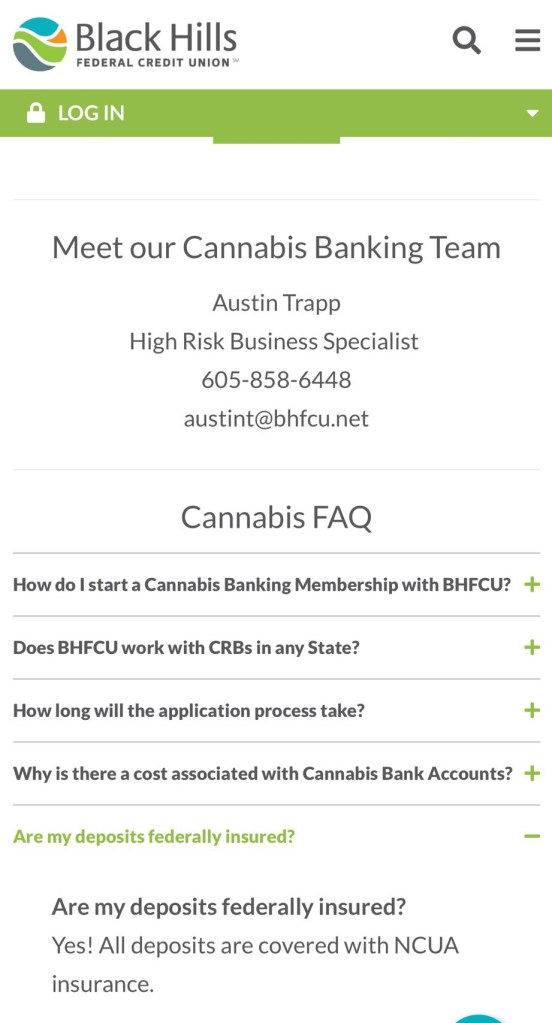
Black Hills Federal Credit Union has been one of the more active institutions openly offering services to cultivators, dispensaries, manufacturers, testing labs, and related businesses. They require extensive compliance documentation and due diligence.⁹ A small number of other community banks or credit unions may work with cannabis businesses on a selective, case-by-case basis.
Most traditional large banks continue to avoid high-THC cannabis accounts due to federal risk. Even businesses that secure bank accounts often continue handling large volumes of cash. Many customers still pay in cash, merchant processing remains difficult or expensive, and armored car services are commonly used to transport and deposit funds. This creates real operational costs, security risks, and accounting challenges for operators.
The claim that South Dakota cannabis banking “isn’t done in cash” overstates the progress. While some banking relationships exist, the industry has not achieved the low-friction, fully electronic banking environment that most legal businesses take for granted.
Why the Gap Persists
The core problem is federal. Until there is broader federal reform (such as the SAFE Banking Act or full descheduling), banks will continue to treat cannabis businesses as high-risk. South Dakota’s 2021 law opened a door at the state level, but federal BSA/AML obligations and the lingering effects of Schedule I status keep that door narrow.
This situation creates ongoing friction for small operators who struggle with cash handling and security, dispensaries that want to offer modern payment options to patients, and the overall professionalism and scalability of the program. Patients ultimately feel the effects through higher costs, limited access points, and operational instability in the businesses that serve them.
The Bottom Line
South Dakota does have some cannabis banking options — most notably through institutions like Black Hills Federal Credit Union. That is real progress compared to states with no options at all. However, the industry remains significantly more cash-heavy than normal businesses, and full-service banking relationships are still limited and compliance-heavy.
The idea that cannabis banking in South Dakota has moved entirely beyond cash and that banks are routinely and comfortably serving the industry does not match the current reality. The federal overlay continues to shape what is possible, and the practical experience on the ground for most operators still involves substantial cash management.
Until broader federal reform occurs, this tension between state legalization and federal banking rules will remain one of the most stubborn challenges in South Dakota’s medical cannabis program.
Footnotes
¹ Bank Secrecy Act, 31 U.S.C. § 5311 et seq.
² FinCEN Guidance, BSA Expectations Regarding Marijuana-Related Businesses, FIN-2014-G001 (Feb. 14, 2014), https://www.fincen.gov/resources/statutes-regulations/guidance/bsa-expectations-regarding-marijuana-related-businesses.
³ SDCL 51A-4-1.1, https://sdlegislature.gov/Statutes/Codified_Laws/51A-4-1.1.
⁴ Industry and policy analyses of state-by-state cannabis banking access (2025–2026).
⁵ Illinois Banking Options for Legal Cannabis-Related Businesses Act (2019), 205 ILCS 710/.
⁶ California cannabis banking framework and credit union participation (various measures).
⁷ Colorado cannabis banking environment and credit union participation.
⁸ Oregon and Washington cannabis banking practices through credit unions and community banks.
⁹ Black Hills Federal Credit Union, Cannabis Banking services, https://www.bhfcu.com/cannabis-banking.
¹⁰ FinCEN Guidance, supra note 2.
¹¹ SDCL 34-20G (Medical Cannabis Act), https://sdlegislature.gov/Statutes/34-20G.
¹² Acting Attorney General Order of April 23, 2026 (placing state-regulated medical cannabis products into Schedule III).
¹³ South Dakota Division of Banking, Guidance on Financial Services for Cannabis-Related Businesses (2021).
¹⁴ FinCEN, Marijuana-Related Businesses Metrics and Reporting Data, https://www.fincen.gov.
¹⁵ Practical industry reporting on cash handling, armored services, and merchant processing challenges in state-legal cannabis markets (2025–2026).
¹⁶ SDCL 51A-4-1.1 (full text and legislative history).


Leave a Reply