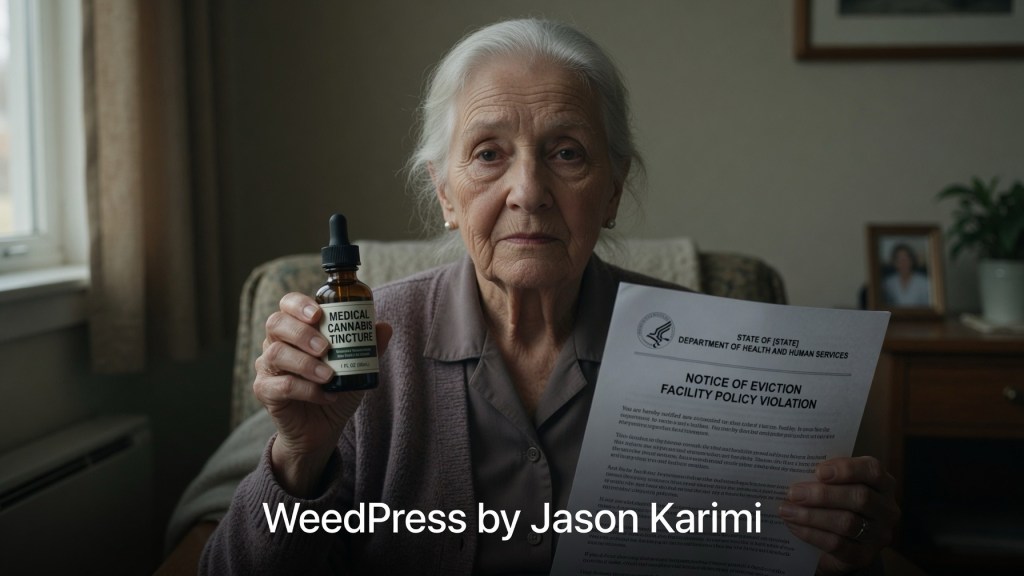
In Iowa recently, a 91-year-old woman was told she had to leave the nursing home she called home because she used medical cannabis to manage her pain and symptoms. The facility gave her an ultimatum: stop using the medicine her doctor supported, or move out. She refused. The case went to court. What should have been a private medical decision for an elderly patient became a public legal fight over whether a nursing home could evict someone for following state medical cannabis law.¹
That story is not unique to Iowa. It is the predictable result of how many state medical cannabis programs were originally written — including South Dakota’s.

When South Dakota voters approved Initiated Measure 26 and the Legislature later passed the Medical Cannabis Act, the law was crafted with full awareness that federal prohibition would create hard barriers in certain settings. One of the clearest and most consequential of those barriers was nursing homes and other healthcare facilities. The statute itself built in an escape hatch for those facilities rather than creating a true right of access for patients.
Under South Dakota law, a registered qualifying patient is supposed to be treated, in important respects, the same as someone who has been prescribed a pharmaceutical medication. The statute states that such a patient “must be afforded the same rights under state and local law, as the person would be afforded if the person were solely prescribed a pharmaceutical medication” when it comes to employment and drug testing.² The law further provides that a qualifying patient’s use of cannabis in accordance with the chapter “is considered the equivalent of the authorized use of any other medication used at the discretion of a practitioner” and does not constitute the use of an illicit substance or disqualify the patient from needed medical care.³
These are strong protections on paper. They reflect a deliberate decision to treat medical cannabis as medicine, not as a criminal substance with limited exceptions. Yet the very next relevant section of the law undercuts that principle when it comes to the places where many of the most vulnerable patients actually live.
South Dakota law explicitly allows healthcare facilities — including nursing homes — to adopt their own restrictions on medical cannabis. A facility may decide it will not store a patient’s medicine, will not provide it, and may limit use to specific areas or prohibit it entirely on the grounds. The statute makes clear that nothing in the law requires a facility to allow consumption of medical cannabis on its property.⁴ In other words, the same law that tells patients they should be treated like any other person with a prescription also tells nursing homes they are free to treat medical cannabis differently from every other medication.
This was not an oversight. It was a structural compromise built into the program from the beginning. The architects of the law understood that federal Schedule I status created massive practical and legal problems for institutions that receive federal funding, participate in Medicare and Medicaid, or are subject to federal conditions of participation. Rather than forcing those institutions to accommodate patients, the law gave the institutions permission to opt out.⁵ Nursing home residents — many of them elderly, disabled, and without realistic alternatives for where to live — were effectively written out of meaningful access.
That design choice is now indefensible.
In April 2026, the federal government moved marijuana products regulated under state medical cannabis programs out of Schedule I and into Schedule III.⁶ The primary federal legal barrier that once justified treating medical cannabis as uniquely dangerous or incompatible with institutional settings no longer exists in the same form. What was once a difficult federal-state conflict has become something narrower: a question of whether South Dakota will continue to allow its most vulnerable residents to be excluded from a medicine the state itself has declared equivalent to pharmaceutical treatment.
Other states are already confronting this reality. In Iowa, the 91-year-old nursing home resident’s case drew widespread attention precisely because it exposed the human cost of facilities using federal concerns as a blanket justification to ban medical cannabis even when state law authorizes it.⁷ Similar stories have emerged in other states where nursing homes have cited federal funding rules to justify blanket prohibitions, even as those federal rules have evolved.
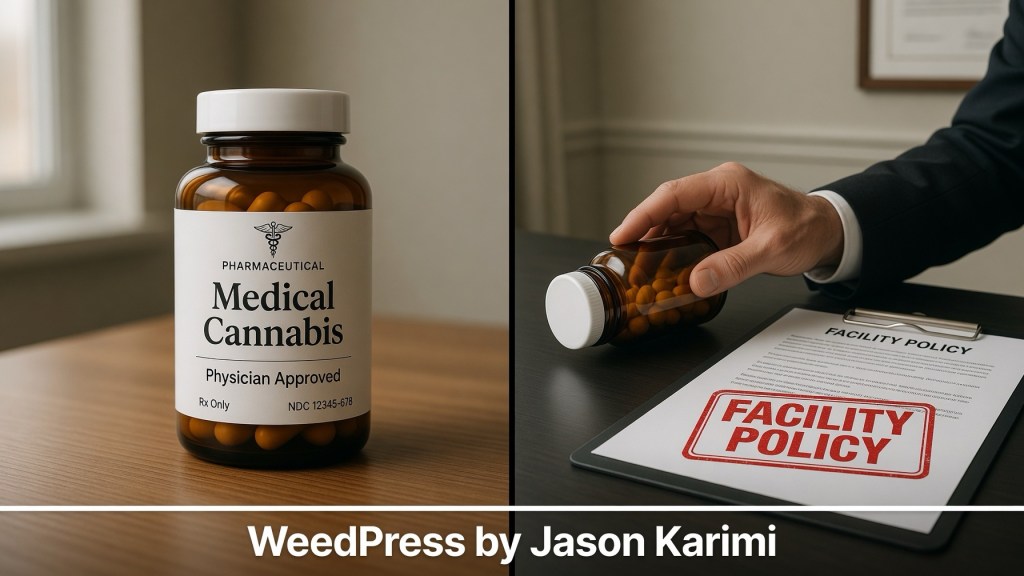
South Dakota now faces the same test. The original justification for allowing nursing homes to exclude medical cannabis — that federal law made accommodation too legally risky — has been substantially undermined by federal rescheduling. Continuing to leave elderly and seriously ill residents without meaningful access is no longer a necessary compromise with federal law. It is a policy choice to prioritize institutional comfort and old risk calculations over the people the medical cannabis program was supposedly created to help.
The patients most affected by this gap are not abstract. They are people in the final years or months of their lives, managing pain, nausea, appetite loss, anxiety, and other symptoms that medical cannabis can address when other medications have failed or caused unacceptable side effects. Many have no family nearby. Many have limited financial resources. For them, being told they must either stop using their medicine or leave the only home they have left is not a minor regulatory friction. It is a profound failure of the system that was sold to voters as compassionate medical access.
The original law was written in a specific federal context. That context has changed. The question now is whether South Dakota will update its approach to reflect current reality or whether it will continue to sacrifice the sickest and most vulnerable patients on the altar of institutional caution and outdated federal assumptions. The lives of real people — people who followed the law, obtained cards, and believed the state when it said medical cannabis was medicine — hang in the balance.
Footnotes
¹ Iowa Capital Dispatch, “Nursing Home Takes Regulators to Court Over Resident’s Eviction” (June 4, 2026), https://iowacapitaldispatch.com/2026/06/04/nursing-home-takes-regulators-to-court-over-residents-eviction/.
² SDCL 34-20G-22.
³ Id.
⁴ SDCL 34-20G-25.1.
⁵ Id. (providing that nothing in the chapter requires a healthcare facility to allow the consumption of medical cannabis on its grounds).
⁶ Schedules of Controlled Substances: Rescheduling of Food and Drug Administration Approved Products Containing Marijuana From Schedule I to Schedule III; Corresponding Change to Permit Requirements, 91 Fed. Reg. 22714 (Apr. 28, 2026) (2026-08176).
⁷ Iowa Capital Dispatch, supra note 1.
⁸ SDCL 34-20G-1 (definitions section establishing the framework for qualifying patients).
⁹ See generally SDCL ch. 34-20G (Medical Cannabis Act).
¹⁰ 91 Fed. Reg. 22714, supra note 6.
¹¹ See reporting and court records regarding the Iowa nursing home eviction proceedings involving a 91-year-old medical cannabis patient (2024–2026).
¹² SDCL 34-20G-25.1.
¹³ Id.
¹⁴ See Iowa Capital Dispatch, supra note 1 (detailing the eviction threat and subsequent legal proceedings).
¹⁵ SDCL 34-20G-22.
¹⁶ Id.
¹⁷ 91 Fed. Reg. 22714, supra note 6.
¹⁸ See analysis of post-rescheduling implications for healthcare facilities and institutional settings (2026).
¹⁹ Iowa nursing home litigation records and contemporaneous news coverage (2024–2026).
²⁰ SDCL 34-20G-25.1.
²¹ See broader pattern of nursing home policies regarding medical cannabis in states with medical programs, including the Iowa example.
²² SDCL 34-20G-22.
²³ 91 Fed. Reg. 22714, supra note 6.
²⁴ Iowa Capital Dispatch, supra note 1.
²⁵ SDCL 34-20G-25.1.
²⁶ See discussion of institutional resistance to medical cannabis access in long-term care settings following federal policy developments.
²⁷ See generally SDCL ch. 34-20G.
²⁸ 91 Fed. Reg. 22714, supra note 6.
²⁹ Iowa Capital Dispatch, supra note 1.
³⁰ SDCL 34-20G-25.1.
³¹ See evolving legal and policy analysis regarding medical cannabis access in healthcare facilities after federal rescheduling.


Leave a Reply