Editors note: WeedPress has studied this federal exemption and rescheduling issue for 17 years.
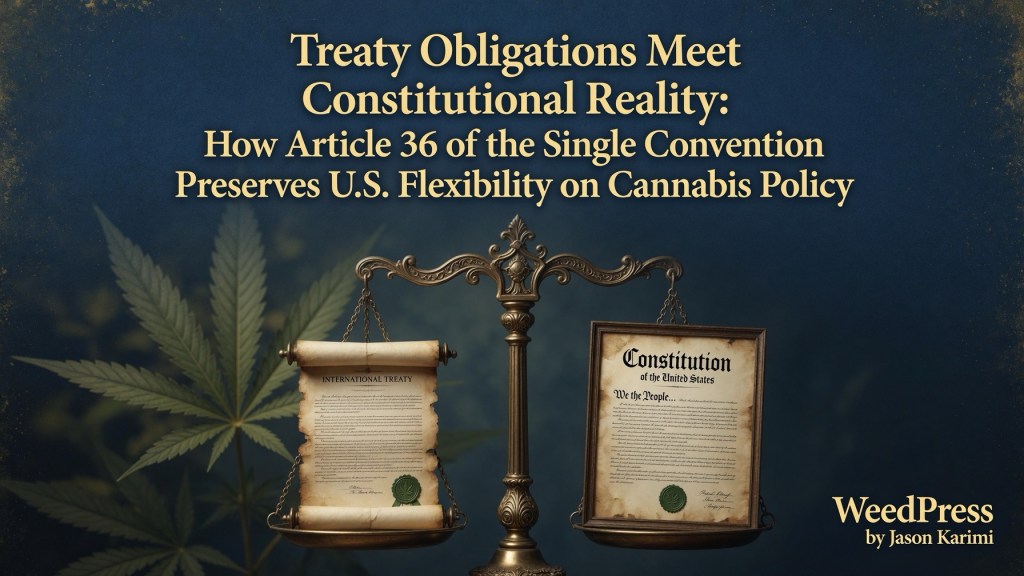
The international drug control regime does not impose a one-size-fits-all criminal hammer. Article 36 of the Single Convention on Narcotic Drugs, 1961 (as amended by the 1972 Protocol) requires parties to criminalize intentional violations of the treaty’s controls on cultivation, production, manufacture, possession, distribution, and related acts. Yet it repeatedly and explicitly subordinates those obligations to each nation’s “constitutional limitations,” “legal system,” and “domestic law.”²
Recent developments in Nebraska and at the federal level illustrate both the promise and the peril of how the United States chooses to honor—or sidestep—that feature. A 1972 commission under the Nixon administration further underscored this point, concluding that the treaties do not require criminalization of personal use and recommending that neither federal nor state governments criminalize it, leaving enforcement discretion firmly to domestic authorities.³
The Treaty Text: Clear Obligations, Clear Limits
Article 36, paragraph 1(a) directs each party to adopt measures ensuring that listed drug activities “contrary to the provisions of this Convention” are punishable offenses when committed intentionally, with serious offenses subject to “adequate punishment particularly by imprisonment.” Paragraph 1(b) immediately carves out space: when abusers of drugs commit such offenses, parties “may provide, either as an alternative to conviction or punishment or in addition,” measures of “treatment, education, after-care, rehabilitation and social reintegration.”⁴
Paragraph 2 subjects jurisdiction, extradition, and related rules to “the constitutional limitations of a Party, its legal system and domestic law.” Paragraph 3 reinforces that the entire article remains “subject to the provisions of the criminal law of the Party concerned on questions of jurisdiction.” Paragraph 4 states plainly that nothing in the article affects the principle that offenses “shall be defined, prosecuted and punished in conformity with the domestic law of a Party.”⁵
In short, the treaty demands control and penal consequences for illicit traffic but leaves the precise definition, scope, and enforcement—including accommodations for constitutional rights, treatment-focused responses, and non-punitive pathways—largely to each sovereign’s domestic framework. The 1972 commission’s findings align directly with this textual emphasis on domestic discretion.⁶
U.S. Implementation: The Controlled Substances Act’s Two Tracks
The United States implements its Single Convention obligations primarily through the Controlled Substances Act (CSA). Two provisions are central to current debates.
Section 811 governs the scheduling process and related criteria for placing substances under control. It provides the framework for determining medical use, abuse potential, and safety—pathways heavily used for “medical” and “scientific” purposes.⁷
Section 822 addresses registration requirements for manufacturers, distributors, and dispensers. Subsection (d) authorizes the Attorney General, by regulation, to “waive the requirement for registration of certain manufacturers, distributors, or dispensers if he finds it consistent with the public health and safety.”⁸
These are not identical tracks. The 811 path is tightly linked to accepted medical and scientific use. The 822(d) waiver authority is broader and more discretionary, capable of accommodating activities that fall outside strict medical/scientific channels while remaining consistent with treaty obligations and public health. Religious or sacramental use, certain state-regulated intrastate programs, and other non-punitive accommodations have historically found footing in this more flexible space or through complementary constitutional doctrines such as the Religious Freedom Restoration Act (RFRA).
Current Flashpoints: Nebraska and the DEA Hearing
On June 30, 2026, Nebraska Attorney General Mike Hilgers approved regulations promulgated by the state Medical Cannabis Commission. In his signing statement, the Attorney General concluded that the regulations “do not clearly violate the state or federal Constitutions on their face,” even while reiterating personal policy opposition. Governor Jim Pillen approved the permanent regulations the following day.⁹
This episode demonstrates a state exercising domestic authority within constitutional bounds—an approach fully compatible with Article 36’s repeated deference to constitutional limitations and domestic law, as well as the 1972 commission’s recommendations against criminalizing personal use.¹⁰
Simultaneously, the DEA is conducting an expedited administrative hearing (June 29–July 15, 2026) on the proposed rescheduling of marijuana from Schedule I to Schedule III. The hearing has drawn sharp criticism for procedural choices: participant selection limited largely to opponents of broader reform, absence of livestreaming or full public broadcast despite repeated requests, and a resulting perception that the process prioritizes defense of a narrow “medical” framing over open examination of treaty-compliant alternatives.¹¹
These choices matter. When the federal government narrows the conversation to one statutory track while the treaty itself preserves broader domestic flexibility, it risks creating arbitrary distinctions that future litigation or policy shifts will have to unwind.
The Core Problem: Split Tracks and Missed Flexibility
Treating cannabis exclusively or primarily through the medical/scientific lens of Section 811 while downplaying or ignoring the waiver and constitutional-accommodation pathways available under Section 822(d) and Article 36 creates several practical difficulties:
• It forces a binary (medical vs. everything else) that the treaty does not require.
• It places heavy pressure on the “medical use” determination, inviting disputes over chemistry, reproducibility, and accepted medical standards that may be unnecessary for non-medical but constitutionally protected uses.
• It risks inconsistent enforcement: state medical programs proceed under one set of rules while religious, sacramental, or other non-punitive uses face uncertainty or outright prohibition, even though Article 36 explicitly allows parties to calibrate penalties and alternatives according to domestic constitutional and legal frameworks.
• Procedural opacity in administrative hearings undermines public confidence and the legitimacy of the resulting rules.
The treaty’s text—and the 1972 commission’s contemporaneous interpretation—does not compel this rigidity. It permits—and in some readings encourages—nations to use their own constitutional structures and domestic policy tools to achieve control without unnecessary criminalization of every non-medical activity.¹²
The Path Forward: Honoring the Treaty’s Built-In Guardrails
A clearer, more coherent approach would treat the Single Convention’s flexibility as a feature, not a bug:
1. Use the full toolkit of the CSA. Petitions for waivers or exemptions under Section 822(d), where consistent with public health and safety, offer a statutory vehicle for narrowly tailored accommodations (including religious or sacramental use) that do not require fitting every activity into the medical/scientific mold.
2. Integrate constitutional analysis from the outset. RFRA and First Amendment precedents (including those involving peyote and other sacramental substances) provide established frameworks for evaluating sincere religious claims. These analyses align directly with Article 36’s constitutional-limitation clauses.
3. Respect state experimentation within federal bounds. Nebraska’s recent regulatory approval shows states can and do act within their constitutional and statutory authority. Federal policy should facilitate, rather than frustrate, such domestic implementation where it does not conflict with core treaty obligations.
4. Demand transparent administrative process. Hearings on rescheduling or exemption petitions should include balanced participation and public access sufficient to allow meaningful scrutiny. Closed or one-sided proceedings breed suspicion and invite later legal challenges.
5. Consider targeted legislative or regulatory clarification. Congress or the Attorney General could issue guidance or rules that explicitly map the relationship between Article 36’s flexibility, Section 822(d) waivers, and constitutional protections—reducing litigation and providing predictability for patients, religious practitioners, states, and industry.
Conclusion
Article 36 of the Single Convention is not a command to criminalize first and ask questions later. It is a mandate for control coupled with explicit respect for each nation’s constitutional architecture and domestic legal choices, a position reinforced by the 1972 commission’s recommendations against criminalizing personal use.¹³ The United States has the statutory tools—particularly the waiver authority in 21 U.S.C. § 822(d)—and the constitutional doctrines to implement its treaty obligations without forcing every non-medical use into an ill-fitting medical box or subjecting sincere religious practice to unnecessary prohibition.
Recent state actions in Nebraska and the ongoing federal rescheduling process present a timely opportunity. By reading the treaty and the CSA together—rather than in tension—policymakers, regulators, and advocates can craft solutions that are both internationally compliant and domestically legitimate. That is not merely good policy. It is what the treaty itself contemplates.
Footnotes
¹ Single Convention on Narcotic Drugs, Mar. 30, 1961, 520 U.N.T.S. 151, as amended by Protocol Amending the Single Convention on Narcotic Drugs, 1972, 976 U.N.T.S. 3.
² Id. art. 36, ¶¶ 1–4.
³ National Commission on Marihuana and Drug Abuse (Shafer Commission), Marihuana: A Signal of Misunderstanding (1972) (finding treaties do not require criminalization of personal use and recommending against it at state and federal levels).
⁴ Single Convention on Narcotic Drugs, supra note 1, art. 36, ¶ 1.
⁵ Id. art. 36, ¶¶ 2–4.
⁶ See Shafer Commission, supra note 3.
⁷ 21 U.S.C. § 811.
⁸ 21 U.S.C. § 822(d).
⁹ Neb. Att’y Gen., Statement on Approving Regulations from the Medical Cannabis Commission (June 30, 2026).
¹⁰ Id.; see also Shafer Commission, supra note 3.
¹¹ See, e.g., Schedules of Controlled Substances: Rescheduling of Marijuana, 91 Fed. Reg. 22777 (Apr. 28, 2026) (notice of hearing).
¹² Single Convention on Narcotic Drugs, supra note 1, art. 36; Shafer Commission, supra note 3.
¹³ Single Convention on Narcotic Drugs, supra note 1, art. 36; Shafer Commission, supra note 3.
The analysis above is offered for informational and policy discussion purposes and does not constitute legal advice. Specific applications require consultation with qualified counsel and review of the full administrative and judicial record


Leave a Reply