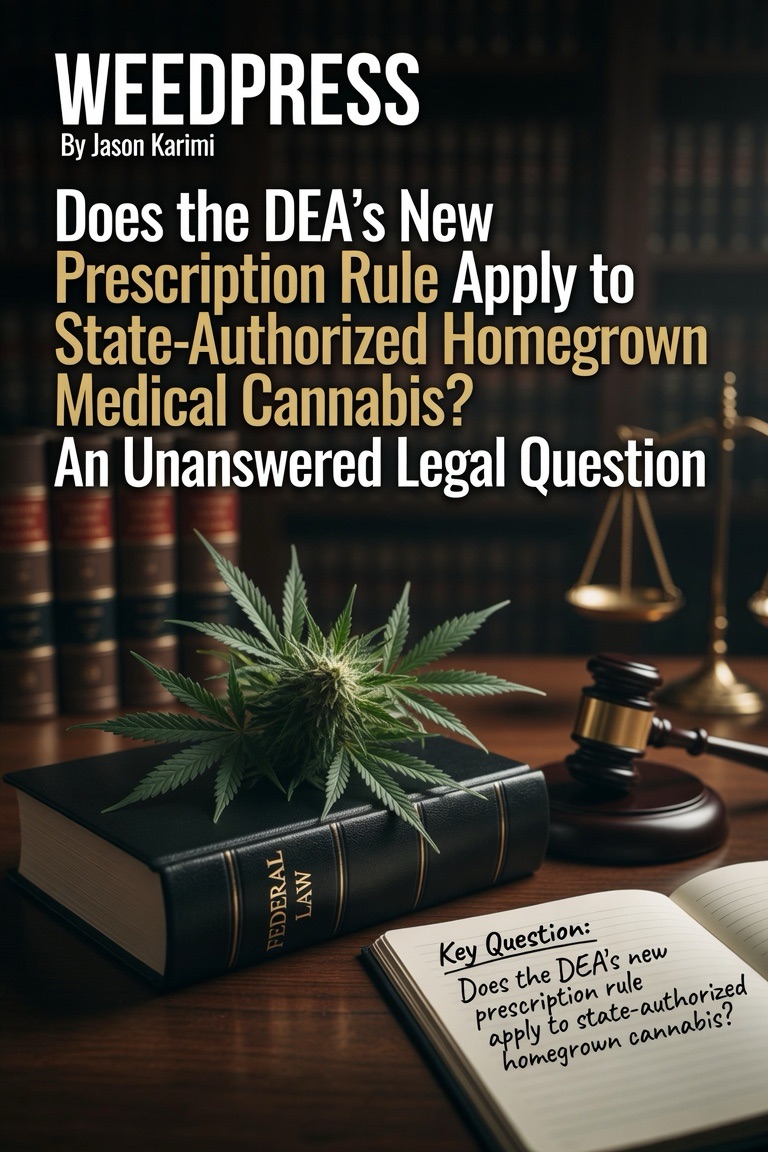
The DEA’s revised definition of what qualifies as a valid “prescription” under 21 C.F.R. § 1301.13(k)(5)¹ does not expressly address whether that definition applies to, or alters the legal treatment of, non-commercial homegrown medical cannabis authorized under state law.
Twenty-five states currently permit patients or caregivers to cultivate cannabis at home for medical use.² These programs existed long before the DEA published its revised prescription rule. The new federal language was drafted around a traditional doctor-to-pharmacy dispensing model and does not expressly explain how, if at all, it applies to non-commercial, intrastate home cultivation. To date, there does not appear to be a published federal interpretation explaining how, if at all, the revised prescription definition applies to state-authorized home cultivation.³
Some may conclude that the revised prescription definition has no application to state-authorized home cultivation because home cultivation does not depend on prescriptions in the first place. The regulation, however, does not expressly address that question, leaving room for differing interpretations and highlighting the value of a definitive federal explanation.
This question matters because homegrown medical cannabis operates differently from commercial dispensing. It is intrastate and non-commercial, and it is generally authorized through state medical cannabis laws rather than through a traditional prescription filled at a pharmacy.⁴ The regulation does not expressly explain how its prescription definition interacts with state-authorized home cultivation. As a result, patients, regulators, and advocates lack clear published federal guidance regarding whether the revised prescription definition has any legal effect on state-authorized home cultivation.
It is also possible that the revised prescription definition was never intended to affect state-authorized home cultivation at all. If that is the case, the absence of express federal guidance still leaves patients and regulators without confirmation of that understanding.
Several avenues exist to seek clarity. One possible path would be for the Department of Justice to seek guidance from the Office of Legal Counsel regarding whether the revised prescription definition has any legal effect on state-authorized home cultivation. Another would be for affected patients or organizations to petition the DEA or DOJ for a formal interpretation or rulemaking expressly addressing home cultivation. One man in Iowa has filed with DEA for a formal interpretation which has been covered here on WeedPress. OLC has yet to be engaged. Litigation also remains available as a mechanism for obtaining judicial interpretation, although it would likely be slower and more expensive.⁵
Advocates should avoid assuming this question has already been resolved. Until a published federal interpretation or judicial decision directly addresses the issue, patients and regulators in homegrow states will continue without clear federal guidance explaining how, if at all, the revised prescription definition applies to state-authorized home cultivation.
Footnotes
¹ 21 C.F.R. § 1301.13(k)(5).
² See, e.g., Colo. Const. art. XVIII, § 14; Cal. Health & Safety Code § 11362.5 et seq.; Mich. Comp. Laws § 333.26421 et seq.
³ See 21 C.F.R. Part 1306 (governing prescriptions for controlled substances).
⁴ See, e.g., Gonzales v. Raich, 545 U.S. 1 (2005).
⁵ See generally Robert A. Mikos, On the Limits of Supremacy: Medical Marijuana and the States’ Overlooked Power to Legalize Federal Crime, 62 Vand. L. Rev. 1421 (2009). https://scholarship.law.vanderbilt.edu/vlr/vol62/iss5/2/
 WeedPress: The Paper Trail
Leave a comment