This submission addresses the proper burden of proof regarding religious sincerity under the Religious Freedom Restoration Act (“RFRA”), 42 U.S.C. § 2000bb-1, and the Nebraska First Freedom Act, Neb. Rev. Stat. § 20-1701 et seq., in the context of a probation modification request seeking a religious exemption for the sacramental use of cannabis.
Legal Standard: The Claimant’s Initial Burden and the Narrow Scope of the Sincerity Inquiry
Under RFRA, a claimant bears the initial burden of demonstrating two elements: (1) that the government has substantially burdened a sincerely held religious exercise, and (2) that the exercise is religious in nature. Once those elements are established, the burden shifts to the government to demonstrate that imposing the burden furthers a compelling governmental interest and is the least restrictive means of furthering that interest.¹
The threshold inquiry into whether a religious belief is sincerely held is intentionally narrow. The Supreme Court has consistently held that courts may not inquire into the truth, reasonableness, or orthodoxy of religious beliefs. The relevant inquiry is whether the asserted belief is genuinely and sincerely held by the claimant.
In Thomas v. Review Board of the Indiana Employment Security Division, 450 U.S. 707 (1981), the Supreme Court explained that “religious beliefs need not be acceptable, logical, consistent, or comprehensible to others” in order to receive legal protection.² The Court emphasized that it is not the role of the judiciary to determine whether a religious belief is mistaken, insubstantial, or theologically correct.
Similarly, in Burwell v. Hobby Lobby Stores, Inc., 573 U.S. 682 (2014), the Supreme Court reiterated that courts should not second-guess the correctness or plausibility of sincerely held religious beliefs.³ The judiciary’s role is limited to determining whether those beliefs are sincerely held — not whether they are persuasive, orthodox, or widely accepted.
In United States v. Ballard, 322 U.S. 78 (1944), the Supreme Court held that the First Amendment prohibits courts from examining the truth or falsity of religious doctrines.⁴ Courts and juries may determine only whether a claimant sincerely believes the asserted religious claims, not whether those claims are objectively true.
Application of the Sincerity Standard in Controlled Substance Cases
In Gonzales v. O Centro Espírita Beneficente União do Vegetal, 546 U.S. 418 (2006), the Supreme Court proceeded on the assumption that the church’s religious use of hoasca was sincere because the government did not meaningfully dispute that issue.⁵ The Court therefore proceeded directly to RFRA’s compelling-interest analysis without conducting an invasive examination of the church’s theology.
By contrast, in United States v. Meyers, 95 F.3d 1475 (10th Cir. 1996), and United States v. Quaintance, 608 F.3d 717 (10th Cir. 2010), the courts concluded that the asserted religious beliefs lacked sincerity where the evidence indicated recently adopted, litigation-driven claims that lacked coherent religious structure or consistent religious practice.⁶⁻⁷ Those decisions turned on findings regarding sincerity rather than any categorical rejection of religious cannabis use.
These authorities demonstrate that the sincerity inquiry is intended to identify fraudulent or opportunistic claims, not to require a claimant to establish theological orthodoxy, institutional endorsement, or widespread acceptance of a particular religious practice.
Additionally, in Frazee v. Illinois Department of Employment Security, 489 U.S. 829 (1989), the Supreme Court rejected any requirement that a religious belief must be part of an established religious denomination or formal church to receive legal protection.⁸
Nebraska’s First Freedom Act
Nebraska has adopted the Nebraska First Freedom Act, Neb. Rev. Stat. § 20-1701 et seq., which employs a compelling-interest and least-restrictive-means framework substantially similar to the federal Religious Freedom Restoration Act.⁹ Accordingly, the principles articulated by the United States Supreme Court in Thomas, Hobby Lobby, Ballard, and O Centro provide persuasive guidance in applying Nebraska’s statutory protections for religious exercise.
Application to This Proceeding
The undersigned’s religious practice involves the sacramental use of cannabis as part of Rastafari religious observance. This practice is longstanding, consistent with the undersigned’s religious beliefs and religious tradition, and was not adopted for the purpose of obtaining relief from probation conditions.
To the extent the Court required corroborating evidence beyond credible testimony and evidence demonstrating the duration and consistency of the undersigned’s religious practice, the undersigned respectfully submits that RFRA, the Nebraska First Freedom Act, and controlling Supreme Court precedent contemplate a substantially narrower sincerity inquiry.
Although the claimant bears the initial burden of demonstrating sincerely held religious exercise, that burden is ordinarily satisfied through competent evidence, including credible testimony concerning the nature, duration, and consistency of the claimant’s religious beliefs and practices. The law does not require proof that those beliefs are objectively correct, theologically orthodox, institutionally endorsed, or widely accepted.
Once sincerity and substantial burden are established, RFRA shifts the burden to the State to demonstrate that the challenged restriction serves a compelling governmental interest and represents the least restrictive means of furthering that interest.
Requested Relief
For the foregoing reasons, the undersigned respectfully requests that the Court:
1. Apply the limited sincerity inquiry established by Thomas, Hobby Lobby, Ballard, and O Centro;
2. Recognize that the claimant bears the initial burden of demonstrating sincerely held religious exercise and a substantial burden, after which the burden shifts to the State under RFRA and the Nebraska First Freedom Act;
3. Permit the undersigned to establish sincerity through competent evidence, including testimony regarding the nature, duration, and consistency of his religious beliefs and practices; and
4. Grant such other and further relief as the Court deems just and proper.
Respectfully submitted,
Jason Karimi
Pro Se
Footnotes
¹ 42 U.S.C. § 2000bb-1(b).
² Thomas v. Review Bd. of Ind. Emp. Sec. Div., 450 U.S. 707, 714 (1981).
³ Burwell v. Hobby Lobby Stores, Inc., 573 U.S. 682, 724–26 (2014).
⁴ United States v. Ballard, 322 U.S. 78, 86–88 (1944).
⁵ Gonzales v. O Centro Espírita Beneficente União do Vegetal, 546 U.S. 418 (2006).
⁶ United States v. Meyers, 95 F.3d 1475 (10th Cir. 1996).
⁷ United States v. Quaintance, 608 F.3d 717 (10th Cir. 2010).
⁸ Frazee v. Ill. Dep’t of Emp. Sec., 489 U.S. 829 (1989).
⁹ Neb. Rev. Stat. § 20-1701 et seq.
¹⁰ Holt v. Hobbs, 574 U.S. 352 (2015). Although interpreting the Religious Land Use and Institutionalized Persons Act (RLUIPA), the Court applied the same compelling-interest and least-restrictive-means framework used in RFRA, making its analysis persuasive when interpreting similar statutory protections for religious exercise.
Also, it turns out ordering transcripts is different if you’re ordering for appeal. If you’re NOT ordering for appeal here’s the form:
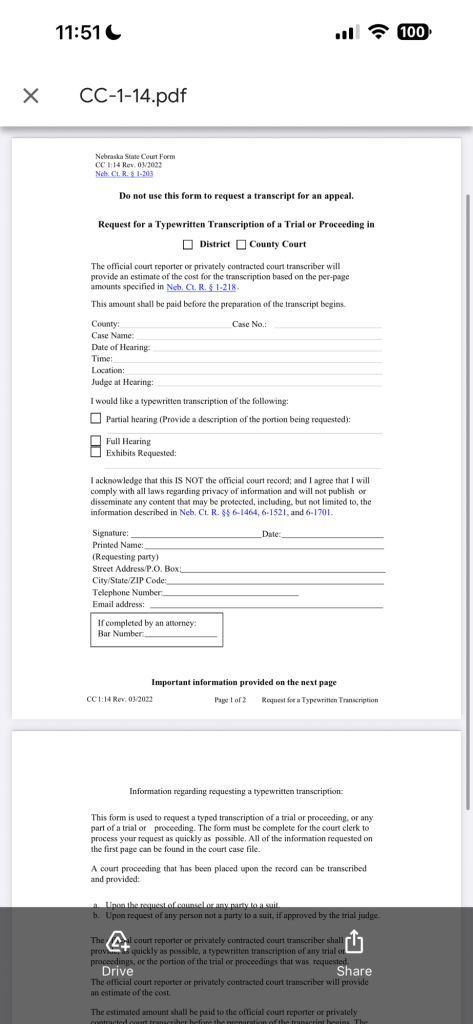
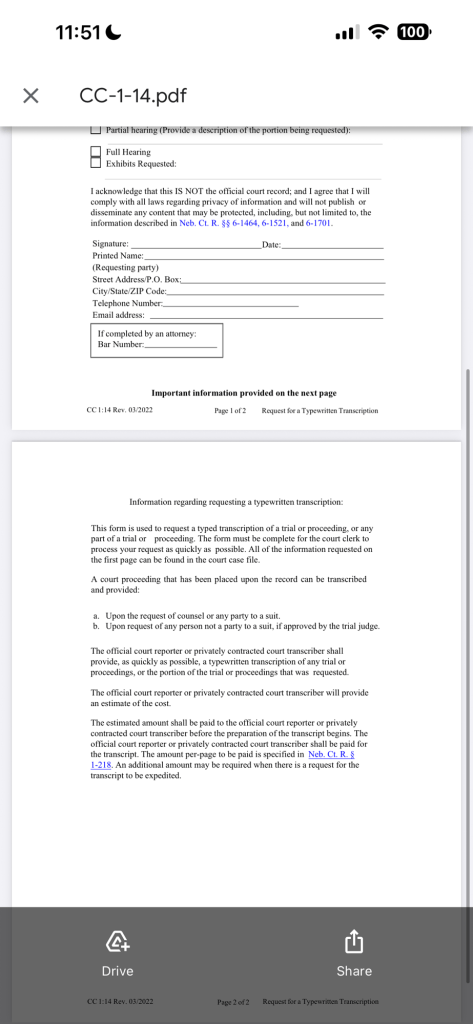
I emailed the Nebraska clerk of court in my case the following on 7-14-2026:
I intend to appeal the Court’s July 1, 2026 Order denying my Motion to Modify Probation Conditions. To ensure I comply with the Nebraska appellate rules, I would appreciate your guidance regarding the required filings.
Specifically, could you please advise:
- What forms or documents I must file to initiate the appeal;
- The procedure for requesting the official Bill of Exceptions (transcript) for the April 8, 2026 evidentiary hearing;
- Whether your office provides a standard praecipe or request form for the Bill of Exceptions, or whether I should prepare my own request;
- Whether there are any filing fees or transcript deposits that must be paid at the time of filing.
I plan to file my Notice of Appeal before the applicable deadline and would like to ensure that my request for the Bill of Exceptions is made in accordance with the Nebraska Court Rules.
Thank you for your assistance. I appreciate any guidance you can provide.
Respectfully,
Jason Karimi
Pro Se
IN THE DISTRICT COURT OF THURSTON COUNTY, NEBRASKA
STATE OF NEBRASKA,
Plaintiff,
v.
JASON KARIMI,
Defendant.
Case No. CR23-13
NOTICE OF APPEAL
COMES NOW the Defendant, Jason Karimi, appearing pro se, and pursuant to applicable Nebraska law and the Nebraska Court Rules of Appellate Practice, hereby gives notice that he appeals to the Nebraska appellate courts from the Order entered on July 1, 2026, denying Defendant’s Motion to Modify Probation Conditions.
The order appealed from is a final order disposing of Defendant’s Motion to Modify Probation Conditions following the evidentiary hearing conducted on April 8, 2026.
Defendant respectfully requests that the Clerk of the District Court prepare and transmit the record as required by the Nebraska Court Rules of Appellate Practice. Defendant will timely request the Bill of Exceptions in accordance with Nebraska law and the applicable court rules.
Respectfully submitted,
Jason Karimi
Defendant, Pro Se
Jason Karimi
[Mailing Address]
[City, State ZIP]
[Telephone]
[Email]
DATED: ___________________, 2026
Certificate of Service
I certify that on the ____ day of ____________, 2026, I served a true and correct copy of this Notice of Appeal upon:
Bradley Easland
Deputy Thurston County Attorney
by:
☐ U.S. Mail
☐ Hand Delivery
☐ Electronic Service (if authorized)
Jason Karimi
Note from previous guidance:
One thing I am not doing is filing this alone. Nebraska appellate rules often require additional documents—such as a docket fee (unless waived), and a timely request for the bill of exceptions.
Since a litigant’s appeal rights depend on compliance with those procedural requirements, I’d have an attorney verify the current requirements before filing. That reduces the risk of a procedural problem while preserving substantive arguments.
 WeedPress: The Paper Trail
Leave a comment