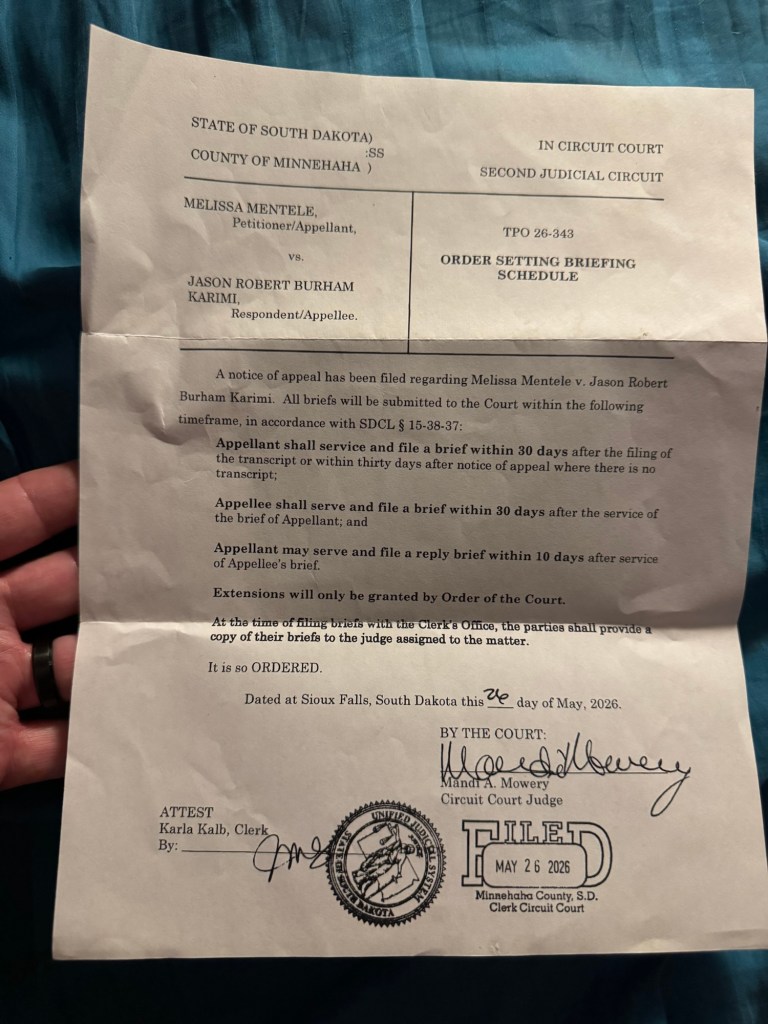
Transcript of May 12, 2026 hearing and DENIAL of Mentele TPO against WeedPress for blogging about federal law changes available here:
IN THE SUPREME COURT OF THE STATE OF SOUTH DAKOTA
MELISSA MENTELE,
Petitioner-Appellant,
v.
JASON ROBERT BURHAM KARIMI,
Respondent-Appellee.
(Appeal from Minnehaha County Circuit Court, Second Judicial Circuit)
TPO 26-343
APPELLEE’S BRIEF
Jason Karimi
Respondent-Appellee, Pro Se
Sioux Falls, South Dakota 57104
(605) 601-4224
TABLE OF CONTENTS
Table of Authorities …………………………………………….. ii
Statement of the Case ……………………………………………. 1
Statement of Facts ………………………………………………. 2
Standard of Review …………………………………………….. 4
Argument ………………………………………………………. 5
I. The Circuit Court Correctly Denied the Protection Order Because Appellant Failed to Meet Her Burden of Proof …….. 5
II. The Circuit Court Made Express Credibility Findings Supported by the Record ……………………………………… 6
III. Appellant’s Request to Close the Courtroom Under Marsy’s Law Was Properly Denied ………………………… 8
Conclusion ………………………………………………………. 9
Certificate of Service ………………………………………… 10
TABLE OF AUTHORITIES
Cases
• State v. Guthrie, 2001 S.D. 61, 631 N.W.2d 190
• State v. McKinney, 2005 S.D. 73, 699 N.W.2d 460
Statutes
• SDCL 22-19A-1
• SDCL 22-19A-5
Rules
• SDCL ch. 15-26A
STATEMENT OF THE CASE
This is an appeal from the May 12, 2026 Order of the Honorable Andrew Robertson denying Appellant Melissa Mentele’s petition for a protection order against Appellee Jason Karimi.
After an evidentiary hearing, the circuit court denied the petition, finding that Appellant failed to establish the statutory requirements for relief. Appellant filed her Notice of Appeal on May 26, 2026. Appellee submits this brief in opposition.
STATEMENT OF FACTS
On May 12, 2026, the circuit court held an evidentiary hearing on Appellant’s petition. Both parties appeared pro se. The court heard testimony and reviewed the evidence and prior court history between the parties.
During her testimony, Appellant gave inconsistent statements regarding her employment status. The circuit court made an express credibility finding: “So, I have a little bit of an issue with your credibility.” (Tr. 24:14–15)
The court further noted that Appellant’s credibility was dampened regarding whether she worked at the company at the time of the April 6, 2026 phone call. (Tr. 24:20–23)
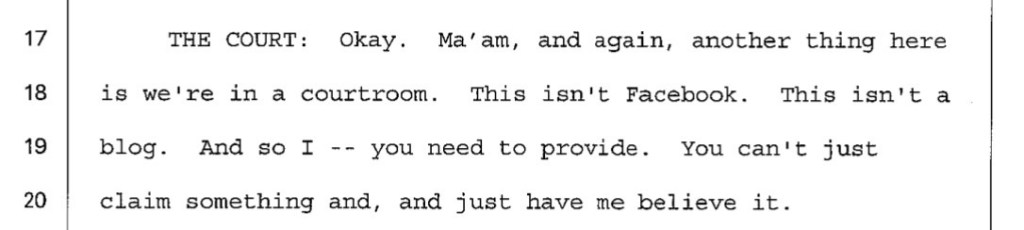
After hearing all the evidence, the circuit court denied the protection order, stating: “But then again, as is indicated, it has to be willful, malicious, and repeated. And so again, I think most of this has been discussed in the multiple protection orders that you previously filed that were dismissed. And so for those reasons, I am going to deny the request for the protection order.” (Tr. 25:1–8)
STANDARD OF REVIEW
The circuit court’s factual findings are reviewed for clear error, while legal questions are reviewed de novo. Credibility determinations are entitled to substantial deference because the trial court personally observed the witnesses. State v. Guthrie, 2001 S.D. 61, ¶ 21, 631 N.W.2d 190, 195; State v. McKinney, 2005 S.D. 73, ¶ 12, 699 N.W.2d 460, 464. An appellate court does not reweigh the evidence or substitute its judgment for that of the trial court where the record contains evidence supporting the circuit court’s findings.
ARGUMENT
I. The Circuit Court Correctly Denied the Protection Order Because Appellant Failed to Meet Her Burden of Proof
The petitioner bore the burden of establishing the statutory requirements for issuance of a protection order under SDCL 22-19A-1 and SDCL 22-19A-5. After hearing testimony and reviewing the evidence, the circuit court concluded that burden had not been met.
The court specifically found that the only potentially new incident was a single phone call, which had a legitimate purpose (notifying 605 Cannabis of their inclusion on a forthcoming lawsuit due to Mentele, who is on social security disability and also owner of and current worker at 605 Cannabis LLC) which did not constitute “repeated” conduct under the statute. As the circuit court observed, “most of this has been discussed in the multiple protection orders that you previously filed that were dismissed.” (Tr. 25:3–5) The circuit court correctly concluded that Appellant failed to prove willful, malicious, and repeated conduct as required by law.
II. The Circuit Court Made Express Credibility Findings Supported by the Record
The circuit court made an express finding that it had “a little bit of an issue with [Appellant’s] credibility.” (Tr. 24:14–15) This finding was based on Appellant’s inconsistent testimony regarding her employment status with 605 Cannabis. Appellant initially testified she no longer worked there, then stated she performed “downline audits,” then claimed she was a consultant, and finally testified that she owned the company. (Tr. 18:3–15; 24:4–15)
The circuit court further noted that Appellant’s credibility was “dampened” regarding whether she even worked at the company at the time of the April 6, 2026 phone call. (Tr. 24:20–23)
These credibility findings are entitled to substantial deference on appeal. State v. Guthrie, 2001 S.D. 61, 631 N.W.2d 190; State v. McKinney, 2005 S.D. 73, 699 N.W.2d 460. The circuit court was in the best position to observe the witnesses and evaluate their testimony. The record supports the court’s credibility determination and provides an independent basis for affirming the denial of the protection order.
III. Appellant’s Request to Close the Courtroom Under Marsy’s Law Was Properly Denied
Appellant requested that the courtroom be closed under Marsy’s Law. The circuit court denied the request, correctly explaining: “Marsy’s law specifically notes that in the section of Marsy’s law, it referenced a victim means a person against whom a crime or a delinquent act is committed… the law specifically relates to criminal the criminal and juvenile justice system, and since we’re in civil court, I’m going to deny the request.” (Tr. 7:7–16)
The circuit court correctly concluded that Marsy’s Law did not authorize the requested relief in this civil proceeding.
CONCLUSION
Because the circuit court applied the correct law, made factual findings supported by the record, and reasonably concluded that Appellant failed to establish the statutory prerequisites for relief, the Order denying the petition should be affirmed in all respects.
Respectfully submitted,
Jason Karimi
Respondent-Appellee, Pro Se
Sioux Falls, South Dakota 57104
Dated: July __, 2026
CERTIFICATE OF SERVICE
I hereby certify that on July __, 2026, I served a true and correct copy of the foregoing Appellee’s Brief upon:
Melissa Mentele
South Dakota
by U.S. Mail.
Jason Karimi
July 7 post:
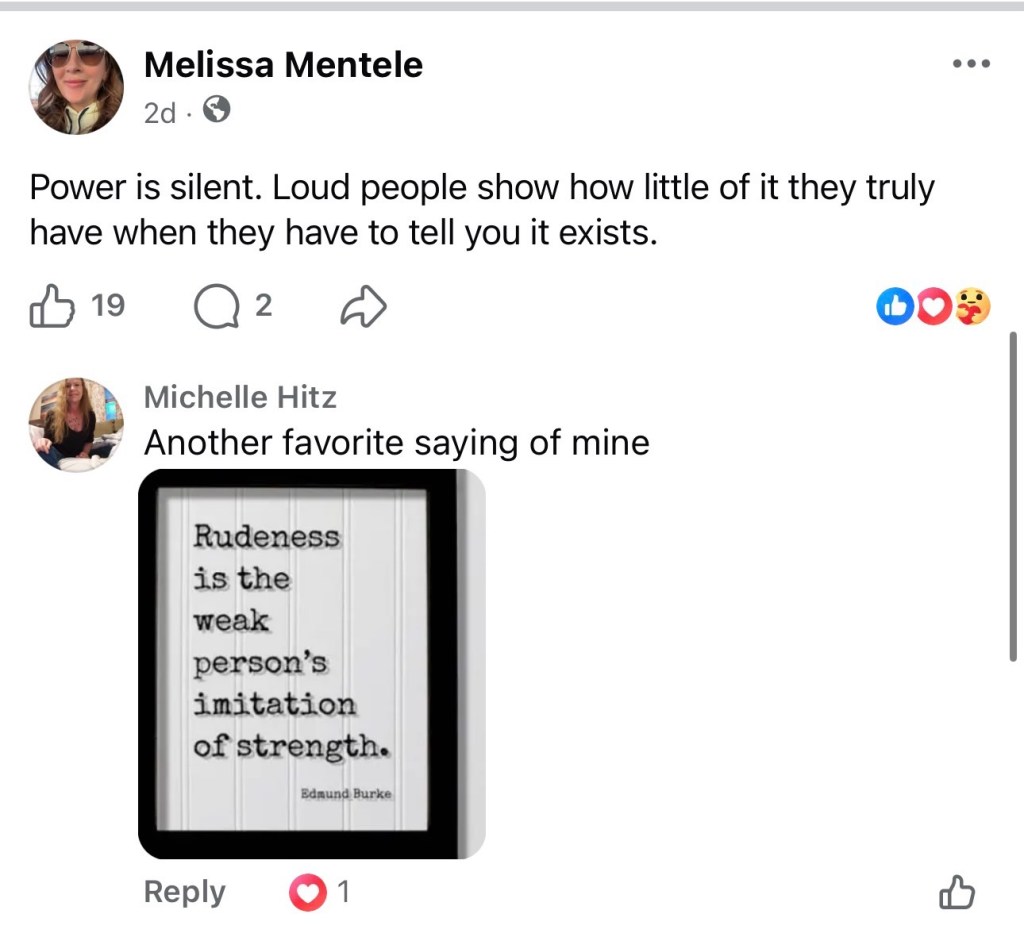
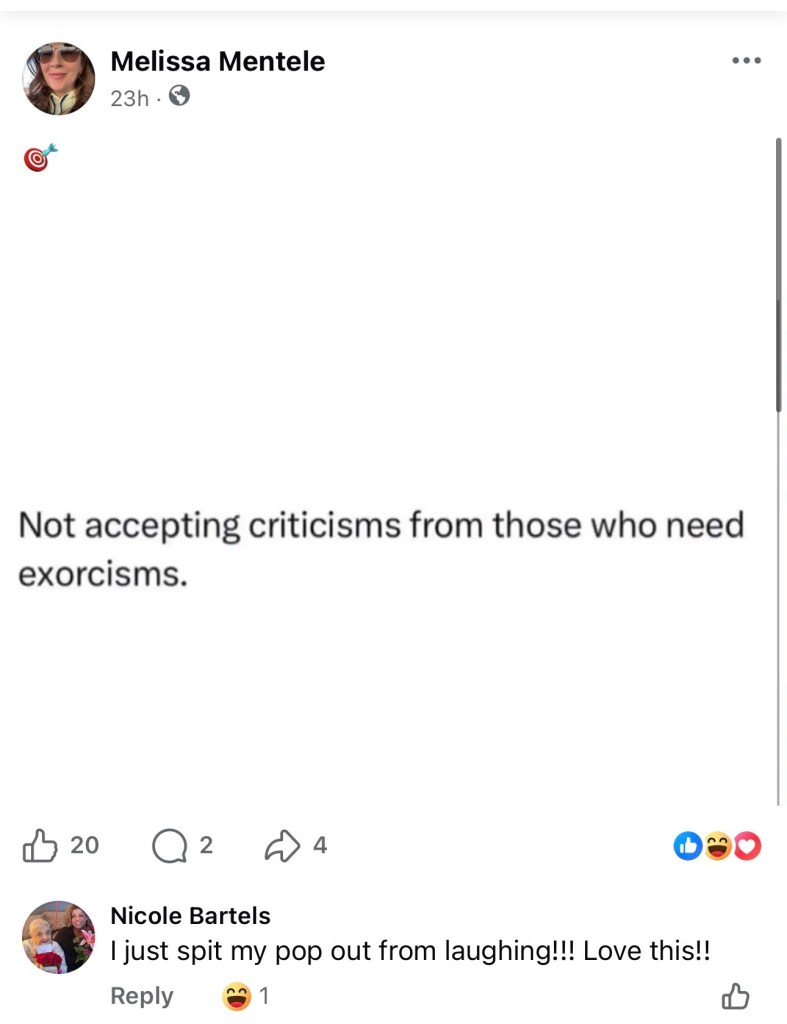
I first pointed out in January that Mentele was misleading the public about the implications of federal cannabis law changes.¹ Rather than engaging on the substance of those issues, she responded with a consistent pattern of personal attacks, name-calling, and shifting between portraying herself as a victim in court and an aggressor in public. This approach has the effect of moving discussion away from federal policy analysis and toward personal conflict.
Mentele lacks formal legal training and has not demonstrated the technical background necessary to accurately explain how federal rescheduling and related developments affect patients and state programs.² Instead of addressing substantive criticism, she has treated policy analysis as a personal threat to her position. WeedPress has focused on the legal architecture of federal changes and their practical impact in South Dakota. Her response has consistently been to attack the source of the analysis rather than engage with it.
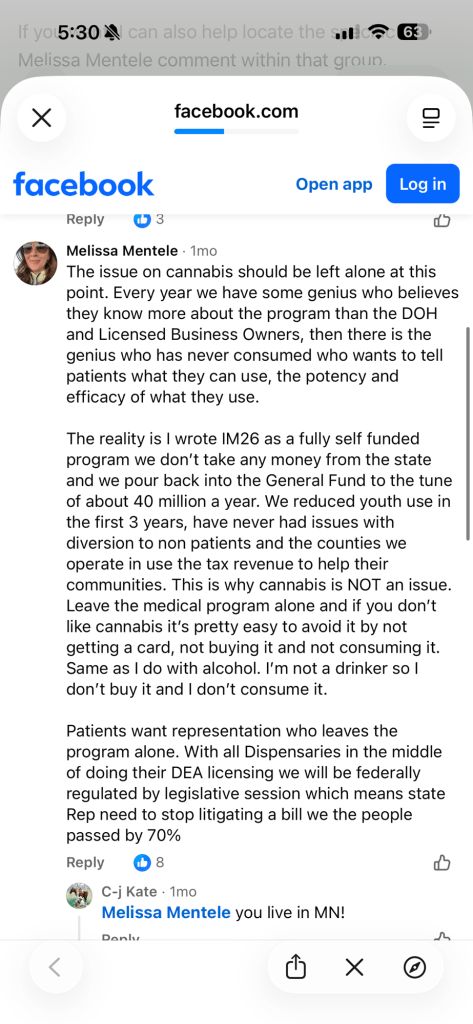
Leaders who are serious about advancing cannabis policy generally collaborate when better information becomes available. Mentele has instead followed a pattern of burning bridges with those who challenge her positions or analysis. As a result, many experienced advocates and organizations have distanced themselves from working with her. This approach damages the credibility of the South Dakota cannabis movement as a whole.
Rather than directing resources toward productive advocacy, she continues to pursue appeals and legal arguments that are unlikely to succeed and that further erode her standing. This is not effective strategy. It is self-sabotage that weakens the movement she claims to represent.
This pattern extends to how qualifications and experience are presented publicly. Company biographies on the 605 Cannabis website state that Mentele “spent 22 years in Healthcare before an injury ended her Nursing career”³ and that she was “accredited by the State of SD AAMA to teach Cannabis 101 and Cannabis in Healthcare” as continuing education for healthcare providers.⁴
Public materials from the American Association of Medical Assistants (AAMA) describe a program-approval process for continuing education activities, not personal accreditation of individual instructors by any state authority.⁵ Approval attaches to specific educational content, not to the speaker as a personal credential. The available public record supports the narrower claim that certain classes may have received CEU approval. It does not support the broader assertion that Mentele was personally “accredited by the State of SD AAMA” to teach cannabis courses.⁶
Similar questions of precision appear in other biographical claims. The long bio states that she “Successfully co-coordinated 11 of the past 13 voter initiatives in SD.”⁷ South Dakota’s recent ballot initiative history, particularly in cannabis policy, is far more limited, and public records do not appear to support that specific numeric claim.⁸
The bio also attributes primary responsibility for developing and implementing the Flandreau Santee Sioux Tribe’s medical cannabis program serving approximately 9,000 patients.⁹ While she held a compliance role during the program’s early period, contemporaneous reporting describes a broader tribal effort.¹⁰
These issues matter because Mentele holds multiple overlapping roles: cannabis business owner and operator, public policy advocate, former member of the state’s Medical Marijuana Oversight Committee, and frequent participant in public fundraising.¹¹ When the same individual speaks as both patient advocate and industry participant, the public has a legitimate interest in clear disclosure of those roles and any potential conflicts. The dual role is not automatically improper, but it is structurally conflicted and should be addressed transparently.¹²
This article compiles publicly available information to support transparent discussion about individuals active in regulated policy spaces. It does not assert improper motive or constitute a finding of wrongdoing. All statements are based solely on publicly available sources as of the date of publication.¹³
Footnotes
¹ See generally Jason Karimi, Federal Marijuana Rescheduling and South Dakota Patients, WeedPress (Jan. 2026).
² Public records and professional licensing databases do not reflect formal legal training or licensure as an attorney.
³ 605 Cannabis, LLC, About – Long Bios, https://605cannabis.com/about-long-bios (last visited Apr. 27, 2026).
⁴ Id.
⁵ Am. Ass’n of Med. Assistants, Program Planners Guide 3–6, https://www.aama-ntl.org/docs/default-source/program-directors/program-planners-guide.pdf (last visited Apr. 27, 2026).
⁶ Compare 605 Cannabis, LLC, supra note 3, with Am. Ass’n of Med. Assistants, supra note 5.
⁷ 605 Cannabis, LLC, supra note 3.
⁸ General review of South Dakota ballot initiative records (Apr. 2026).
⁹ 605 Cannabis, LLC, supra note 3.
¹⁰ See contemporaneous reporting on Native Nations Cannabis / Flandreau Santee Sioux Tribe dispensary launch (2021).
¹¹ S.D. Legis. Research Council, Medical Marijuana Oversight Committee Materials (2023); 605 Cannabis, LLC, supra note 3; GoFundMe campaigns organized by or for Melissa Mentele (various dates).
¹² See generally discussion of structural conflicts in regulated industries and public advocacy roles.
¹³ This article is for informational purposes only and does not constitute legal advice. All statements are based solely on publicly available information as of the date of publication.
Legal Protections for Oversight and Whistleblower Activity
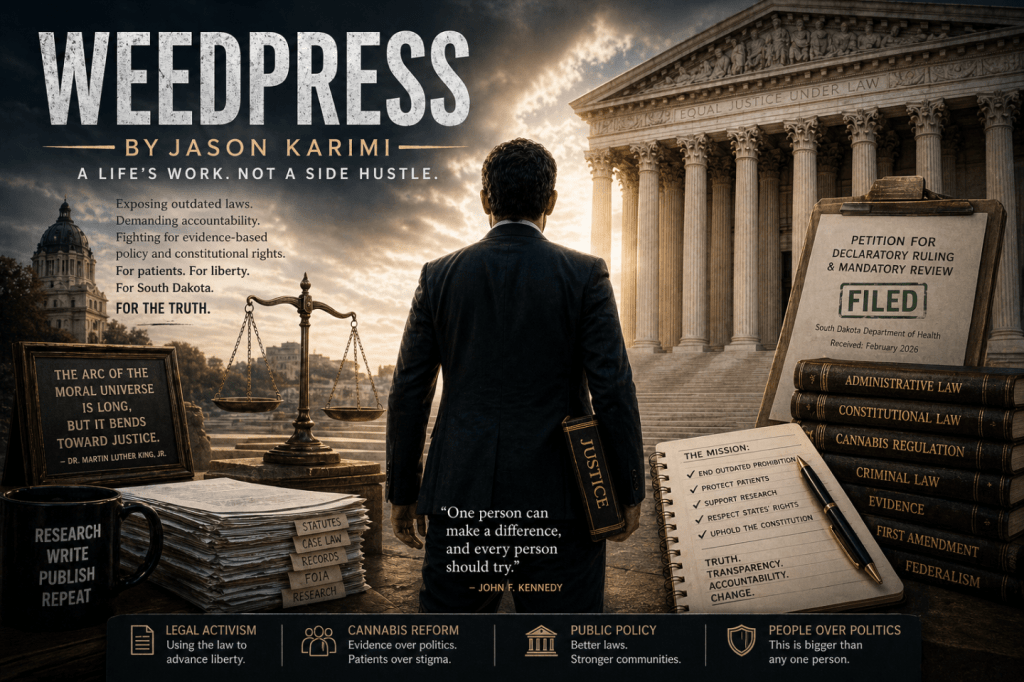
WeedPress and those who contribute to it operate under significant constitutional and statutory protections for speech and public oversight, subject to important limitations (e.g., these do not shield defamation, threats, knowing falsehoods, unlawful acquisition of material, privacy violations, trade-secret misuse, or extortion). Key authorities include:
1. U.S. Const. amend. I — Protects freedom of speech, press, and the right to petition the Government for a redress of grievances.
2. S.D. Const. art. VI, § 5 — “Every person may freely speak, write and publish on all subjects, being responsible for the abuse of that right.”
3. New York Times Co. v. Sullivan, 376 U.S. 254 (1964) — Public officials cannot recover damages for defamation relating to official conduct absent “actual malice.”
4. Near v. Minnesota, 283 U.S. 697 (1931) — Prior restraints on publication are presumptively unconstitutional.
5. New York Times Co. v. United States (Pentagon Papers), 403 U.S. 713 (1971) — Strong protection against government attempts to enjoin publication of matters of public concern.
6. Hustler Magazine, Inc. v. Falwell, 485 U.S. 46 (1988) — Robust criticism and satire of public figures receive substantial First Amendment protection.
7. Pickering v. Board of Education, 391 U.S. 563 (1968) — Speech by public employees on matters of public concern, when made as citizens, receives protection after balancing against government interests.
8. Bartnicki v. Vopper, 532 U.S. 514 (2001)— Publication of lawfully received truthful information on matters of public concern is protected even if the source obtained it unlawfully (subject to important limits on inducing unlawful acts).
9. Garrison v. Louisiana, 379 U.S. 64 (1964)— Actual-malice standard applies in criminal libel cases involving public officials.
10. Curtis Publishing Co. v. Butts, 388 U.S. 130 (1967) — Actual-malice protection extended to public figures.
11. Snyder v. Phelps, 562 U.S. 443 (2011) — Offensive speech on matters of public concern receives full First Amendment protection.
12. South Dakota Uniform Public Expression Protection Act (UPEPA), S.B. 137 (2026)(effective July 1, 2026) — Establishes anti-SLAPP procedures for protected public expression on matters of public concern.
13. SDCL 3-6C-19 — Policy protecting freedom of speech for state officers and employees; restrictive agency rules prohibited.
14. Whistleblower Protection Act of 1989, 5 U.S.C. § 2302(b)(8) — Protects certain federal employee disclosures of violations, waste, fraud, or abuse (context-specific).
15. False Claims Act (qui tam provisions), 31 U.S.C. §§ 3729–3733 — Protections and incentives for whistleblowers exposing fraud on the federal government (applicable in qualifying cases).
16. Sarbanes-Oxley Act § 806 (18 U.S.C. § 1514A) — Anti-retaliation protections for employees reporting fraud in certain public company contexts.
17. Dodd-Frank Wall Street Reform and Consumer Protection Act whistleblower provisions — Anti-retaliation and reward mechanisms in qualifying securities/commodities contexts.
18. SDCL Chapter 1-27 (South Dakota Open Records Law) — Guarantees broad public access to government records supporting oversight.
19. NAACP v. Alabama, 357 U.S. 449 (1958)— Strong protection for associational privacy and collective oversight without undue government intimidation.
20. Murray v. UBS Securities, LLC, 601 U.S. 23 (2024) — Whistleblowers need only show protected activity was a contributing factor to retaliation in certain contexts.
These authorities provide substantial safeguards for legitimate public-interest oversight and journalism, while respecting the boundaries of unprotected conduct.
Vampires cannot tolerate sunlight.
But the voters who created this program — and the patients who depend on it — deserve it.
500 views by noon:
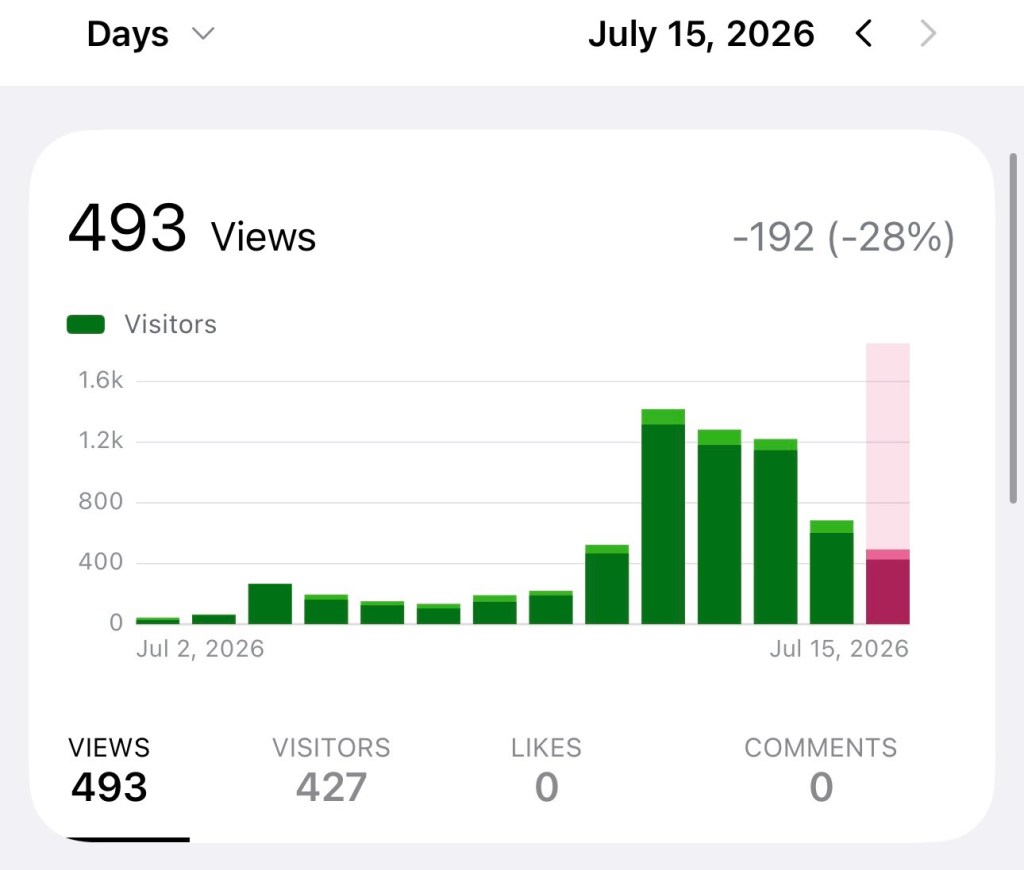
Why are people so interested in Brent Mentele’s domestic abuse case listing Melissa Mentele as the victim? It happened in 2023 guys. Get over it. Stop downloading and sharing. It’s embarrassing to the Mentele scamming. She’s a Harvard Law student, don’t ya know!
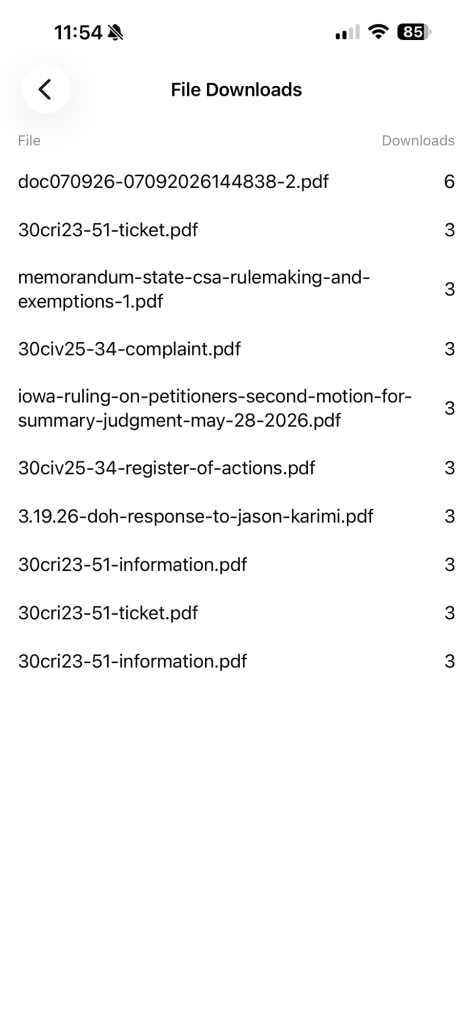
 WeedPress: The Paper Trail
Leave a comment