
The Department of Health did not need a ballot fight to put a warning on the medical cannabis statute. It used the August Medical Marijuana Oversight Committee.¹
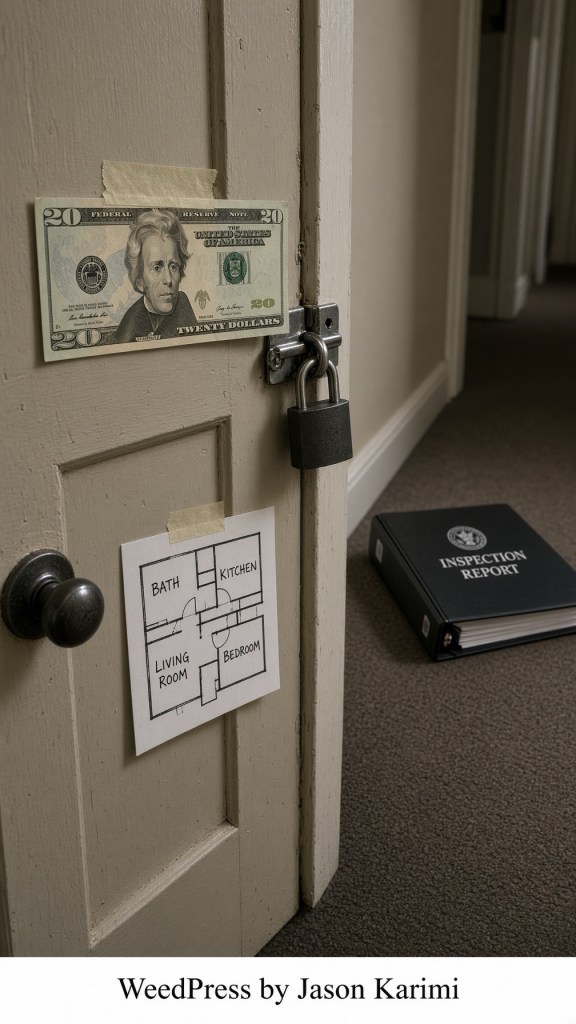
Program administrator Whitney Brunner told the committee that licensed home cultivators rose from 61 in fiscal year 2022 to 715 in fiscal year 2026 — a 1,072 percent increase.² Caregiver cultivators rose from 22 to 37 over the last fiscal year.³ Adding home cultivation to a patient card costs twenty dollars.⁴ The statutory cap is two flowering plants and two non-flowering plants.⁵ Applicants submit a photo of the grow room, a photo of a lock, and a diagram. Brunner said those diagrams are often hand-drawn and short on detail.⁶
Then she said the sentence the Department cannot walk back:
“The lack of regulation in this area is a bit concerning for us.”⁷
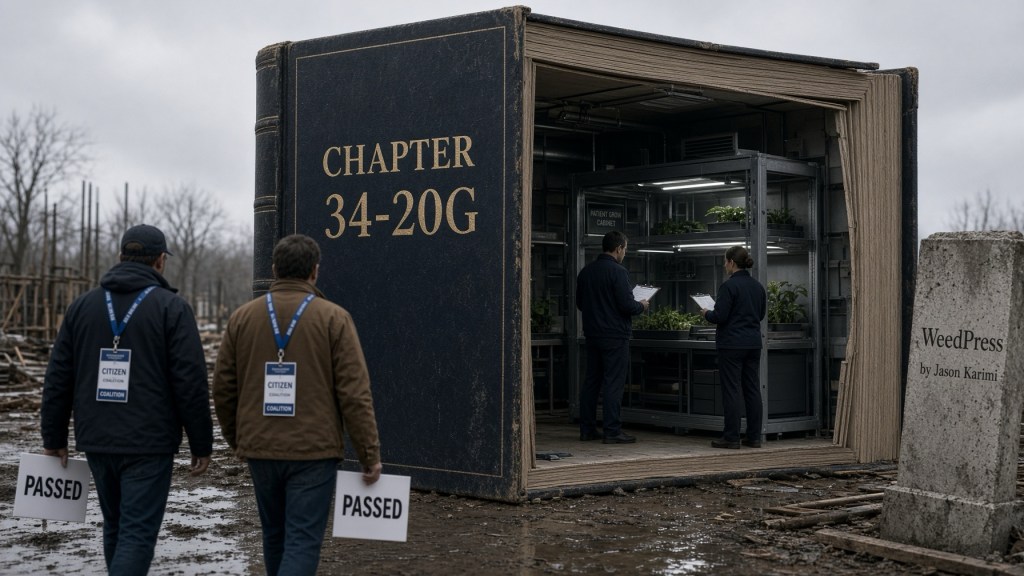
She declined to assume patients are abusing the licenses. She also said the agency has already looked at whether more can be done. That next sentence is the one Pierre should read twice:
“It does present some legal and safety considerations if we were to attempt to regulate this further.”⁸

That is not a claim that patients are a menace. It is the Department telling lawmakers that the current home-cultivation law is hard to supervise, and that writing a thicker rule set is not free of legal and safety problems either. KCCR reported the same presentation as a concern about the rapid increase in cultivator licenses, and quoted Brunner saying a home-cultivation license is fairly easy to obtain and that regulating home cultivators further will not be easy.⁹
What the law actually authorizes
Home cultivation is not a loophole invented last year. It is in chapter 34-20G. A registered patient may cultivate no more than two flowering plants and two plants that are not flowering.¹⁰ Cannabis produced from those plants and kept at the same property is part of the authorized amount.¹¹ The Department’s own patient materials repeat the plant cap and the twenty-dollar add-on fee.¹²
That is a voter-written access rule, not a commercial license. Establishment cultivators pay thousands and sit in seed-to-sale tracking.¹³ Home growers do not. The Department is now saying, on the record, that the gap between those two systems is “a bit concerning.”
What that warning is, and what it is not
It is not proof of diversion. Brunner said she does not want to assume abuse.¹⁴
It is not a finding that IM 26 is illegal.
It is not a Schedule I analysis.
It is an admission that the agency administering the program does not think the home-grow paperwork is enough to see what is happening in 715 residences, and that building a real inspection regime would raise legal and safety questions the Department does not want to answer alone. Sen. John Carley said after the hearing that members will come back to “that concern” at the next meeting.¹⁵
If Health believes the statute is too thin to police, that is a legislative problem. It is also a drafting problem. An agency that cannot see home grows, and that says tighter rules raise safety issues, is telling the Legislature the current text is the constraint. October’s committee can either write a recommendation or leave 715 licensed grows sitting on a twenty-dollar form and a hand-drawn map.
The number in context
Patient cards were about 19,375 at the end of June, up 30.5 percent from 14,843 the prior fiscal year.¹⁶ Department monthly data put approved cards at 19,530 as of August 3, 2026.¹⁷ Home cultivators are still a small slice of the registry. They are also the slice the Department singled out as under-regulated.
A 1,000 percent increase from a small base is how programs look when a cheap add-on exists and commercial flower is expensive or geographically thin. That can be access. It can also be a statute that never built an inspection method equal to the right it created. Brunner put both possibilities on the table and asked for a “greater conversation.”¹⁸
What WeedPress takes from this
When the Department of Health tells MMOC that a core IM 26 access rule lacks regulation and that more regulation raises safety considerations, the honest headline is not that patients became dangerous. The honest headline is that the agency that runs the program has now said the home-cultivation law is operationally weak.
That is useful. It is also a warning about how Pierre will talk about medical cannabis this winter. “Safety considerations” is the phrase that travels. If the next hearing turns that phrase into a repeal pitch, the transcript from August will show the Department started with paperwork and plant counts, not a public-safety emergency. If the next hearing turns it into a real rule — locks, inspections, clearer diagrams, or a statutory clarification — that is the conversation Brunner said she wanted.

The Department has the numbers. The statute has the plant cap. The committee said it will return to the concern. The record now includes an agency statement that the medical home-grow law is easy to enter and hard to police. That is enough to write down. It is not enough to pretend Health declared the medical program a threat to the public. It declared the current rule thin, and the next rule legally and operationally loaded. Those are different sentences. Keep them different.
And for the written perspective – relevant to policy analysis and improvements – when an amateur group with no training and loud claims of skill writes a medical law that isn’t perfect, but won’t accept others offering improvements to the imperfect laws they wrote, it’s reasonable to then expect agency experts to eventually notice the weakly written law. Dodging accountability and bullying critics leads to agencies taking action for what critics tried to warn you about in advance.
Without welcoming citizen monitoring and input, existing medical marijuana laws in South Dakota leave patients concerns in the dust – while promoting business profiteering and gatekeeping access to lawmakers. Citizens have a right to demand better cannabis laws for patients. But South Dakota’s toxic activist ecosystem has been preventing such concerns. Now, suddenly, the Department is also voicing concerns about the inadequately written cannabis laws.
Time will tell how policy improves, and WeedPress will continue documenting it as it happens.
See you in the rooms that actually count.
Footnotes
¹ Makenzie Huber, Medical marijuana home cultivation licenses surge in South Dakota, S.D. Searchlight (Aug. 17, 2026); Zach Nelson, Department of Health Concerned With Rapid Increase In Home Medical Marijuana Cultivator Licenses, KCCR (Aug. 31, 2026).
² Huber, supra note 1 (61 in FY2022 to 715 in FY2026; 1,072%).
³ Nelson, supra note 1 (caregiver cultivators 22 in FY2025 to 37 in FY2026).
⁴ S.D. Dep’t of Health, Patients, Caregivers & Practitioners (home cultivation add-on fee of $20).
⁵ S.D.C.L. § 34-20G-1(1) (two flowering plants and two non-flowering plants).
⁶ Huber, supra note 1.
⁷ Id. (quoting Whitney Brunner).
⁸ Id.
⁹ Nelson, supra note 1.
¹⁰ S.D.C.L. § 34-20G-1(1).
¹¹ Id.
¹² S.D. Dep’t of Health, Patients, Caregivers & Practitioners; S.D. Dep’t of Health, Educational Resources.
¹³ S.D.C.L. ch. 34-20G; S.D. Dep’t of Health, Med Cannabis Establishments (establishment registration).
¹⁴ Huber, supra note 1.
¹⁵ Id. (quoting Sen. John Carley).
¹⁶ Id.
¹⁷ S.D. Dep’t of Health, Medical Cannabis Data (Aug. 3, 2026: 19,530 approved patient cards).
¹⁸ Huber, supra note 1.
 WeedPress: The Paper Trail
Leave a comment