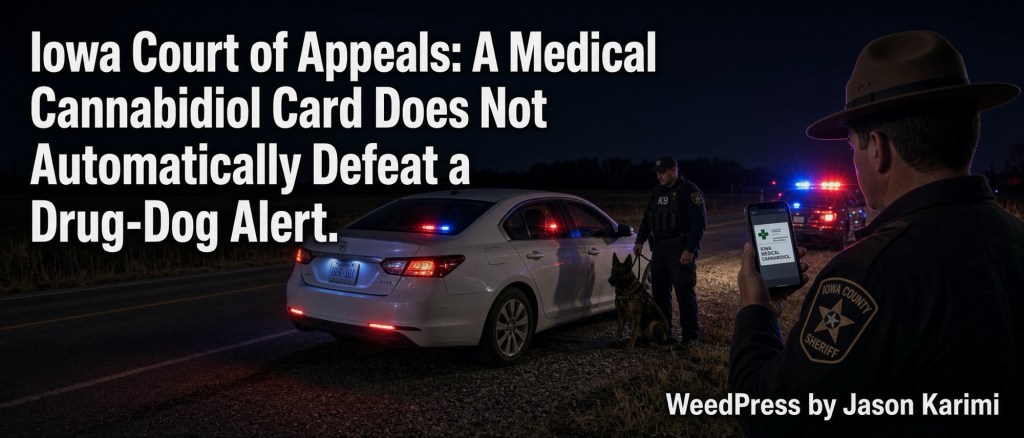
Patients who carry a valid Iowa medical cannabidiol registration card often assume the card creates a meaningful shield during traffic stops. A new decision from the Iowa Court of Appeals shows the limits of that assumption. In State v. Leonard, the court held that officers had probable cause to search a vehicle after a drug dog alerted, even though the driver possessed a valid medical card and a legal THC vape pen, and even though officers smelled no marijuana odor.¹
The ruling does not authorize random searches of cardholders. It does confirm that a medical card is not a “get-out-of-probable-cause-free card.”² For patients concerned about drug-dog encounters, the case is worth understanding in detail.
What Happened
On May 4, 2025, the Central Iowa Drug Task Force tipped Story County deputies that a car traveling west from Marshalltown had marijuana onboard. A deputy began following the vehicle. When a passenger tossed a cigarette out the window, the deputy stopped the car for littering.³
At the window, the deputy saw a small THC vape pen in the center console. The driver, Dartangan Leonard, produced a valid Iowa medical cannabidiol registration card on his phone and explained the pen was medical. Officers smelled no marijuana odor. Leonard denied having anything illegal in the car. When asked separately where they had come from, the driver and passenger gave inconsistent answers.⁴
Officers removed the vape pen from the vehicle and had the windows rolled up. A drug dog trained to detect marijuana and three other controlled substances then circled the car and alerted near the rear passenger door—away from the driver’s seat and the temporary location of the removed pen. A search of the trunk turned up more than ten pounds of illegal marijuana products.⁵
Leonard moved to suppress the evidence. He argued that because officers already knew legal medical cannabidiol was present, the dog’s alert did not create a fair probability that illegal drugs would be found. The district court denied the motion. Leonard entered a conditional guilty plea to possession with intent to deliver marijuana as a habitual offender, preserving the suppression issue for appeal. The Court of Appeals affirmed.⁶
The Legal Framework
Under both the Fourth Amendment and article I, section 8 of the Iowa Constitution, warrantless searches are presumptively unreasonable. The automobile exception allows a warrantless search when there is probable cause to believe the vehicle contains evidence of a crime.⁷ Probable cause exists when the totality of the circumstances would lead a reasonably prudent person to believe evidence of a crime will be found. Certainty is not required—only a fair probability.⁸
Iowa courts have long treated a reliable drug dog’s alert as generally sufficient to establish probable cause to search a vehicle.⁹ The location of the alert and the presence of vehicle occupants can affect the analysis, but an alert is powerful evidence.¹⁰
Iowa’s medical cannabidiol statute adds an important protection: officers may not treat possession of a medical cannabidiol registration card itself as grounds for probable cause or use the card “to support a search” of the cardholder’s property.¹¹ Authorized medical products also carry statutory defenses against certain possession charges.¹² Leonard’s argument sought to expand that protection: if the dog could have been reacting to legal medical cannabidiol, the alert should be discounted or eliminated as a basis for probable cause.
Why the Court Rejected That Argument
The Court of Appeals refused to treat the medical card as an inoculation against an otherwise supported search. The court acknowledged the statutory limit on using the card itself as probable cause. It also recognized that some forms of medical cannabidiol are legal.¹³ But it held that the existence of legal uses does not erase the relevance of a dog alert when other circumstances point toward criminal activity.¹⁴
Several facts mattered:
• Officers had an independent tip that the car was carrying marijuana.
• The driver and passenger gave contradictory travel stories.
• The only known source of legal medical cannabidiol odor—the vape pen—had been removed from the vehicle before the sniff.
• The windows were rolled up.
• Officers detected no marijuana odor themselves.
• The dog alerted at the rear of the vehicle, away from where the pen had been.
• Leonard had told officers there were no illegal drugs in the car, making the alert more significant.¹⁵
Because the dog alert was not the sole basis for the search, the court distinguished a recent Florida decision that suppressed evidence where a dog alert was the only justification and the passenger held a medical marijuana card.¹⁶ Iowa precedent, by contrast, has treated the odor of marijuana as supporting probable cause even when the odor could theoretically come from legal hemp, and federal courts in the Eighth Circuit have reached similar conclusions when other suspicious circumstances exist.¹⁷
In short, the court applied a traditional totality-of-the-circumstances test. The medical card prevented officers from treating the card itself as suspicious. It did not require them to ignore a trained dog’s alert when the rest of the facts still supported a fair probability that illegal drugs were present.
What This Means for Medical Card Patients
For patients who use Iowa’s medical cannabidiol program, several practical points emerge from Leonard.
First, carrying a valid registration card remains important. The statute still bars officers from using the card alone as a reason to search. Produce the card calmly if asked about a visible medical product.
Second, a card does not neutralize a drug-dog alert. Dogs trained to detect marijuana (and other controlled substances) can alert to residual odor, to other drugs, or to larger quantities of cannabis that fall outside authorized medical products. When officers have additional indicators—tips, inconsistent statements, observed behavior, or the removal of the only known legal source of odor—courts are likely to find probable cause.
Third, the location of the alert and the handling of known medical products can matter. In this case, removing the vape pen and rolling up the windows before the sniff strengthened the State’s position that the alert pointed to something else. Patients should understand that officers may take similar steps.
Fourth, the case does not hold that every dog alert after a medical product is observed will automatically justify a search. The court emphasized the combination of facts. A pure “alert-only” case involving a cardholder and no other suspicious circumstances was not before the court, and the Florida decision the defense cited shows that some jurisdictions draw the line differently when the alert is the sole basis.¹⁸
Fifth, Iowa’s medical program remains limited. The products authorized under Iowa Administrative Code chapter 154 are not the same as full adult-use cannabis. Possession of forms or quantities outside the medical program can still support criminal charges. A dog that alerts to “marijuana” is not necessarily alerting only to legal medical cannabidiol.
Broader Context
Leonard fits a larger pattern. As more states authorize medical or adult-use cannabis, courts continue to confront the interaction between legal cannabis products and traditional drug-detection tools. Iowa has not treated legalization of limited medical products as a reason to abandon odor- or alert-based probable cause. Other courts have reached similar results when the totality of circumstances still points toward criminal activity.¹⁹
For patients, the practical lesson is caution rather than panic. A medical card is a legal protection against the card itself being used as justification for a search. It is not a guarantee that a drug dog’s alert will be disregarded when officers can point to additional facts. Understanding the difference helps patients make informed decisions about how they travel, what they carry, and how they respond during a stop.
The full opinion is available from the Iowa Judicial Branch.²⁰ Patients facing charges after a dog-assisted search should consult counsel familiar with both Iowa’s medical cannabidiol statute and current Fourth Amendment and article I, section 8 case law. The law in this area continues to develop one fact pattern at a time.
Footnotes
¹ State v. Leonard, No. 25-1396 (Iowa Ct. App. Sept. 2, 2026), https://www.iowacourts.gov/courtcases/26965/embed/CourtAppealsOpinion.
² Id.
³ Id.; see Iowa Code § 321.369 (2025).
⁴ Leonard, No. 25-1396.
⁵ Id.
⁶ Id.
⁷ U.S. Const. amend. IV; Iowa Const. art. I, § 8; State v. Storm, 898 N.W.2d 140, 155 (Iowa 2017); State v. Moriarty, 566 N.W.2d 866, 868 (Iowa 1997).
⁸ Moriarty, 566 N.W.2d at 868; State v. Stevens, 970 N.W.2d 598, 605–06 (Iowa 2022); State v. Tipton, 897 N.W.2d 653, 687 (Iowa 2017).
⁹ Stevens, 970 N.W.2d at 602.
¹⁰ Id. at 606, 608–10.
¹¹ Iowa Code § 124E.12(9).
¹² Id. § 124E.12(4); see Iowa Admin. Code r. 641-154.13; State v. Middlekauff, 974 N.W.2d 781, 803 (Iowa 2022).
¹³ Leonard, No. 25-1396.
¹⁴ Id. (citing State v. Luckett, No. 21-1808, 2022 WL 3064782, at *2–3 (Iowa Ct. App. Aug. 3, 2022)).
¹⁵ Id.
¹⁶ Id. (distinguishing Ford v. State, 400 So. 3d 838 (Fla. Dist. Ct. App. 2025)).
¹⁷ Luckett, 2022 WL 3064782, at *2–3; United States v. Gilmore, 111 F.4th 942, 944–45 (8th Cir. 2024); United States v. Williams, 684 F. Supp. 3d 923, 939–40 & n.11 (N.D. Iowa 2023); State v. Eubanks, 355 N.W.2d 57, 59 (Iowa 1984).
¹⁸ See Ford, 400 So. 3d at 843–44.
¹⁹ See Gilmore, 111 F.4th at 944–45; Luckett, 2022 WL 3064782, at *2–3.
²⁰ Leonard, No. 25-1396, https://www.iowacourts.gov/courtcases/26965/embed/CourtAppealsOpinion.
 WeedPress: The Paper Trail
Leave a comment