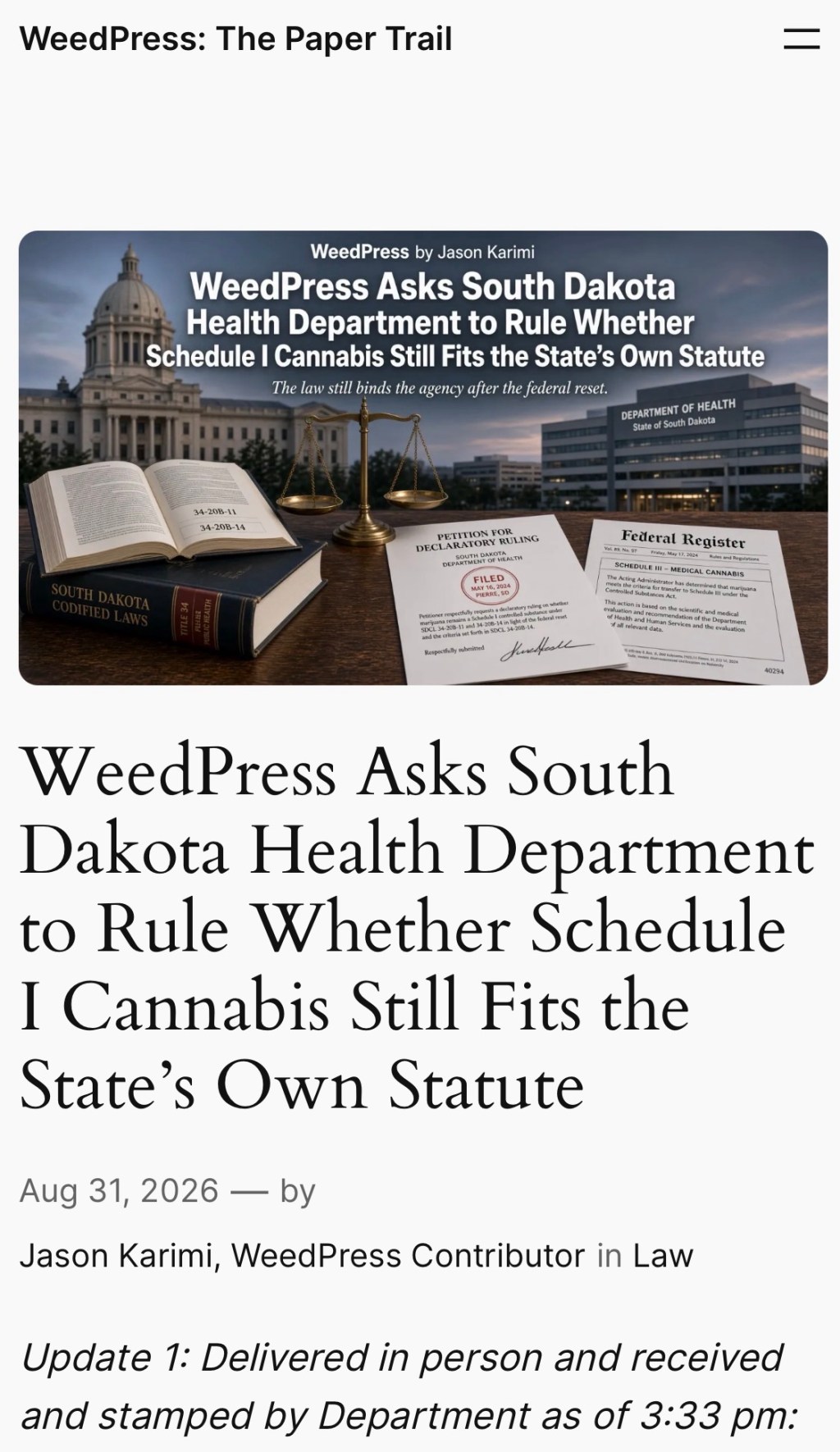
Alabama’s health chief just put a useful distinction on the record.
Dr. Scott Harris said the July comments were not about the consequences of rescheduling. They were people who like medical marijuana and people who do not. Then he said this:
“The program’s already live, even though it’s still Schedule I in Alabama. The reason is, the statute was written essentially to decriminalize it for people who are authorized to have it.”¹
That sentence is useful. It is not a South Dakota statute.
Harris was describing an operating medical program that already protected authorized participants while the state schedule still said Schedule I. South Dakota already built that second half. Chapter 34-20G protects qualifying registered participants from specified state-law consequences for conduct authorized by the chapter.² Chapter 22-42 still hits everyone else.³ The leftover question is narrower than whether Pierre should copy Alabama. It is what construction South Dakota gives § 34-20B-11(2)—“no accepted medical use in the United States”—after Chapter 34-20G and after the April 28, 2026 federal scheduling action covering FDA-approved products and marijuana subject to qualifying state medical-marijuana licenses.⁴
Alabama could move its label with a Board vote because Ala. Code § 20-2-20(c) auto-follows a federal final order after 30 days unless the Board objects.⁵ South Dakota cannot. SDCL § 34-20B-27 is the South Dakota provision people keep treating as the same machine. It is not. It says the Department “shall make recommendations to the Legislature that a substance be added, deleted, or rescheduled when the department determines that such substance has a different potential for abuse.”⁶ The trigger in that sentence is abuse potential. It is not a finding that the accepted-medical-use criterion failed. Schedule I requires all three criteria in § 34-20B-11. Those criteria are separate.⁷ Vicente Sederberg’s older fifty-state survey is useful corroboration that South Dakota is not an automatic-conformity state. The statute itself carries the proposition.⁸
Harris is still worth putting in the record. He is the health officer of a state with an operating medical program saying corresponding scheduling treatment did not dismantle that program, did not turn it into recreational use, and did not require the public to relitigate legalization.⁹ That is comparative practice about what happened to an operating medical program. It is not a 30-day clock that does not exist here.
The April federal rule is also narrower than the talking points. Document 2026-08176, published at 91 Fed. Reg. 22,714, covers FDA-approved marijuana products and marijuana or products subject to a qualifying state-issued license to manufacture, distribute, and/or dispense for medical purposes. It does not simply move all marijuana into Schedule III.¹⁰ A possible response is that Alabama only followed that limited placement and that South Dakota should wait for the broader DEA proceeding. That is a possible response. It still leaves unanswered what construction South Dakota gives § 34-20B-11(2) in light of the narrower federal action.
If the Legislature eventually changed only the scheduling provisions while leaving Chapters 34-20G and 22-42 intact, the medical-program rules would not disappear merely because the schedule changed. The registry, possession limits, restrictions on public use, and local regulatory provisions are separately established in Chapter 34-20G.¹¹ Finding that § 34-20B-11(2) no longer fits is also not the same question as asking which South Dakota schedule would then apply. Schedule II and Schedule IV use “currently accepted medical use.” Schedule III uses “well documented and approved medical use in the United States.”¹² Those destination criteria are separate from the Schedule I inquiry this filing presents.
For industry, federal rescheduling also raises separate questions involving § 280E and banking.¹³ Those questions are distinct from the South Dakota statutory issue here. Alabama is evidence that a medical program can sit under corresponding Schedule III treatment without the program falling over.
The Attorney General will say the schedules are legislative. That is correct. The chapter itself separates three things that should not be collapsed. Section 34-20B-11 says what a Schedule I substance shall have. Sections 34-20B-12 through 34-20B-14 are the Legislature’s list. Section 34-20B-27 tells the Department to recommend a change when it finds a different potential for abuse.¹⁴ The question worth asking both the Department and the Attorney General is what construction the State gives “no accepted medical use in the United States,” and what mechanism South Dakota law provides if that criterion no longer fits the category the April rule actually covers. An opinion that names that mechanism is possible, and if granted, helpful to everyone and increases quality of governance.
The filing below is written to force those questions without handing the Department the easy out. If the Department says § 34-20B-27 does not apply because it has not found a different potential for abuse, that answer matters. The next question is then the one the current code actually creates: what happens when a substance may no longer satisfy one of § 34-20B-11’s mandatory Schedule I criteria, but the only express recommendation statute talks about changed abuse potential.
That question should be researched against the 1970 Session Laws and the Uniform Controlled Substances Act machinery South Dakota adopted, omitted, or modified before anyone assumes the answer is “nothing,” “§ 27 anyway,” or an implied Department duty. Alabama supplied new facts. It did not supply South Dakota’s procedure.
Footnotes
¹ Anna Barrett, Alabama Officials Withdraw Objection To Rescheduling Marijuana Under State Law In Line With Trump’s Federal Move, Marijuana Moment (Sept. 19, 2026) (quoting Dr. Scott Harris).
² SDCL § 34-20G-2.
³ SDCL ch. 22-42.
⁴ SDCL § 34-20B-11(2); Schedules of Controlled Substances: Rescheduling of Food and Drug Administration Approved Products Containing Marijuana From Schedule I to Schedule III; Corresponding Change to Permit Requirements, 91 Fed. Reg. 22,714, 22,714–15 (Apr. 28, 2026).
⁵ Ala. Code § 20-2-20(c).
⁶ SDCL § 34-20B-27.
⁷ SDCL § 34-20B-11.
⁸ Vicente Sederberg LLP, State Controlled Substances Acts: Exemptions and Regulatory Mechanisms for Schedule Changes 2–3, 29 (corroborating that South Dakota requires legislation rather than automatic federal conformity).
⁹ Barrett, supra note 1.
¹⁰ 91 Fed. Reg. at 22,714–15.
¹¹ SDCL ch. 34-20G.
¹² SDCL §§ 34-20B-15, 34-20B-18, 34-20B-24.
¹³ See 26 U.S.C. § 280E.
¹⁴ SDCL §§ 34-20B-11 to 34-20B-14, 34-20B-27.
 WeedPress: The Paper Trail
Leave a comment