Can a medical marijuana card be used against you in a South Dakota child custody case? South Dakota law specifically protects medical cannabis patients—but the Legislature changed an important protection that voters originally approved.
By Jason Karimi | WeedPress
A South Dakota medical cannabis patient recently asked a question on Reddit that many parents may have wondered privately:
Has anyone dealt with a child custody case where the other parent tried to use their medical marijuana card against them? What did the courts do?
For anyone Googling “South Dakota child custody medical marijuana,” “medical marijuana card custody South Dakota,” or “can I lose custody for medical marijuana?”, there is an important fact to know immediately:
South Dakota has a law specifically addressing this situation.
SDCL § 34-20G-21 says a person may not be denied custody, visitation or parenting time solely because the person is a medical cannabis cardholder. It also says conduct allowed under South Dakota’s medical-cannabis law does not create a presumption of neglect or child endangerment unless the person’s behavior creates an unreasonable danger to the child’s safety.¹
But there is an equally important limitation.
The statute expressly preserves custody decisions based on the best interests of the child.¹
In other words, having a medical marijuana card is not supposed to make someone an unfit parent.
But a medical card does not make actual parenting behavior irrelevant either.
And WeedPress’s review of the history behind this statute uncovered something South Dakota patients may not know:
The protection voters approved in 2020 was stronger in one significant respect than the law that exists today.
The original voter-approved statute provided that the unreasonable danger to the child had to be “established by clear and convincing evidence.”²
The South Dakota Legislature removed that language in 2022.
That deletion was deliberate and publicly debated. During the Legislature’s marijuana interim study, a cannabis-industry representative specifically objected to removing the clear-and-convincing-evidence requirement because of its potential consequences in custody litigation.
Lawmakers ultimately removed it anyway.

What South Dakota’s Medical Marijuana Custody Law Says Today
Current SDCL § 34-20G-21 contains three important rules.
First, a person cannot be denied custody, visitation or parenting time solely because the person is a cardholder.
Second, conduct allowed under Chapter 34-20G does not create a presumption of neglect or child endangerment unless the person’s behavior creates an unreasonable danger to the child’s safety.
Third, nothing in South Dakota’s medical-cannabis chapter overrides custody decisions based upon the best interests of the child.¹
Those provisions have to be read together.
The statute does not say:
“Cannabis can never be discussed in a custody case.”
It also does not say:
“A medical marijuana patient can lose custody because they use cannabis.”
Instead, the law creates an important distinction between status and conduct.
Being a registered medical cannabis patient is one thing.
Evidence that a parent’s actual behavior endangered a child is another.
Your Medical Marijuana Card Alone Is Not Supposed to Decide Custody
Imagine one parent goes into court and says:
“My ex has a medical marijuana card.”
Now compare that with an allegation that:
“My ex was impaired while responsible for our child and left cannabis somewhere the child could access it.”
Those allegations are fundamentally different.
The first concerns the parent’s status as a cardholder.
South Dakota law expressly says that status, standing alone, cannot be the reason someone is denied custody, visitation or parenting time.¹
The second concerns alleged conduct.
Whether such an allegation is true is another matter entirely. An accusation does not establish a fact.
But the statute itself recognizes that behavior creating an “unreasonable danger to the safety of the minor” can matter.¹
That is why patients should be careful with simplistic statements in either direction.
A medical card is not proof that someone is an unsafe parent.
A medical card is also not blanket immunity from evidence concerning actual child safety.
South Dakota Voters Approved a Different Version in 2020
The history begins with Initiated Measure 26.
South Dakota voters approved the medical-cannabis initiative on November 3, 2020. It became effective July 1, 2021.
Section 21 specifically addressed custody, visitation, parenting time, neglect and child endangerment.
The original provision contained essentially the same basic protection patients have today.
But it contained additional language that no longer appears in the statute.
Under the voter-approved version, conduct permitted under the medical-cannabis chapter did not create a presumption of neglect or child endangerment unless the person’s behavior created an unreasonable danger to the child’s safety “as established by clear and convincing evidence.”²
Those words matter.
“Clear and convincing evidence” is an elevated evidentiary standard.
So voters did not merely approve protection against losing custody because someone possessed a medical cannabis card.
They approved an express evidentiary requirement governing the statutory unreasonable-danger exception.
That requirement became law.
Then lawmakers reconsidered it.

The Legislature Reexamined the Custody Protection
South Dakota lawmakers undertook an extensive marijuana interim study after passage of IM 26.
Among the provisions examined was § 34-20G-21.
A legislative proposal known as Draft 155 proposed revising the custody provision.
Representative Caleb Finck presented the proposal.
The draft changed the wording surrounding cardholder status, preserved the no-presumption rule, removed the clear-and-convincing-evidence requirement and added a new sentence preserving custody decisions based upon the best interests of the child.³
The change was significant enough to draw an objection.
Cannabis Advocates Specifically Objected to Removing “Clear and Convincing Evidence”
Jeremiah M. Murphy, representing the Cannabis Industry Association of South Dakota, raised the issue during the October 27, 2021 Marijuana Interim Study Committee meeting.
According to the official committee minutes, the association objected specifically because Draft 155 struck “as established by clear and convincing evidence.”
Murphy warned about the consequences in a custody battle and indicated that CIASD could support the proposal if the language were restored.⁴
Representative Caleb Finck explained the workgroup’s position differently.
According to the official minutes, Finck explained that § 34-20G-21 was intended to ensure a person could not be denied custody merely because the person was a medical-marijuana cardholder. The workgroup did not believe the additional evidentiary language was necessary.⁴
The committee proceeded without restoring it.
Draft 155 was adopted 21–1.⁴
That history matters because it tells us something we cannot always determine from a statutory amendment.
The deletion was deliberate and publicly debated.
Someone specifically identified the language.
Someone specifically raised its potential consequences in a custody battle.
Restoring it was specifically proposed.
Lawmakers nevertheless proceeded without it.
Senate Bill 7 Made the Change Official
Draft 155 became 2022 Senate Bill 7.
The bill’s title stated its purpose directly:
“An Act to revise provisions related to custody and visitation rights by medical cannabis cardholders.”⁵
And the official bill provides an unusually clear before-and-after picture.
The Legislature retained the rule that there is no presumption of neglect or child endangerment for conduct allowed under Chapter 34-20G unless the person’s behavior creates an unreasonable danger.
But immediately following “unreasonable danger to the safety of the minor,” the bill struck:
“as established by clear and convincing evidence.”⁵
Then lawmakers added:
“Nothing in this chapter supersedes or otherwise affects custody decisions, visitation rights, or parenting time based upon the best interests of the child.”⁵
The Legislature’s current statute confirms the result and identifies both sources in its history: Initiated Measure 26, effective July 1, 2021, and 2022 Session Laws chapter 123, § 1.¹
What the Legislature Changed—and What It Didn’t
This distinction is important.
The Legislature did not eliminate the custody protection for medical cannabis patients.
That protection remains.
A South Dakota parent still cannot be denied custody, visitation or parenting time solely because the parent is a cardholder.¹
Nor did lawmakers eliminate the rule against automatically presuming neglect or child endangerment from conduct permitted by the medical-cannabis chapter.¹
Instead, lawmakers changed the legal architecture around those protections.
The voters’ version expressly required clear and convincing evidence to establish unreasonable danger.
The Legislature removed that express standard.
It then expressly preserved best-interests-of-the-child determinations.
That means someone who finds the original IM 26 language online today is not reading the complete current law.

“Solely” May Be the Most Important Word for Parents
There is another word patients should notice:
solely.
The statute doesn’t say cardholder status is invisible.
It says custody, visitation or parenting time cannot be denied solely because the person is a cardholder.¹
That creates a practical issue in contentious custody litigation.
An opposing party may not frame an argument as:
“This parent has a medical marijuana card, therefore this parent should lose custody.”
Instead, the argument may become:
“This isn’t about the card. It’s about the parent’s behavior.”
Then the factual questions become critical.
What behavior?
When did it happen?
Was the person actually impaired?
Was cannabis accessible to the child?
Was the conduct permitted under Chapter 34-20G?
What evidence establishes the allegation?
What actual danger did it create?
How did it affect the child?
Those are very different questions from simply asking whether somebody is a medical cannabis patient.
South Dakota Law Separately Recognizes Lawful Medical Cannabis Conduct
Section 34-20G-21 also sits inside a broader statutory scheme.
Chapter 34-20G contains separate provisions covering patient protections, presumptions concerning medical use, searches, lawful activity, unauthorized conduct and medical care.⁶
For example, SDCL § 34-20G-15 declares activity conducted in accordance with the chapter lawful under South Dakota law.
Section 34-20G-4 creates a rebuttable presumption under specified circumstances that a qualifying patient or designated caregiver is engaged in the medical use of cannabis in accordance with the chapter.
Section 34-20G-14 addresses registry cards and searches.
And § 34-20G-20 provides protections involving medical care. The Legislature’s chapter places all of those provisions alongside the custody protection.⁶
Those statutes do not determine the outcome of a custody case.
But they provide important context.
South Dakota law does not treat registered medical-cannabis status as automatically equivalent to illegal drug activity.
Compliance Can Matter
The statutory protection is tied in part to “conduct allowed under this chapter.”¹
Those words matter too.
A medical cannabis card does not transform conduct prohibited by law into protected conduct.
That means compliance may become important if cannabis becomes an issue in a custody case.
Was the person a valid cardholder?
Was the cannabis being used as permitted by Chapter 34-20G?
Was possession within applicable limits?
If cultivation was involved, was it authorized?
Was the product safely stored?
Was cannabis actually being used medically?
Was a child exposed?
Those questions are fact-specific.
But they demonstrate why “parent uses marijuana” is an inadequate description of the legal issue.

Where Are the South Dakota Court Decisions?
This is where the research becomes surprisingly thin.
WeedPress searched published South Dakota appellate decisions for cases interpreting § 34-20G-21 in custody, visitation, parenting-time and child-welfare disputes involving registered medical-cannabis patients.
We did not locate a published South Dakota Supreme Court decision interpreting the statute in that setting.
That does not mean no South Dakota judge has ever dealt with the issue.
Circuit courts handle custody disputes, and ordinary family-court orders are not comprehensively published and searchable like South Dakota Supreme Court opinions.
So the responsible conclusion is narrower:
WeedPress has not located published South Dakota appellate precedent explaining how § 34-20G-21 should be applied in a contested medical-cannabis custody case.
That makes decisions from states with similar statutes potentially informative—not because they control South Dakota courts, but because they show how similar statutory language has operated in actual litigation.
South Dakota’s Original Language Was Not Unique
The deeper history reveals something else.
The language South Dakota voters approved in 2020 closely resembles medical-marijuana custody protections enacted elsewhere years earlier.
Arizona’s voter-approved medical-marijuana law, for example, says there is no presumption of neglect or child endangerment for protected conduct unless the person’s behavior creates an unreasonable danger to the minor established by clear and convincing evidence.⁷
Similar formulations have appeared in other state medical-cannabis laws.
That does not establish that South Dakota copied any particular state’s statute, and WeedPress has not located primary drafting records proving the exact source from which IM 26’s drafters took § 21.
But the similarity matters.
Arizona courts have actually interpreted their provision.
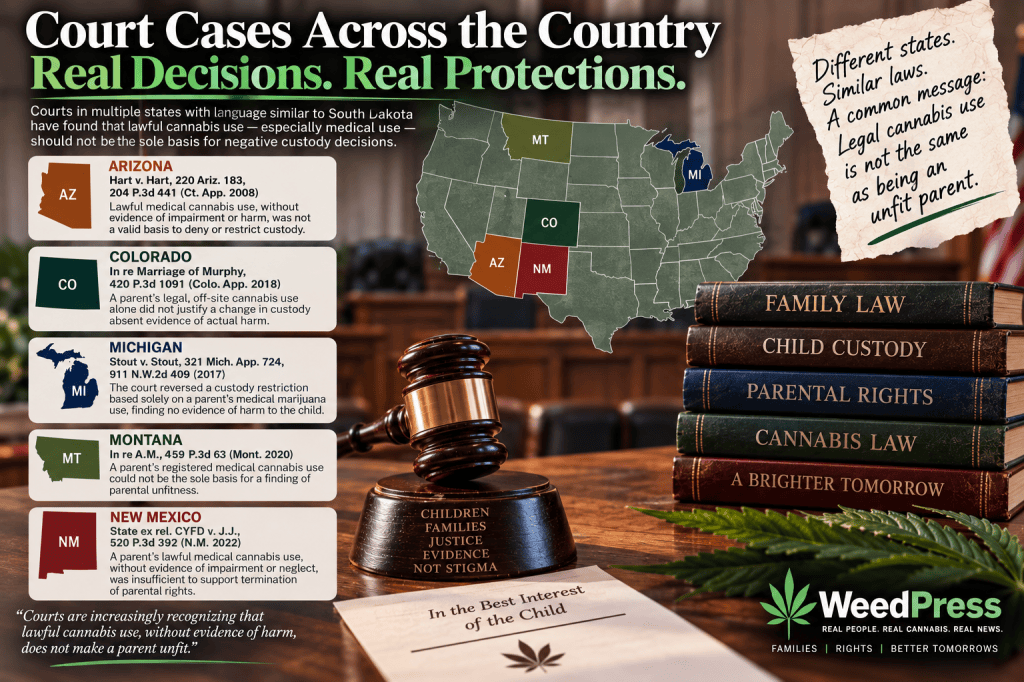
An Arizona Court Vacated a Dependency Finding and Sent the Case Back
One of the most instructive cases is Gerald M. v. Department of Child Safety.
There, the father was an Arizona medical-marijuana patient.
The factual record was not spotless.
Authorities had previously found marijuana plants being grown without authorization. The case also involved allegations concerning children’s exposure to marijuana.
But by the time of the dependency adjudication, the juvenile court appeared to find that the father was purchasing marijuana in compliance with Arizona’s medical-marijuana law.
The problem was that the court apparently had not considered the statute’s special protection for medical-marijuana patients.
Arizona’s Court of Appeals vacated the dependency adjudication and sent the case back.
The appellate court instructed the juvenile court to determine whether the father was using marijuana in compliance with the medical-marijuana law at the time of adjudication. If he was, the court had to consider the medical-marijuana statute when determining whether the evidence supported dependency.⁸
That case illustrates why compliance can matter.
It also illustrates why simply establishing that a parent uses cannabis does not necessarily end the legal inquiry.
The Arizona court specifically recognized that its medical-marijuana statute applied in civil contexts involving allegations of neglect or child endangerment.⁸
The Arizona Case Was Not an Easy Cannabis-Wins Story
Gerald M. also provides a useful warning against oversimplification.
The appellate decision contained a dissent.
The dissenting judge emphasized allegations that the father had illegally grown marijuana in an area accessible to young children and that the children had been exposed to marijuana smoke.⁸
The majority nevertheless concluded that the lower court needed to determine whether the father’s use at the time of adjudication complied with the medical-marijuana law and, if so, actually apply the statutory protections.
That’s much more informative than treating the case as either:
“Medical marijuana parents always win.”
or:
“Marijuana means neglect.”
Neither proposition accurately describes it.
The real questions were compliance, evidence, conduct and the governing statutory standard.
Another Arizona Custody Case Shows How the Protection Works
The 2022 Arizona case Webster v. Smith involved a dispute over relocation and parenting arrangements.
The mother argued that the trial court improperly relied on evidence concerning her medical-marijuana card.
Arizona’s Court of Appeals explained that the state’s medical-marijuana statute prohibited a presumption of neglect or child endangerment from protected conduct unless the person’s behavior created an unreasonable danger to the child established by clear and convincing evidence.⁹
But the appellate court ultimately affirmed.
The trial court had found a history of drug use but also found that the mother had been sober for more than four years. Although there was speculative testimony concerning marijuana exposure, the trial court ultimately found insufficient evidence to depart from joint legal decision-making.⁹
That nuance matters.
The medical-marijuana statute did not make every cannabis-related fact disappear.
It constrained the presumption that could be drawn from protected medical-marijuana conduct.
And the ultimate custody determination still involved the child’s best interests and the full evidentiary record.
Why Arizona Is Useful—but Not South Dakota Law
Neither Gerald M. nor Webster controls a South Dakota judge.
Both interpret Arizona law.
Both are also designated nonprecedential memorandum decisions under Arizona rules.⁸ ⁹
And there is now another critical difference:
Arizona’s statute contains the clear-and-convincing-evidence language South Dakota removed in 2022.
So these decisions cannot simply be imported into South Dakota.
Their value is comparative.
They demonstrate how language closely resembling the original voter-approved South Dakota provision can affect the analysis when courts confront medical marijuana, parenting and alleged child danger.

Older South Dakota Marijuana Cases Don’t Answer the Modern Question
South Dakota has older cases in which marijuana appeared in custody or child-welfare records.
Those cases need to be handled carefully.
They predate Chapter 34-20G.
A decades-old case involving illegal marijuana use does not tell us how § 34-20G-21 protects a registered medical-cannabis patient today.
Likewise, dependency and termination cases involving multiple substances, domestic instability, incarceration or other serious allegations cannot fairly be reduced to:
“A parent used marijuana and lost custody.”
The modern question is much narrower:
How does South Dakota’s express statutory protection for medical-cannabis cardholders operate when cannabis becomes an issue in a custody case?
On that question, published South Dakota appellate guidance appears sparse.
What Does “Best Interests of the Child” Mean for Medical Cannabis?
South Dakota’s 2022 amendment expressly says Chapter 34-20G does not supersede custody decisions based on the child’s best interests.¹
That is not necessarily inconsistent with protecting medical cannabis patients.
The concepts can coexist.
A court can evaluate actual parenting behavior and child safety while refusing to treat medical-patient status itself as evidence of parental unfitness.
That is the central structure of current § 34-20G-21:
No automatic penalty because of the card.
No automatic presumption of neglect from authorized conduct.
But no exemption from the child’s best interests either.
What Happened to the “Clear and Convincing Evidence” Protection?
This may ultimately be the most legally interesting part of the story.
South Dakota voters approved it.
The Legislature removed it.
The official 2022 bill confirms the deletion directly.⁵
The current statute confirms that the words are gone.¹
What WeedPress should not do is jump from that history to an unsupported conclusion about exactly what evidentiary burden applies in every South Dakota family-court proceeding today.
Different proceedings can involve different statutes, burdens and procedural rules.
The safer—and more important—point is factual:
The current medical-cannabis custody statute no longer contains the express clear-and-convincing-evidence requirement voters approved.
If a future South Dakota appellate case asks what consequences follow from that deletion, the legislative history will be sitting there.
And it is unusually specific.
The cannabis industry warned lawmakers about custody litigation.
Lawmakers were told what language was being removed.
The Legislature removed it anyway.
If Someone Is Using Your Medical Card Against You in a Custody Case
This article is not a substitute for an attorney looking at an actual custody file.
But a South Dakota medical cannabis patient involved in a real dispute should at minimum know the statute exists.
The starting point is:
SDCL § 34-20G-21.
A lawyer evaluating the issue may also want to examine the other protections and limitations throughout Chapter 34-20G, the original voter-approved provision, the 2021 interim-study materials, Draft 155 and Senate Bill 7.
And if the dispute concerns alleged behavior rather than merely possession of a card, the evidence surrounding that behavior will matter.
A medical card is not evidence that a parent endangered a child.
But neither should a parent assume the card makes questions about impairment, storage, exposure, unauthorized conduct or actual child safety legally irrelevant.

So, Can You Lose Custody Because You Have a South Dakota Medical Marijuana Card?
The card alone is not supposed to be enough.
South Dakota law expressly says a person may not be denied custody, visitation or parenting time solely because the person is a cardholder.¹
It also expressly rejects a presumption of neglect or child endangerment for conduct allowed under South Dakota’s medical-cannabis law, unless the person’s behavior creates an unreasonable danger to the child’s safety.¹
But courts retain their authority to decide custody according to the child’s best interests.
Actual unsafe conduct can matter.
Compliance can matter.
Evidence can matter.
What should not substitute for those things is stigma attached to the words “medical marijuana patient.”
And there is one piece of this story South Dakota patients deserve to know.
When voters created the medical-cannabis program, they gave parents an additional protection: unreasonable danger had to be “established by clear and convincing evidence.”
Lawmakers reconsidered that protection almost immediately.
Cannabis advocates specifically objected to its removal because of the potential consequences in custody litigation.
In 2022, the Legislature removed it.
South Dakota’s appellate courts have apparently not yet published an opinion telling patients, lawyers and family-court judges exactly how the amended statute operates when a medical cannabis card becomes an issue in a contested custody case.
Until they do, the statutory line is clearer than the case law:
Being a medical cannabis patient, by itself, is not supposed to cost a South Dakota parent their child.
This article provides general information about South Dakota law and is not legal advice. Child-custody, abuse-and-neglect and termination proceedings can involve different statutes, evidentiary standards and facts. Anyone involved in an actual case should consult a South Dakota attorney about the specific circumstances.

Footnotes
¹ S.D. Codified Laws § 34-20G-21 (2026), https://sdlegislature.gov/Statutes/34-20G-21.
² S.D. Codified Laws § 34-20G-21 (2021) (enacted by Initiated Measure No. 26, approved Nov. 3, 2020, effective July 1, 2021), https://law.justia.com/codes/south-dakota/2021/title-34/chapter-20g/section-34-20g-21/.
³ Draft 155, 97th Legis. Sess. 1 (S.D. 2022), https://mylrc.sdlegislature.gov/api/Documents/222645.pdf.
⁴ Marijuana Interim Study Comm., Minutes 8–9 (Oct. 27, 2021) (discussion of Draft 155 and testimony of Jeremiah M. Murphy on behalf of the Cannabis Industry Association of South Dakota), https://mylrc.sdlegislature.gov/api/Documents/Minutes/222564.pdf?Year=2021.
⁵ S.B. 7, 97th Legis. Sess. § 1 (S.D. 2022), https://mylrc.sdlegislature.gov/api/Documents/Bill/225571.pdf?Year=2022; 2022 S.D. Sess. Laws ch. 123, § 1, https://mylrc.sdlegislature.gov/api/Documents/SessionLawsBook/220625.pdf?Year=2022.
⁶ S.D. Codified Laws §§ 34-20G-4, -14, -15, -20 (2026), https://sdlegislature.gov/api/Statutes/34-20G.html.
⁷ Ariz. Rev. Stat. Ann. § 36-2813(D) (2026); Arizona Secretary of State, 2010 General Election Publicity Pamphlet, Proposition 203, https://apps.azsos.gov/election/2010/Info/PubPamphlet/English/prop203.htm.
⁸ Gerald M. v. Dep’t of Child Safety, No. 2 CA-JV 2015-0130, ¶¶ 14–15, 48 (Ariz. Ct. App. Apr. 20, 2016) (mem. decision), https://law.justia.com/cases/arizona/court-of-appeals-division-two-unpublished/2016/2-ca-jv-2015-0130.html.
⁹ Webster v. Smith, No. 1 CA-CV 22-0145 FC, ¶¶ 7–9 (Ariz. Ct. App. Nov. 1, 2022) (mem. decision), https://law.justia.com/cases/arizona/court-of-appeals-division-one-unpublished/2022/1-ca-cv-22-0145-fc.html.
 WeedPress: The Paper Trail
Leave a comment