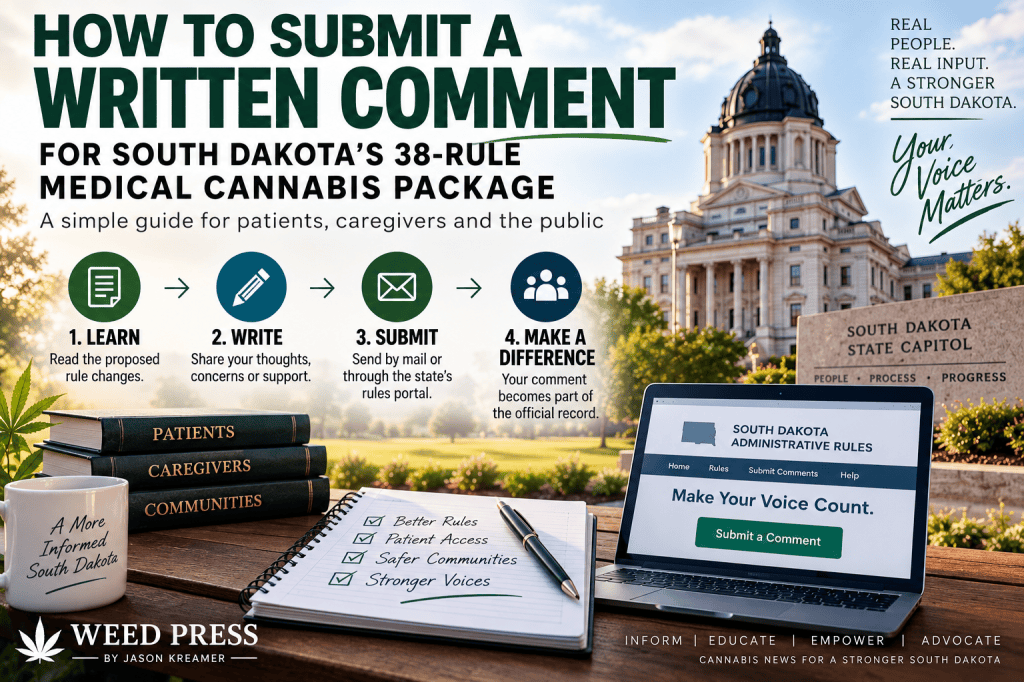
South Dakota is rewriting 38 sections of its medical-cannabis regulations. You do not have to be a lawyer, cannabis-business owner, lobbyist, or person sitting in the hearing room in Pierre to put something into the rulemaking record.
You can file a written comment.
The South Dakota Department of Health filed its proposed amendments to Administrative Rules Article 44:90 with the Legislative Research Council on August 21, 2026.¹ The package reaches across patient and caregiver rules, medical-cannabis establishments, testing, security, packaging, recordkeeping, corrective-action plans, and enforcement.²
The public hearing is scheduled for September 23, 2026, at 10:00 a.m. Central Time at the Floyd Matthew Training Center in the Foss Building, 523 East Capitol Avenue in Pierre.³
But the hearing is not the end of the public’s opportunity to participate.
**The deadline for written comments is October 3, 2026.**⁴
Here is how to put yours in the record.
The State Gives You Two Official Ways to Submit a Written Comment
The Department’s published rulemaking notice says written comments may be submitted to:
South Dakota Department of Health
Office of Medical Cannabis
600 East Capitol Avenue
Pierre, South Dakota 57501
The notice also allows comments to be submitted electronically through South Dakota’s administrative-rules website.⁵
The state rules portal is:
The Department’s notice says the deadline to submit written comments **for consideration is October 3, 2026.**⁶
That date matters.
Do not assume that attending the September 23 hearing is the only way to participate. The published notice expressly provides a written-comment period extending beyond the hearing.⁷
If you want your position considered as part of this rulemaking, put it in writing and submit it before the deadline.
What Should a Comment Say?
There is no requirement that a member of the public write a law-review article.
A useful comment can be one page.
Start by identifying the rule or subject you are commenting on. If you know the rule number, use it. For example:
Re: Written Comment on Proposed Amendment to ARSD 44:90:12:11
Then identify who you are to the extent you are comfortable doing so and explain why the rule affects you.
A patient might explain how a proposed requirement affects access or cost.
A caregiver might explain how it operates in practice.
An establishment might identify compliance costs, staffing requirements, software changes, testing expenses, security problems, or operational consequences.
A practitioner can identify effects on certification or patient care.
A member of the public can simply identify a problem in the proposed text and explain why the Department should change it.
The important part is specificity.
Instead of writing:
“These rules are bad.”
tell the Department:
Which proposed rule are you discussing?
What language creates the problem?
What will happen if the Department adopts it?
What evidence supports your concern?
What should the Department change?
A short comment answering those questions can be considerably more useful than ten pages of generalized opposition.
You Can Support a Rule, Oppose It, or Ask the Department to Change It
The Department’s notice expressly invites “amendments, data, opinions, and arguments for or against” the proposed rules.⁸
That means a written comment does not have to be an all-or-nothing vote on the entire 38-rule package.
You can support one amendment and oppose another.
You can agree with the Department’s objective while arguing that its proposed language does not accomplish it.
You can submit data.
You can identify an ambiguity.
You can ask what a provision means.
You can propose replacement language.
You can point out that two proposed provisions appear to operate differently when read together.
And you can ask the Department to explain assumptions contained in its regulatory-impact analysis.
That is what a rulemaking record is for.
Cite the Actual Rule
The strongest public comments usually start with the document the agency is actually proposing to adopt.
The August 31 notice identifies 38 proposed amendments across Article 44:90, beginning with ARSD 44:90:01:01 and extending through ARSD 44:90:12:11.⁹
Copies of the proposed rules are available without charge through the Department and through the state rules website.¹⁰
The state rules portal is:
Read the proposed language before commenting.
If your concern is with one sentence, quote that sentence.
If your concern is with a change from the existing rule, identify what the existing rule says and what the proposal would change.
If your concern is economic, give the Department numbers if you have them.
If your concern comes from personal experience with the program, explain the experience and connect it to the proposed language.
The goal is to give the agency something concrete that can be answered.
Attach Evidence When Evidence Helps
A written comment can be more than a letter.
If a Department report supports your point, identify it.
If you are relying on a patient-data table, attach it or provide a citation.
If you operate an establishment and believe a proposed requirement will cost $5,000 rather than nothing, explain how you calculated that amount.
If a proposed recordkeeping rule would require additional employee hours, say approximately how many and why.
If another section of South Dakota law appears relevant, cite it.
South Dakota’s permanent-rule procedure requires a regulatory-impact analysis containing information that includes the need for the rule, alternatives considered, benefits, compliance costs, indirect costs, opportunity costs, small-business effects, sources, assumptions, and uncertainties.¹¹
That makes factual comments about costs and alternatives particularly useful when those subjects are implicated by the proposal.
Ask for a Specific Result
Do not make the Department guess what you want.
End the substantive portion of the comment with a request.
For example:
I ask the Department to retain the existing language.
Or:
I ask the Department to amend the proposed rule to state expressly that ______.
Or:
I ask the Department to explain in the rulemaking record how these two provisions operate together.
Or:
I ask the Department to revise its regulatory-impact analysis to account for this cost.
That creates a much cleaner administrative record than simply saying that you dislike the proposal.
There Is Another Provision Worth Knowing: SDCL § 1-26-7.1
Someone submitting a substantial comment should also know about SDCL § 1-26-7.1.
Upon adoption of a rule, if an interested person makes the required written request either before adoption or within thirty days afterward, the agency must issue a concise written statement addressing the principal reasons for and against adoption and its reasons for overruling considerations urged against adoption.¹²
That is different from merely filing a comment.
If you want to invoke § 1-26-7.1, say so expressly in writing.
For example:
Pursuant to SDCL § 1-26-7.1, I request the Department’s written, concise statement of the principal reasons for and against adoption of the proposed amendment addressed in this comment and, if the Department adopts the amendment over the considerations raised here, its reasons for overruling those considerations.
The current statute also requires the agency to serve its statement on the members of the Interim Rules Review Committee and code counsel.¹³
You do not have to include a § 1-26-7.1 request merely to submit an ordinary public comment. But people building a detailed record should know the provision exists.
A Simple Comment Can Look Like This
A basic comment does not need elaborate formatting:
September __, 2026
South Dakota Department of Health
Office of Medical Cannabis
600 East Capitol Avenue
Pierre, SD 57501
Re: Written Comment on Proposed Amendments to ARSD Article 44:90
To the Department:
I submit this written comment concerning proposed ARSD __________.
I am a [patient/caregiver/business owner/practitioner/member of the public].
The proposed rule states __________.
My concern is __________.
This matters because __________.
The information supporting my comment is __________.
I ask the Department to __________.
Please include this submission in the written-comment record for the proposed amendments to Article 44:90.
Respectfully,
[Name]
That is enough to participate.
Add supporting documents when they make the comment stronger.
Keep Proof That You Submitted It
Save the final version of your comment.
If you submit electronically, save the submission confirmation or take a screenshot showing that it was received.
If you mail it, leave enough time for delivery and consider using a method that provides tracking.
If the Department acknowledges receipt, save that message too.
This is not about ceremony. It creates a simple record showing exactly what you submitted and when.
What Happens After the Comment Period?
The Department does not simply collect the comments and forget about them.
Its notice states that after the written-comment period it will consider the written and oral comments received on the proposed rules. The Department may then modify the proposed rules to include or exclude matters described in the notice.¹⁴
The current schedule places the Article 44:90 package before the Legislature’s Interim Rules Review Committee on October 14, 2026.¹⁵
That is why comments should be written for more than one reader.
The immediate reader is the Department of Health.
But the administrative record can also matter when the package reaches legislative rule review and if questions about the rule later arise.
This Is the Public’s Rulemaking Record Too
Thirty-eight sections are open.
The Department says the purpose of the package is to update and clarify Article 44:90, align the rules with current medical-cannabis industry standards, improve consistency, modernize administrative processes, eliminate contradictions, correct errors, and address operational issues identified by the industry and the Department.¹⁶
The public gets to respond to that proposition.
You do not need permission from an industry organization.
You do not need a lobbyist.
You do not need to travel to Pierre.
And you do not need to agree with WeedPress.
Read the proposal. Find the provision that affects you. Explain what the Department should know. Cite your evidence. Ask for the result you want.
Then submit it.
**Written comments on South Dakota’s proposed Article 44:90 medical-cannabis amendments are due October 3, 2026.**¹⁷
The hearing is September 23.
The written record remains open after it.
Use it.
Footnotes
¹ S.D. Legislative Research Council, South Dakota Register, Vol. 53, at 25 (Aug. 31, 2026) (Department of Health filing dated Aug. 21, 2026), https://mylrc.sdlegislature.gov/api/Documents/Register/307532.pdf?Year=2026.
² Id.; S.D. Dep’t of Health, Proposed Amendments to S.D. Admin. R. art. 44:90 (2026), https://rules.sd.gov/.
³ S.D. Legislative Research Council, South Dakota Register, Vol. 53, at 25 (Aug. 31, 2026), https://mylrc.sdlegislature.gov/api/Documents/Register/307532.pdf?Year=2026.
⁴ Id.
⁵ Id. The official notice directs written comments to the South Dakota Department of Health, Office of Medical Cannabis, 600 East Capitol Avenue, Pierre, South Dakota 57501, or through the South Dakota administrative-rules website, https://rules.sd.gov/.
⁶ S.D. Legislative Research Council, South Dakota Register, Vol. 53, at 25 (Aug. 31, 2026), https://mylrc.sdlegislature.gov/api/Documents/Register/307532.pdf?Year=2026.
⁷ Id.
⁸ Id.
⁹ Id.
¹⁰ Id.; South Dakota Administrative Rules, https://rules.sd.gov/.
¹¹ S.D. Codified Laws § 1-26-4.11 (2026), https://sdlegislature.gov/Statutes/1-26-4.11.
¹² S.D. Codified Laws § 1-26-7.1 (2026), https://sdlegislature.gov/Statutes/1-26-7.1.
¹³ Id.
¹⁴ S.D. Legislative Research Council, South Dakota Register, Vol. 53, at 25 (Aug. 31, 2026), https://mylrc.sdlegislature.gov/api/Documents/Register/307532.pdf?Year=2026.
¹⁵ S.D. Legislative Research Council, South Dakota Register, Vol. 53 (Aug. 31, 2026), https://mylrc.sdlegislature.gov/api/Documents/Register/307532.pdf?Year=2026; Jason Karimi, South Dakota Has Rewritten Article 44:90 Before. The 38-Amendment Package Is Large. It Is Not the First., WeedPress (Sept. 10, 2026), https://weedpress.org/2026/09/10/south-dakota-has-rewritten-article-4490-before-the-38-amendment-package-is-large-it-is-not-the-first/.
¹⁶ S.D. Legislative Research Council, South Dakota Register, Vol. 53, at 25 (Aug. 31, 2026), https://mylrc.sdlegislature.gov/api/Documents/Register/307532.pdf?Year=2026.
¹⁷ Id.
 WeedPress: The Paper Trail
Leave a comment