#9…
The federal desk was built for transportation, not Pierre
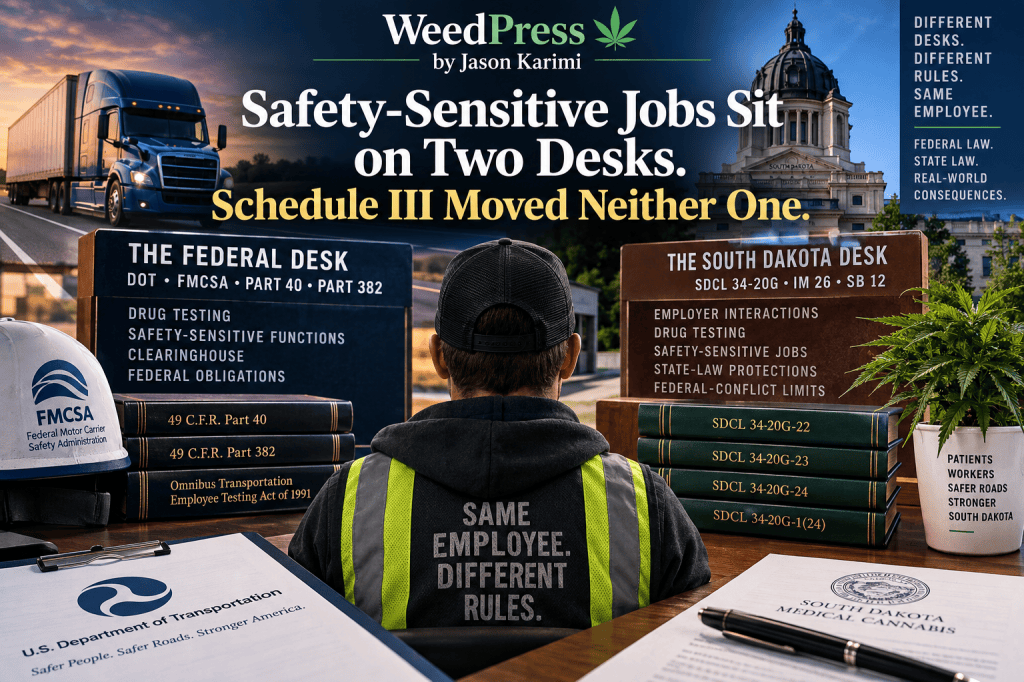
DOT’s transportation drug-testing regime predates South Dakota medical cannabis by decades. Congress enacted the Omnibus Transportation Employee Testing Act of 1991. The current commercial-driver testing statute directs the Secretary of Transportation to maintain controlled-substance testing requirements that incorporate HHS scientific and technical guidelines, including later amendments.¹ Part 40 still names marijuana as an analyte. After a verified positive, Part 382 still requires removal from safety-sensitive functions and reporting to the FMCSA Clearinghouse.²
In 2009, after the Justice Department issued prosecutor guidance on state medical-marijuana laws, DOT reminded regulated employers that 49 C.F.R. § 40.151(e) does not treat a physician’s state-law recommendation of a Schedule I drug as a legitimate medical explanation.³ That sentence is still in Part 40. After April 28, 2026 it is textually stale as applied to state-licensed medical marijuana now placed in Schedule III. Stale wording is not a repeal. ODAPC and the Office of General Counsel answered the current question on May 15, 2026: an MRO may not verify a laboratory-confirmed marijuana positive as negative because the employee used a state-licensed product. For state-program marijuana, that guidance says a legitimate medical explanation requires use of a legally prescribed controlled substance in compliance with federal prescription law. State cards, certifications, and dispensary receipts do not qualify as they are merely recommendations and are not prescriptions legally speaking.⁴
That is the federal desk. It was not rewritten in Pierre, and it was not rewritten in the April order.

Pierre wrote a pharmaceutical sentence, then cut a hole in it
Initiated Measure 26, approved November 3, 2020 and effective July 1, 2021, put the employment rule in what is now SDCL 34-20G-22. A registered qualifying patient who uses cannabis for a medical purpose “must be afforded the same rights under state and local law, as the person would be afforded if the person were solely prescribed a pharmaceutical medication,” as to employer interactions and drug testing.⁵ That is the sentence people quote when they say South Dakota already treats medical cannabis like other medicine.
The original measure also wrote the federal-conflict rule that is still SDCL 34-20G-23. The rights in sections 19 through 25 do not apply to the extent they conflict with an employer’s obligations under federal law or would cost the employer a federal monetary or licensing benefit.⁶ It wrote a workplace rule that is now SDCL 34-20G-24: no employer is required to allow ingestion at work or work while under the influence. The 2020 text added that a patient may not be treated as under the influence solely because metabolites appear in insufficient concentration to cause impairment.⁷ It defined “safety-sensitive job” as any position with tasks or duties an employer reasonably believes could cause illness, injury, or death, or serious property damage.⁸ It listed performing a safety-sensitive job under the influence as unauthorized conduct.⁹
What IM 26 did not put in section 22 was a metabolite exception for safety-sensitive jobs. That hole was cut later.
Senate Bill 12, enacted as 2024 Session Laws chapter 135 and signed February 14, 2024, amended 34-20G-22. Nothing in the section now prohibits adverse action, based solely on a positive test for cannabis metabolites, if the person holds or is seeking a safety-sensitive job.¹⁰ The same act amended 34-20G-24 to confirm drug-free workplace policies and to add that no cause of action for discrimination or wrongful termination arises from enforcing such a policy in compliance with the chapter.¹¹
That is not a federal rule. It is a state carve-out of a state protection. South Dakota did not copy federal Part 40. It wrote its own definition of the job.
Where the desks meet, and where they do not
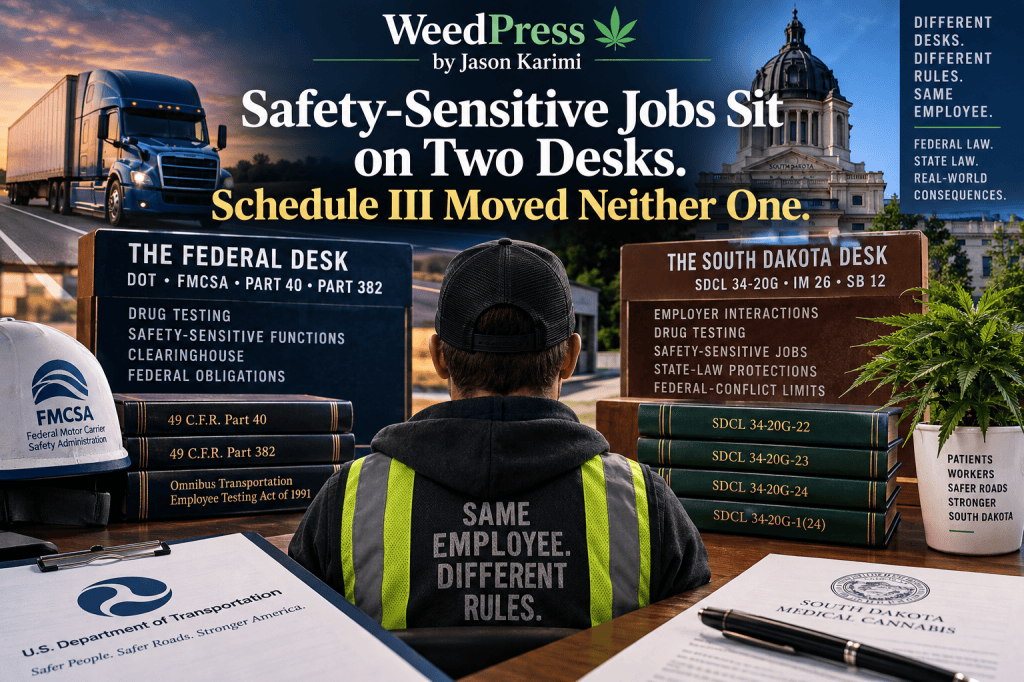
For a DOT-regulated driver, § 34-20G-23 independently matters even without the 2024 safety-sensitive amendment because South Dakota expressly limits its protections to the extent they conflict with an employer’s obligations under federal law. Part 40 and Part 382 are those obligations. A state card does not convert a verified marijuana positive into a negative. Schedule III did not change that reading. ODAPC said so after the April order.¹²
For a South Dakota job that is not under Part 40, the analysis is 34-20G-22 plus the 2024 exception plus the employer’s reasonable belief under 34-20G-1(24). The definition is broader than a CDL. It reaches any position with tasks or duties that an employer reasonably believes could cause illness, injury, or death, or serious property damage. This page does not inventory every South Dakota job that qualifies. The statute leaves that to the employer’s reasonable belief, subject to whatever later record a court or agency builds.
The April order moved FDA-approved marijuana products and marijuana subject to a state medical-marijuana license to Schedule III.¹³ It did not amend OTETA. It did not amend Part 40. It did not amend 34-20G-22. Treating those three events as one event is the error the last pages of this series have been written to stop.
What this page does not do
It does not analyze ADA reasonable accommodation. That is a different statute and a different series file.
It does not say Schedule III legalized medical cannabis for a CDL.
It does not say Schedule III “did nothing.” It did not amend the testing desk. That is the accurate sentence.
It does not say every South Dakota employer may fire every cardholder who tests positive. 34-20G-22 still contains the pharmaceutical-treatment sentence. SB 12 cut a safety-sensitive hole in it. The hole is not the whole statute.
It does not guess how many employers reclassified jobs after July 1, 2024.
The question left on the employment desk
IM 26 told employers to treat a qualifying patient’s medical use like other medication. Congress had already told transportation employers to test for marijuana and remove a positive driver. Pierre then wrote a federal-conflict savings clause, defined safety-sensitive work for itself, and in 2024 let metabolite positives support adverse action in those jobs. DOT, after Schedule III, said a state card is still not a Part 40 medical explanation.
Two desks. The CDL result is the same. The non-DOT result depends on whether the job is safety-sensitive under 34-20G-1(24). That is the South Dakota question the April order did not answer.
Footnotes
¹ Omnibus Transportation Employee Testing Act of 1991, Pub. L. No. 102-143, tit. V, 105 Stat. 917, 952; 49 U.S.C. § 31306(b)–(c).
² 49 C.F.R. § 40.85 (marijuana-metabolite testing); 49 C.F.R. § 382.501 (removal from safety-sensitive functions); 49 C.F.R. § 382.705(a)(1)(i) (MRO reporting of verified positive controlled-substances test results to the Clearinghouse).
³ 49 C.F.R. § 40.151(e); U.S. Dep’t of Transp., ODAPC Notice on Medical Marijuana (2009).
⁴ U.S. Dep’t of Transp., Part 40 Questions and Answers (updated May 15, 2026), https://www.transportation.gov/odapc/part40QandA; 49 C.F.R. §§ 40.137(a), 40.141(b).
⁵ Initiated Measure No. 26 (approved Nov. 3, 2020, eff. July 1, 2021); SDCL 34-20G-22, https://sdlegislature.gov/Statutes/34-20G-22.
⁶ SDCL 34-20G-23, https://sdlegislature.gov/Statutes/34-20G-23.
⁷ Initiated Measure No. 26, § 24 (2020 text); SDCL 34-20G-24, https://sdlegislature.gov/Statutes/34-20G-24.
⁸ SDCL 34-20G-1(24), https://sdlegislature.gov/Statutes/34-20G-1.
⁹ SDCL 34-20G-18, https://sdlegislature.gov/Statutes/34-20G-18.
¹⁰ 2024 S.D. Sess. Laws ch. 135, § 1 (S.B. 12), https://sdlegislature.gov/Statutes/Session_Laws/Chapter/7905; SDCL 34-20G-22.
¹¹ 2024 S.D. Sess. Laws ch. 135, § 2; SDCL 34-20G-24.
¹² U.S. Dep’t of Transp., Part 40 Questions and Answers, supra note 4.
¹³ Schedules of Controlled Substances: Rescheduling of Food and Drug Administration Approved Products Containing Marijuana From Schedule I to Schedule III; Corresponding Change to Permit Requirements, 91 Fed. Reg. 22,714 (Apr. 28, 2026), https://www.govinfo.gov/content/pkg/FR-2026-04-28/pdf/2026-08176.pdf.
 WeedPress: The Paper Trail
Leave a comment