How mistakes, limited resources, and administrative law taught me to turn public information into decisions.
There was a time when I thought the advantage was knowing something other people did not know.
I do not think that anymore, after 17 obsessed years studying cannabis law and admin law as best as I can as often as I can totaling 20,000 hours of personal research.
Here’s what has changed in 17 years in the competitive arenas litigating thee drastically changing cannabis laws in 2026.
The internet destroyed much of the old scarcity around information. Statutes are online. Administrative rules are online. Federal regulations are searchable. Legislative packets can be downloaded from a phone. Agency notices, fiscal notes, hearing materials, committee minutes, and government forms increasingly sit in public databases available to anyone willing to open them.
The competitive advantage is moving somewhere else.
The advantage is knowing what to do with information once everybody can get it.
For me, learning that has required mistakes.
It has also required learning something I did not even have a name for when I started: institutional literacy.
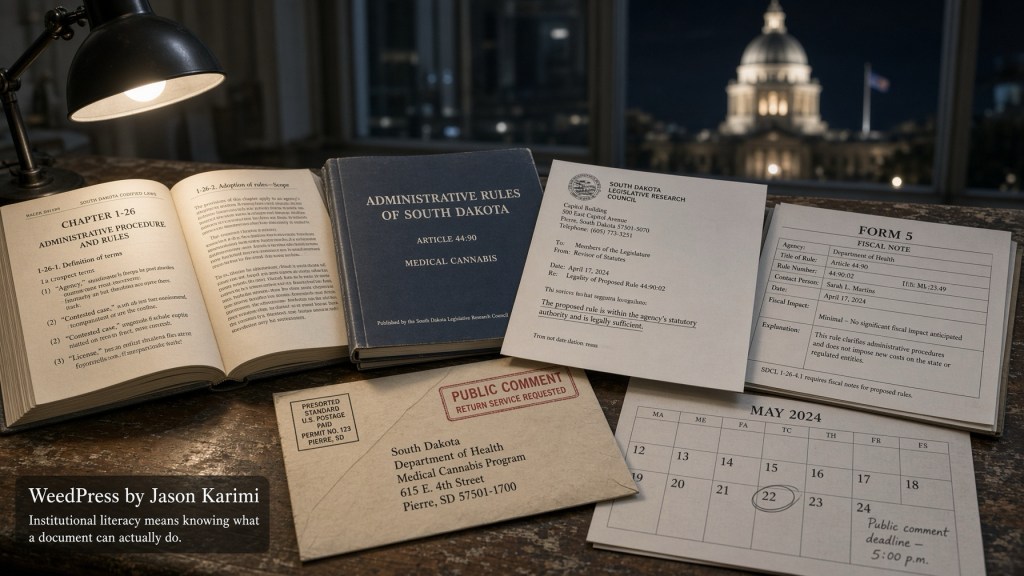
Institutional literacy means knowing what a document can actually do
Knowing the law is not the same thing as understanding the institution administering it.
A statute is not a rule. A proposed rule is not an adopted rule. A public comment is not an agency decision. A Legislative Research Council recommendation is not a judicial holding. A federal regulation does not automatically tell a state agency what language to put into its own administrative code.
Those distinctions sound obvious after you learn them.
Learning to operate inside them is different.
South Dakota’s permanent-rule process illustrates why. An agency does not simply write regulatory language and declare it law. Chapter 1-26 creates a procedure involving notice, fiscal analysis, regulatory-impact analysis, public comment, Legislative Research Council review, agency consideration, Interim Rules Review Committee review, and ultimately filing requirements.¹ The state’s own administrative-rules drafting manual reduces that process to an ordered workflow: propose, serve, publish, accept comments, receive LRC recommendations, incorporate or appeal those recommendations, consider public comments, and complete the remaining adoption process.²
That procedure is not bureaucratic background noise.
The procedure tells you where an individual can act.
That was a major change in how I started looking at government.
Instead of asking only, What do I think about this policy?, I began asking different questions.
What proceeding is open?
What document controls this question?
Who owns this decision?
What statute gives that office authority?
What is the deadline?
What belongs in the record?
What happens to the document after I submit it?
And, most importantly:
What can I actually do next?
Compression is becoming more valuable than collection
A small operation cannot compete by reading everything.
It can compete by learning what deserves to be read.
That distinction matters to WeedPress because there is no giant research department behind this publication. There is no room full of lawyers waiting for assignments. There is no lobbying firm’s regulatory staff dividing hundreds of pages among specialists.
That forces compression.
A government can produce seventy-five pages. The first job is not to write seventy-five pages about them.
The first job is to determine which three pages change the decision.
Then three pages might become three propositions.
Those propositions might become one article.
And the article might produce one thing that needs to be watched when the agency publishes its next draft.
That is the workflow I am trying to build:
document → signal → proposition → decision → action → next document.
The ability to compress information without distorting it is becoming extraordinarily valuable.
Compression does not mean simplification until the inconvenient parts disappear. It means preserving the distinctions that actually determine the result while removing everything that does not affect the immediate decision.
That requires judgment.
And judgment is expensive because mistakes are part of acquiring it.
I learned some of this by doing it badly
There is a temptation when discussing lessons learned to rewrite the past so that every mistake was secretly part of the plan.
Mine were not.
Some things were dead ends. Some ideas received too much attention. Sometimes I did not yet understand which government desk owned a problem. Sometimes I treated an interesting fact as though being interesting made it actionable. Sometimes the scope was too broad.
But mistakes can produce something useful if they change the next process.
Over time, the question became less:
How much can I say about this?
And more:
What is the narrowest proposition I can establish, and what does establishing it allow me to do?
That change has been enormous.
It is also why administrative law increasingly interests me.
Administrative law punishes vagueness.
There is usually a statute. There is an agency. There is delegated authority. There is proposed language. There are required forms. There are deadlines. There is a record. There are lawyers reviewing whether rules fit the authority supplied by the Legislature.
South Dakota law expressly assigns code counsel a role in reviewing proposed rules, including whether a rule is authorized by the statutes cited by the agency.³ And the adoption process ultimately requires, among other things, code counsel’s signature and filing of the rule in a form showing amendments, deletions, and other changes.⁴
Those are constraints.
Constraints are useful.
They turn enormous political arguments into smaller questions that can sometimes be answered from paper.
Movement building taught me what I do not want to build around
I have also learned this by contrast.
Broad movement politics can consume extraordinary amounts of energy.
People become personalities. Personalities develop factions. Factions develop grievances. Disagreement becomes loyalty testing. Ego becomes confused with strategy. Drama becomes confused with activity.
Eventually people can spend enormous amounts of time talking about the cause while becoming less capable of making a concrete decision about it.
That is toxic to execution.
It also creates endless excuses for why nothing got done.
The wrong person was involved. Someone said something offensive. Another organization received the credit. Someone did not share a post. Somebody’s motives were questioned. A personality dispute swallowed the meeting. Another argument began over who was sufficiently committed to the movement.
Meanwhile, the comment deadline passed Friday.
That is the contrast that increasingly matters to me.
Administrative law does not eliminate personalities, politics, discretion, or conflict. Of course it does not.
But it can force the work toward a different unit of measurement.
Did you file it?
Did you cite the authority?
Did you preserve the issue in the record?
Did you submit before the deadline?
Did the agency change the language?
What does the next draft say?
Those questions are harder to hide from.
Specialization is expensive—and that creates an opening
There is a reason administrative and regulatory work becomes highly specialized.
The details compound.
You have to learn the enabling statutes. Then the rules. Then the rulemaking statute. Then the forms. Then the agency’s terminology. Then which office has jurisdiction. Then the difference between general authority and law implemented. Then how legislative review works. Then the federal overlay, if there is one.
South Dakota’s own rulemaking system demonstrates that specialization. The LRC manual directs agencies through distinct fiscal, regulatory-impact, notice, public-comment, legislative-review, and final-adoption requirements.⁵ The Legislature’s 2026 materials also reflect continuing changes to that machinery, including a new regulatory-impact-analysis filing and expanded committee procedures for major rules.⁶
Professional expertise in that environment is expensive for a reason.
But that creates an interesting opening for a tiny publication.
I do not need to become everything.
I can become unusually literate in one seam.
For WeedPress, that seam is increasingly the intersection between South Dakota’s medical-cannabis statutes, Article 44:90, the state’s administrative procedure, and the relevant federal controlled-substance framework.
Every document read inside that seam makes the next document cheaper to understand.
The first rule packet can take hours because every noun is unfamiliar.
Eventually you recognize the nouns.
Then you recognize the forms.
Then you recognize the statutory citations.
Then you notice when a citation changes.
Eventually you notice when the citation doesn’t change even though something else did.
That is compounding institutional literacy.
Limited resources can improve the decision process
Having limited resources is obviously a disadvantage in many ways.
It can also impose discipline.
A large organization can afford to pursue ten interesting questions.
A one-person or tiny operation eventually has to ask which two matter.
That pressure can produce a useful habit:
Do not maximize information. Maximize decision-relevant information.
That means a research session should ideally terminate in something.
A citation.
A filing.
A question.
A chart.
A public-record request.
A paragraph.
A deadline.
A comparison to make when the next draft arrives.
Or sometimes a deliberate decision to do nothing yet.
That last one has taken time to learn.
Not every discovery needs an immediate article. Not every disagreement requires an intervention. Not every document needs a response.
Sometimes the highest-value action is to identify exactly what evidence would answer the question and then wait for the institution to produce it.
That is still work.
It is just work disciplined by sequence.
The goal is a decision architecture
I am increasingly less interested in accumulating a giant pile of knowledge.
I want an architecture that turns knowledge into decisions.
Something like this:
What happened?
Find the primary document.
What does it actually say?
Separate quotation from interpretation.
Who has authority over it?
Find the statute and institutional desk.
What is unresolved?
Reduce the problem to the smallest defensible question.
Is there somewhere to act?
Find the proceeding, form, deadline, or decision point.
What action fits that opening?
Comment, petition, report, request records, publish—or wait.
What document comes next?
Watch for it.
What changed?
Compare.
That is much more useful to a small team than trying to become omniscient.
And it scales.
A two-person organization can use it. A neighborhood group can use it. An independent journalist can use it. Someone working a regular job who has only a few hours at night can use it.
You do not need unlimited resources if you can repeatedly identify the next consequential decision.
Information is cheap. Discernment is not.
There is a paradox in having nearly unlimited information available.
More information can make people less effective.
Every new fact creates another direction to travel. Every search produces another twenty tabs. Every controversy contains another controversy. Eventually research itself becomes a way of avoiding a decision.
The answer is not knowing less.
It is knowing why you are looking.
My own mistakes have gradually clarified that.
I want the statute because it answers an authority question.
I want the rule because it tells me what the agency has actually written.
I want the LRC review because it shows what legislative lawyers questioned.
I want the public comments because they establish what was placed before the agency.
I want the next redline because it tells me what the agency did after receiving all of it.
Each document has a job.
Once the document has performed that job, move.
That is the competitive advantage I am trying to develop.
Not secret information.
Not access.
Not being the loudest person in the room.
Institutional literacy. Compression. Discernment. Sequence. Execution.
Everyone can download the seventy-five pages.
The advantage is recognizing the three that matter, understanding what they mean without claiming more than they establish, and knowing exactly what to look for when page seventy-six arrives.
¹ S.D. Codified Laws ch. 1-26 (2026) (establishing South Dakota’s administrative procedure and rulemaking framework, including permanent rulemaking, fiscal-note, regulatory-impact, legislative-review, and final-adoption provisions), https://sdlegislature.gov/api/Statutes/1-26.html.
² S.D. Legislative Research Council, Drafting Manual: Administrative Rules of South Dakota 48 (rev. Sept. 2026) (setting out the procedure for adopting permanent rules, including public comment, LRC review, incorporation or appeal of recommendations, and consideration of comments), https://mylrc.sdlegislature.gov/api/Documents/72140.pdf.
³ S.D. Codified Laws § 1-26-6.5 (2026), https://sdlegislature.gov/api/Statutes/1-26-6.5.html; see also S.D. Codified Laws ch. 1-26 (2026), https://sdlegislature.gov/api/Statutes/1-26.html.
⁴ S.D. Codified Laws § 1-26-6(3)–(5) (2026), https://sdlegislature.gov/api/Statutes/1-26-6.html.
⁵ S.D. Legislative Research Council, Drafting Manual: Administrative Rules of South Dakota 48 (rev. Sept. 2026), https://mylrc.sdlegislature.gov/api/Documents/72140.pdf.
⁶ S.D. Legislative Research Council, Minutes, Interim Rules Review Committee 1 (Mar. 12, 2026) (discussing 2026 changes to the chapter 1-26 rulemaking process, including regulatory-impact analysis and provisions concerning major rules), https://mylrc.sdlegislature.gov/api/Documents/Combined.html?Ids=306528&Ids=306821&Ids=306851&Ids=306883&Ids=306981.


Leave a comment