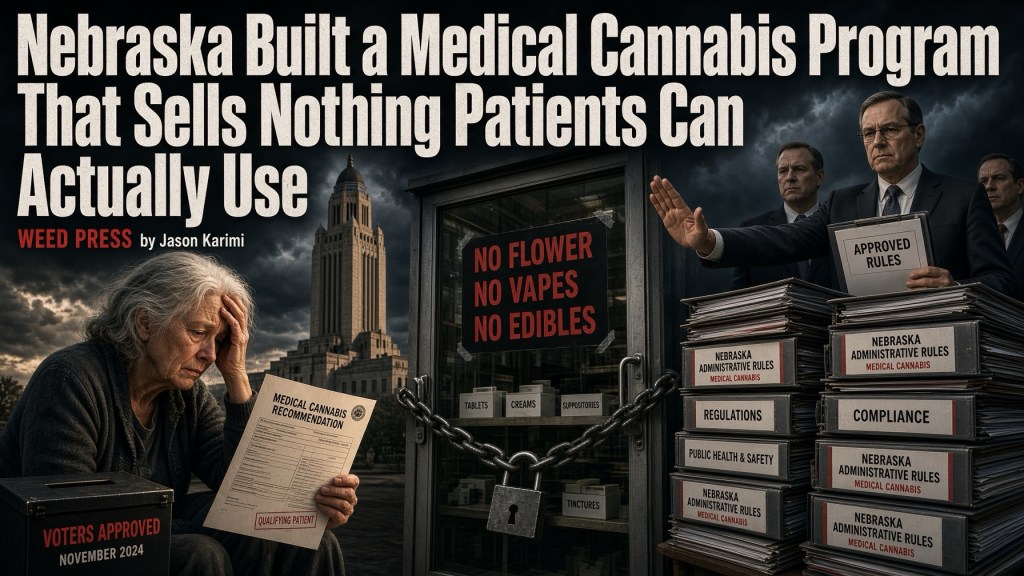
Nebraska voters approved a medical cannabis law that lets qualified patients possess up to five ounces. The Nebraska Medical Cannabis Commission then adopted permanent rules that ban several familiar forms of medical cannabis, including flower, vaping products, and infused foods, while the regulated supply chain remains incomplete.¹
Under the permanent rules approved by the Attorney General on June 30 and the Governor on July 1, 2026, dispensaries may sell only oral tablets, capsules, tinctures, gels, oils, creams and other topicals, suppositories, transdermal patches, nasal sprays, and liquids or oils for a nebulizer or inhaler.² They may not sell raw plant material, any product administered by smoking, combustion, or vaping, or any food or drink that has cannabis baked, mixed, or otherwise infused into it.³ Products are also limited by potency and dose restrictions set in the rules.⁴
Initiative 437, the Nebraska Medical Cannabis Patient Protection Act, protects a qualified patient from state and local penalties for the use, possession, and acquisition of up to five ounces of cannabis with a written recommendation from a health care practitioner.⁵ Initiative 438 created the Commission and defined “cannabis products” as products “comprised of cannabis, cannabis concentrate, or cannabis extract, and other ingredients, and that are intended for use or consumption, such as, but not limited to, edible products, ointments, and tinctures.”⁶ The same statute defined “cannabis accessories” to include equipment designed for use in vaporizing or for ingesting, inhaling, or otherwise introducing cannabis into the human body.⁷
The Commission’s rules prohibit dispensaries from selling raw cannabis flower, products administered by smoking or vaping, and cannabis-infused foods and beverages. Those restrictions exclude edible products expressly contemplated by the voter-approved definition of cannabis products and prohibit vaporized cannabis preparations, even though the statutory definition of cannabis accessories expressly contemplates vaporizing cannabis.
The Commission has authority under Neb. Rev. Stat. §§ 71-24,110 and 71-24,111 to regulate registered establishments and adopt rules. The unresolved legal question is how far that authority extends when the rules prohibit entire categories of products contemplated by the initiatives.
The Marijuana Policy Project has stated that the rules “contradict and eviscerate” the initiatives by banning raw cannabis, vaporized products, and edibles.⁸ NORML has likewise criticized restrictions on botanical cannabis as inconsistent with the access voters approved. In July 2025, NORML Deputy Director Paul Armentano publicly challenged the Commission’s earlier emergency rules restricting botanical cannabis.⁹
The practical result is a program without a functioning commercial supply. Cultivators have been licensed and at least one is nearing harvest, but the Commission has not yet established the manufacturer and dispensary licensing necessary to convert cannabis into the permitted products and sell them through a functioning regulated market.¹⁰
According to October 14 reporting by the Nebraska Examiner, the Commission has identified a lack of statutory authority to license testing laboratories.¹¹
The Commission scheduled a public hearing for October 15 on proposed amendments to its regulations, including licensing and fee provisions. The hearing does not itself repeal the existing restrictions on flower, vaping products, or infused foods. Written comments on the proposed amendments are accepted through 11:59 p.m. Central at mcc.contact@nebraska.gov.¹²
Nebraska voters protected qualifying patients’ possession and acquisition of medical cannabis and created a commission to regulate its commercial supply. Nearly two years later, the state has licensed cultivators but has not established a functioning system of manufacturers and dispensaries delivering regulated products to patients.
The Commission’s rules also exclude flower, vaping products, and cannabis-infused foods from that future market. Whether those restrictions fall within the authority voters granted the Commission remains a separate legal question.
For patients, the immediate distinction is simpler: Nebraska has recognized their right to possess qualifying medical cannabis without yet providing an operational regulated market through which to obtain it.
¹ Nebraska Medical Cannabis Commission, 238 Neb. Admin. Code ch. 1, § 013.09 (2026).
² Id. § 013.09(A).
³ Id. § 013.09(B)(i)–(iv).
⁴ Id. § 013.09(B).
⁵ Neb. Rev. Stat. §§ 71-24,104(1), 71-24,105(1) (Initiative Law 2024, No. 437).
⁶ Neb. Rev. Stat. § 71-24,107(4) (Initiative Law 2024, No. 438).
⁷ Id. § 71-24,107(2).
⁸ Marijuana Policy Project, Comments on Nebraska Medical Cannabis Regulations (Feb. 26, 2026), https://www.mpp.org/assets/pdf/states/nebraska/nebraska-medical-cannabis-regulations-comments.pdf.
⁹ Nebraska: Regulators Enact Emergency Rules Repealing Patients’ Access to Botanical Cannabis, NORML (July 2, 2025), https://norml.org/blog/2025/07/02/nebraska-regulators-enact-emergency-rules-repealing-patients-access-to-botanical-cannabis/.
¹⁰ Zach Wendling, Advocates, Nebraska Medical Cannabis Commission Continue to Clash, Nebraska Examiner (Oct. 14, 2026), https://nebraskaexaminer.com/2026/10/14/advocates-nebraska-medical-cannabis-commission-continue-to-clash-over-agencys-direction/; Nebraska Medical Cannabis Commission, Rules & Regulations, https://mcc.nebraska.gov/rules-regulations.
¹¹ Wendling, supra note 10.
¹² Nebraska Medical Cannabis Commission, Public Hearing (Oct. 15, 2026), https://mcc.nebraska.gov/about-us/events/2026/public-hearing.


Leave a Reply