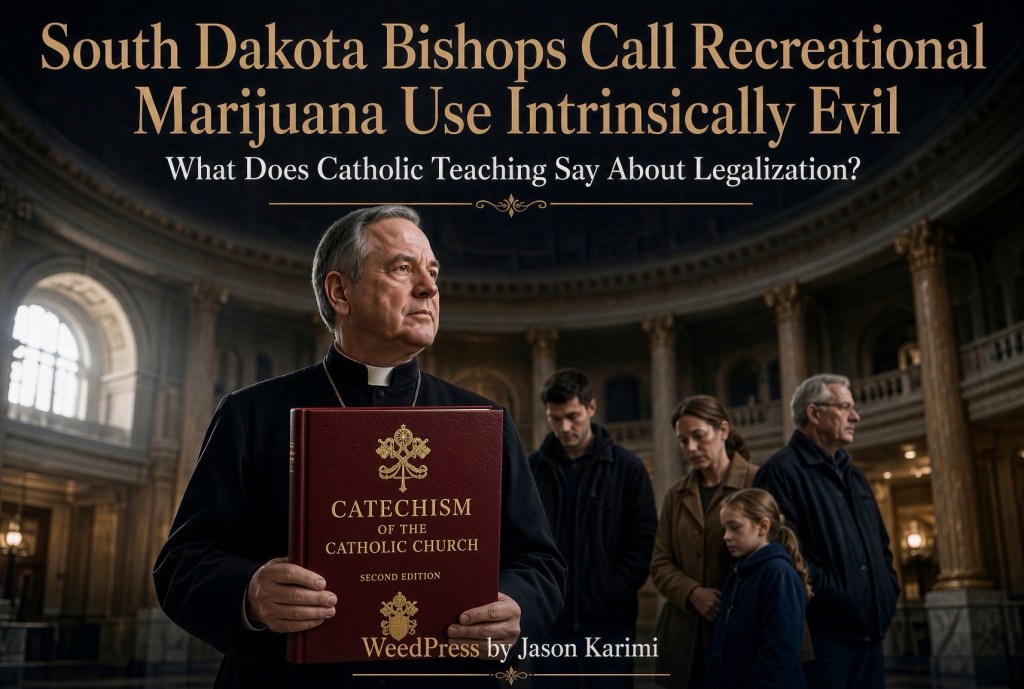
Does Catholic teaching necessarily condemn the legalization of a regulated adult-use market, or does it condemn the underlying non-therapeutic use while leaving room for different judgments about public policy?
On October 16, 2026, Bishops Donald E. DeGrood of Sioux Falls and Scott E. Bullock of Rapid City issued a joint statement supporting Amendment L, a proposed constitutional amendment that would raise the threshold for future constitutional changes to 60 percent.¹ In explaining why they have previously taken positions on certain ballot measures, the bishops wrote:
“We have in the past taken positions on ballot measures that had an objective moral content, such as measures to legalize abortion and recreational marijuana. We opposed these measures as they would have promoted behavior that, according to the Catholic Magisterium, is intrinsically evil.²”
The sentence places recreational marijuana legalization in the same category of “objective moral content” as abortion measures. It does so by reference to the Catholic magisterium. The principal text that supports that reference is paragraph 2291 of the Catechism of the Catholic Church:
“The use of drugs inflicts very grave damage on human health and life. Their use, except on strictly therapeutic grounds, is a grave offense. Clandestine production of and trafficking in drugs are scandalous practices. They constitute direct co-operation in evil, since they encourage people to practices gravely contrary to the moral law.³”
The paragraph contains two related but distinct claims. The first is that the non-therapeutic use of drugs is a grave offense. The second is that clandestine production and trafficking are scandalous because they encourage that use. The paragraph also contains an express exception for use on “strictly therapeutic grounds.”
The South Dakota bishops have applied this framework to recreational measures before. In August 2022 they opposed Initiated Measure 27, which would have legalized possession, use, and distribution of marijuana for any purpose. Their statement cited CCC 2291 and argued that the measure threatened harms to individuals, families, and the state.⁴ In June 2024 they opposed Initiated Measure 29 on similar grounds, emphasizing public-health and common-good concerns, including effects on youth and mental health.⁵
The bishops have offered public-health and common-good arguments against recreational legalization. Their statements, however, do not separately explain whether the Catechism’s specific condemnation of clandestine production and trafficking applies in the same way to a licensed, inspected commercial market. The distinction does not eliminate their objection to non-therapeutic drug use; it raises a separate question about the moral evaluation of legalization and regulation.
South Dakota has operated a voter-approved medical cannabis program under chapter 34-20G since 2021.⁶ The bishops have not argued that medical use under that program is illicit. Their opposition has been directed at measures that would authorize non-therapeutic use. The distinction in CCC 2291 turns on the purpose and circumstances of use, not simply the chemical identity of the product. But that leaves a practical question for South Dakota’s existing medical program: how do the bishops distinguish strictly therapeutic cannabis use from non-therapeutic use, and what significance do they assign to the state’s medical certification system?
A related text in the same section of the Catechism addresses alcohol. Paragraph 2290 states that the virtue of temperance disposes persons to avoid every kind of excess, including the abuse of alcohol, and that those who endanger themselves or others by drunkenness incur grave guilt.⁷ The paragraph does not treat moderate alcohol use as a grave offense. The bishops’ statements on recreational marijuana have not explained why cannabis is placed categorically under the prohibition in 2291 while alcohol is analyzed under the temperance framework in 2290. The distinction may reflect historical judgments about particular substances. It is not elaborated in the South Dakota bishops’ ballot-measure statements.
The October 16 statement on Amendment L itself draws a distinction between measures with objective moral content and questions of political process on which Catholics acting in good faith may reach different conclusions.⁸ Catholic teaching can condemn particular conduct while leaving the practical consequences of a ballot measure open to prudential judgment. The difficult issue is whether—and to what extent—that distinction applies to recreational marijuana legalization.
The October 16 statement uses the recreational-marijuana reference to illustrate the category of measures the bishops have judged to possess “objective moral content.” CCC 2291 supplies the bishops’ stated ground for treating non-therapeutic use as a grave offense. It does not, by its own terms, spell out every conclusion about how a state should regulate a market once non-therapeutic use is judged illicit. Those are questions the bishops’ application leaves open.
The proliferation of dangerous synthetic unregulated cannabinoids is the explicit tragic consequence of states prohibiting themselves from regulating cannabis and opting to attempt to prohibit cannabinoids/THC entirely. The middle ground of effective drug policy with moral consistency remains to be reached…for now. Legalization, where states regulate safely products so the market doesn’t go nuts, is in my opinion the solution, and the only moral one. And it applies to all drugs. Otherwise college kids making research chemicals lead to my friends teenage kids risking death. Because abstinence only doesn’t stop experimentation, and policy created these markers by moralizing the issue instead of regulating it towards safety and now we have had drug crises to deal with, scapegoating China or Mexico for exploiting these policy failures notwithstanding.
This issue isn’t about the obvious immorality of harming your body through drug and alcohol abuse. It is the question of how policy leads to consequences via the hidden hand of the market, incentives, and whether we are actively implementing effective government regulations to treat and help addicts or are instead incentivizing creations of new deadlier substances by misguided drug policy that stops annoying addiction and replaces it with drug overdose death. Cold, callous, cruel.
Missing the point entirely of effective regulation – which we don’t have, we have an ineffective enforcement regime openly tolerating cannabis hemp sales in South Dakota – opining on the morality of drug abuse or marijuana abuse leaves the churches out of the game of fighting drugs and instead leaves them the unwitting enablers of drug market profit incentives. Incentives…which creates profitable synthetic substances, constantly evolving markets, and will keep doing so, until clergy, provides moral consistency. Ducking the merits and playing holier than thou on the souls of addicts has failed for decades.
Crackdowns are half of a solution. Only by removing the incentives creating these new drug chemicals in the first place is worth investigating and researching.
Effective and successful Catholic approvable drug regulations are best exampled in Portugal. The worst example, and an abject failure, is in Oregon. The following two articles explain why.
https://mises.org/mises-wire/oregon-problem-its-not-drugs-its-socialistic-political-culture
Article one explains how drug abuse plummeted following state intervention (not prohibition – intervention and regulations), and the second Mises article by Mark Thornton explains the authors who wrote drug laws in Oregon wrote them poorly by leaving out private property considerations.
Footnotes
¹ Joint Statement of the Bishops of the Roman Catholic Dioceses of South Dakota on Amendment L (Oct. 16, 2026), https://sfcatholic.org/bishop-degrood/joint-statement-of-the-bishops-of-the-roman-catholic-dioceses-of-south-dakota-on-amendment-l/.
² Id.
³ Catechism of the Catholic Church ¶ 2291 (2d ed. 1997).
⁴ Statement of the Bishops of South Dakota in Opposition to Marijuana Legalization (Aug. 22, 2022), https://sdfamilyvoice.org/2022/09/07/statement-of-the-bishops-of-south-dakota-in-opposition-to-marijuana-legalization/.
⁵ Joint Statement of the Spiritual Leaders of the Roman Catholic Dioceses of South Dakota on Ballot Measure to Legalize Marijuana (June 6, 2024), https://sfcatholic.org/bishop-degrood/joint-statement-of-the-spiritual-leaders-of-the-roman-catholic-dioceses-of-south-dakota-on-ballot-measure-to-legalize-marijuana/.
⁶ See S.D. Codified Laws ch. 34-20G (medical cannabis).
⁷ Catechism of the Catholic Church ¶ 2290 (2d ed. 1997).
⁸ Joint Statement of the Bishops of the Roman Catholic Dioceses of South Dakota on Amendment L, supra note 1.


Leave a Reply