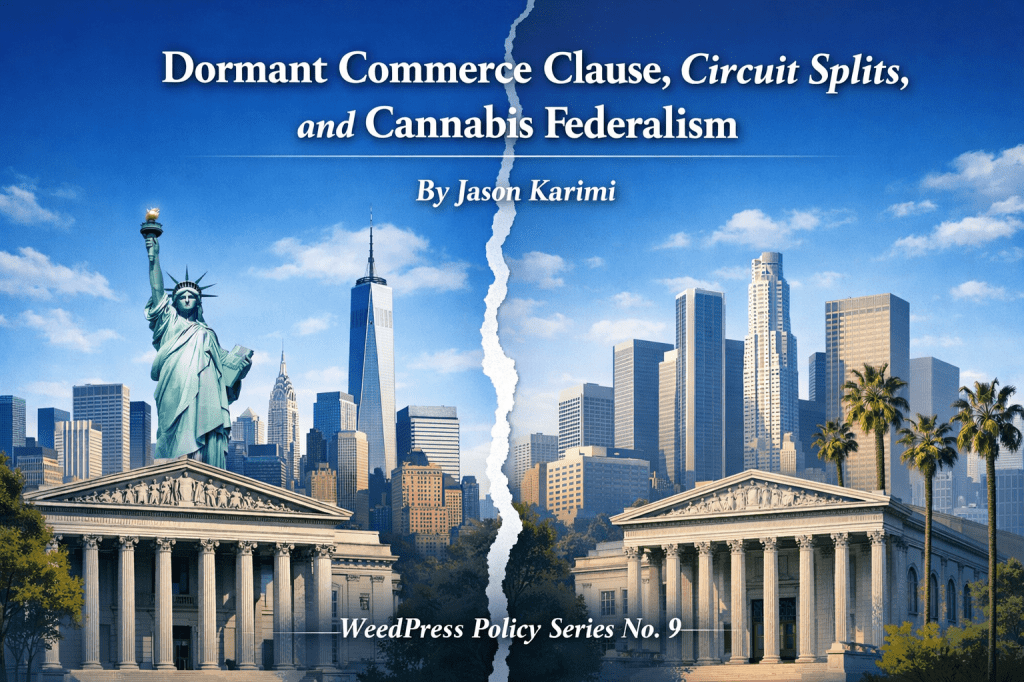
Dormant Commerce Clause, Preemption, and Cannabis Rescheduling
By Jason Karimi | WeedPress Policy Series No. 9
February 2026
The prior essays examined how modern administrative law constrains federal cannabis reform through doctrines of delegation, deference, and procedural review.
If marijuana is rescheduled under the Controlled Substances Act (CSA), however, a different constitutional doctrine may move to the foreground: the Dormant Commerce Clause — and potentially Supremacy Clause preemption.
Rescheduling does not merely alter federal criminal exposure. It may destabilize state regulatory systems built on geographic exclusion.
⸻
I. The Constitutional Baseline
The Commerce Clause grants Congress authority to regulate interstate commerce.¹ From that affirmative grant, the Supreme Court has inferred a negative implication: the Dormant Commerce Clause (DCC).²
The doctrine prohibits states from enacting laws that discriminate against or unduly burden interstate commerce.
As the Supreme Court has explained:
“The Commerce Clause… prohibits state laws that discriminate against interstate commerce.”³
When discrimination is facial:
“State laws that discriminate against interstate commerce are virtually per se invalid.”⁴
The state must demonstrate (1) a legitimate local purpose, and (2) that no reasonable nondiscriminatory alternatives exist.⁵
This is an exacting standard.
⸻
II. Cannabis and the Federal Illegality Argument
Before rescheduling, states defending residency requirements have argued that because marijuana remains illegal under federal law, there is no lawful interstate market for the Dormant Commerce Clause to protect.
Federal courts have divided on that question.
A. The First Circuit: DCC Applies
In Northeast Patients Group v. United Cannabis Patients & Caregivers of Maine, the First Circuit held that Maine’s residency requirement for medical cannabis licenses violated the Dormant Commerce Clause.⁶
The court rejected the “federal illegality eliminates DCC scrutiny” theory:
“Congress has not authorized the States to engage in protectionist discrimination in the market for medical marijuana.”⁷
It further explained:
“The CSA does not purport to authorize Maine to discriminate against out-of-state residents.”⁸
The First Circuit thus held that federal prohibition does not immunize discriminatory state licensing regimes.
⸻
B. The Second Circuit: Variscite Affirmed
In Variscite NY One, Inc. v. New York State Office of Cannabis Management, a federal district court enjoined New York’s residency-based licensing scheme.⁹
The court held that the program likely violated the Dormant Commerce Clause:
“New York’s CAURD program facially discriminates against interstate commerce.”¹⁰
It rejected the argument that federal illegality insulated the state:
“The Dormant Commerce Clause applies even in markets that are subject to federal prohibition.”¹¹
In 2025, the Second Circuit affirmed the application of DCC scrutiny to cannabis licensing restrictions, reinforcing the First Circuit’s approach.¹²
Together, the First and Second Circuits treat cannabis markets as subject to Dormant Commerce Clause constraints despite federal prohibition.
⸻
C. The Ninth Circuit: DCC Inapplicable
In January 2026, however, the Ninth Circuit reached the opposite conclusion.
In Peridot Tree WA, Inc. v. Washington State Liquor & Cannabis Control Board, the court held that the Dormant Commerce Clause does not apply to cannabis residency restrictions because marijuana remains federally prohibited.¹³
The Ninth Circuit reasoned that:
Because Congress has criminalized interstate marijuana commerce under the CSA, there is no lawful interstate market to protect under the Dormant Commerce Clause.
This holding creates a direct circuit split with the First Circuit and with the Second Circuit’s treatment of Variscite.
⸻
III. The Emerging Circuit Split
The divide is now clear:
- First Circuit (2022): DCC applies despite federal illegality.
- Second Circuit (2025): DCC scrutiny applies to cannabis residency rules.
- Ninth Circuit (2026): DCC does not apply because federal law prohibits interstate marijuana commerce.
This split substantially increases the likelihood of Supreme Court review.
If marijuana is rescheduled to Schedule III, the constitutional baseline may shift again — potentially weakening the Ninth Circuit’s reasoning.
Even under the Ninth Circuit’s approach, rescheduling would alter the “federal illegality” premise on which its decision rests.
The analysis in this essay therefore remains directly applicable in circuits following the First and Second Circuit approach, and potentially more broadly if rescheduling changes the legal landscape.
⸻
IV. Supreme Court Analogues
The Supreme Court’s alcohol jurisprudence remains instructive.
In Tennessee Wine & Spirits Retailers Ass’n v. Thomas, the Court invalidated a two-year residency requirement for liquor licenses.¹⁴
Even though the Twenty-First Amendment grants states substantial authority over alcohol regulation, the Court held:
“Protectionism, whether targeted at out-of-state residents or at nonresident corporations, is not a legitimate state interest.”¹⁵
Cannabis lacks even the constitutional reinforcement afforded alcohol.
If alcohol residency rules cannot survive scrutiny, cannabis residency rules face serious vulnerability in jurisdictions applying DCC doctrine.
⸻
V. Pike Balancing
Where a cannabis law is nondiscriminatory but burdens interstate commerce incidentally, courts apply Pike v. Bruce Church, Inc.¹⁶
A statute will be invalid if:
“The burden imposed on such commerce is clearly excessive in relation to the putative local benefits.”¹⁷
Post-rescheduling, plaintiffs may argue that:
- Caps on out-of-state capital;
- Restrictions on interstate supply chains;
- Ownership residency requirements;
impose excessive burdens relative to asserted local benefits.
⸻
VI. Rescheduling as Constitutional Inflection Point
If marijuana moves to Schedule III:
- Federal registration under 21 U.S.C. § 823 becomes available;
- Medical use is federally acknowledged;
- Federal criminal penalties change;
- Interstate research expands;
- Section 280E tax treatment changes.
At that point, the “no lawful interstate market exists” rationale becomes materially weaker.
Federal recognition of lawful handling alters the constitutional baseline.
The Ninth Circuit’s reasoning in Peridot Tree rests explicitly on continued federal prohibition. Rescheduling would complicate that foundation.
⸻
VII. Supremacy Clause and Preemption
Beyond the Dormant Commerce Clause, rescheduling raises preemption questions.
The Supremacy Clause provides that federal law “shall be the supreme Law of the Land.”¹⁸
The CSA contains an express preemption clause:
State law is not preempted “unless there is a positive conflict… so that the two cannot consistently stand together.”¹⁹
Courts recognize three forms of preemption:
1. Express preemption
2. Field preemption
3. Conflict preemption
See Arizona v. United States.²⁰
Rescheduling could create arguments that:
- State residency barriers frustrate federal registration schemes;
- Geographic exclusion conflicts with federally authorized distribution;
- State restrictions stand as obstacles to federal medical-use determinations.
Under obstacle preemption analysis, courts ask whether state law stands as an obstacle to the accomplishment of full federal purposes.²¹
This inquiry may intensify if federal law formally recognizes lawful handling of marijuana.
⸻
VIII. Litigation Pathways
Dormant Commerce Clause and preemption challenges would proceed in federal district courts.
Plaintiffs may include:
- Out-of-state license applicants
- Multistate operators
- Interstate research entities
- Capital investors
Relief could include:
- Preliminary injunctions
- Declaratory judgments
- Invalidation of residency requirements
- Structural market restructuring
If the Supreme Court grants certiorari to resolve the circuit split, the constitutional status of cannabis residency restrictions could be definitively clarified.
⸻
Conclusion
Rescheduling is often framed as tax reform or criminal reform.
It may instead become a federalism event.
The Dormant Commerce Clause does not turn on political motive. It turns on economic structure.
The Ninth Circuit has held that federal prohibition blocks DCC scrutiny.
The First and Second Circuits have held the opposite.
That split now places the issue on a potential Supreme Court trajectory.
If marijuana moves into a federally recognized regulatory category, the constitutional shield around geographic protectionism may erode.
Delegation exists.
Judicial scrutiny intensifies.
Federalism recalibrates.
The next wave of cannabis litigation may not be about scheduling — but about borders.
⸻
Footnotes
1. U.S. Const. art. I, § 8, cl. 3.
2. See Granholm v. Heald, 544 U.S. 460, 472 (2005).
3. Id.
4. Id. at 476.
5. Id. at 489.
6. Northeast Patients Group v. United Cannabis Patients & Caregivers of Me., 45 F.4th 542 (1st Cir. 2022).
7. Id. at 550.
8. Id. at 553.
9. Variscite NY One, Inc. v. N.Y. State Off. of Cannabis Mgmt., 640 F. Supp. 3d 232 (N.D.N.Y. 2022).
10. Id. at 243.
11. Id. at 242.
12. Variscite NY One, Inc. v. N.Y. State Off. of Cannabis Mgmt., 2d Cir. 2025 (affirming application of DCC scrutiny).
13. Peridot Tree WA, Inc. v. Wash. State Liquor & Cannabis Control Bd., 9th Cir. Jan. 2026.
14. Tennessee Wine & Spirits Retailers Ass’n v. Thomas, 588 U.S. 504 (2019).
15. Id. at 535.
16. Pike v. Bruce Church, Inc., 397 U.S. 137 (1970).
17. Id. at 142.
18. U.S. Const. art. VI, cl. 2.
19. 21 U.S.C. § 903.
20. Arizona v. United States, 567 U.S. 387, 399 (2012).
21. Hines v. Davidowitz, 312 U.S. 52, 67 (1941).
WeedPress Policy Series
No. 1 — Legal Memorandum: Common Misconceptions in Cannabis Activism Regarding Federal Drug Law (January 25, 2026)
No. 2 — The Path to a Religious Cannabis Exemption: How Medical Cannabis Systems Change the RFRA Equation (January 27, 2026)
No. 3 — Structural Contradictions and Prospective Litigation Risk in Post-Rescheduling Cannabis Policy (February 6, 2026)
No. 4 — The Controlled Substances Act Is Not a Blunt Instrument — It Is an Architecture of Exceptions (February 13, 2026)
No. 5 — The Limits of § 822(d): What It Does — and Does Not — Authorize (February 13, 2026)
No. 6 — The Major Questions Doctrine and Cannabis Reform: Delegation, Scale, and Judicial Review (February 14, 2026)
No. 7 — Chevron’s Collapse and Cannabis Regulation: Judicial Review After Loper Bright (February 17, 2026)
No. 8 — Administrative Procedure Act Vulnerabilities in DEA Rescheduling(February 20, 2026)
No. 9 – No. 9 — Dormant Commerce Clause, Circuit Splits, and Cannabis Federalism (February 23, 2026)
No. 10 — Federal Preemption After Rescheduling: Conflict, Obstacle, and Cannabis Federalism (February 27, 2026)
No. 11 — Equal Protection and Economic Protectionism in Cannabis Licensing: Classification, Remedial Design, and Constitutional Limits (March 3, 2026)
No. 12 — Federal Rescheduling as a Preemption Trigger: Rational Basis, Conflict, and State Schedule I Exposure(March 6, 2026).
No. 13 — Criminal Prosecution After Federal Medical Recognition: Motions Practice, Rational Basis, and Schedule I Litigation Exposure (March 10, 2026).
About Weedpress Policy Series
The Weedpress Policy Series publishes in-depth, citation-supported analysis of federal cannabis law, regulatory policy, and enforcement practices. The series is designed to provide lawmakers, attorneys, journalists, and stakeholders with legally grounded, non-activist, non-promotional analysis focused on statutory reality and institutional accountability.
Weedpress Policy Series emphasizes:
• Federal statutory interpretation
• Congressional intent and legislative history
• Treaty and international law implications
• Administrative law and agency authority
• Oversight of enforcement discretion and regulatory gaps
 WeedPress: The Paper Trail
Leave a comment