Category: WeedPress Policy Series
-
Deep Dive: Legal Research On Federal Barriers For State Patients And Veterans
Re: How a federal rule locks a state patient out, and what the Committee can forward History of the state statuteThe South Dakota Controlled Substances Act was enacted in 1970, the same year as the federal Act. Schedule I still requires no accepted medical use. The Department recommends. The Legislature reschedules.https://weedpress.org/2026/03/24/the-south-dakota-controlled-substances-act-legislative-architecture-intent-and-institutional-design-in-a-potential-federal-rescheduling-context/ The treaty changeIn December…
-
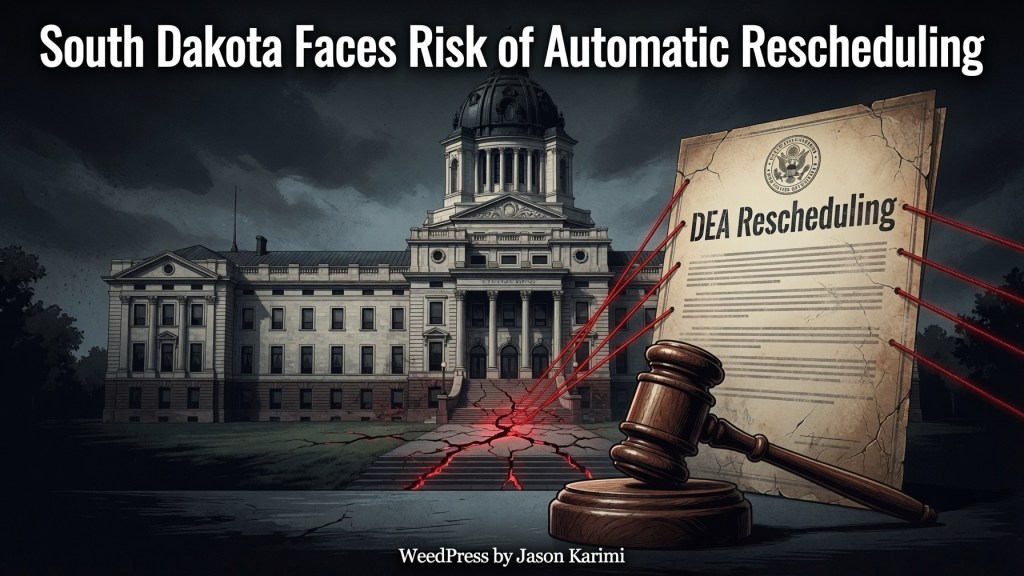
South Dakota Faces Risk of Automatic Rescheduling Under Existing Statutory Language
The recent action by Wyoming’s Attorney General demonstrates that states are increasingly recognizing the legal significance of federal marijuana rescheduling where state statutes incorporate federal scheduling decisions. South Dakota’s existing statutory language raises similar questions that should be addressed before federal reform takes effect. WeedPress has previously warned that South Dakota law contains automatic trigger…
-

South Dakota Protects Free Speech With New Anti-SLAPP Law
I’m a prisoner? locked up for what?Freedom of Speech? ain’t that all we’ve got? – Stephen Marley https://www.youtube.com/watch?v=zuGNzfXG9Gw April 17, 2026 For years, South Dakota had a hole in its legal architecture that should have embarrassed any state claiming to respect free speech. If someone with money, status, or institutional backing wanted to punish a…
-

South Dakota Cannabis Banking: The Persistent Cash Problem Behind the Claims
“If you’re gonna take the risk, you gotta do the frisk.” – ZipTrader Charlie South Dakota’s medical cannabis program has always operated under a difficult reality: while the state legalized medical access, the federal government still treats cannabis as a Schedule I substance (with only partial movement to Schedule III for state-regulated products in 2026).…
-

5 Things to Know About the June 29 DEA Cannabis Rescheduling Hearing
If you want to know how WeedPress became the smartest, best looking without filters, and best informed cannabis activist in South Dakota, it’s because of zoom meetings about federal exemption procedures with Vicente years ago. Use them. Retain them. They have unheard of knowledge on cannabis laws amongst lawyers in this country. Believe me, WeedPressers…
-
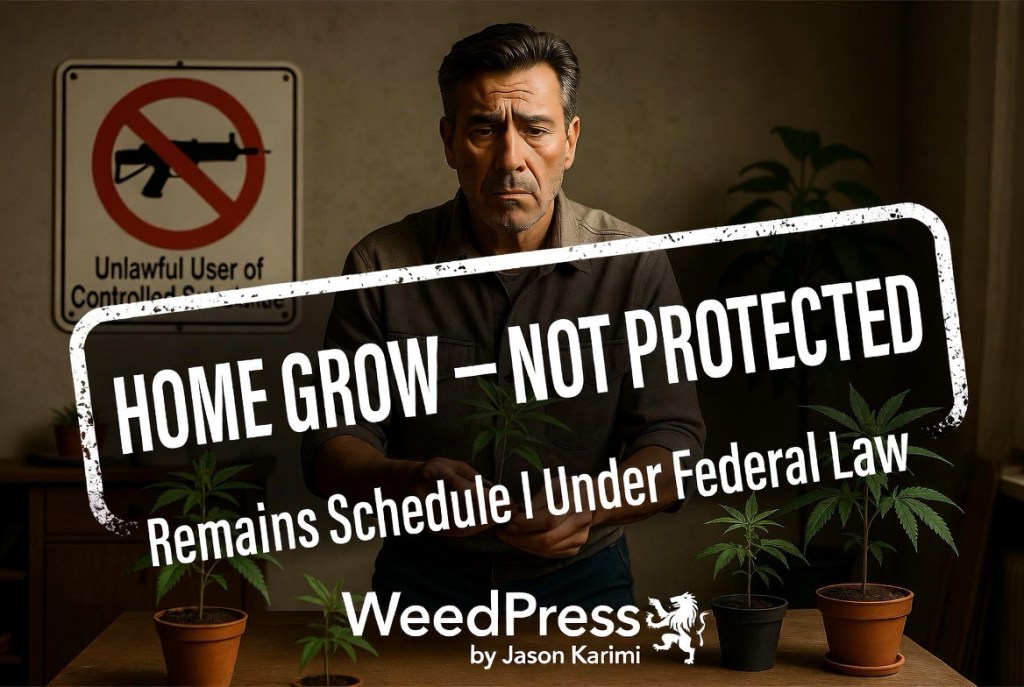
ILLEGAL: Homegrown Cannabis Remains Outside Federal Schedule III Protections — An Open Question With Real Consequences for Patients
The April 28, 2026 federal partial rescheduling order moved only two narrow categories of marijuana from Schedule I to Schedule III: certain FDA-approved products and marijuana produced under qualifying state-issued medical marijuana licenses.¹ Personal home cultivation was not included in either category. This creates a significant gap. In states that permit limited home growing for…
-
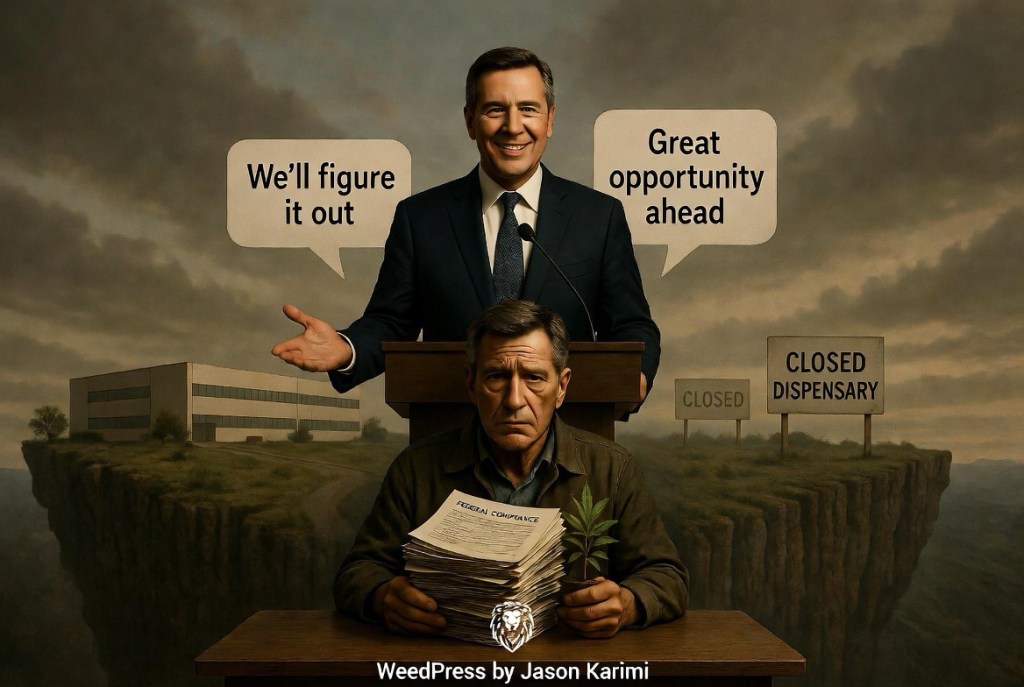
South Dakota Small Cannabis Operators Face a Compliance Cliff: Federal Rescheduling Likely to Drive More Closures and Force Consolidation
The collapse of recreational legalization efforts in South Dakota already triggered a wave of dispensary closures. At least eight licensed medical cannabis businesses shuttered in late 2024 and early 2025 amid falling cardholder numbers, intense price competition, and regulatory pressures.¹ “Then it was a race to the bottom on pricing,” one industry participant observed as…
-

Medical Marijuana State Protections: The Full 12-Year History of the Appropriations Rider and Iowa’s Delegation Voting Record
Every year since 2014, Congress has included a critical appropriations rider — commonly known as the Rohrabacher-Farr Amendment (and its successors) — that prohibits the Department of Justice from using federal funds to interfere with states that have legalized medical marijuana. This bipartisan protection has been renewed in every major appropriations bill, ensuring that state…
-
Advance Notice to South Dakota Department of Health: Petition for Scheduling Review Will Follow Federal Rescheduling Hearings
South Dakota’s medical cannabis program stands at a critical juncture following the federal partial rescheduling of certain marijuana products to Schedule III.¹ After the DEA’s June 29, 2026 rescheduling hearing concludes, the undersigned will formally petition the South Dakota Department of Health (DOH) to review and align the state’s Schedule I classification of marijuana with…
-

WeedPress Proved Harvard Law Review Wrong: The Controlled Substances Act Is an Architecture of Exemptions — and History Just Proved It
For nearly two decades WeedPress has argued that the Controlled Substances Act is not a rigid prohibition statute but an architecture of exemptions — a flexible regulatory framework deliberately designed to allow medical, research, and other carve-outs while maintaining federal control.¹ A recent Harvard Law Review article largely missed this central feature of the statute.²…
-
Why South Dakota’s Own Statutes Now Make Schedule I Marijuana Unlawful to Maintain
“Acting Attorney General Todd Blanche is placing both FDA-approved drug products containing marijuana, and medicinal marijuana products subject to a qualifying state-issued license in Schedule III under his authority to reschedule drugs to carry out the United States’ obligations under the Single Convention on Narcotic Drugs.”¹ South Dakota, however, is not automatically bound by that…
-

South Dakota’s Schedule I Marijuana Prohibition Heads to Court This Summer: Lawsuit Will Seek Declaration That State Law No Longer Satisfies Its Own Criteria
This summer I intend to file a civil action against the State of South Dakota seeking a judicial declaration that the state’s Schedule I classification of marijuana no longer satisfies the statutory criteria required for Schedule I placement under South Dakota law.¹ The claim is straightforward: once the factual predicate of “no accepted medical use”…
-
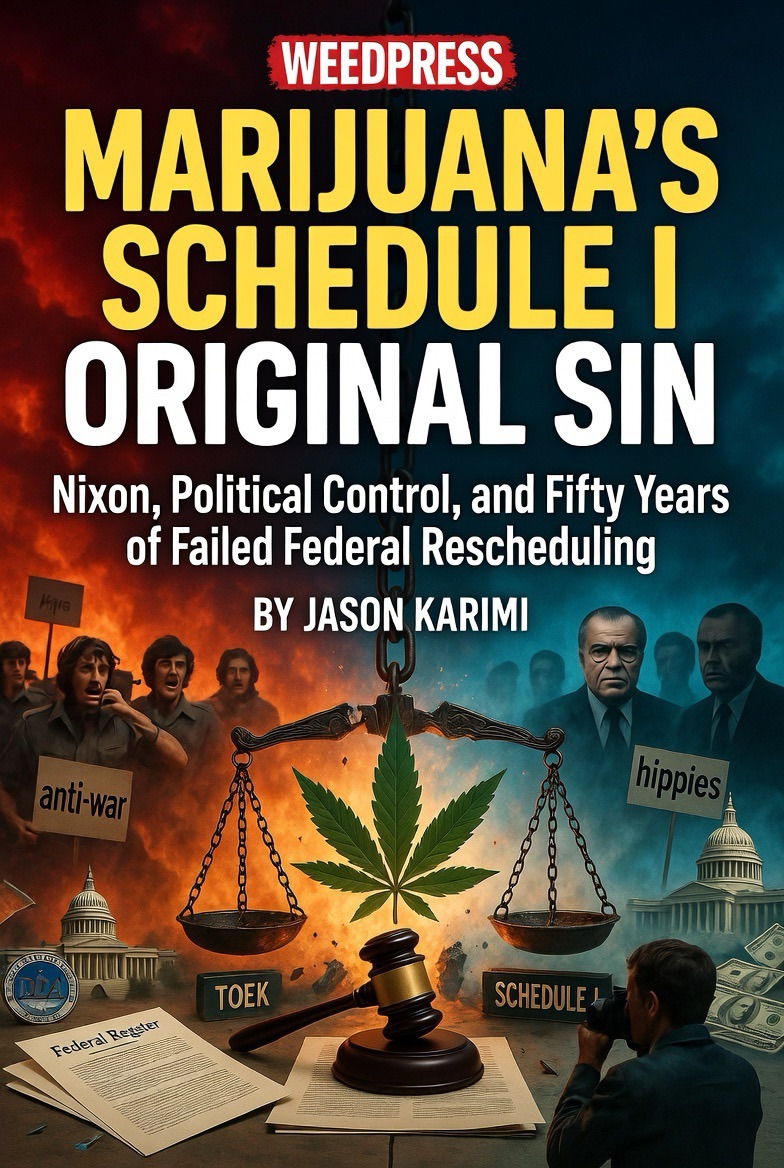
Marijuana’s Schedule I Original Sin: Nixon, Political Control, and Fifty Years of Failed Federal Rescheduling
April 23, 2026 Marijuana’s federal Schedule I status was never just a scientific judgment. It was born at the intersection of bureaucracy, racial politics, antiwar backlash, and executive power. The Controlled Substances Act placed marijuana in Schedule I in 1970, the most restrictive category in federal drug law, reserved for substances deemed to have a…
-
No. 19 — Religious Accommodation in Medical-Only Cannabis States
No. 19 — Religious Accommodation in Medical-Only Cannabis States: Structural Litigation Risk and Legislative Design By Jason Karimi | WeedPress Policy Series No. 19April 20, 2026 ⸻ I. Introduction: The Unaddressed Gap Medical-only cannabis states operate within a tightly regulated framework. Cultivation is limited. Home grows require registration. Plant counts are capped. Inspections are authorized.…
-
No. 18 — Federal Question Preservation in State Cannabis Prosecutions
April 15, 2026 ⸻ I. Introduction: The Structural Risk No One Discusses Cannabis litigation frequently turns on constitutional arguments. Yet many disputes fail not because the constitutional theory is weak, but because the federal question was not properly preserved. In state prosecutions, litigation sequencing determines whether a federal issue survives long enough to reach meaningful…
-
No. 17 — Federal Rescheduling and State Statutory Insulation: Indiana as a Case Study in Vertical Federalism Design
No. 17 — Federal Rescheduling and State Statutory Insulation: Indiana as a Case Study in Vertical Federalism Design By Jason Karimi | WeedPress Policy Series No. 17April 7, 2026 ⸻ When the federal government signals that marijuana may be rescheduled under the Controlled Substances Act, public debate gravitates toward legalization politics. That is the wrong…
-
No. 16 — The Dormant Commerce Clause After Cannabis Rescheduling: Interstate Market Protectionism and Constitutional Pressure
Cannabis reform is not a culture war — it is the most active federalism stress test in modern constitutional law. No. 16 — The Dormant Commerce Clause After Cannabis Rescheduling: Interstate Market Protectionism and Constitutional Pressure Horizontal Federalism in Emerging Cannabis Markets By Jason Karimi | WeedPress Policy Series No. 16 April 7, 2026 ⸻…
-

The 10 Best WeedPress Articles So Far — And the Full Links to Read Them
The 10 Best WeedPress Articles So Far — And the Full Links to Read Them By Jason Karimi | WeedPress April 4, 2026 Every publication reaches a point where its strongest work stops feeling like a pile of posts and starts feeling like an identity. WeedPress is there. Its best articles do more than react…
-
No. 15 — The Uniform Controlled Substances Act and the Architecture of Modern Drug Scheduling
No. 15 — The Uniform Controlled Substances Act and the Architecture of Modern Drug Scheduling A Structural Analysis of State Scheduling Mechanisms in a Post-Medical Recognition Era By Jason Karimi | WeedPress Policy Series No. 15 March 1st, 2026 Note: The following notes were provided from Vicente LLP and are referenced in this article: I.…
-
No. 14 – The South Dakota Controlled Substances Act: Legislative Architecture, Intent, and Institutional Design in a Potential Federal Rescheduling Context
The South Dakota Controlled Substances Act: Legislative Architecture, Intent, and Institutional Design in a Potential Federal Rescheduling Context By Jason Karimi | WeedPress Policy Series No 14 March 24, 2026 I. Introduction As previewed in WeedPress White Paper No. 1, South Dakota adopted its Controlled Substances Act (“CSA”) in 1970 as part of a broader…
-
Cannabis Federalism After Medical Recognition
Cannabis Federalism After Medical Recognition Administrative Record, Rational Basis, and Vertical Separation of Powers Jason KarimiWeedPress White Paper No. 1March 17 2026 ⸻ Executive Summary Federal acknowledgment that cannabis has “currently accepted medical use” under the Controlled Substances Act (“CSA”) would not merely reclassify a substance. It would recalibrate the constitutional and evidentiary framework within…
-
No. 13 — Criminal Prosecution After Federal Medical Recognition: Motions Practice, Rational Basis, and Schedule I Litigation Exposure
No. 13 — Criminal Prosecution After Federal Medical Recognition: Motions Practice, Rational Basis, and Schedule I Litigation Exposure By Jason Karimi | WeedPress Policy Series No. 13 | March 10, 2026 ⸻ Abstract Federal rescheduling of cannabis based on a determination of “currently accepted medical use” alters not only regulatory classifications but also the litigation…
-
No. 12 – Federal Rescheduling as a Preemption Trigger — How Acknowledged Medical Use Constrains State Schedule I Enforcement
Federal Rescheduling as a Preemption Trigger — How Acknowledged Medical Use Constrains State Schedule I Enforcement By Jason Karimi | WeedPress | March 6, 2026 ⸻ Abstract Federal cannabis rescheduling premised on a finding of “currently accepted medical use” carries implications beyond regulatory reclassification. This Article argues that formal federal acknowledgment of medical legitimacy materially…
-
No. 11 – Equal Protection and Economic Protectionism in Cannabis Licensing: Classification, Remedial Design, and Constitutional Limits
Equal Protection and Economic Protectionism in Cannabis Licensing: Classification, Remedial Design, and Constitutional Limits By Jason Karimi | WeedPress Policy Series No. 11March 3 2026 The prior essays examined how cannabis rescheduling may trigger Dormant Commerce Clause challenges and Supremacy Clause preemption disputes. But constitutional scrutiny does not arise only from interstate commerce or federal…
-
No. 10 — Federal Preemption After Rescheduling: Conflict, Obstacle, and Cannabis Federalism
No. 10 — Federal Preemption After Rescheduling: Conflict, Obstacle, and Cannabis Federalism If federal enforcement priorities shift while federal prohibition remains intact, courts will increasingly confront whether the CSA preempts state licensing structures that depend on continued federal forbearance. Whether state laws are argued as exemptions to new and changing federal CSA directives will likely…
-
No. 9 – Dormant Commerce Clause, Preemption, and Cannabis Rescheduling
Dormant Commerce Clause, Preemption, and Cannabis Rescheduling By Jason Karimi | WeedPress Policy Series No. 9February 2026 The prior essays examined how modern administrative law constrains federal cannabis reform through doctrines of delegation, deference, and procedural review. If marijuana is rescheduled under the Controlled Substances Act (CSA), however, a different constitutional doctrine may move to…
-

South Dakota’s Schedule I Problem Is Now in the Administrative Record
South Dakota’s Schedule I Problem Is Now in the Administrative Record By Jason Karimi | WeedPress February 23, 2026 Today, a formal Petition for Declaratory Ruling and Mandatory Scheduling Review of Cannabis was submitted to the South Dakota Department of Health under SDCL § 1-26-13, requesting review of marijuana’s continued placement in Schedule I. I…
-
No. 8 – Administrative Procedure Act Vulnerabilities in DEA Rescheduling
Administrative Procedure Act Vulnerabilities in DEA Rescheduling By Jason Karimi | WeedPress Policy Series No. 8February 20 2026 The prior essays examined how the Major Questions Doctrine and the collapse of Chevron deference reshape judicial review of agency action. If the Drug Enforcement Administration (DEA) undertakes significant rescheduling under the Controlled Substances Act (CSA), the…
-
No. 7 – Chevron’s Collapse and Cannabis Regulation: Judicial Review After Loper Bright
Chevron’s Collapse and Cannabis Regulation: Judicial Review After Loper Bright By Jason Karimi | WeedPress Policy Series No. 7February 2026 The prior essay examined how the Major Questions Doctrine shapes judicial scrutiny when agencies assert power over issues of vast economic or political significance. But another doctrinal shift may prove even more consequential for cannabis…
-
The RFRA Trap: Litigation Sequencing and the Structural Limits of State Religious Freedom Claims in Drug Law
The RFRA Trap: Litigation Sequencing and the Structural Limits of State Religious Freedom Claims in Drug Law Why arguing state RFRA before federal constitutional claims can foreclose Supreme Court review — and how litigation order determines survival. By Jason Karimi | WeedPress February 15, 2026 State Religious Freedom Restoration Acts are often treated as constitutional…
-
No. 6 – The Major Questions Doctrine and Cannabis Reform: Delegation, Scale, and Judicial Review
The Major Questions Doctrine and Cannabis Reform: Delegation, Scale, and Judicial Review By Jason Karimi | WeedPress Policy Series No. 6 February 14, 2026 The prior essays examined the Controlled Substances Act (CSA) as a regulatory architecture containing delegated exception authority and then clarified the limits of that delegation under 21 U.S.C. §…
-
No. 5 – The Limits of § 822(d): What It Does — and Does Not — Authorize
The Limits of § 822(d): What It Does — and Does Not — Authorize By Jason Karimi | WeedPress Policy Series #5 February 13, 2026 The prior essay argued that the Controlled Substances Act (CSA) is not a blunt prohibition instrument, but a regulatory architecture containing delegated exception authority. That structural claim warrants clarification. This…
-
No. 4 – The Controlled Substances Act Is Not a Blunt Instrument — It Is an Architecture of Exceptions
A recent Harvard Law Review–discussed argument (as reviewed in Drug Scheduling Is Institutional Design — And That Changes Everything) suggests the Controlled Substances Act (CSA) is structurally imperfect — designed for prohibition rather than regulation — and therefore in need of legislative overhaul. That framing misunderstands the statute’s architecture. The CSA was not written as…
-
No. 3 – Structural Contradictions and Prospective Litigation Risk in Post-Rescheduling Cannabis Policy
Structural Contradictions and Litigation Exposure in Post-Rescheduling Cannabis Policy By Jason Karimi | WeedPress Policy Series No. 3 February 6, 2026 ⸻ I. Executive Summary Federal rescheduling of cannabis under the Controlled Substances Act (“CSA”) alters classification but does not eliminate structural tension between federal authority and state regulatory regimes.¹ Reclassification under 21 U.S.C. §…
-
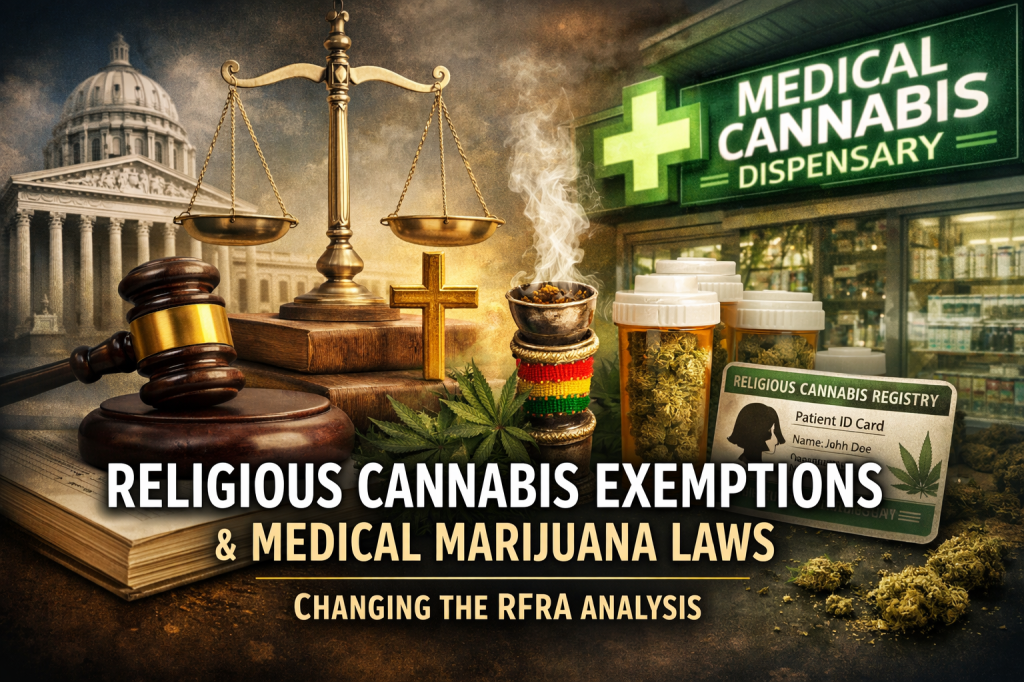
No. 2 – The Path to a Religious Cannabis Exemption: Why Medical Cannabis Systems Change the RFRA Equation
The Path to a Religious Cannabis Exemption: Why Medical Cannabis Systems Change the RFRA Equation By Jason Karimi | WeedPress Policy Series No. 2 January 27, 2026 For decades, U.S. courts have uniformly rejected claims that marijuana is protected as a religious sacrament under the First Amendment or the Religious Freedom Restoration Act (RFRA). Ethiopian…
-
No. 1 – Legal Memorandum: Common Misconceptions in Cannabis Activism Regarding Federal Drug Law
Legal Memorandum: Common Misconceptions in Cannabis Activism Regarding Federal Drug Law Jason KarimiWeedpress | January 2026 Executive Summary Public discourse surrounding cannabis reform continues to reflect widespread misunderstanding of federal drug law. In particular, cannabis advocacy frequently conflates administrative scheduling changes with legalization, underestimates the role of international treaty obligations, and overlooks existing statutory mechanisms…

