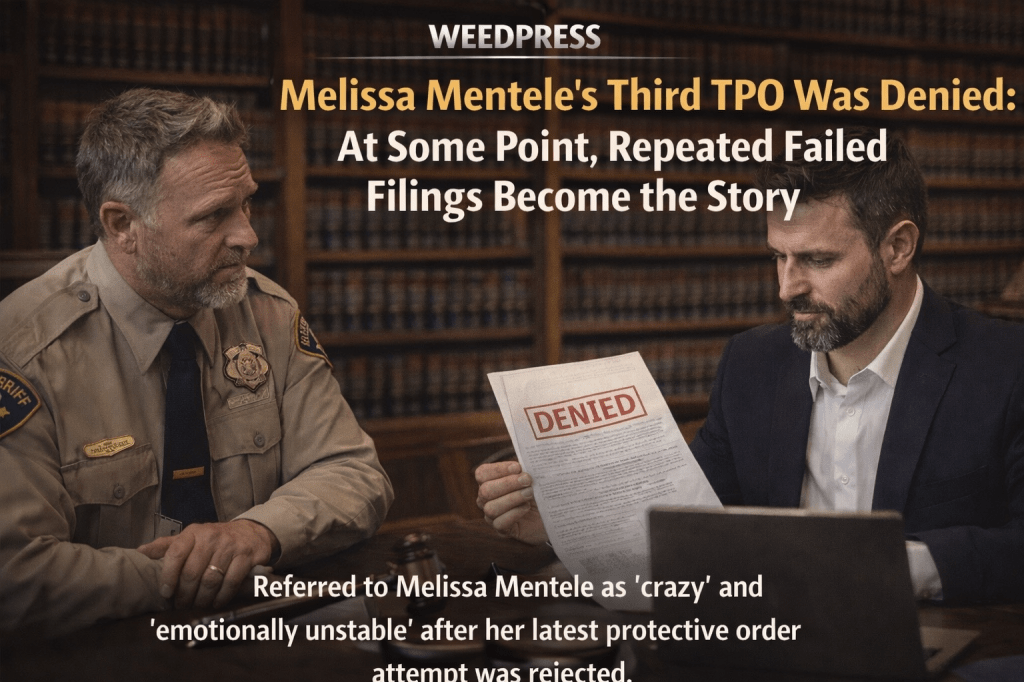
Melissa Mentele’s Third TPO Was Denied Too: At What Point Does Failed Lawfare Become the Story?
By Jason Karimi | WeedPress
April 15, 2026
Melissa Mentele has now filed for a third temporary protection order against WeedPress for reporting on marijuana policy issues.
It was denied.
Again.
At this point, the public no longer has to guess what is happening. The pattern is visible. The record is visible. The strategy is visible. And none of it looks like legitimate use of a protection-order process. It looks like repeated legal escalation against a critic that keeps collapsing when it reaches the point where an actual court has to evaluate it.
Three denied filings is not bad luck. Three denied filings is not confusion. Three denied filings is not a close call.
Three denied filings is a pattern.
At a certain point patterns repeated outcomes speak for themselves.
This latest episode only made that clearer. The sheriff called me to come pick up the paperwork, and described Mentele as “nuts” for forcing him to waste his time over repeat filings. Those were not my words. They were the sheriff’s words, reacting to a situation that by now appears obvious to anyone who has had to deal with it directly.
That detail matters, not because it is colorful, but because it underscores how far this has drifted from any serious claim of legal necessity.
Protection orders are supposed to exist for actual threats and actual danger. They are not supposed to become a revolving-door tool for a public figure who cannot handle scrutiny, cannot absorb criticism, and apparently keeps trying to convert personal grievance into state action.
But that is where this story has gone.
And after three denials, it is no longer reasonable to pretend otherwise.
Every failed filing strips away a little more of the pretense. Every denial makes the underlying motive harder to hide. Every return trip to the courthouse makes the misuse look less accidental and more deliberate. At some point, the filings themselves become the evidence — not evidence that I am dangerous, but evidence that the legal system keeps being asked to do something it was never designed to do: serve as a personal weapon in a vendetta dressed up as protection.
That should alarm people.
It should alarm people because courts are not props. Sheriffs are not public-relations staff. Protective-order procedures are not supposed to be repurposed into intimidation theater for people with bruised egos and weak factual footing. Yet that is what this increasingly resembles: a repeated attempt to harness legal process not for safety, but for pressure.
And the more it fails, the uglier it looks.
Melissa Mentele had options. She could have answered criticism in public. She could have rebutted facts with facts. She could have responded like someone confident in her own credibility. Instead, the pattern that keeps emerging is legal escalation followed by legal failure. Filing followed by denial. Allegation followed by collapse.
That is not strength. That is not credibility. That is not leadership.
That is a person repeatedly trying to force the machinery of the state to do what public argument would not do for her.
The most important part of this story is no longer any single accusation. It is the accumulation. One denied TPO might be brushed off as overreaction. Two starts to look reckless. A third denied filing starts to look like something far more serious: an abuse pattern that deserves to be named plainly and remembered clearly.
Because this is how lawfare works when stripped of its euphemisms. It is not always dramatic in the beginning. Sometimes it arrives as paperwork. Sometimes it arrives as allegations that sound urgent until a court actually looks at them. Sometimes it arrives as one failed filing, then another, then another, until the repetition itself becomes the scandal.
That is where this is now.
The court keeps refusing to turn Melissa Mentele’s grievances into emergency legal force. That is not a minor detail. That is the central fact. Whatever story she may want told elsewhere, the actual judicial record keeps producing the same answer.
Denied.
Denied.
Denied.
That is the headline.
And after three denials, the real issue is no longer whether Melissa Mentele feels aggrieved. The real issue is why she keeps trying to escalate those grievances through a legal process that keeps rejecting them. The real issue is how many times a person gets to point courts and law enforcement at a critic before the public admits what it is looking at. The real issue is that repeated failed TPO filings do not make the target look dangerous.
They make the filer look desperate.
And by now, desperation is not even the most charitable reading.
Because when someone keeps reaching for state power, keeps failing, and keeps coming back for another try, the problem is no longer the criticism they claim to fear.
The problem is the pattern they cannot stop creating.
Melissa Mentele’s third TPO was denied too.
At this point, the denials are not interrupting the story.
They are the story.
STATE OF SOUTH DAKOTA
COUNTY OF ____________
IN CIRCUIT COURT
_____ JUDICIAL CIRCUIT
[PETITIONER NAME],
Petitioner,
v. Case No. __________
JASON KARIMI,
Respondent.
RESPONDENT’S MOTION TO DISMISS OR, IN THE ALTERNATIVE, DENY PETITION FOR PROTECTION ORDER; MEMORANDUM IN SUPPORT; AFFIDAVIT OF RESPONDENT; AND PROPOSED ORDER
Respondent Jason Karimi, appearing pro se, moves this Court for an order dismissing, or in the alternative denying, the Petition for Protection Order. The Petition fails because it attempts to convert protected public commentary into actionable stalking or harassment without proof of direct contact, a credible threat, or any unprotected course of conduct. South Dakota’s stalking chapter expressly excludes constitutionally protected activity from the statutory meaning of “course of conduct,” and South Dakota law does not permit protection-order procedure to be used as an overbroad restraint on lawful speech.
This motion is based on the Petition, the record in this matter, the attached Affidavit of Respondent, any exhibits offered at hearing, and the following memorandum.
MEMORANDUM IN SUPPORT
I. INTRODUCTION
This case concerns public commentary, not stalking.
The Petition attempts to convert protected public criticism into actionable harassment even though there was no direct contact, no credible threat, no physical following, no solicitation of third parties, and no unprotected course of conduct. Public-facing blog articles about matters of public concern are not stalking merely because they criticize the petitioner. South Dakota law expressly excludes constitutionally protected activity from the meaning of “course of conduct,” and the South Dakota Supreme Court has cautioned against using protection-order procedure to impose overbroad restraints on protected speech and petitioning.
At issue here is public commentary concerning matters of public controversy, public statements, public conduct, litigation, and movement politics. But public commentary is not the same as direct contact, and criticism is not the same as a threat. South Dakota’s stalking framework must be applied in a way that respects both the statute’s own exclusion for constitutionally protected activity and the First Amendment limits recognized by the South Dakota Supreme Court.
II. GOVERNING LAW
South Dakota’s stalking statute provides that a person commits stalking if the person: (1) willfully, maliciously, and repeatedly follows or harasses another person; (2) makes a credible threat to another person with the intent to place that person in reasonable fear of death or great bodily injury; or (3) willfully, maliciously, and repeatedly harasses another person by verbal, electronic, digital media, mechanical, telegraphic, or written communication.
The statute separately defines “harasses” as “a knowing and willful course of conduct directed at a specific person which seriously alarms, annoys, or harasses the person, and which serves no legitimate purpose.” It further defines “course of conduct” as “a pattern of conduct composed of a series of acts over a period of time, however short, evidencing a continuity of purpose,” and expressly states that “Constitutionally protected activity is not included within the meaning of course of conduct.”
In Hobart v. Ferebee, 2004 SD 138, the South Dakota Supreme Court reviewed a protection order that restricted complaints to government agencies and held that the order went too far because it imposed an unconstitutional prior restraint on protected speech and petitioning. The court emphasized that prior restraints are strongly disfavored, that constitutionally protected activity is excluded by SDCL 22-19A-5, and that even ill-motivated but otherwise protected complaints could not be absolutely frozen by judicial order.
III. ARGUMENT
A. The Petition fails absent proof of direct contact, a credible threat, or other unprotected conduct.
The Court should decide this case on statutory elements, not on generalized offense at criticism. Public blog posts are not direct contact merely because Petitioner reads them or learns of them. Public commentary about matters of public concern does not become stalking simply because it is harsh, unwelcome, embarrassing, or politically damaging. South Dakota law distinguishes between actionable stalking conduct and constitutionally protected activity.
If Petitioner cannot show that Respondent directly contacted Petitioner, made a credible threat, followed or surveilled Petitioner, physically approached Petitioner, instructed others to contact or harass Petitioner, or otherwise engaged in unprotected conduct satisfying SDCL chapter 22-19A, then the Petition should be dismissed or denied. The absence of those facts is fatal to any attempt to convert public commentary into stalking.
B. Public commentary on public controversy and public conduct serves a legitimate purpose.
The definition of “harasses” requires a course of conduct that serves no legitimate purpose. Political commentary, media criticism, public accountability writing, and commentary regarding public litigation, leadership, or public statements can plainly serve legitimate purposes even when the subject strongly dislikes them. The statute itself requires the Court to ask whether the alleged conduct serves a legitimate purpose; it does not authorize relief merely because speech is uncomfortable or unfavorable.
Here, the complained-of speech concerned matters of public concern, public controversy, public statements, public conduct, or litigation. That subject matter weighs strongly against treating it as stalking.
C. Constitutionally protected activity is expressly excluded from the statutory meaning of “course of conduct.”
This point is central. SDCL 22-19A-5 expressly states that constitutionally protected activity is not included within “course of conduct.” Before the Court can treat any series of public writings as stalking, it must first determine whether the writings are constitutionally protected commentary. If they are, they cannot be used as the statutory “course of conduct” needed to establish harassment.
Petitioner cannot evade that statutory exclusion by relabeling protected public commentary as harassment.
D. Any order restraining future articles or public commentary would risk becoming an unconstitutional prior restraint.
If Petitioner seeks relief barring Respondent from writing about Petitioner, referencing Petitioner publicly, discussing Petitioner’s public conduct, or otherwise engaging in lawful public commentary, that request is constitutionally suspect. In Hobart, the South Dakota Supreme Court held that a protection order was an impermissible prior restraint where it required court preapproval before future complaints could be made, explaining that prior restraint “freezes” protected speech and that the effect of the order, not merely its intended target, controls the constitutional analysis.
Any relief here must be narrowly tied to proven, unprotected conduct. It cannot lawfully function as a blanket prohibition on future reporting, criticism, commentary, or public discussion. The effect of an order matters, not merely its stated intent. Hobart is especially useful on that point.
E. The Court should require exact identification of the allegedly actionable statements and acts.
Petitioner is not entitled to relief based on vague references to “posts,” “articles,” or “online harassment.” If Petitioner claims that specific language crossed the line from protected commentary into actionable conduct, Petitioner should be required to identify the precise words, dates, and statutory theory for each alleged act.
If the Court does not dismiss outright, Respondent requests that Petitioner be required to identify with specificity:
each article, post, or statement alleged to be actionable; the exact words claimed to constitute stalking or harassment; the date of each alleged act; whether any statement was sent directly to Petitioner; whether any threat was made; whether any third party was solicited or directed to contact Petitioner; whether any private address, phone number, or other nonpublic personal identifying information was published; and what statutory element each alleged act is supposed to satisfy.
Without that specificity, the proceeding risks collapsing protected public speech into a vague claim of emotional offense.
F. To the extent this is another attempt to use court process against protected criticism, the Court should insist on strict proof.
Respondent further submits that where public commentary has repeatedly been followed by attempts to invoke state process, the Court should be especially careful to require real proof that the complained-of conduct is unprotected conduct rather than protected criticism. This point matters not as a stand-alone grievance, but as a reason the Court should insist on an element-by-element showing before imposing any state restraint affecting speech.
IV. FACTS RESPONDENT EXPECTS TO SHOW
Respondent expects the evidence will show:
Respondent publishes public-facing commentary and blog articles. The challenged speech, if any, was public commentary rather than direct private communication to Petitioner. No article was sent directly to Petitioner. No social-media tag or direct message was sent to Petitioner. No call, text, email, or in-person contact occurred. Respondent did not threaten Petitioner with death or great bodily injury. Respondent did not follow, surveil, stalk, or physically approach Petitioner. Respondent did not direct, solicit, or encourage any third party to contact or harass Petitioner. Respondent did not publish Petitioner’s private address, phone number, or other nonpublic personal identifying information. The complained-of speech concerned matters of public concern, public controversy, public statements, public conduct, or litigation. This proceeding reflects an attempt to suppress or deter protected criticism rather than to prevent genuine stalking.
V. REQUEST FOR RELIEF
For the foregoing reasons, Respondent respectfully requests that the Court:
dismiss the Petition for Protection Order, or in the alternative deny the requested protection order after hearing; decline to enter any relief that restrains protected speech or operates as a prior restraint on lawful public commentary; require Petitioner, if the matter proceeds, to identify with specificity the exact statements and acts claimed to be actionable; if the Court denies dismissal, enter written findings identifying the exact statement or act found to be unprotected, the statutory element it satisfies, and why constitutionally protected activity does not bar relief on those facts; and grant such other and further relief as the Court deems just and proper.
Dated: _____________, 2026.
Respectfully submitted,
Jason Karimi
Respondent, pro se
[Address]
[City, State ZIP]
[Phone]
[Email]
AFFIDAVIT OF RESPONDENT JASON KARIMI
STATE OF ____________ )
: ss.
COUNTY OF __________ )
I, Jason Karimi, being first duly sworn, state as follows:
I am the Respondent in this matter and submit this affidavit in support of my Motion to Dismiss or, in the Alternative, Deny Petition for Protection Order. I publish public-facing commentary and blog articles. The speech complained of in this matter, if any, consisted of public commentary rather than private or direct communication to Petitioner. I did not send any article directly to Petitioner. I did not send Petitioner any direct message, social-media tag, text message, email, or private communication related to the challenged articles or commentary. I did not call Petitioner. I did not threaten Petitioner with death or great bodily injury. I did not follow, surveil, stalk, or physically approach Petitioner. I did not instruct, solicit, direct, or encourage any third party to contact, threaten, or harass Petitioner. I did not publish Petitioner’s private address, phone number, or other nonpublic personal identifying information. My public commentary addressed matters of public concern, including public controversy, public statements, public conduct, litigation, leadership, and related issues. My commentary was public-facing and served a legitimate expressive, political, and journalistic purpose. To my knowledge, the Petition attempts to characterize public commentary as stalking even though there was no direct contact, no credible threat, and no unprotected conduct. I submit this affidavit to make clear that the challenged conduct was public commentary and not direct harassment or stalking.
I declare under penalty of perjury under the laws of the State of South Dakota that the foregoing is true and correct.
Dated: _____________, 2026.
Jason Karimi
Subscribed and sworn to before me on this ____ day of _____________, 2026.
Notary Public
My Commission Expires: __________
PROPOSED ORDER
STATE OF SOUTH DAKOTA
COUNTY OF ____________
IN CIRCUIT COURT
_____ JUDICIAL CIRCUIT
[PETITIONER NAME],
Petitioner,
v. Case No. __________
JASON KARIMI,
Respondent.
ORDER GRANTING RESPONDENT’S MOTION TO DISMISS OR, IN THE ALTERNATIVE, DENY PETITION FOR PROTECTION ORDER
Respondent’s Motion to Dismiss or, in the Alternative, Deny Petition for Protection Order came before the Court on _____________, 2026. Respondent appeared pro se. Petitioner appeared [personally / through counsel].
The Court, having reviewed the file, considered the parties’ submissions, and heard the evidence and arguments of the parties, now finds and orders as follows:
The Petition is based in whole or substantial part on public commentary and blog articles. South Dakota’s stalking statute, SDCL 22-19A-1, includes repeated harassment by communication, but the statutory definition of “harasses” requires a course of conduct serving no legitimate purpose, and SDCL 22-19A-5 expressly states that constitutionally protected activity is not included within the meaning of “course of conduct.” On the record before the Court, Petitioner has not established by sufficient evidence that Respondent engaged in actionable stalking through direct contact, a credible threat, or other unprotected conduct under SDCL chapter 22-19A. To the extent the Petition seeks relief restraining future lawful public commentary, such relief would raise serious constitutional concerns under Hobart v. Ferebee, 2004 SD 138.
IT IS THEREFORE ORDERED:
Respondent’s Motion is GRANTED. The Petition for Protection Order is dismissed / denied. No relief shall issue restraining constitutionally protected speech. Any other pending requests inconsistent with this Order are denied.
Dated: _____________, 2026.
BY THE COURT:
Circuit Court Judge
 WeedPress: The Paper Trail
Leave a comment