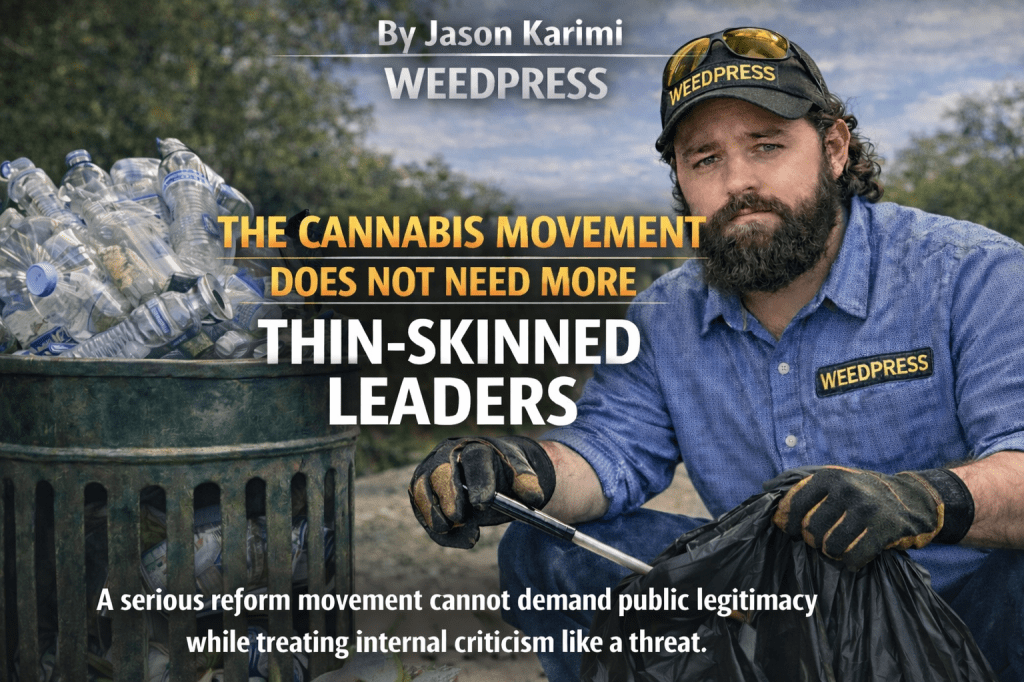
The Cannabis Movement Does Not Need More Thin-Skinned Leaders
A serious reform movement cannot demand public legitimacy while treating internal criticism like a threat.
By Jason Karimi | WeedPress
April 15, 2026
Cannabis reform has spent years asking courts, lawmakers, patients, journalists, and the broader public to take it seriously.
That demand cuts both ways.
A movement that wants legitimacy has to prove it can handle scrutiny. It has to show it can survive disagreement without collapsing into grievance, cliques, retaliation, or procedural intimidation. It has to show that its leaders are sturdy enough to face criticism without reaching for legal force, backstage pressure, or moral theatrics every time someone challenges the narrative.
That is not a side issue.
That is a maturity test.
And too often, parts of the cannabis movement keep failing it.
The problem is no longer just prohibition. The problem is that portions of the reform world have developed a second weakness of their own: fragile leadership cultures that want public deference without public accountability. They want influence without scrutiny. They want status without rebuttal. They want to shape the conversation while treating criticism itself as some kind of misconduct.
That is not how serious political movements work.
It is how unserious ones decay.

Real leaders get challenged. Real public figures get criticized. Real advocates have their claims examined, their judgment questioned, and their conduct measured against the standards they preach. That is not persecution. That is the price of visibility. That is the cost of choosing to occupy public space, speak in public, influence public institutions, and claim moral authority in a contested field.
If a person cannot handle that, they do not need more power.
They need less of it.
This is where the cannabis movement has to stop lying to itself. For years, too many insiders have acted as though criticism from within is somehow more dangerous than bad leadership itself. Too many people have treated accountability as disloyalty, exposure as sabotage, and hard questions as betrayal. Too many have quietly accepted a culture in which connected personalities are allowed to posture as reformers while behaving as though they are above challenge.
That culture poisons movements from the inside.
It teaches younger advocates to keep quiet. It teaches insiders that influence can substitute for integrity. It teaches the public that branding matters more than truth. It teaches weak leaders that they do not need better answers, only better mechanisms for suppressing dissent.
And once a movement starts teaching those lessons, it stops getting stronger.
It starts rotting.
Rot in a movement rarely begins with one dramatic collapse. More often it begins with tolerated ego, selective outrage, whispered pressure, false urgency, and repeated efforts to protect personalities from the ordinary consequences of public life. It begins when people decide that preserving access matters more than telling the truth. It deepens when movement media becomes timid, when critics are isolated, and when institutional overreach gets excused because the target is inconvenient.
That is how accountability dies.
And when accountability dies, reform gets hollowed out from the inside. The movement may still have slogans. It may still have fundraisers, conferences, podcasts, and polished branding. But beneath the surface, the culture becomes softer, pettier, more dishonest, and more vulnerable to capture by exactly the kind of people least fit to lead it.
That is the danger.
Because cannabis reform is not supposed to be a social club for insulated personalities. It is supposed to be a fight for liberty, legality, fairness, patient dignity, constitutional principle, and public honesty. It is supposed to mean something bigger than who has the microphone, who has the donor list, or who gets protected when conflict breaks out.
If those values are real, they have to apply internally too.
That means movement figures do not get to claim the language of justice while trying to suppress scrutiny. They do not get to denounce overreach by the state while indulging overreach by insiders. They do not get to preach accountability outward and reject it inward. And they do not get to wrap themselves in reform credentials while acting like criticism is an injury that must be punished rather than answered.
That is entitlement disguised as advocacy.
A healthy movement should want critics. A healthy movement should value people willing to document, question, challenge, and expose. A healthy movement should understand that internal scrutiny is not a threat to reform but one of the few things that keeps reform from turning into theater.
Because once criticism is treated as the enemy, the real opportunists take over.
The people most threatened by scrutiny are rarely the strongest leaders. Usually they are the weakest ones: the image managers, the grievance merchants, the people who confuse attention with legitimacy and influence with moral authority. They need insulation because they cannot withstand examination. They need loyalty rituals because they cannot defend the record. They need critics marginalized because they cannot defeat criticism on the merits.
That weakness should not run a movement.
It should be exposed by one.
Cannabis reform needs stronger norms. It needs higher standards for public figures. It needs a culture that recognizes a basic truth: if you make public claims, seek public trust, and exercise public influence, then you are answerable in public. Not sometimes. Not only when it is convenient. Always.
That is not cruelty.
That is accountability.
And accountability is not what weakens a reform movement. Accountability is what prevents a reform movement from becoming a vanity project for unstable personalities and protected insiders.
The movement does not need more people who can deliver speeches and wilt under scrutiny. It does not need more figures who talk like dissidents and behave like censors. It does not need more gatekeepers who demand loyalty while dodging examination. It does not need more public operators who mistake criticism for abuse because they have never learned the difference between being challenged and being harmed.
It needs adults.
It needs leaders with enough discipline to answer questions instead of escalating against the people asking them. It needs institutions with enough backbone to tolerate discomfort. It needs media with enough integrity to report on insiders the same way they would report on opponents. And it needs a public ethic that rejects the idea that any one personality is too important to be scrutinized.
That is how serious reform survives.
Not by making criticism taboo.
Not by treating dissent as contamination.
Not by protecting the fragile.
But by forcing everyone who seeks influence to stand in the light and survive ordinary democratic judgment.
That is the standard.
And any leader who cannot survive that standard is not being persecuted by the movement.
They are being revealed by it.
If cannabis reform cannot tolerate scrutiny from its own critics, then the movement’s problem is no longer just prohibition. It is cowardice at the top.

 WeedPress: The Paper Trail
Leave a comment