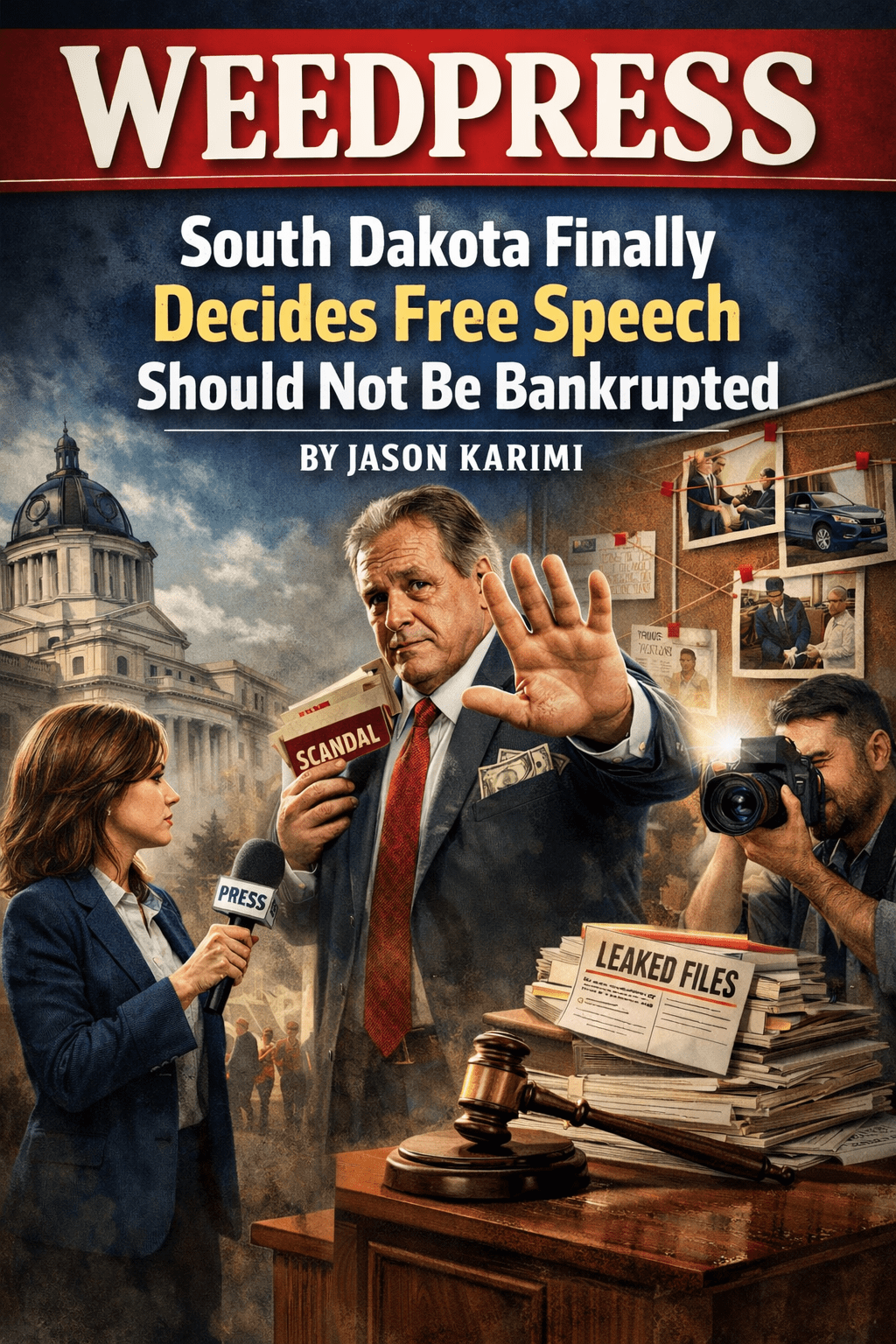
April 17, 2026
For years, South Dakota had a hole in its legal architecture that should have embarrassed any state claiming to respect free speech. If someone with money, status, or institutional backing wanted to punish a critic, a journalist, a blogger, or an activist, the process itself could become the weapon. Even a weak civil claim could do the job. Discovery is expensive. Litigation is stressful. Procedure becomes punishment. That is the point of a Strategic Lawsuit Against Public Participation, or SLAPP.²
Now, at long last, South Dakota has done something about it.¹
Beginning July 1, 2026, South Dakota’s new anti-SLAPP law — Senate Bill 137 — takes effect.³ It is the state’s first real, comprehensive protection against Strategic Lawsuits Against Public Participation. Before this, South Dakota had no such law at all.³ That absence mattered. It left a vacuum where intimidation could thrive.
SB 137 was not some fringe stunt or narrow partisan hobbyhorse. It passed with overwhelming bipartisan support — 33-0 in the Senate and 65-2 in the House — and was signed by Governor Larry Rhoden in March.⁴ That margin says something important: this was not a close moral question. The legislature understood the problem. It understood that in a supposedly free society, people should not be dragged through ruinous civil litigation just for speaking on matters of public concern.
And South Dakota did not merely improvise. It followed a tested model. SB 137 is based directly on the Uniform Public Expression Protection Act, the UPEPA, a model statute designed to stop abusive lawsuits aimed at public participation and constitutional expression.⁵ In plain English: if someone tries to use civil litigation to punish speech instead of actually win on the merits, the target now has a real procedural weapon to fight back.
That is how it should have been all along.
The law’s core purpose is simple and righteous. It creates a fast-track process to knock out meritless civil claims brought to chill speech, drain resources, or terrorize critics into silence.⁶ Senator Amber Hulse, the bill’s sponsor, put it plainly: powerful people can use the court system not necessarily to win, but to bury ordinary South Dakotans in fees, stress, and discovery.⁴ That sentence should be posted on every courthouse wall in the country.
Because that is exactly how abusive lawfare works.
Not every censor wears a censor’s uniform. Sometimes censorship arrives in a complaint caption, dressed up in legal language, demanding damages, discovery, and submission. Sometimes the goal is not vindication. The goal is exhaustion. The goal is to make criticism so expensive, stressful, and procedurally dangerous that only the rich or reckless will dare engage in it.
Anti-SLAPP laws exist because the state should not be a subcontractor for that kind of cowardice.
South Dakota’s new law broadly protects “public expression.”⁶ That includes communications made in legislative, executive, judicial, administrative, or other governmental proceedings. It covers communications on issues under review in those proceedings. And it protects the exercise of speech, press, assembly, petition, and association rights on matters of public concern under both the United States and South Dakota Constitutions.⁶ That breadth matters. Free speech is not only the right to whisper agreeable things. It includes criticism, advocacy, dissent, reporting, and public accountability. It includes speech that makes thin-skinned officials, public figures, and local power brokers uncomfortable. Especially that speech.
And here is where SB 137 gets serious.
A defendant can file a special motion to dismiss within 60 days of service.⁶ Once that happens, the case is automatically stayed. Discovery stops. Hearings stop. The machinery of attrition stops.⁶ That alone is enormous. In many abusive cases, discovery is the punishment. The target is forced to spend money, surrender records, hire counsel, and live under the weight of litigation while the plaintiff shops for leverage. South Dakota’s new law recognizes that if a case is really about punishing public expression, the defendant should not have to endure months or years of procedural bleeding just to prove the point.
Then comes the heart of the statute: if the moving party shows the claim is based on protected public expression, and the plaintiff cannot establish a prima facie case for every essential element, the court must dismiss with prejudice.⁶ Not maybe. Must.
That word matters.
So does fee-shifting. If the defendant wins, the court must award costs, reasonable attorney fees, and litigation expenses.⁶ That is not a decorative flourish. It is the spine of the law. Without fee-shifting, many anti-SLAPP laws become moral gestures rather than practical shields. A person can still be dragged through tens of thousands of dollars in defense costs just to earn the honor of being right. SB 137 goes further. It says the person who weaponized the courts may have to pay for the damage.
As they should.
If someone files a weak or abusive civil claim to intimidate a critic, and that tactic collapses under scrutiny, the target should not walk away with a hollow victory and a mountain of bills. The aggressor should feel the cost of that failed suppression effort. Otherwise the incentive structure stays rotten.
The law also provides an appeal as of right if the motion is denied, and the stay remains in place during appeal.⁶ Again: this is what a serious anti-SLAPP statute looks like. It does not merely whisper disapproval at abusive litigation. It builds actual mechanisms to stop it before the process itself achieves the censor’s goal.
There are exemptions, of course.⁶ Government enforcement actions tied to imminent threats to public health or safety are not covered. Lawsuits against government actors in official capacity are outside its scope. And there is a commercial-speech carveout for those primarily selling goods or services, though that exemption does not swallow artistic, literary, journalistic, musical, or political work.⁶ That last part is important. The statute preserves protection for actual public expression rather than letting plaintiffs repackage attacks on journalism or criticism as some kind of business dispute.
The practical effect is hard to overstate.
For bloggers, journalists, watchdogs, activists, public critics, and ordinary citizens speaking out on matters of public concern, this law creates a real deterrent against speech-chilling civil abuse.³ It tells would-be censors: if your case is hollow, if your claim is performative, if your real objective is intimidation rather than truth, you may lose fast — and pay for the privilege.
That is a healthy message.
South Dakota is now joining the national trend rather than lagging behind it. It becomes the 40th state to adopt anti-SLAPP protections.⁴⁻⁵ Good. It was overdue. Public discourse in a free society cannot depend solely on the bravery or bank account of the speaker. The law must recognize that process can be punishment, and that meritless litigation can function as censorship by other means.
That is what SB 137 finally does.
And let’s be blunt about the larger moral point.
If your first instinct when criticized is not rebuttal but procedural escalation, not public argument but legal intimidation, not persuasion but burden, then your problem is not defamation. Your problem is that you want the prestige of public life without the risk of public scrutiny. You want the court system to do what your arguments cannot.
South Dakota’s legislature just sent a message to that mindset.
No more.
Not every harsh statement is actionable. Not every public criticism is tortious. Not every wounded ego deserves discovery. And not every person targeted for speaking out should have to bleed money just to reach the obvious conclusion that the suit never should have been filed in the first place.
SB 137 is not immunity for lies. It is not a license for defamation. Valid claims can still proceed.⁶ That is exactly as it should be. But the era of using civil litigation as a lazy club against public participation just got more dangerous for the people wielding it.
Good.
A state that values liberty should protect speech not only in theory, but in procedure. Not only in slogans, but in motion practice. Not only in constitutional mythology, but in the ugly real world where people with power try to make criticism hurt.
South Dakota finally did that.
And for the people who built careers, reputations, or petty little fiefdoms assuming they could always use process to punish dissent, July 1 should feel like a warning.
The public square is no longer quite so easy to rig.
Footnotes
¹ Gov. Larry Rhoden, Gov. Rhoden Signs Justice Bills into Law (Mar. 16, 2026) (announcing signature of SB 137 and describing it as anti-SLAPP legislation protecting South Dakotans from frivolous lawsuits meant to silence free speech). (news.sd.gov)
² Andrew J. Nelson, South Dakota Governor Signs Anti-SLAPP Legislation, Courthouse News Serv. (Mar. 17, 2026) (describing anti-SLAPP laws as protections against being burdened with legal fees in suits aimed at public participation). (courthousenews.com)
³ South Dakota Anti-SLAPP, Reporters Comm. for Freedom of the Press (noting South Dakota previously had no anti-SLAPP law, that SB 137 is codified as a new chapter in Title 15, and that it takes effect July 1, 2026). (rcfp.org)
⁴ Nelson, supra note 2 (reporting passage by votes of 33-0 in the Senate and 65-2 in the House and quoting Sen. Amber Hulse’s explanation of the bill’s purpose). (courthousenews.com)
⁵ South Dakota Becomes the 40th State in the Union to Enact Anti-SLAPP Protections, Inst. for Free Speech (Mar. 17, 2026) (explaining that SB 137 follows the Uniform Public Expression Protection Act and that South Dakota became the 40th state with anti-SLAPP protections). (ifs.org)
⁶ S.B. 137, 101st Leg., Reg. Sess. (S.D. 2026) (enrolled bill) (defining covered speech, creating the special motion procedure, imposing the automatic stay, setting hearing and ruling timelines, establishing dismissal standards, authorizing appeal, providing fee-shifting, and listing exemptions). (mylrc.sdlegislature.gov)
 WeedPress: The Paper Trail
Leave a comment