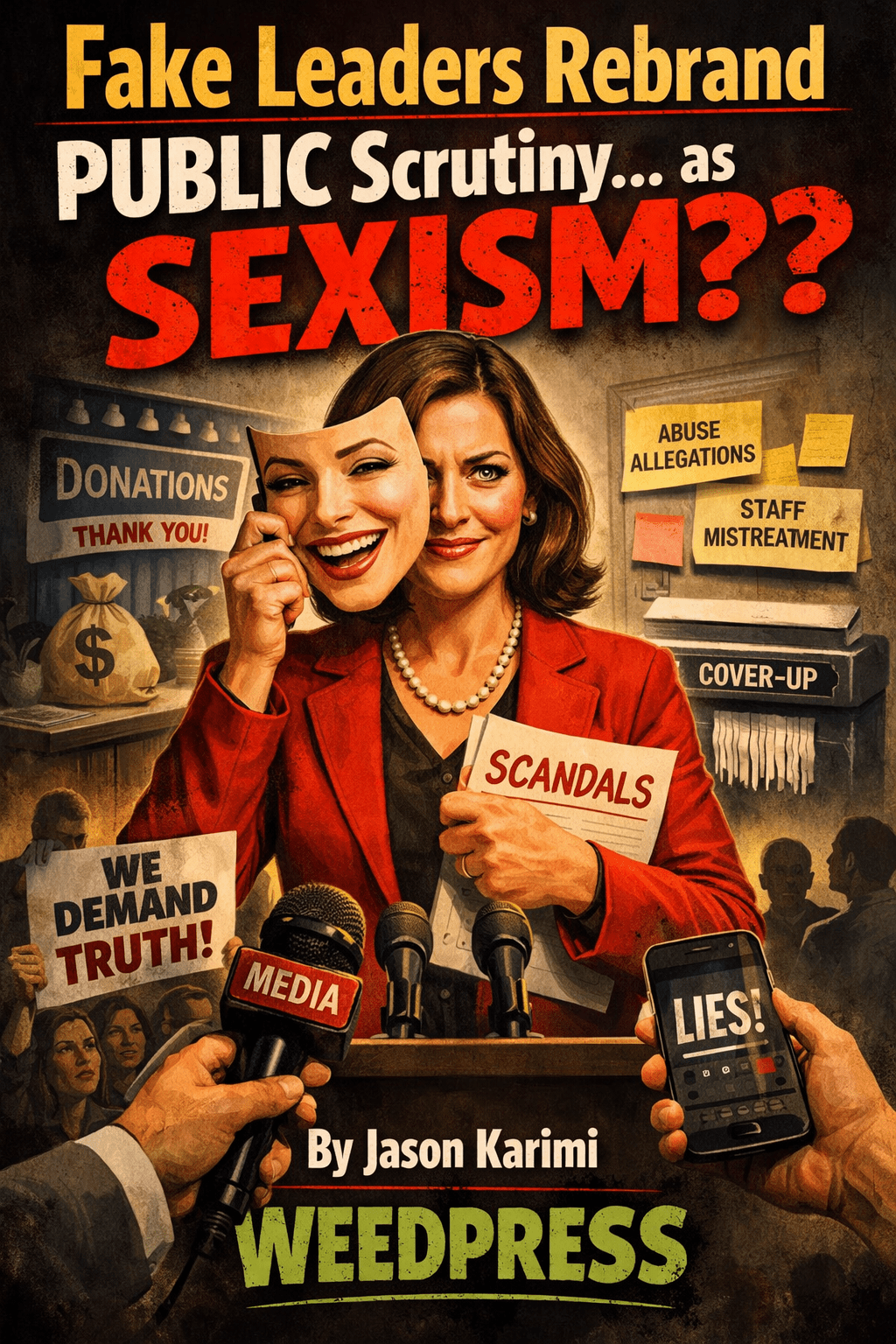
For “some” public figures, scrutiny is righteous when aimed outward and “oppressive” when aimed inward. Katie Porter’s response to abuse and mistreatment questions showed how quickly accountability can be reframed as sexism when the accused is a woman with political allies and a moral brand. “Some” public figures try to recast accountability as sexism when the questions turn on them.
April 18, 2026
One of the oldest tricks in modern political culture is the attempt to turn accountability into prejudice. A public figure faces ugly allegations, bad press, or questions about her conduct. Instead of answering the substance cleanly, she shifts the frame. The issue is no longer what she did, or what she is accused of doing. The issue becomes sexism, bias, or society’s discomfort with strong women. It is a clever move because it does not actually rebut the allegation. It just tries to make the allegation feel illegitimate. Katie Porter has become a vivid example of that maneuver.
To be clear, precision matters here. Porter has denied abuse allegations connected to 2013 divorce filings, and those allegations were contested, not adjudicated findings. Reporting in April 2023 highlighted that her ex-husband said he did “not recant” his domestic-abuse allegations after her campaign suggested otherwise. That does not prove the allegations true. It does mean they were serious, publicly documented, and still very much disputed in the public arena.
But the most revealing part of the Porter story is not merely that allegations existed. It is how she responded when asked about them and about separate allegations of staff mistreatment. During an April 2023 appearance on The View, Porter said that lots of the so-called “bad bosses” are women and disproportionately people of color. That line mattered because it did more than deny. It reframed. The defense was no longer simply “this is false.” The defense became “people like me get labeled this way.” That is not a rebuttal to misconduct. It is an attempt to place criticism itself under suspicion.
That distinction is the heart of the problem. Anyone accused of wrongdoing can deny it. Anyone can say reporting is incomplete or unfair. But when the accused tries to convert scrutiny into proof of prejudice, the conversation gets rigged. The public is nudged away from the question of conduct and toward the emotional comfort of a familiar moral script: woman criticized, therefore misogyny is probably nearby. That script can be powerful even when the facts remain ugly, unresolved, or politically inconvenient. Porter’s own phrasing on The View is exactly why critics keep returning to her as a case study.
The Associated Press reported this week that the House Ethics Committee had begun investigating whether Swalwell engaged in sexual misconduct toward an employee working under his supervision, and that he then said he would resign from Congress. The Washington Post separately reported on April 15 and April 18 that Swalwell resigned amid sexual-misconduct allegations and that the scandal was helping trigger a broader reckoning in Congress. Those are serious developments, and they help explain why anyone publicly attaching herself to that fight would immediately face scrutiny of her own record and credibility.
That is why Porter’s example resonates beyond Porter. The broader cultural pattern is real even if people dislike hearing it stated plainly: female cruelty is often narrated differently than male cruelty. Male misconduct is usually named head-on. Female misconduct is softened, psychologized, aestheticized, or rerouted through identity language. She is not abusive, we are told; she is merely intense. She is not demeaning; she is just demanding. She is not toxic; she is being judged by standards men never face. Sometimes that may even be true. But sometimes it is just a polished excuse for behavior that would be condemned immediately in a man. Porter’s response showed how fast that rhetorical escape hatch can appear.
The strongest version of the argument is not that only men ever call abusive women out. That is too absolute and too easy to dismiss. Women call them out too. Reporters do. Former staff do. Ex-partners do. The sharper point is that male critics are especially easy to intimidate into silence, because their criticism can be turned back on them as proof of sexism. That is what makes this pattern so useful to people who want to avoid plain moral judgment. They do not have to win the factual argument. They just have to make the argument socially radioactive.
And that is where the equal-standards issue comes in. If abuse allegations against a man are supposed to trigger scrutiny, then allegations against a woman should trigger scrutiny too. If public figures are allowed to weaponize morality against others, they should expect their own records to be examined when they step into that role. If sexism is going to be alleged, it should be because there is actual evidence of sexist treatment, not because “sexism” is a convenient shield whenever a politically connected woman faces hard questions. The standard cannot be that accountability is noble when aimed outward and “misogyny” (eye roll) when aimed inward.
Katie Porter may deny every allegation against her. That is her right. But the public has a right to notice the pattern too. When the questions came, the answer was not just denial. It was inversion. Conduct questions became bias questions. Scrutiny became oppression. Accountability became the alleged offense. That trick still works in some rooms. Outside those rooms, more people are starting to recognize it for what it is: not feminism, not fairness, not moral courage. Just another way for powerful people to dodge judgment they would eagerly impose on everyone else.
 WeedPress: The Paper Trail
Leave a comment