April 24, 2026
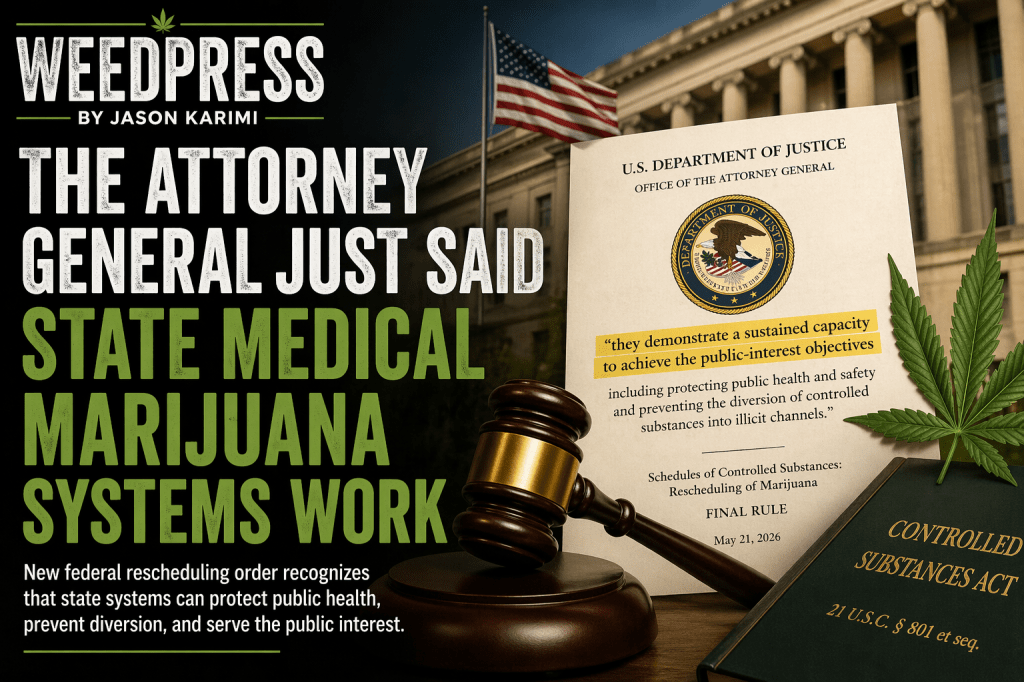
The most important sentence in the new federal marijuana rescheduling order may not be the word “Schedule III.” It may be the Attorney General’s finding that state medical-marijuana systems, “taken as a whole,” have demonstrated a “sustained capacity” to achieve the public-interest objectives behind the Controlled Substances Act’s registration framework: public health, safety, records, inspections, and diversion control.¹
That is the real legal news.
For decades, federal marijuana policy treated state medical-cannabis systems as tolerated at the margins but structurally suspect. This order changes that posture. It does not deschedule marijuana. It does not create national adult-use legalization. But it does recognize state-licensed medical marijuana as capable of fitting inside a federal registration structure.²
The order places two categories into Schedule III: FDA-approved drug products containing marijuana, and marijuana subject to a state medical-marijuana license.³ The Attorney General grounds that move in treaty-compliance authority under 21 U.S.C. § 811(d)(1), rather than waiting for the ordinary scheduling process to finish.⁴
That distinction matters. The order is not saying all cannabis is now Schedule III. It is saying federally approved marijuana products and state-licensed medical marijuana can be treated differently from illicit marijuana.
The strongest section is the discussion of state medical-marijuana licensing. The order says state systems have matured significantly since California first authorized medical use in 1996. Today, according to the order, most states with medical marijuana have licensing frameworks governing cultivation, processing, distribution, and dispensing.⁵
Then comes the key concession: those state regimes have built infrastructure for preventing diversion, ensuring product safety, maintaining records, and conducting facility inspections.⁶ In other words, the federal government is acknowledging that state cannabis regulators are not merely tolerating an unlawful market. They are performing functions that overlap with the purposes of federal controlled-substances regulation.
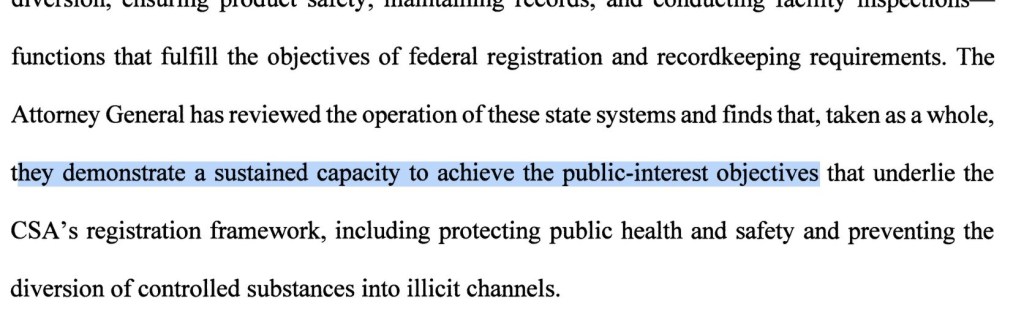
The order goes further. It says incorporating state licensing systems into the federal registration framework is the most effective and efficient way to achieve CSA objectives for medical marijuana while causing the least disruption for patients and existing state systems.⁷
That is a cooperative-federalism theory of cannabis regulation.
Under the rule, state medical-marijuana licensees may seek federal DEA registration as manufacturers, distributors, or dispensers. State credentials can be submitted as proof of state-law authorization. DEA must grant registration unless doing so would be inconsistent with the public interest under 21 U.S.C. § 823 or inconsistent with the Single Convention.⁸
The order also provides that federal registration automatically suspends if the underlying state license is suspended, revoked, or expires.⁹ That means federal authorization tracks state authorization. The state license becomes the foundation for federal recognition.
The tax consequences are also significant. The order states that holders of state medical-marijuana licenses will no longer be subject to Internal Revenue Code § 280E because § 280E applies to trafficking in Schedule I or II substances.¹⁰ The order does not itself decide any taxpayer’s liability, but it encourages Treasury to consider retrospective relief and tells licensees to consult tax counsel.¹¹
For researchers, the order also removes a barrier. It says federally registered researchers may obtain marijuana products from state licensees without civil or criminal liability under the CSA solely because the products came from a state-licensed source rather than a separate DEA bulk manufacturer, so long as the rule’s conditions are satisfied.¹²
But the limits are just as important as the breakthrough. The order does not cover synthetically derived THC, which remains outside the CSA definition of marijuana and remains in Schedule I.¹³ It also does not resolve adult-use marijuana. Recreational cannabis remains outside this new protection unless separately addressed later.
That is why this order should be read carefully. It is not full legalization. It is not full rescheduling of every cannabis market. It is a narrow but important federal recognition of state medical-marijuana systems.
The takeaway is simple: for the first time, the Attorney General has written into federal law that state medical-marijuana systems, as a whole, can protect public health and safety, prevent diversion, maintain records, conduct inspections, and help satisfy CSA objectives.¹⁴
For years, federal marijuana policy treated state cannabis programs as existing in spite of federal law. This order says state medical systems can help carry out federal law.
That is the real shift.
⸻
Footnotes
¹ Schedules of Controlled Substances: Rescheduling of Marijuana, Final Rule, U.S. Dep’t of Just., at 20 (2026).
² Id. at 20–22.
³ Id. at 6.
⁴ Id. at 9–10; 21 U.S.C. § 811(d)(1).
⁵ Final Rule, supra note 1, at 20.
⁶ Id.
⁷ Id. at 20–21.
⁸ Id. at 21.
⁹ Id.
¹⁰ Id. at 23; I.R.C. § 280E.
¹¹ Final Rule, supra note 1, at 23.
¹² Id. at 22–23.
¹³ Id. at 16.
¹⁴ Id. at 20.


Leave a Reply