April 24, 2026
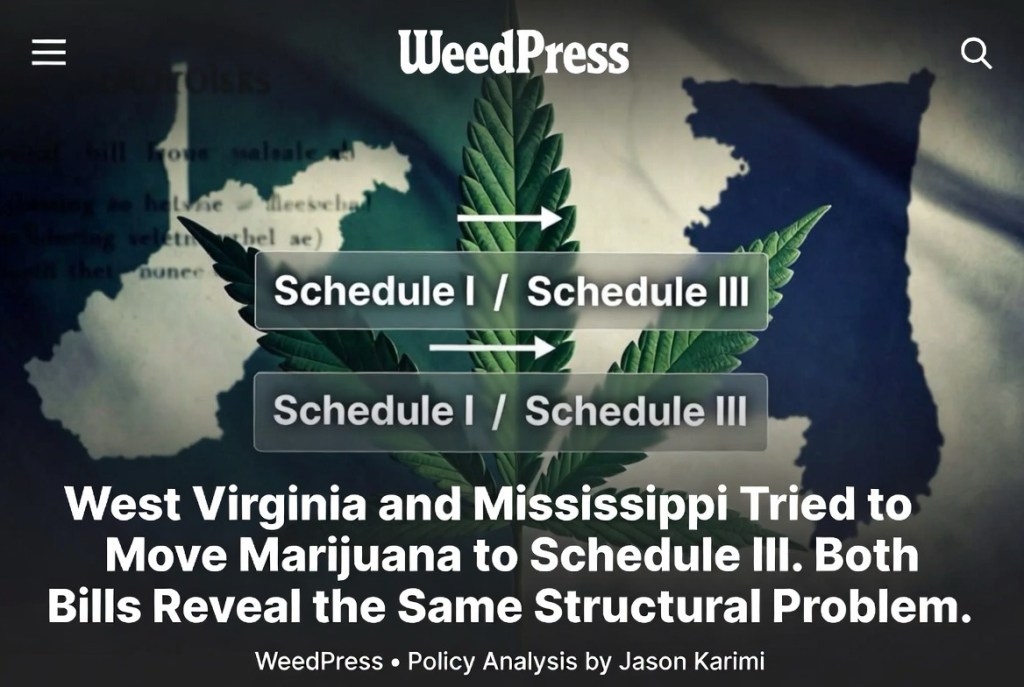
West Virginia and Mississippi each opened the 2026 session with a bill that would have done something their existing marijuana laws still refuse to do: move cannabis from Schedule I to Schedule III under state law.¹ ² Both proposals were straightforward on paper. West Virginia’s SB 809 would amend W. Va. Code §§ 60A-2-204 and 60A-2-208 to move cannabis and its natural and synthetic derivatives out of Schedule I and into Schedule III.³ Mississippi’s HB 865 would amend Miss. Code Ann. §§ 41-29-113 and 41-29-117 to remove marijuana from Schedule I and include it in Schedule III, while also amending penalty provisions in § 41-29-139 to conform to that shift.⁴ But neither bill became law. West Virginia’s bill was referred to the Senate Health and Human Resources Committee and appears to have stalled there.⁵ Mississippi’s bill was tabled on February 10, 2026.⁶
That legislative failure matters because both states already have functioning medical-cannabis systems. West Virginia’s Medical Cannabis Act makes the use or possession of medical cannabis lawful for certified, registered patients under state law.⁷ West Virginia’s Office of Medical Cannabis continues to operate patient registration and program administration accordingly.⁸ Mississippi likewise operates a statewide Medical Cannabis Program through the Mississippi State Department of Health.⁹ In other words, both states already allow cannabis as medicine in structured, state-licensed channels while still leaving marijuana formally classified in the most restrictive schedule of their controlled-substances acts. That is not just a policy tension. It is a legal contradiction.
West Virginia’s bill was notable for how directly it confronted that contradiction. Under current West Virginia law, marijuana sits in Schedule I.¹⁰ Schedule III, by contrast, is a separate statutory category under § 60A-2-208.¹¹ SB 809 proposed to move cannabis and its natural and synthetic derivatives into that lower schedule.¹² The bill’s own summary stated its purpose plainly: “Rescheduling cannabis from Schedule 1 to Schedule 3.”¹³ Yet the bill never advanced beyond committee referral.¹⁴ So West Virginia remains in the strange posture of authorizing medical cannabis through one chapter of state law while continuing to classify cannabis as a Schedule I substance in another.
Mississippi’s HB 865 was even more explicit. Its introduced text would remove marijuana from Schedule I in § 41-29-113, add it to Schedule III in § 41-29-117, and amend § 41-29-139 so the state’s criminal-penalty structure would match the rescheduling.¹⁵ The bill also included a legislative finding that Mississippi should align itself with the future of federal law by rescheduling marijuana from Schedule I to Schedule III.¹⁶ But the bill was tabled, and Mississippi’s statutory scheduling framework therefore remains unchanged for now.¹⁷ That leaves Mississippi with a licensed medical-cannabis program on one side and Schedule I classification on the other.¹⁸
The most obvious significance of these failed bills is doctrinal coherence. Schedule I is supposed to be reserved for substances with the highest level of restriction and no accepted medical use within the relevant legal framework. Yet both West Virginia and Mississippi already operate government-recognized medical-cannabis systems.¹⁹ ²⁰ That means the legal fiction is no longer subtle. The state says, in effect: this substance is dangerous enough to remain in Schedule I, but also lawful enough to be cultivated, dispensed, possessed, and used in a regulated medical program. Legislatures can preserve that inconsistency if they want. But they should at least admit that it is an inconsistency.
The bills also mattered because they would have forced state criminal codes to catch up with state medical policy. In West Virginia, marijuana remains listed in Schedule I under § 60A-2-204, even though separate state law makes regulated medical possession lawful.²¹ In Mississippi, the bill recognized the same structural mismatch by expressly proposing to amend not just the scheduling sections, but also the penalty section.²² That is exactly what honest rescheduling legislation is supposed to do. It does not merely send a symbolic message. It rewrites the classification architecture and the penalty architecture together.
There is also a timing point here. These state bills did not arise in a vacuum. In May 2024, the DEA formally proposed rescheduling marijuana to Schedule III at the federal level, and the federal process remained a live issue into 2026.²³ Then, in April 2026, the Justice Department announced an immediate federal move placing FDA-approved marijuana products and products containing marijuana subject to a qualifying state-issued medical license in Schedule III, while broader federal rescheduling proceedings continue.²⁴ That limited federal shift does not itself rewrite West Virginia or Mississippi law. But it makes the state-level contradiction even harder to defend. When states already run medical-cannabis programs and the federal government begins formally loosening classification for state-licensed medical marijuana, keeping state marijuana law frozen in Schedule I starts to look less like caution and more like legislative inertia.
None of this means either bill was guaranteed to pass, or that Schedule III would have solved every legal problem. It would not. Rescheduling does not itself answer questions about adult-use legalization, advertising, interstate commerce, or the continuing federal-state divide. Mississippi’s own legal environment shows how many cannabis disputes survive far beyond basic legalization; the Fifth Circuit, for example, upheld Mississippi’s ban on medical-marijuana advertising in 2024 precisely because marijuana remained federally illegal.²⁵ West Virginia likewise still has active medical-cannabis expansion debates in 2026, including bills involving product forms and broader access.²⁶ Rescheduling is not the end of the story. But it is still a meaningful legal correction.
That is why these two failed bills deserve attention. They were not fringe measures proposing immediate recreational legalization. They were narrower efforts to make state scheduling law better match state medical-cannabis reality. West Virginia’s SB 809 and Mississippi’s HB 865 both recognized the same institutional truth: once a state creates a lawful medical-cannabis system, continuing to classify marijuana as a Schedule I substance becomes increasingly difficult to justify on the state’s own terms.²⁷ ²⁸
So the real lesson from West Virginia and Mississippi is not just that the bills failed. It is that both states have already reached the point where their cannabis regimes are saying two different things at once. One body of law says marijuana has accepted medical use under carefully regulated conditions. Another still treats it as if it belongs in the most restrictive schedule. Until those states resolve that contradiction, their medical-cannabis programs will remain legally operational but conceptually unstable.²⁹ ³⁰
Footnotes
¹ S.B. 809, 2026 Reg. Sess. (W. Va. 2026).
² H.B. 865, 2026 Reg. Sess. (Miss. 2026).
³ S.B. 809, 2026 Reg. Sess. (W. Va. 2026) (proposing amendments to W. Va. Code §§ 60A-2-204, -208).
⁴ H.B. 865, 2026 Reg. Sess. (Miss. 2026) (proposing amendments to Miss. Code Ann. §§ 41-29-113, -117, -139).
⁵ Bill Status, S.B. 809, W. Va. Legislature, 2026 Reg. Sess. (last action Feb. 6, 2026, “To Health and Human Resources”).
⁶ H.B. 865, Bill Status, 2026 Reg. Sess. (Miss.) (showing status as tabled Feb. 10, 2026).
⁷ W. Va. Code § 16A-3-2(a) (2026).
⁸ Office of Med. Cannabis, W. Va. Dep’t of Health, Patient Registration, WV.gov.
⁹ Miss. Med. Cannabis Program, Miss. State Dep’t of Health, MS.GOV.
¹⁰ W. Va. Code § 60A-2-204 (2026).
¹¹ W. Va. Code § 60A-2-208 (2026).
¹² S.B. 809, 2026 Reg. Sess. (W. Va. 2026).
¹³ Bill History, S.B. 809, W. Va. Legislature, 2026 Reg. Sess.
¹⁴ Id.
¹⁵ H.B. 865, 2026 Reg. Sess. (Miss. 2026).
¹⁶ Id.
¹⁷ H.B. 865, Bill Status, 2026 Reg. Sess. (Miss.); see also H.B. 865 History XML, Miss. Legislature.
¹⁸ Miss. Med. Cannabis Program, Miss. State Dep’t of Health, MS.GOV.
¹⁹ W. Va. Code § 16A-3-2(a) (2026).
²⁰ Miss. Med. Cannabis Program, Miss. State Dep’t of Health, MS.GOV.
²¹ W. Va. Code § 60A-2-204 (2026); W. Va. Code § 16A-3-2(a) (2026).
²² H.B. 865, 2026 Reg. Sess. (Miss. 2026).
²³ Schedules of Controlled Substances: Rescheduling of Marijuana, 89 Fed. Reg. 44,597 (May 21, 2024); see also 89 Fed. Reg. 70,148 (Aug. 29, 2024) (notice of hearing).
²⁴ Press Release, U.S. Dep’t of Justice, Justice Department Places FDA-Approved Marijuana Products and Products Containing Marijuana Subject to a Qualifying State-issued License in Schedule III, Strengthening Medical Research While Maintaining Strict Federal Controls (Apr. 23, 2026).
²⁵ Tru Source Med. Cannabis, LLC v. Fitch, No. 23-60576, 2024 WL [citation omitted] (5th Cir. Nov. 22, 2024); see also Associated Press, Court agrees with ban on medical marijuana advertising in Mississippi (Nov. 25, 2024).
²⁶ See, e.g., H.B. 5260, 2026 Reg. Sess. (W. Va. 2026) (medical-cannabis expansion proposal); Marijuana Policy Project, West Virginia State Update (Mar. 2026).
²⁷ S.B. 809, 2026 Reg. Sess. (W. Va. 2026).
²⁸ H.B. 865, 2026 Reg. Sess. (Miss. 2026).
²⁹ W. Va. Code § 16A-3-2(a) (2026); W. Va. Code § 60A-2-204 (2026).
³⁰ Miss. Med. Cannabis Program, Miss. State Dep’t of Health, MS.GOV; H.B. 865, 2026 Reg. Sess. (Miss. 2026).


Leave a Reply