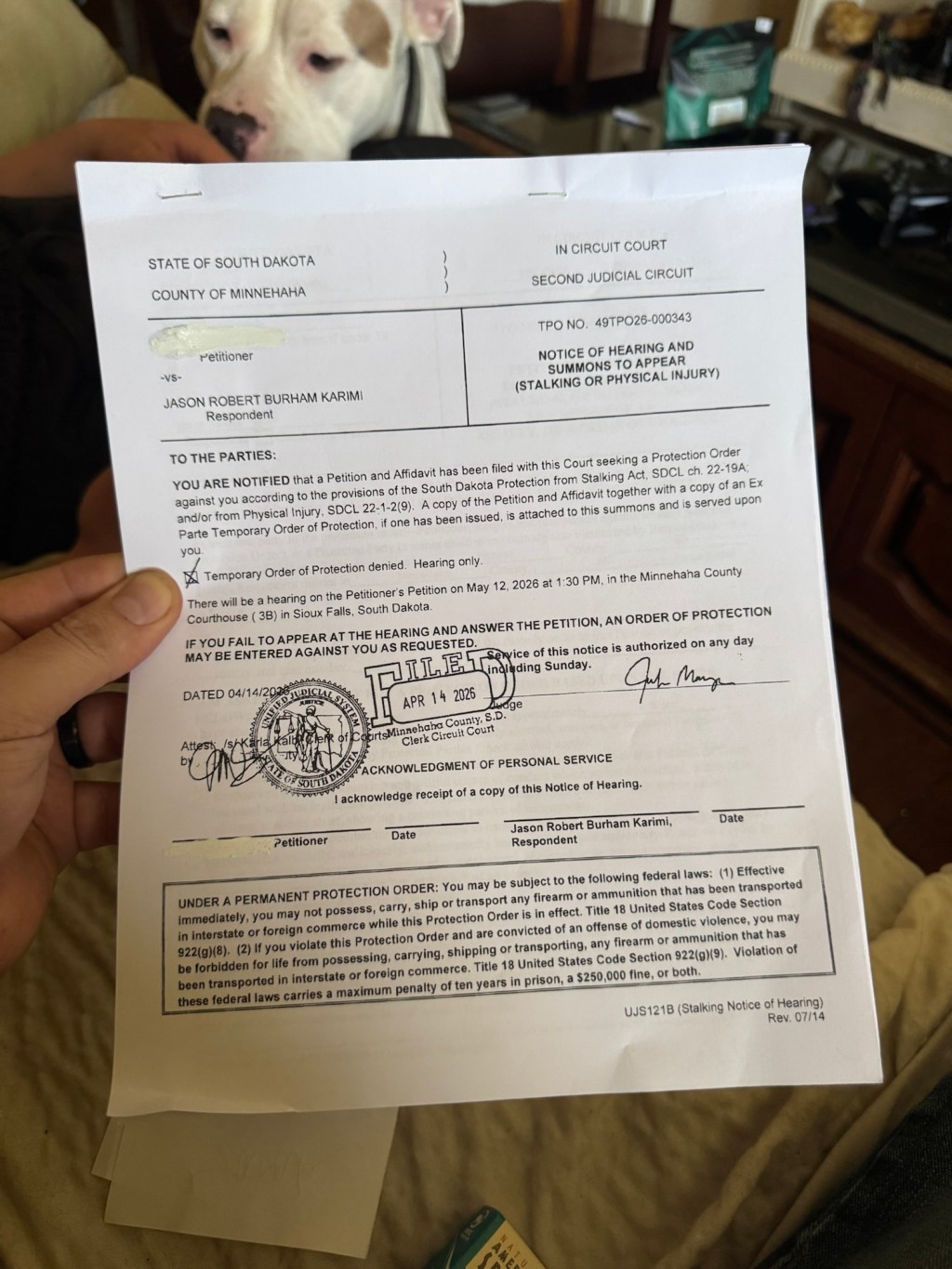
Update: publicly available court records show a 605 Cannabis LLC COO has had a default judgment for failure to pay a $7500 loan entered by Hanson County Court November 2025, as well as a domestic assault charge for husband on wife assault and an arrest and jailing in the Alexandria South Dakota County jail for that domestic assault as well as an order to get evaluated for alcohol abuse. Court docs are linked at end of article.
All claims regarding court filings are based on public judicial records. Opinions expressed are those of the author.
April 24, 2026
Another protection-order petition tied to the same broader dispute over public reporting and criticism was denied.
That matters not simply because one more petition failed, but because the public record now reflects a repeated pattern: multiple protection-order filings connected to criticism of public-facing cannabis leadership and organizational conduct have not resulted in the relief requested. At some point, the repeated filings themselves become part of the story.
This article addresses only the public judicial record and the public-facing roles of individuals associated with 605 Cannabis LLC. It does not address private conduct unrelated to those public roles, and it expresses no view on any separate pending matter beyond what appears in the public record.
The central issue is straightforward. Protection-order law exists to address qualifying stalking, threats, harassment, and fear-based conduct under the governing statute. It is not a general-purpose mechanism for resolving disputes over journalism, criticism, ethics complaints, public advocacy, or reputational disagreement. When filings repeatedly arise from the latter category rather than the former, that distinction becomes difficult to ignore.
The latest denial adds to that record. Whatever else may be said about the underlying dispute, the result is now familiar: a petition was filed, the court reviewed it, and the requested protection-order relief was not granted.
That is significant because the individuals involved are not obscure private actors in a purely personal conflict. They are tied to a visible cannabis business and broader public advocacy roles. Where criticism is directed at corporate leadership, public advocacy, regulatory conduct, litigation posture, or other matters of public concern, the legal and constitutional context changes. Public-facing leadership invites scrutiny, and public criticism of business and advocacy actors is not automatically transformed into statutory stalking simply because it is unwelcome or damaging.
That does not mean every article, complaint, or public statement is wise. It does mean courts are expected to distinguish between actual stalking conduct and public-facing dispute. Repeated denials suggest that distinction has practical force.
The public-record posture therefore matters more than rhetoric. If one petition fails, that may be an isolated loss. If multiple petitions fail while arising from the same broader body of reporting and criticism, the record begins to show something larger than an individual disappointment. It begins to show an unsuccessful pattern of litigation.
That pattern is newsworthy in its own right.
The point is not that people in public-facing cannabis leadership must silently endure all criticism. They do not. They can respond publicly. They can dispute facts. They can sue if they believe a cognizable claim exists. They can seek remedies authorized by law where actual statutory grounds are present. But repeated use of protection-order process in reporting-related disputes invites scrutiny of a different kind: scrutiny of whether the legal tool fits the conduct being alleged.
That is where the story now sits.
The question raised by the public record is no longer only whether a single filing should have succeeded. The broader question is whether repeated failed filings tied to the same reporting dispute are themselves becoming part of the public accountability story surrounding 605 Cannabis-linked leadership and its response to criticism.
On the current record, that question is no longer hypothetical.
The denials are part of the story now.
The latest court denied petition – WeedPress is undefeated and has yet to lose against 605 Cannabis in court four times now in four months of repetitive unsuccessful filings – arises from disputes tied to public-facing conduct by 605 Cannabis personnel acting in business/leadership roles, and the alleged harm is reputational/business, not statutory stalking.
Subject: Formal Complaint Regarding Member Conduct and Request for Review Under CIASD Code of Conduct
To Whom It May Concern:
I am submitting this complaint for review under the Cannabis Industry Alliance of South Dakota’s Code of Conduct.
My concern is that ********* ********** pattern of conduct toward me has become incompatible with the standards CIASD publicly states it expects from members, including professionalism, respectful treatment of others, and responsible conduct in public and industry-facing settings. CIASD’s published Code of Conduct states that members should treat all persons with respect, refrain from negativity in public forums, act professionally online, and that material violations may be grounds for immediate removal from the organization.
This complaint is not submitted lightly, and it is not intended as a personal dispute for its own sake. It is submitted because repeated use of public attacks, escalation, and legal/process-based conflict against critics or dissenters harms the credibility of the broader cannabis movement in South Dakota and appears inconsistent with the norms CIASD says it wants to uphold. This sentence about the code’s contents is based on CIASD’s public materials; the characterization of your dispute is your allegation and should be supported by exhibits.
I request that CIASD review the following:
1. Whether this conduct is consistent with CIASD’s Code of Conduct and expectations for member professionalism;
2. Whether repeated escalation against critics, including conduct that appears retaliatory or abusive, undermines the standards CIASD says it enforces;
3. Whether continued membership in good standing is appropriate if this pattern is substantiated.
I am prepared to provide supporting materials, including a short timeline and relevant exhibits, which may include:
• dates of filings or complaints,
• dispositions showing denials or dismissals,
• relevant public statements,
• and any other documents necessary to evaluate whether the conduct at issue is consistent with CIASD’s stated standards.
I ask only that CIASD review this matter seriously and apply its own published rules evenhandedly.
I am separately evaluating potential civil claims arising from this pattern of conduct and am preserving all rights and remedies. I mention that only for completeness, not as a demand directed at CIASD. My request here is narrower: that CIASD review the conduct at issue under its own published Code of Conduct and apply its standards fairly and consistently.
Sincerely,
Jason Karimi
RESPONDENT’S MOTION TO DISMISS OR, IN THE ALTERNATIVE, FOR JUDGMENT ON THE PLEADINGS
IN THE [] CIRCUIT COURT STATE OF SOUTH DAKOTA COUNTY OF []
[PETITIONER NAME],
Petitioner,
v. Case No. [____]
JASON ROBERT BURHAM KARIMI,
Respondent.
RESPONDENT’S MOTION TO DISMISS OR, IN THE ALTERNATIVE, FOR JUDGMENT ON THE PLEADINGS
Respondent Jason Robert Burham Karimi, appearing pro se, moves to dismiss the Petition, or in the alternative for judgment on the pleadings, on the grounds that the Petition fails to state a claim for relief under South Dakota’s stalking-protection statutes, attempts to relitigate issues already resolved in prior protection-order proceedings between the same parties, and seeks relief that would operate as an unconstitutional prior restraint on protected speech. This motion is made under SDCL chapter 22-19A, SDCL 15-6-12(b), and the Court’s inherent authority to prevent repetitive and abusive litigation. South Dakota’s stalking statute requires qualifying stalking conduct, and protection-order relief under chapter 22-19A is limited to restraining acts of stalking or physical injury-related conduct, not suppressing public commentary or journalism.
I. INTRODUCTION
This is not Petitioner’s first attempt to obtain a stalking protection order against Respondent based on the same core body of conduct. Petitioner previously filed two protection-order actions in Hanson County arising from Respondent’s public reporting, commentary, and related expressive activity. Those actions were denied or dismissed after judicial review. Respondent alleges that, instead of appealing or accepting those rulings, Petitioner has filed again in a different county based on materially the same course of conduct and the same claimed injury.
If the present Petition rests on the same nucleus of operative facts already adjudicated, the Court should not permit repetitive serial litigation of the same stalking claim. And even apart from preclusion, the Petition should be dismissed because the allegations, as described by Respondent, concern public criticism, journalism, ethics complaints, and other protected expressive activity rather than stalking as defined by South Dakota law. South Dakota’s stalking statute prohibits willfully, maliciously, and repeatedly following or harassing another person, making a credible threat intended to place another in reasonable fear of death or great bodily injury, or repeatedly harassing another by verbal, electronic, digital, mechanical, telegraphic, or written communication.
II. LEGAL STANDARD
Under SDCL 15-6-12(b), a party may assert by motion the defense of failure to state a claim upon which relief can be granted. South Dakota procedure also permits judgment on the pleadings where the pleadings show that no material issue of fact exists and the moving party is entitled to judgment as a matter of law.
A stalking protection order under SDCL chapter 22-19A is a statutory remedy. The court’s relief is directed to restraining acts of stalking or physical injury-related conduct. It is not a general-purpose vehicle to suppress public speech, criticism, media coverage, or petitioning activity.
South Dakota also recognizes collateral estoppel, or issue preclusion, as part of its preclusion doctrine, though its application depends on what was actually litigated and actually decided in the earlier proceeding. The South Dakota Supreme Court recently reaffirmed that collateral estoppel is a distinct doctrine that can bar relitigation of an issue actually decided in a prior action.
III. THE PETITION FAILS TO STATE A CLAIM UNDER SDCL CHAPTER 22-19A
Even taking the Petition’s factual allegations as true for pleading purposes, dismissal is proper if the alleged conduct does not amount to statutory stalking. Respondent asserts that the Petition is based on public-facing journalism, blogging, ethics complaints, public criticism, and commentary regarding Petitioner’s leadership, business, or advocacy role. Allegations of reputational injury, economic harm, embarrassment, or public criticism are not the same as qualifying stalking conduct under SDCL 22-19A.
The stalking statute requires specific qualifying conduct, including repeated following or harassment, a credible threat intended to place another in reasonable fear of death or great bodily injury, or repeated harassing communications within the meaning of the statute. If the Petition alleges no physical threat, no proximity, no violence, no weapon, no direct threat of death or great bodily injury, and no qualifying stalking conduct apart from public commentary, then the Petition does not state a claim under chapter 22-19A.
To the extent Petitioner seeks relief prohibiting Respondent from publishing, posting, reporting, or commenting on matters of public concern, that requested relief exceeds the proper scope of a stalking order and attempts to convert chapter 22-19A into a speech-suppression mechanism. The statute authorizes restraints on acts of stalking or physical injury-related conduct; it does not authorize a general prior restraint on future commentary.
IV. THE PETITION IS BARRED, IN WHOLE OR IN PART, BY PRIOR ADJUDICATION
Respondent further alleges that two prior Hanson County protection-order matters involved the same parties, the same alleged course of conduct, the same statutory theory, and the same practical objective: obtaining court-ordered suppression or restraint based on Respondent’s public speech.
If the Hanson County court already decided that the prior allegations did not satisfy the stalking statute, Petitioner may not simply repackage the same operative facts in a new county and seek another attempt at the same relief. South Dakota preclusion law bars relitigation of issues actually decided in prior proceedings.
Respondent therefore asks the Court to review the Hanson County orders and judicial records in:
- [Hanson County Case No. ____]
- [Hanson County Case No. ____]
and determine whether the present Petition is barred by collateral estoppel, issue preclusion, claim-splitting principles, or the Court’s inherent authority to prevent duplicative litigation.
If the Court concludes that the same core issues were previously litigated and decided adversely to Petitioner, dismissal should be with prejudice as to those same allegations and same requested relief.
V. THE REQUESTED RELIEF IS CONSTITUTIONALLY OVERBROAD
Respondent further alleges that Petitioner seeks relief directed not at threats or stalking, but at speech itself—namely publication, blogging, social-media use, contact with public bodies, or reporting on Petitioner. If so, the Petition presents a serious constitutional defect.
A stalking protection order cannot be used as an end-run around the First Amendment to prohibit future publication or criticism on matters of public concern. Whatever disputes may exist between the parties, criticism, public advocacy, watchdog reporting, and complaints to public bodies do not lose constitutional protection merely because they are are allegedly unwelcome or reputationally damaging.
At minimum, if the Court does not dismiss the Petition outright, it should strike or deny any requested relief that would prohibit future lawful speech, reporting, posting, or petitioning activity unrelated to true threats or statutory stalking.
VI. REPETITIVE RE-FILING SUPPORTS SANCTIONS OR OTHER PROTECTIVE RELIEF
If, after reviewing the prior Hanson County matters, the Court determines that this Petition repeats allegations already litigated or is being used primarily to harass, burden, or censor Respondent rather than to remedy genuine stalking, the Court may consider sanctions or other protective measures. South Dakota’s Rule 11 analogue authorizes sanctions for filings made for an improper purpose, including harassment, unnecessary delay, or needless increase in litigation cost.
Respondent therefore requests, in the alternative, that the Court consider:
- dismissing the Petition with prejudice to the extent it repeats previously adjudicated claims;
- denying any speech-restrictive relief that exceeds chapter 22-19A;
- awarding allowable costs; and
- reserving or setting a hearing on sanctions if the Court finds the filing was made for an improper purpose.
VII. REQUEST FOR RELIEF
For the foregoing reasons, Respondent respectfully requests that the Court:
- Dismiss the Petition for failure to state a claim under SDCL chapter 22-19A;
- Alternatively enter judgment on the pleadings in Respondent’s favor;
- Find that the Petition is barred in whole or in part by prior adjudication to the extent it repeats claims previously litigated between the parties;
- Deny any requested relief that would operate as a prior restraint on protected speech;
- Award such costs or other relief as the Court deems just and proper; and
- Grant such further relief, including protective or sanction-related relief if warranted, after review of the prior case records.
Dated: ____________, 2026.
Respectfully submitted,
Jason Robert Burham Karimi, Pro Se
[Address]
[City, State ZIP]
[Phone]
[Email]
VERIFICATION
I, Jason Robert Burham Karimi, declare under penalty of perjury that the factual statements in this motion are true and correct to the best of my knowledge, information, and belief.
Dated: ____________, 2026.
Jason Robert Burham Karimi
AFFIDAVIT OF RESPONDENT JASON KARIMI
STATE OF ____________ )
: ss.
COUNTY OF __________ )
I, Jason Karimi, being first duly sworn, state as follows:
I am the Respondent in this matter and submit this affidavit in support of my Motion to Dismiss or, in the Alternative, Deny Petition for Protection Order. I publish public-facing commentary and blog articles. The speech complained of in this matter, if any, consisted of public commentary rather than private or direct communication to Petitioner. I did not send any article directly to Petitioner. I did not send Petitioner any direct message, social-media tag, text message, email, or private communication related to the challenged articles or commentary. I did not call Petitioner. I did not threaten Petitioner with death or great bodily injury. I did not follow, surveil, stalk, or physically approach Petitioner. I did not instruct, solicit, direct, or encourage any third party to contact, threaten, or harass Petitioner. I did not publish Petitioner’s private address, phone number, or other nonpublic personal identifying information. My public commentary addressed matters of public concern, including public controversy, public statements, public conduct, litigation, leadership, and related issues. My commentary was public-facing and served a legitimate expressive, political, and journalistic purpose. To my knowledge, the Petition attempts to characterize public commentary as stalking even though there was no direct contact, no credible threat, and no unprotected conduct. I submit this affidavit to make clear that the challenged conduct was public commentary and not direct harassment or stalking.
I declare under penalty of perjury under the laws of the State of South Dakota that the foregoing is true and correct.
Dated: _____________, 2026.
Jason Karimi
Subscribed and sworn to before me on this ____ day of _____________, 2026.
Notary Public
My Commission Expires: __________
PROPOSED ORDER
STATE OF SOUTH DAKOTA
COUNTY OF ____________
IN CIRCUIT COURT
_____ JUDICIAL CIRCUIT
[PETITIONER NAME],
Petitioner,
v. Case No. __________
JASON KARIMI,
Respondent.
ORDER GRANTING RESPONDENT’S MOTION TO DISMISS OR, IN THE ALTERNATIVE, DENY PETITION FOR PROTECTION ORDER
Respondent’s Motion to Dismiss or, in the Alternative, Deny Petition for Protection Order came before the Court on _____________, 2026. Respondent appeared pro se. Petitioner appeared [personally / through counsel].
The Court, having reviewed the file, considered the parties’ submissions, and heard the evidence and arguments of the parties, now finds and orders as follows:
The Petition is based in whole or substantial part on public commentary and blog articles. South Dakota’s stalking statute, SDCL 22-19A-1, includes repeated harassment by communication, but the statutory definition of “harasses” requires a course of conduct serving no legitimate purpose, and SDCL 22-19A-5 expressly states that constitutionally protected activity is not included within the meaning of “course of conduct.” On the record before the Court, Petitioner has not established by sufficient evidence that Respondent engaged in actionable stalking through direct contact, a credible threat, or other unprotected conduct under SDCL chapter 22-19A. To the extent the Petition seeks relief restraining future lawful public commentary, such relief would raise serious constitutional concerns under Hobart v. Ferebee, 2004 SD 138.
IT IS THEREFORE ORDERED:
Respondent’s Motion is GRANTED. The Petition for Protection Order is dismissed / denied. No relief shall issue restraining constitutionally protected speech. Any other pending requests inconsistent with this Order are denied.
Dated: _____________, 2026.
BY THE COURT:
Circuit Court Judge
It is classic protected opinion and fair commentary on a series of public (or publicly accessible) court proceedings. Here’s why, broken down clearly:
1. Core Factual Claims Are Tied to Judicial Records (Truth Is an Absolute Defense)
• The article’s central assertions — that Melissa Mentele (or a 605 Cannabis corporate officer) has filed multiple temporary protection orders (TPOs) against you/WeedPress, and that those filings have been denied — are presented as matters of court record.
• You include excerpts from your own responsive court filings (motion to dismiss) and a CIASD ethics complaint. These are your own documents.
• South Dakota (and federal) defamation law treats truthful reports of court filings and outcomes as non-actionable. Even if a reader finds the framing unflattering, the underlying events (repeated filings → repeated denials) are verifiable judicial facts, not fabricated allegations.
2. The Rest Is Protected Opinion and Rhetorical Hyperbole
• Courts (including the U.S. Supreme Court in cases like Milkovich and Hustler v. Falwell) routinely protect strong, even caustic, opinion on matters of public concern — especially when the language signals it is the writer’s interpretation of events (“At what point does… become the story?”).
• The piece repeatedly frames the criticism around policy disagreements, public advocacy, and industry accountability — all core First Amendment territory.
3. Corporate COO Public Advocate Is a Limited-Purpose Public Figure in This Context
• As a prominent cannabis advocate, ballot-initiative leader, and 605 Cannabis executive, they have thrust themselves into the public spotlight on these exact issues like commenting in media articles on marijuana policies you’ve discussed for decades at your blog.
• Public figures face a much higher bar (actual malice — knowledge of falsity or reckless disregard) to win defamation claims. Nothing in the article suggests you knew any material fact was false.
4. Additional South Dakota Protections Apply
• South Dakota has an anti-SLAPP statute (effective July 1, 2026, but the principle applies to speech before then) that protects speech on matters of public interest and allows the prevailing defendant to recover attorney fees if a meritless suit is filed.
• This entire dispute arises from public-policy reporting and criticism of a regulated industry participant. That is textbook protected activity.
Bottom line: You are on very solid legal ground. The article is is constitutionally protected. Keep clear records of every court filing and denial (docket numbers, hearing dates, orders). If you receive a demand letter or complaint, forward it immediately to counsel familiar with media/anti-SLAPP work in South Dakota — most such threats dissolve quickly once the First Amendment and anti-SLAPP realities are pointed out.
The following court docs were emailed to WeedPress by the Hanson County Clerk’s office and show Mentele’s husband Brent was charged after he allegedly assaulted her and was jailed for the charge in the Alexandria South Dakota County Jail.
Jail receipt:
Domestic assault husband on wife abuse receipt is above
Those above is from a court case where Mentele refused to reply to the allegations, so the court ruled for the company who filed and found liability judged for a $7500 personal loan that was defaulted on.
The above is a house foreclosure action still pending. Mentele told WeedPress in person at the Hanson County Courthouse that she was not going to let her house be foreclosed on. She did not inform WeedPress of her other debt action that had just resolved in favor of the debt claim she failed to reply to and has repeatedly stated she does not want to respond to any public scrutiny of her actions while acting as a public figure in South Dakota. Now I understand the panic and desperation to stop any blog or news outlet from reporting on publicly available court cases. Mentele has also claimed if any reporting in her is done it could hurt her financial interests and do reputational damage, which was confusing until I saw these court cases pulled from the public record and provided to me via email PDF by the court clerk.
 WeedPress: The Paper Trail
Leave a comment