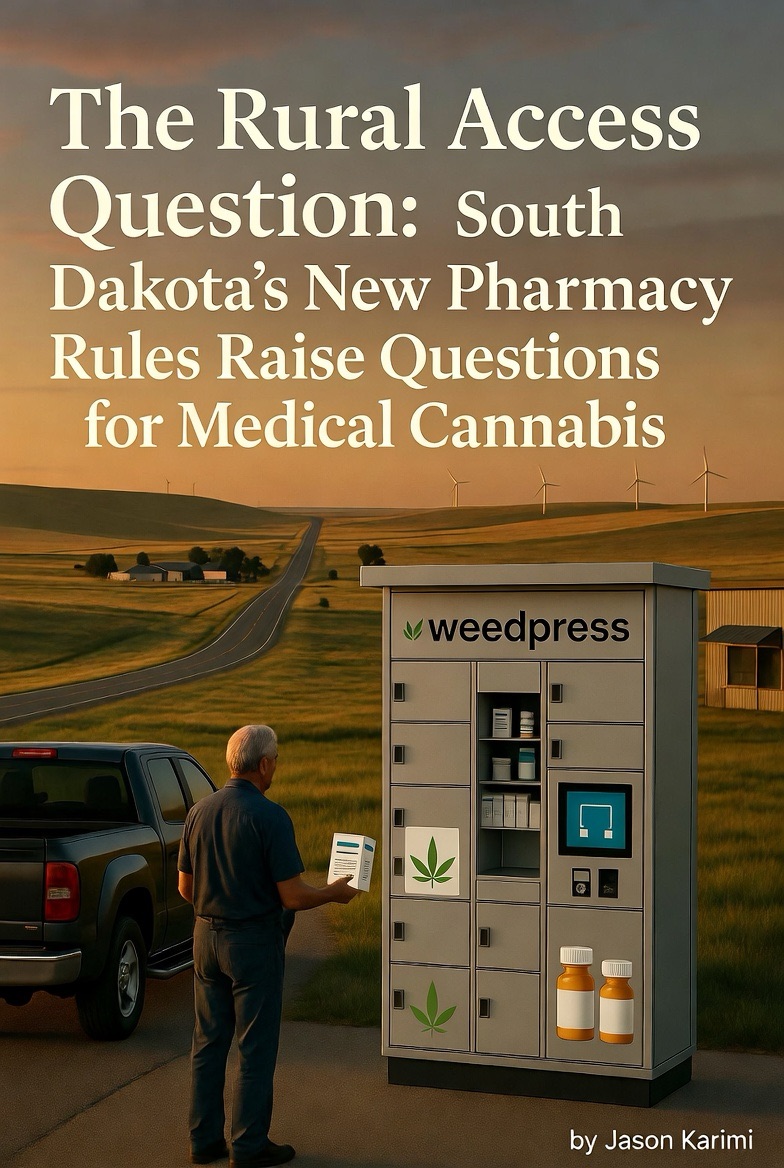
As regulators embrace telepharmacy and remote prescription pickup, policymakers may eventually face similar questions about medical cannabis access in rural communities.
South Dakota’s Board of Pharmacy is advancing updated rules under Article 20:51 of the Administrative Rules of South Dakota (ARSD) that formalize the use of remote drop sites for prescription medications and introduce a formal variance process for pharmacy operations.¹² These changes, stemming in part from Senate Bill 14 (2026), which modified provisions related to the practice of pharmacy, promise to improve medication access in a state defined by its vast rural expanses.³ Yet for medical cannabis patients—many of whom live far from dispensaries—this development underscores a persistent gap in the state’s approach to equitable healthcare access.
Medical cannabis and prescription drugs operate under different statutory frameworks, and the Board of Pharmacy’s proposal does not apply to cannabis dispensaries. Nevertheless, the underlying policy question—how to deliver regulated medicine safely to rural patients—remains relevant across both systems.
The New Pharmacy Framework
The proposed rules allow licensed pharmacies to establish secure remote drop sites (such as kiosks or lockers) for patient pickup of prescriptions, without requiring separate pharmacy licensing for each site.¹ All such sites must remain under the supervision of the pharmacist-in-charge at a central licensed pharmacy. A public hearing on the package is scheduled for June 18, 2026.⁴
This builds on South Dakota’s existing telepharmacy provisions in ARSD 20:51:30 and reflects a practical response to rural healthcare challenges.⁵ In a state where roughly two-thirds of counties face health professional shortages, reducing travel burdens for routine prescriptions makes clear public health sense.⁶
Particularly noteworthy is the addition of a formal variance process. Regulators are increasingly recognizing that rigid, one-size-fits-all rules do not always serve rural populations well. This philosophy of flexibility could prove instructive for future medical cannabis policy adjustments.
Rural Barriers for Medical Cannabis Patients
South Dakota’s medical cannabis program, governed by SDCL Chapter 34-20G and ARSD Article 44:90, operates separately from traditional pharmacies. Dispensaries are fewer and more concentrated than standard pharmacies, leaving patients in frontier counties with long drives—often hours round-trip—to obtain their medicine.⁷
As of May 2026, the program had approximately 18,984 approved patient cards.⁸ Patients use cannabis primarily for qualifying conditions such as chronic pain, PTSD, and epilepsy—conditions that frequently limit mobility or make extended travel difficult.
According to South Dakota Department of Health program statistics, only about 10% of patients qualify for the reduced $20 card fee available to low-income households (those below 130% of the federal poverty level). The remaining ~90% pay the standard $75 fee, indicating that while many patients are not extremely low-income, they still confront substantial non-financial barriers: fuel costs, time off work, limited public transportation, and caregiver burdens in rural areas.⁹
Although South Dakota has roughly 78 licensed dispensaries, they are unevenly distributed across the state’s 66 counties and remain concentrated in larger population centers. This leaves many rural and frontier counties without nearby options, forcing patients to travel significant distances.
Broader Implications for Telepharmacy and Access
The Board of Pharmacy’s emphasis on remote access, variance processes, and secure pickup points highlights a proven model that could be adapted for medical cannabis. Such innovations have the potential to enhance program integrity through better tracking while dramatically improving patient adherence. Extending similar flexibilities to the medical cannabis framework would not require weakening controls; rather, it could harmonize oversight between traditional pharmacy infrastructure and cannabis dispensaries.
Rural South Dakota already relies heavily on telehealth and remote service delivery innovations. Applying parallel thinking to cannabis could improve participation in the regulated market and support better integration with mainstream healthcare—especially since many patients also manage traditional prescriptions that could benefit from the new remote drop sites.
A Call for Policy Alignment
The Board of Pharmacy’s 2026 rules package represents a forward-thinking step for general medication access.¹ Lawmakers and the Department of Health should evaluate whether parallel innovations in the medical cannabis program—such as regulated remote or delivery options under strict oversight—are warranted to serve rural patients equitably. True patient access means ensuring medicine reaches people where they live, not just where regulations allow dispensaries to open.
As South Dakota’s medical cannabis program matures beyond 18,000 patients, addressing these rural realities will be essential to fulfilling the intent of Initiated Measure 26.
Footnotes
¹ S.D. Admin. R. 20:51 (proposed amendments filed May 22, 2026) (remote drop sites and variance process).
² S.D. Bd. of Pharmacy, Meeting Handouts (Apr. 10, 2026).
³ S.D. Legis. SB 14, 2026 Reg. Sess. (pharmacy practice modifications).
⁴ S.D. Bd. of Pharmacy, Public Notice (May 2026).
⁵ S.D. Admin. R. 20:51:30 (existing telepharmacy rules).
⁶ S.D. Dep’t of Health, Rural Health Data.
⁷ S.D. Codified Laws ch. 34-20G (2021) & S.D. Admin. R. art. 44:90.
⁸ S.D. Dep’t of Health, Medical Cannabis Program Data (May 2026).
⁹ S.D. Dep’t of Health, Medical Cannabis Program Statistics (low-income fee data).
 WeedPress: The Paper Trail
Leave a comment