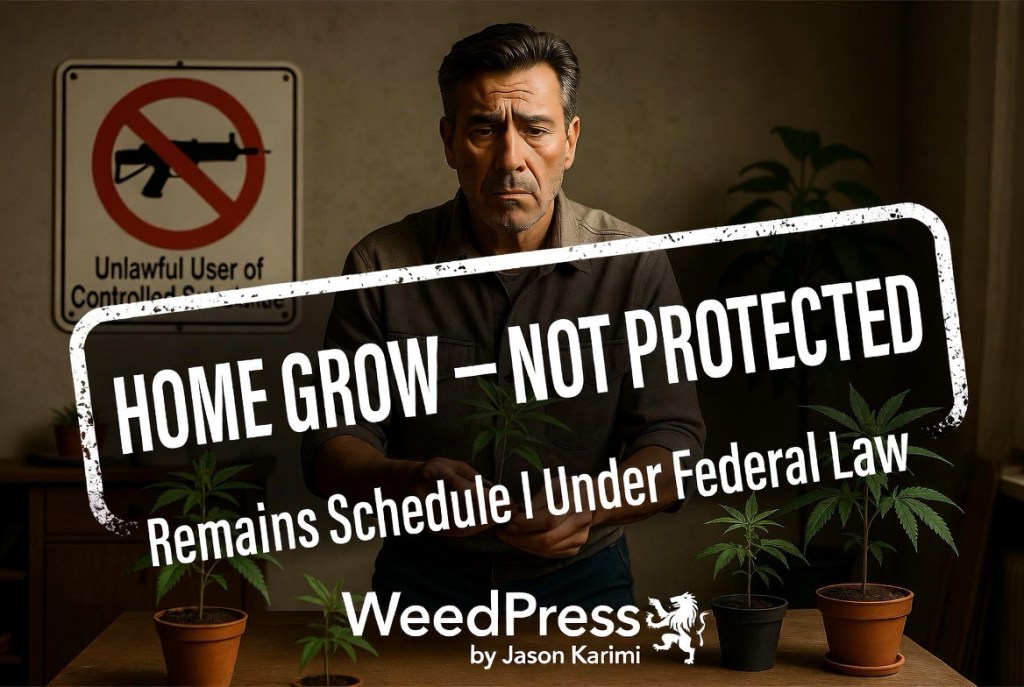
The April 28, 2026 federal partial rescheduling order moved only two narrow categories of marijuana from Schedule I to Schedule III: certain FDA-approved products and marijuana produced under qualifying state-issued medical marijuana licenses.¹ Personal home cultivation was not included in either category.
This creates a significant gap. In states that permit limited home growing for patients or adults, those plants and the cannabis harvested from them do not qualify as “marijuana subject to a qualifying state-issued medical marijuana license” under the federal order. As a result, homegrown cannabis remains a Schedule I controlled substance under federal law, even in states where it is legal at the state level.
Colorado Attorneys and Regulators Have Been Clear
Colorado attorneys and industry observers have been direct about this limitation. One Colorado cannabis attorney stated in public commentary following the rescheduling:
“If you’re growing your own marijuana in your basement, you don’t have a state license for that activity. The federal registration pathway is for state-licensed medical marijuana. So homegrow remains Schedule I federally.”²
Rachel Gillette, a prominent Colorado cannabis attorney, made the following comments in interviews and public analysis following the April 28, 2026 federal rescheduling order:
“Hypothetically, if you’re growing your own in your basement, you don’t have a state license, you can’t apply under the federal registration program. If you give it to your buddy, are you now a trafficker of Schedule I or Schedule III? I don’t know.”³
These comments reflect the prevailing view among Colorado cannabis counsel: home cultivation falls outside the narrow federal rescheduling because it is not produced under a commercial or licensed medical marijuana program in the manner contemplated by the April 28 order.
This Issue Is Not Limited to Colorado
The same problem exists in every state that permits some form of home cultivation, whether for medical patients or recreational adults. The federal order ties Schedule III status to marijuana produced under a qualifying state-issued medical marijuana license. Personal home grows — even when explicitly authorized by state law — are not the same as licensed commercial or medical production.
States with home grow provisions (including Colorado, Michigan, Illinois, and others) now face the same open question: Does state-authorized personal cultivation qualify for the new federal Schedule III pathway? The answer, based on the text of the order and commentary from practitioners, appears to be no.
South Dakota Medical Patients Who Grow at Home Face the Same Uncertainty
South Dakota’s medical cannabis program allows registered patients to cultivate a limited number of plants at home under certain conditions.⁴ However, this home cultivation is personal and patient-specific. It is not produced under a state-issued license for commercial medical marijuana cultivation, processing, or dispensing in the way the federal order appears to require.
Because South Dakota home grows do not fall within the narrow category of “marijuana subject to a qualifying state-issued medical marijuana license,” they likely remain Schedule I under federal law. Patients who grow at home in South Dakota therefore carry the same federal risk as home growers in other states: their plants and harvested cannabis are not protected by the April 28 rescheduling.
Amateurs wrote South Dakota’s medical cannabis laws without legal counsel or legal expertise. The bill writers never anticipated or supported (in fact fought strongly against) federal exemption. Those same authors are now telling South Dakotans not to worry, as South Dakota law will not be affected by federal law. Homegrown rights are not protected in South Dakota. So gun ownership will remain illegal for homegrowing patients, while South Dakota policy “experts” destroy their credibility trying to bluff about laws they don’t understand.
Beard Bros Webinar Panelists Highlighted Ongoing Federal Uncertainty
During the June 3, 2026 Beard Bros Media Network webinar “Schedule 3: Harm or Help?,” panelists repeatedly emphasized that rescheduling did not resolve all federal issues. Attorney Amber Lengacher noted the practical burdens and uncertainties operators and patients still face when navigating the new framework, particularly around compliance and activities that fall outside the narrow rescheduled categories.⁵ Other panelists discussed how federal uncertainty continues to affect patients, especially those relying on home cultivation or non-licensed sources.
These comments align with the broader legal consensus: the April 28 order was narrow by design. It did not create blanket federal protection for all state-legal cannabis activity, including home grows.
Why This Matters for Patients
Patients who grow at home under state law now operate in a legal gray area federally. While state law may protect them from state prosecution, federal law still treats their cannabis as Schedule I. This creates real risks around possession, gifting, sharing, or any activity that could be construed as distribution.
For South Dakota medical patients specifically, the combination of limited state home grow rights and the absence of federal protection means they remain exposed to federal enforcement risk — the exact problem many advocates hoped rescheduling would begin to address.
WeedPress Position
WeedPress is the only independent South Dakota voice consistently analyzing these federal-state gaps with no financial ties to any cannabis business or trade association. Other voices in the state have direct business or organizational interests that create incentive to downplay the remaining federal risks facing patients who grow at home.
Patients deserve accurate information about where federal protection begins and ends. The April 28 rescheduling was a limited step. It did not solve the home grow problem, and it left real uncertainty for patients in every state that permits cultivation outside of licensed commercial programs.
Footnotes
¹ Schedules of Controlled Substances: Rescheduling of Food and Drug Administration Approved Products Containing Marijuana From Schedule I to Schedule III; Corresponding Change to Permit Requirements, 91 Fed. Reg. 22714 (Apr. 28, 2026) (2026-08176).
² Brian Vicente, Colorado cannabis attorney and co-founder of Vicente LLP, comments following the April 28, 2026 federal rescheduling order, stating that personal home cultivation does not qualify for the new Schedule III registration pathway because it is not produced under a state-issued license for commercial or medical marijuana. These comments were widely circulated in Colorado cannabis industry discussions in late April and May 2026.
³ Rachel Gillette, Colorado cannabis attorney, comments on home cultivation following federal rescheduling, Denver Post, Apr. 24, 2026, https://www.denverpost.com/2026/04/24/medical-marijuana-rescheduling-colorado-cannabis-business/ (quoting Gillette on the uncertainty for homegrowers who lack a state license and therefore cannot use the new federal DEA registration pathway).
⁴ S.D. Codified Laws § 34-20G (allowing limited home cultivation for registered medical cannabis patients under specified conditions).
⁵ Beard Bros Media Network, “Schedule 3: Harm or Help?” (June 3, 2026), https://www.youtube.com/watch?v=gy7dtRNpB4Q (Amber Lengacher and panelists discussing remaining federal compliance uncertainties and activities outside the narrow rescheduled categories).
⁶ Id. (panel discussion on how rescheduling did not resolve all federal issues for patients and non-licensed activities).
⁷ See generally 91 Fed. Reg. at 22714 (limiting Schedule III treatment to FDA-approved products and marijuana subject to qualifying state-issued medical marijuana licenses).
⁸ Industry analyses have noted that personal cultivation falls outside the commercial licensing framework targeted by the federal order.
⁹ The narrow scope of the rescheduling leaves home grow in a continued state of federal uncertainty in every state that permits it.
¹⁰ Patients relying on home cultivation should consult independent legal counsel, as state authorization does not equate to federal protection under the current order.
 WeedPress: The Paper Trail
Leave a comment