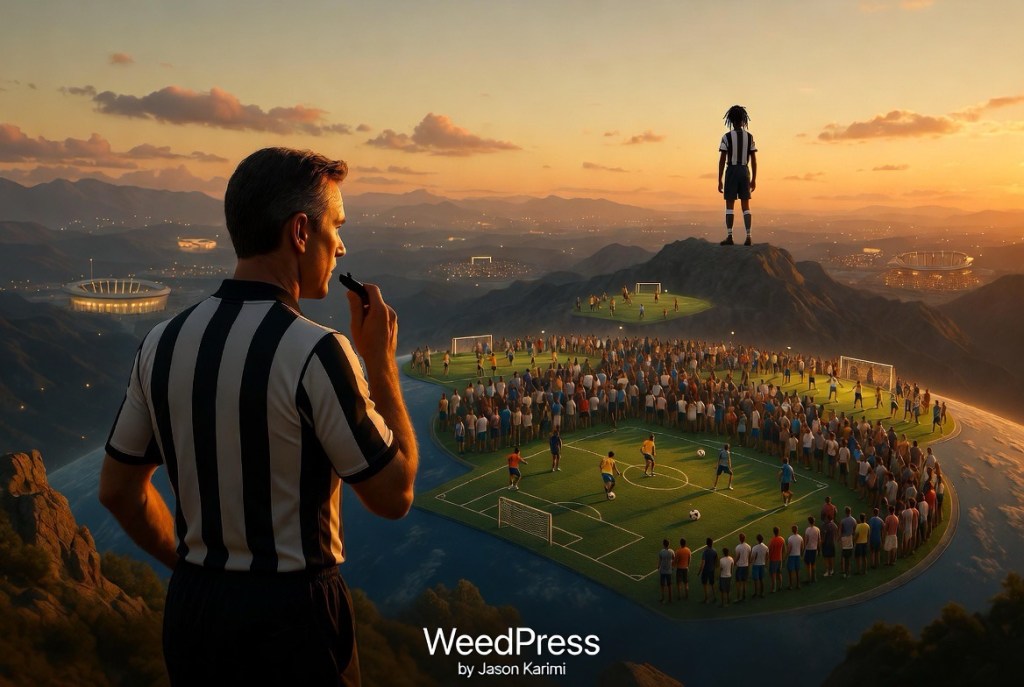
In 2014, I was in Indiana at a national recruiting tournament for U.S. Soccer. I spent the week meeting MLS coaches and refereeing some of the best young players in the country.
Between games I sat in a giant, air-conditioned referee tent with catered organic food and a massive screen tuned to the World Cup. On that screen I watched a dreadlocked kid stand on a mountain. From his vantage point the entire world seemed to play together, laugh together, and forget its divisions for a few hours at a time.
What I saw then is now happening in America.
That is why soccer is the greatest sport in the world.
American football is war. It is built on controlled violence, military metaphors, and territorial conquest. Soccer is different. It is the universal language of play, movement, and shared humanity. In a time of rising global tensions, the World Cup is once again proving that soccer can do what politics and missiles cannot: bring people together across every imaginable line.
Franklin Foer captured this truth better than anyone in his landmark book How Soccer Explains the World. Foer shows that soccer is not merely a game. It is a living map of globalization, identity, tribalism, and the constant tension between local passion and global forces. He writes that soccer “has become the Esperanto of the global village,” a sport that creates new forms of belonging while exposing old hatreds.¹ Foer’s book demonstrates, chapter after chapter, that when people play and watch soccer together, something larger than sport occurs. Old enemies sit in the same stadium. Strangers become temporary allies. The game forces a kind of practical cosmopolitanism that no diplomatic summit has ever matched.
(Side story: I once red carded an Iowa State University player in a game vs the University of Minnesota then rode my moped two blocks away to deliver sandwiches for the ISU campus town Jimmy John’s and as I walked in the whole store yelled at me for red carding an ISU player, as a current Iowa State student and locally famous sandwich maker…and the college weed chapter spokesperson…and the state weed chapter spokesperson…while I refereed college sports in Bob Marley hoodies. RIP flying burrito)
And apparently the Scots drink Boston bars or something out of beer at triple the rate of St. Patrick’s day. Which is hilarious; and a decent segway…
Foer’s analysis of Scottish soccer and the Rangers-Celtic rivalry shows how deeply tribal identities can be, yet even there the game creates space for something more.² In Brazil he explores how soccer became both a source of national pride and a mirror for corruption and inequality, yet still managed to unite a vast and diverse country around a single passion.³ Across continents, Foer finds the same pattern: soccer explains the world because it reveals both our worst instincts and our persistent desire to transcend them through play.⁴
Media coverage of Foer’s book recognized this power immediately.
Reviewers noted that the book uses soccer to explain why globalization has not produced the bland, borderless world many predicted.⁵ Instead, soccer shows how local identities adapt, resist, and sometimes flourish within a global system. The game becomes a laboratory for seeing how people actually behave when they are given a shared activity that rewards skill, creativity, and teamwork rather than ancestry or ideology.
I saw this firsthand during my ten years as a referee. I traveled the country, worked my way onto the top-ten list of referees in my state, and even centered a Des Moines Menace game against the best college team in the state at the time — AIB — a squad loaded with players recruited from Argentina, England, and Brazil.
On those fields I watched young men from completely different worlds communicate through the game. They argued, they celebrated, they learned each other’s styles, and by the end they had created something none of them could have made alone.
That is the peace-bringing quality of soccer. It does not require agreement on politics or history. It only requires a ball, a field, and the willingness to play by the same rules for ninety minutes.
Right now that same phenomenon is unfolding across the United States as we prepare to host the 2026 World Cup. International fans and media are arriving in large numbers. The Today Show and other outlets have begun covering the experiences of visitors discovering American cities, American hospitality, and yes, the hot American summer.⁶ These visitors are not seeing a caricature. They are seeing the real scale, energy, and openness of the country. They are experiencing the practical reality that, despite loud domestic critics who insist America is in terminal decline, this remains the most dynamic, opportunity-rich, and culturally magnetic nation in human history.
Foer understood that soccer’s global spread has often carried American-style commercial energy and consumer culture with it.⁷ Yet the game has also become a vehicle for the rest of the world to encounter America on its own terms — not through political speeches or military bases, but through stadiums, tailgates, and the simple pleasure of watching the best players on earth compete. When foreign fans walk into American stadiums and feel the size, the organization, the food, the music, and the sheer enthusiasm, many of them leave with a different picture than the one painted by America’s loudest internal critics.
This is the enlightenment Foer’s book points toward and that the current World Cup cycle is making visible. Soccer forces people to judge with their own eyes rather than through media filters. A Brazilian fan standing in a packed American stadium, a European supporter experiencing Midwestern hospitality, an African player seeing the resources and professionalism of U.S. youth development — these encounters cut through propaganda in both directions. They show the world a version of America that is bigger, more welcoming, and more impressive than the version some domestic voices prefer to export.
The bitter critics who spend their days insisting America is the source of every global problem are being answered, quietly but powerfully, by the simple fact of people coming here, playing here, watching here, and often loving what they find. Soccer is doing what no political campaign or media narrative can do as effectively: it is letting the world see America for itself.
That is why the dreadlocked kid on the mountain in 2014 playing during a World Cup commercial break in that Indiana referee tent that I saw still matters. He was watching the world play together. Now that same game is being played on American soil, with American fans and American infrastructure at the center. The rest of the world is getting a front-row seat to what this country actually is when it is at its best — open, energetic, ambitious, and capable of hosting the planet’s biggest party without losing its own character.

Soccer will never eliminate conflict. Foer never claimed it would.⁸ But it remains the single best cultural technology humanity has invented for turning strangers into temporary neighbors and turning competition into shared joy.
In a fractured time, that is not a small thing.
It is one of the best reasons, to keep watching.
Footnotes
¹ Franklin Foer, How Soccer Explains the World: An Unlikely Theory of Globalization 3 (Harper Perennial 2005) (“Soccer has become the Esperanto of the global village…”).
² Id. at 45–62 (discussing the Rangers-Celtic rivalry as a living map of sectarian identity that the game both reflects and sometimes transcends).
³ Id. at 115–140 (exploring Brazilian soccer as national passion and mirror of systemic corruption).
⁴ Id. at 4 (“The game explains the world because it shows how local identities adapt inside a global system.”).
⁵ See, e.g., Michiko Kakutani, Books of The Times; Soccer as a Window on a Globalized World, N.Y. Times, June 15, 2004 (reviewing Foer’s argument that soccer reveals the incomplete and contradictory nature of globalization).
⁶ See, e.g., Today Show segments (June 2026) covering international World Cup visitors experiencing American cities and summer weather.
⁷ Foer, supra note 1, at 78–95 (analyzing how soccer has carried consumer capitalism and American-style commercialization into new markets).
⁸ Id. at 250–260 (concluding that soccer reveals both the best and worst human impulses without pretending to solve underlying conflicts).
⁹ See David Goldblatt, The Ball Is Round: A Global History of Soccer 12 (2006) (complementary analysis of soccer’s role in creating shared public rituals across borders).
¹⁰ Foer, supra note 1, at 22 (“In soccer, the local and the global are forced to negotiate in real time on the pitch and in the stands.”).
¹¹ See Simon Kuper & Stefan Szymanski, Soccernomics 45 (2009) (noting soccer’s unusual ability to create temporary cross-group solidarity).
¹² Foer, supra note 1, at 167 (on Nigerian soccer and the tension between global opportunity and local patronage systems).
¹³ Id. at 201 (discussing how soccer clubs become vehicles for expressing suppressed political identities).
¹⁴ See Jonathan Wilson, Inverting the Pyramid 312 (2008) (historical context on soccer’s evolution as a global language).
¹⁵ Foer, supra note 1, at 89 (“The game does not erase difference. It gives difference a common stage.”).
¹⁶ See coverage in The Athletic and ESPN (2026) on international fan experiences in U.S. host cities for the 2026 World Cup.
¹⁷ Foer, supra note 1, at 134 (Brazil chapter on how soccer both unifies and exposes national contradictions).
¹⁸ See Today Show and network coverage (June 2026) highlighting positive visitor reactions to American scale, organization, and hospitality.
¹⁹ Foer, supra note 1, at 7 (“Soccer is the rare cultural product that travels in both directions — from the periphery to the center and back again.”).
²⁰ Id. at 255 (closing reflection on soccer’s imperfect but persistent ability to create moments of shared humanity in a divided world).
²¹ See also New York Times and Wall Street Journal reviews of Foer’s book (2004) praising its use of soccer as a serious lens for understanding globalization’s cultural effects.
²² Foer, supra note 1, at 41 (Scottish chapter on how soccer can both harden and occasionally soften ancient tribal lines).
²³ Author’s personal experience refereeing at national youth tournaments and professional matches, including the Des Moines Menace vs. AIB game (on file with author).
²⁴ Foer, supra note 1, at 19 (“The stadium is one of the last places where people from radically different backgrounds are forced to share space and emotion in real time.”).


Leave a Reply