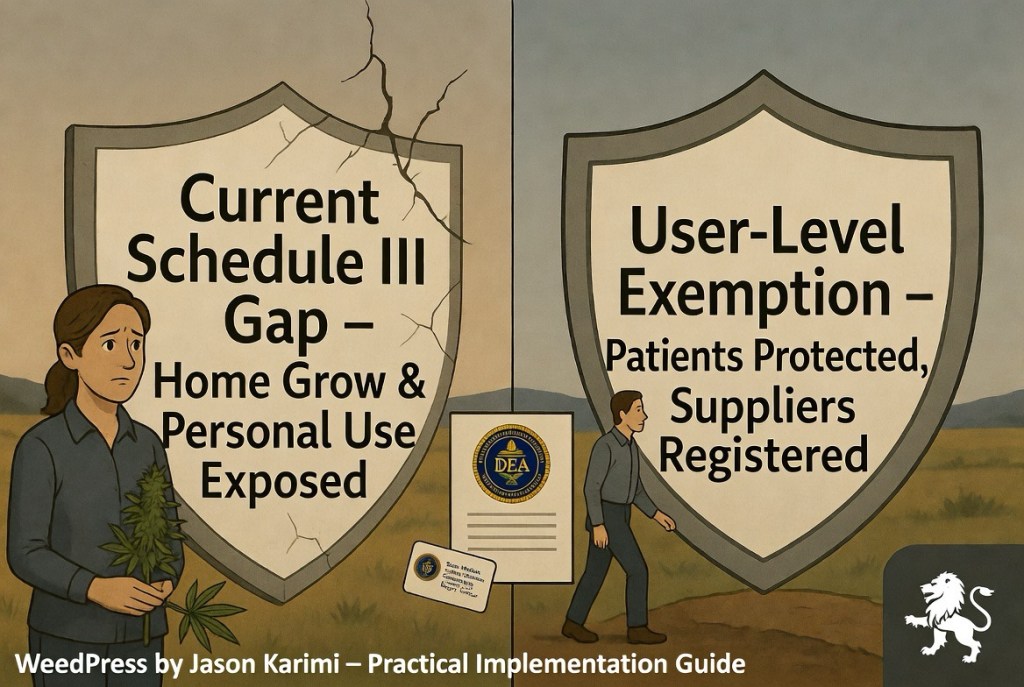
The April 28, 2026 federal partial rescheduling order created a clear compliance burden for licensed operators while leaving patients who grow or use cannabis outside the commercial system in a federal gray area.¹ Reassuring public statements that “you’ll be fine” or that “state law is already strict enough” do not close that gap for home cultivators, caregivers, or patients whose homegrown use falls outside the narrow categories moved to Schedule III.
This article moves from diagnosis to prescription. It outlines a practical, administrable user-level exemption framework that South Dakota could implement to protect qualifying medical cannabis patients and their caregivers while maintaining strong controls against diversion. The model draws directly from an existing federal exemption that has operated successfully for decades.
The Core Concept: Two Parallel Tracks
The framework creates two clear tracks rather than forcing every participant into full commercial DEA registration.
Track 1 covers registered medical cannabis patients and their designated caregivers. These individuals receive a limited exemption from the full commercial registration requirements that apply to manufacturers and distributors.
Track 2 covers any supplier, cultivator, or dispensary that serves exempted patients. These entities still register with the DEA, but they operate under a lighter, patient-focused registration category rather than the full pharmaceutical-grade manufacturing and distribution framework.
This two-track structure mirrors the long-standing peyote exemption for members of the Native American Church.² It keeps strong federal oversight on the supply side while removing unnecessary barriers for individual patients acting in good faith under state law.
Who Qualifies and How to Prove It
Patient Qualification
A patient must hold a valid South Dakota medical cannabis registry identification card issued under SDCL ch. 34-20G.³ The patient must also have a current certification from a licensed South Dakota practitioner confirming that cannabis is being recommended for a qualifying debilitating medical condition. An optional short attestation of sincere medical or therapeutic use (as opposed to recreational intent) can be added for additional clarity during any verification process.
Caregiver / Designated Grower Qualification
A caregiver must be formally designated on the patient’s state registry card. The number of plants permitted should align with or modestly exceed current South Dakota home cultivation limits to avoid creating new enforcement problems. A simple background attestation regarding recent drug trafficking convictions (modeled on existing state caregiver rules) provides basic safeguards without creating an overly burdensome new process.
Proof and Documentation
South Dakota Department of Health would issue a straightforward “User Exemption Verification” document or add a clear field to the existing registry card. Patients and caregivers would carry this documentation when possessing or cultivating cannabis. No entirely new state database is required — the existing medical cannabis registry already contains the necessary information.
Supplier and Dispensary Side: Lighter Registration Track
Any entity that cultivates, manufactures, or dispenses cannabis for exempted patients must still obtain DEA registration under 21 U.S.C. § 823.⁴ However, the registration can be structured as a “medical patient supply” category rather than full commercial manufacturing and distribution registration.
Recordkeeping requirements would focus on verification that the end user holds valid exemption documentation rather than the full commercial inventory tracking system required for large-scale operators. Security and diversion-prevention controls remain robust but are scaled appropriately to patient volumes instead of pharmaceutical manufacturing standards.
This approach allows smaller and tribal operators to continue serving patients without immediately needing full pharmaceutical-grade facility upgrades while the broader market adjusts.
Administrative and Enforcement Framework
The South Dakota Department of Health would administer the state-side verification process using its existing medical cannabis registry infrastructure. The DEA would handle federal registration for suppliers and any necessary oversight of the supply chain.
Enforcement would rely on:
• Annual attestation from patients and caregivers confirming continued qualifying status.
• Random verification audits by DOH.
• Proportionate penalties for clear abuse (such as diversion or false attestation) that do not render the exemption unusable for legitimate patients.
This framework integrates cleanly with South Dakota’s current medical cannabis program under SDCL ch. 34-20G and does not require rewriting the entire regulatory structure.
Benefits for Patients, Small Operators, and Tribal Nations
Patients who cultivate or use cannabis outside the licensed commercial system gain meaningful federal protection rather than operating in continued legal uncertainty. Small and tribal operators gain a realistic pathway to serve exempted patients without facing an immediate and potentially insurmountable compliance cliff. The framework reduces pressure on smaller entities while larger operators complete necessary facility and process upgrades.
Most importantly, it keeps the focus on protecting patients who rely on cannabis for legitimate medical purposes rather than treating all non-commercial activity as presumptively problematic.
Legal and Treaty Compatibility
The proposed exemption fits within the Attorney General’s existing authority under 21 U.S.C. § 822(d) to exempt certain classes of persons from registration requirements when consistent with public health and safety.⁵ The peyote exemption under 21 C.F.R. § 1307.31 has operated for decades under the same statutory authority without creating major enforcement or international difficulties.⁶
Article 36 of the Single Convention on Narcotic Drugs permits limited exemptions consistent with treaty obligations when they are narrowly tailored and subject to appropriate controls.⁷ A properly structured user-level medical cannabis exemption meets this standard.
Path to Implementation in South Dakota
Implementation can proceed through several practical steps:
1. South Dakota Department of Health initiates rulemaking or issues a declaratory ruling establishing the state-side verification process and documentation standards.
2. The state or affected parties petition the DEA for formal recognition of the user-level exemption category or inclusion in forthcoming federal guidance.
3. Legislation can be introduced to codify the framework in state statute, providing stability against future administrative changes.
4. Tribal nations can pursue parallel or compact-based implementation for operations on tribal land, consistent with existing tribal-state agreements in other areas of cannabis regulation.
None of these steps require waiting for full recreational legalization or a complete rewrite of federal scheduling.
WeedPress Position
WeedPress has spent seventeen years mapping the federal exemption architecture under the Controlled Substances Act and documenting how narrow, verifiable exemptions can protect patients without undermining legitimate regulatory goals.⁸ The April 28, 2026 order exposed a significant gap for patients whose use or cultivation falls outside the narrow commercial categories that were moved to Schedule III. Reassuring messaging from industry-aligned voices that minimizes this gap or claims state law already solves it does not serve patients or small operators who face real compliance and legal risks.
A targeted user-level exemption modeled on the peyote framework is administratively feasible, legally grounded, and directly responsive to the problems identified in the federal order. South Dakota patients and small operators deserve practical solutions, not vague assurances that everything will work out. The legal tools exist. The question is whether state leadership will use them to protect the people the medical cannabis program was created to serve.
Conclusion
The compliance burdens created by the April 28, 2026 order and the continued uncertainty around personal cultivation are real and documented. A narrow, verifiable user-level exemption for qualifying medical cannabis patients and caregivers is administratively doable, consistent with existing federal authority, and protective of patients who rely on cannabis for legitimate medical purposes.
South Dakota has the opportunity to lead by implementing a clear, practical framework rather than waiting for problems to compound. Patients come first. The tools are available. The work of building a functional exemption begins with honest assessment and concrete implementation steps.
Footnotes
¹ Schedules of Controlled Substances: Rescheduling of Food and Drug Administration Approved Products Containing Marijuana From Schedule I to Schedule III; Corresponding Change to Permit Requirements, 91 Fed. Reg. 22714 (Apr. 28, 2026) (2026-08176).
² 21 C.F.R. § 1307.31 (2026) (exemption for the use of peyote in religious ceremonies by members of the Native American Church).
³ SDCL ch. 34-20G (medical cannabis program enacted by Initiated Measure 26 (2020)).
⁴ 21 U.S.C. § 823 (2026) (DEA registration requirements for handling controlled substances).
⁵ 21 U.S.C. § 822(d) (2026) (providing authority for the Attorney General to exempt certain persons or classes of persons from registration requirements).
⁶ 21 C.F.R. § 1307.31 (2026).
⁷ Single Convention on Narcotic Drugs, Mar. 30, 1961, 520 U.N.T.S. 151, art. 36.
⁸ See, e.g., WeedPress Policy Series on federal exemption architecture and state conformity mechanisms (2009–2026).
¹⁰ Brian Vicente & Rachel Gillette, public commentary on home cultivation status under the April 28, 2026 rescheduling order (statements made in June 2026 webinar and related discussions).
¹¹ Amber Lengacher, comments during Beard Bros Media Network webinar “Schedule 3: Harm or Help?” (June 3, 2026) (discussing disclosure requirements and instability risks for smaller and tribal operators).
¹² Mary Jane Oatman, comments during Beard Bros Media Network webinar “Schedule 3: Harm or Help?” (June 3, 2026) (addressing tribal operator vulnerabilities post-rescheduling).
¹³ See prior articles in this series: “The Private Reckoning: What Two Out-of-State Consultants Most Likely Taught South Dakota Operators Behind Closed Doors” (Jun. 7, 2026); “South Dakota Small Cannabis Operators Face a Compliance Cliff” (Jun. 7, 2026); and “South Dakota’s Medical Cannabis Rules Do Not Satisfy Federal Schedule III Requirements” (Jun. 2026) (all on file at WeedPress.org)
¹⁴ See also discussion of ongoing federal gaps for home cultivation and tribal operators in Beard Bros Media Network webinar “Schedule 3: Harm or Help?” (June 3, 2026).
This article completes the four-part arc that began with documenting compliance burdens and compromised advice from business industry interests and ends with a concrete, workable path forward for everyone in spite of policy insight differences. The WeedPress series demonstrates that serious analysis of federal changes leads to practical specific detailed patient-protective solutions rather than vague reassurances.
Next steps for readers: South Dakota patients, caregivers, small operators, and tribal nations interested in advancing this framework should contact their legislators and the Department of Health to request rulemaking on a user-level exemption verification process.
WeedPress will continue tracking developments and providing implementation analysis as the federal and state processes unfold.
Welcome…to the show.


Leave a Reply