This piece focuses on due process failures and pretrial detention, not a defense of the underlying allegations.
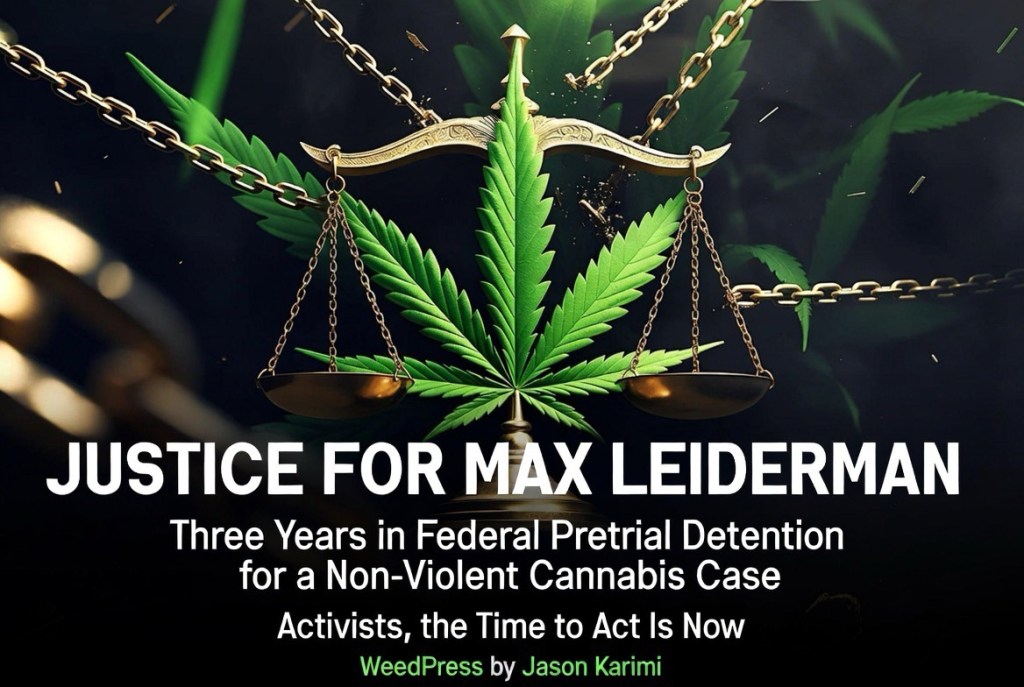
David “Max” Leidermann, a 51-year-old California resident with no prior criminal record and no history of violence, has spent more than three years in federal custody in Nebraska — without a trial, without conviction, and without meaningful contact with his loved ones.²
This is not justice.
This is the lingering machinery of the war on drugs grinding down one man while cannabis is legal in dozens of states, rescheduling discussions continue at the federal level, and the public increasingly recognizes prohibition’s failures. Max’s case — United States v. Leidermann et al. (8:23-cr-00086, D. Neb.) — demands urgent attention from cannabis activists, criminal justice reformers, due process advocates, and anyone who believes prolonged pretrial detention of a first-time, non-violent defendant is fundamentally un-American.
Who Is Max Leidermann?
Max is a California man with deep roots in the Los Angeles creative and music communities. He has been described by supporters as a first-time offender caught in a multi-state federal investigation into what prosecutors allege was a large-scale marijuana trafficking organization.³
Advocacy accounts and his girlfriend Kelly have shared his story widely on Instagram and other platforms, highlighting the human cost: years of isolation, separation from family (including their small poodle Gigi), and the devastating impact on his life while he awaits his day in court.⁴
He was arrested in California in 2023 and transferred to federal detention in Nebraska — a jurisdiction with which he has no personal ties. Supporters note this creates profound barriers to family visits, legal preparation, and community support.²
The Case and the Charges
The investigation originated from a 2019 traffic stop and broader probe in Nebraska involving interstate marijuana transport and money laundering. It expanded to allege a nationwide operation sourcing cannabis from California grows and distributing it across the country, with significant financial proceeds.⁵
Max and co-defendants (including James Reja, who died by suicide in 2023 while a fugitive) were charged in a federal indictment unsealed in April 2023. Key counts include:
• Conspiracy to distribute 1,000 kilograms or more of marijuana — carrying a statutory range of 10 years to life in prison, plus massive fines and supervised release.⁶
• Money laundering and conspiracy to commit money laundering (up to 20 years per count).
Superseding indictments added defendants and details. The case has involved roughly 13–14 individuals total. Some co-defendants have entered pleas or received sentences; others remain in various stages of proceedings.⁷
Prosecutors have pursued forfeiture actions seeking millions in assets tied to the alleged operation.⁵
Important context for activists: All defendants are presumed innocent until proven guilty. Max has not been convicted of any crime. He is a first-time, non-violent offender facing extraordinary sentencing exposure under statutes written for a different era of drug policy.
Why This Case Is a Flashpoint for Reform
1. Prolonged Pretrial Detention as Punishment
Max has been held since 2023 — over 1,100 days in some tallies — without trial or bond in key periods. Supporters and the petition campaign argue this violates fundamental principles of due process and proportionality. Pretrial detention should be the exception for flight risk or danger, not the default for non-violent cases.⁸
2. Venue and Access to Justice
Prosecuting a California resident in Nebraska creates enormous practical and emotional burdens. Family support, attorney meetings, and community ties are strained or severed. This raises serious questions about fairness in federal venue decisions.
3. Outdated Federal Law vs. Modern Reality
Cannabis is legal for adult use or medical purposes in most states. Federal rescheduling efforts (moving marijuana from Schedule I) acknowledge its lower risk profile compared to substances like heroin or fentanyl. Yet legacy cases like Max’s continue under harsh penalties. The disconnect between state legalization and aggressive federal enforcement in selected cases fuels perceptions of selective or arbitrary prosecution.
4. Human Cost
Max has endured years without seeing loved ones, limited outdoor time, and reported challenges with medical care while detained. His girlfriend Kelly has publicly shared the toll of this separation. The case has devastated not just Max but his entire support network.²
5. Broader Pattern
Max’s situation echoes other long-running federal cannabis cases where non-violent defendants face life-altering consequences years after state laws changed. It highlights the need for comprehensive review of legacy prosecutions, expanded use of clemency, and reforms to pretrial detention practices.
What Activists Can Do Right Now — Concrete Action Steps
This is not a case that will resolve itself through quiet hope. Public pressure works. Prosecutors, judges, and elected officials respond when cases gain visibility. Here’s how to help:
1. Sign and Share the Petition for Pre-Trial Release
Demand immediate review and relief so Max can be released pending trial (or resolution). The petition is addressed to Attorney General Pam Bondi, the DOJ, the U.S. Attorney’s Office for the District of Nebraska, the House Judiciary Committee, and others.
→ Sign here: https://actionnetwork.org/petitions/bring-them-home⁹
2. Urge Presidential Clemency Review
Federal cases fall under presidential clemency authority. Contact the White House and relevant offices to request a thorough, expedited review of Max’s case on humanitarian and proportionality grounds. Reference the petition and his status as a first-time, non-violent offender with years of pretrial detention.
3. Amplify the Story on Social Media
• Follow and share content from accounts like @jailedforweed and the Justice for Max campaign.
• Use hashtags: #FreeMaxLeidermann #JusticeForMax #EndPretrialDetention #CannabisJustice
• Tag media outlets, criminal justice organizations (e.g., FAMM, ACLU Drug Law Reform Project, NORML), and elected officials.
• Share reels featuring Kelly and Max’s own words — they humanize the statistics powerfully.⁴
4. Contact Officials Directly
• Write or call your U.S. Senators and Representative (especially Judiciary Committee members).
• Reach out to the U.S. Attorney’s Office for the District of Nebraska and the DOJ.
• Request oversight hearings or inquiries into prolonged pretrial detention in non-violent federal drug cases.
5. Support Legal Defense and Advocacy Infrastructure
• The campaign notes Max is represented by a public defender handling a complex, high-stakes case. Advocates are seeking connections to experienced federal criminal defense counsel.
• Share leads on attorneys or resources via the savemaxi.com contact form.
• Consider supporting related legal defense funds or organizations fighting similar cases.
6. Build Broader Coalitions
• Connect this case to ongoing fights around federal rescheduling implementation, legacy prisoner releases, and pretrial reform.
• Organize letter-writing campaigns, virtual town halls, or local events around cannabis justice.
• Partner with groups focused on over-incarceration, racial justice in drug policy, and due process.
7. Monitor and Document
• Track the docket on CourtListener or PACER (case 8:23-cr-00086).
• Document developments and share verified updates to maintain pressure and accuracy.
Resources
• Justice for Max Campaign: https://www.savemaxi.com/ — Petition links, story, ways to help.²
• Petition for Release: https://actionnetwork.org/petitions/bring-them-home⁹
• Official Case Info: U.S. Attorney’s Office press release (May 2023) and subsequent court filings.⁶
• Advocacy Videos: Search Instagram for reels from @jailedforweed featuring Kelly and Max’s perspective (example reel IDs and similar content highlight the personal toll).⁴
The Bottom Line
Max Leidermann is not a statistic. He is a human being — presumed innocent — who has already lost more than three years of his life to pretrial detention in a cannabis case. His girlfriend has lost years with her partner. His community has lost a member to an outdated system.
Justice delayed is justice denied. Max deserves his day in court — or better yet, release while that day is prepared. The machinery of the state should not be allowed to warehouse non-violent, first-time defendants for years on end.
Take action today. Sign the petition. Share his story. Contact officials. Amplify the voices of Kelly and the Justice for Max campaign. Every signature, every share, every call adds pressure that can make a difference.
Free Max Leidermann. End the injustice. Reform the system.
Footnotes
¹ This article draws on public court records, DOJ announcements, and advocacy materials to present facts and calls to action. All defendants are presumed innocent.
² Justice for Max Campaign, SAVEMAXI.COM, https://www.savemaxi.com/ (last visited June 25, 2026) (detailing pretrial detention exceeding 1,100 days, family impact, and calls for release).
³ The Rabbit Hole: Drugs, Death, and Rock & Roll, COURTWATCH.NEWS (Feb. 22, 2026), https://www.courtwatch.news/p/the-rabbit-hole-drugs-death-and-rock-roll.
⁴ See, e.g., Instagram reel by @jailedforweed featuring Kelly (girlfriend of Max Leidermann) discussing three years of separation (reel DZYp0zUIXC2 and similar content, accessed via public search June 2026).
⁵ Feds in Nebraska Seek Forfeiture of $7.4M in Drug Case, OMAHA.COM (reporting on investigation origins and asset seizures).
⁶ Press Release, U.S. Dep’t of Justice, U.S. Attorney’s Office, Dist. of Neb., California Men Arraigned for Conspiring to Distribute Drugs and Money Laundering (May 11, 2023), https://www.justice.gov/usao-ne/pr/california-men-arraigned-conspiring-distribute-drugs-and-money-laundering.
⁷ United States v. Leidermann, No. 8:23-cr-00086 (D. Neb.), docket available via CourtListener (various superseding indictments and proceedings through 2025–2026).
⁸ Petition for Pre-Trial Release, Action Network, https://actionnetwork.org/petitions/bring-them-home (addressed to Attorney General and DOJ officials, emphasizing due process concerns as of 2026).
⁹ Id.


Leave a Reply