The recent action by Wyoming’s Attorney General demonstrates that states are increasingly recognizing the legal significance of federal marijuana rescheduling where state statutes incorporate federal scheduling decisions. South Dakota’s existing statutory language raises similar questions that should be addressed before federal reform takes effect.
WeedPress has previously warned that South Dakota law contains automatic trigger language that could be interpreted to require corresponding changes to South Dakota’s scheduling of marijuana following a federal change. Without legislative clarification, this incorporation-by-reference language creates a credible risk that Schedule I status could be altered at the state level without further action by the South Dakota Legislature.
This exposure is not hypothetical. Tennessee has already enacted legislation to prevent automatic rescheduling triggered by federal changes. At least twenty-seven states maintain similar federal conformity provisions in their controlled substances statutes. South Carolina has interpreted federal rescheduling as requiring the state to recognize medical cannabis under its existing statutory framework.
WeedPress has documented these developments and previously warned South Dakota that failure to address federal conformity language could leave the state vulnerable to policy changes resulting from federal action rather than deliberate legislative choice.
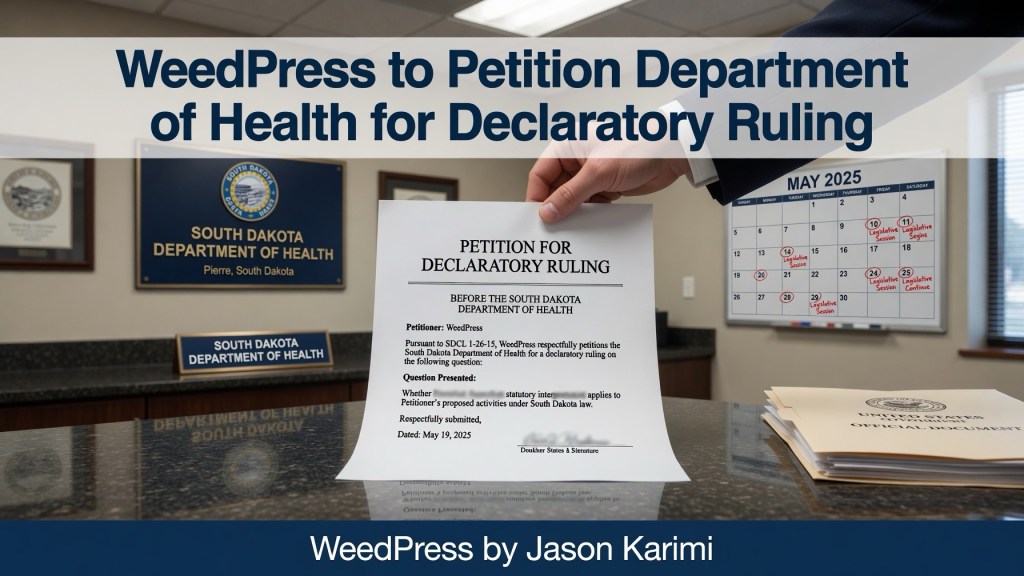
Rather than waiting for litigation or an administrative interpretation after federal reform occurs, WeedPress intends to petition the South Dakota Department of Health for a formal declaratory ruling on whether South Dakota’s existing statutes require automatic rescheduling following a federal change. A declaratory ruling would create an official administrative record, clarify the Department’s interpretation before the next legislative session, and provide lawmakers with a defined legal framework for considering any necessary statutory amendments.
States that fail to address federal conformity language in their controlled substances statutes may increasingly find themselves reacting to legal developments rather than directing their own cannabis policy.
Footnotes
¹ Paul Armentano, Wyoming Attorney General Blocks State Marijuana Rescheduling That Would Be Triggered by Trump’s Federal Reform, Marijuana Moment (2026), https://www.marijuanamoment.net/wyoming-attorney-general-blocks-state-marijuana-rescheduling-that-would-be-triggered-by-trumps-federal-reform/.
² Jason Karimi, South Dakota’s Medical Cannabis Law Contains Automatic Trigger Language Vulnerable to Federal Rescheduling, WeedPress (2026).
³ Tennessee Governor Signs Bill Blocking State Medical Marijuana Legalization Review Following Federal Rescheduling, Marijuana Moment (2026), https://www.marijuanamoment.net/tennessee-governor-signs-bill-blocking-state-medical-marijuana-legalization-review-following-federal-rescheduling/.
⁴ Jason Karimi, Twenty-Seven States Will Automatically Reschedule Cannabis Once the Feds Reschedule, WeedPress (Dec. 16, 2024), https://weedpress.org/2024/12/16/27-states-will-automatically-reschedule-cannabis-once-the-feds-reschedule/.
⁵ South Carolina Department of Health and Environmental Control, Declaratory Ruling on Federal Rescheduling and State Medical Cannabis Obligations (2026).
⁶ Supra note 4.
⁷ Supra note 2.
⁸ Supra note 1.


Leave a Reply