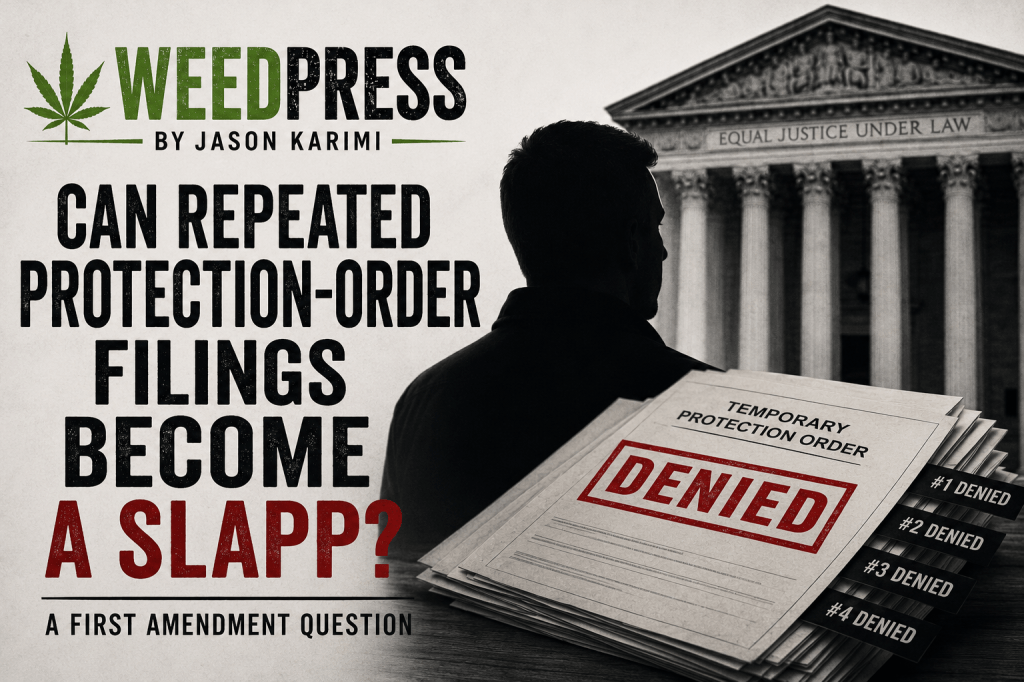
Repetitive protection-order filings can become speech pressure when they are aimed at a critic publishing on public issues. WeedPress has faced four TPO-related filings in 2026 in two counties filed unsuccessfully by New Approach South Dakota leadership, and each time, publication was delayed, narrowed, or withheld rather than escalated. Most recently, on May 12, 2026, a judge again denied a fourth TPO filing after hearing, continuing a pattern in which requested relief included efforts to bar WeedPress from blogging or asking MMOC leadership questions.
This article asks a narrow but serious question: when protection-order filings repeatedly fail, yet still cause an advocacy publisher to hold back lawful public-interest reporting, are they beginning to function like a SLAPP?
A SLAPP is not defined only by the label on a lawsuit. It is defined by function: does legal process burden speech, deter criticism, or punish public participation through cost and pressure?¹ Protection-order systems serve vital safety functions, and real victims need them. But any legal mechanism can be misused. If defamation suits, injunctions, discovery, and subpoenas can chill speech, repetitive TPO filings can raise the same concern when they target advocacy journalism.
WeedPress’s response has not been reckless escalation. It has been restraint. Four times, publication decisions were altered because of TPO pressure. Articles were held. Drafts were shelved. Public-record reporting was delayed. That pattern undercuts any claim that WeedPress is using publication to harass. It shows the opposite: a publisher repeatedly stepping back to avoid inflaming court proceedings while preserving its right to speak.
That restraint does not mean the pressure was legitimate. It means WeedPress chose discipline over reaction. And that distinction is legally important.
The First Amendment protects sharp criticism on matters of public concern. That includes reporting about cannabis policy, public advocacy, political leadership, litigation, lobbying, public records, and institutional accountability.² Speech does not lose protection because it is harsh, embarrassing, or inconvenient. Courts have repeatedly protected uncomfortable public-issue advocacy because democratic debate requires breathing room.³
The Supreme Court’s prior-restraint cases are especially relevant. In Near v. Minnesota, the Court treated prior restraints as among the most serious First Amendment violations.⁴ In Organization for a Better Austin v. Keefe, the Court reversed an injunction against activists distributing critical pamphlets about a real-estate broker, stressing that courts must be extremely cautious before suppressing criticism.⁵ That principle applies beyond pamphlets. It applies whenever legal process threatens to suppress public criticism before it is published.
That is why “SLAPP by TPO” is a fair question, even if it should be asked carefully. The claim is not that every failed TPO is a SLAPP. It is not that every petitioner acts in bad faith. The claim is narrower: when repeated protection-order filings are used against an advocacy publisher, and the effect is to chill reporting on public issues, courts should examine whether process itself is becoming pressure.
South Dakota’s prior lack of a broad anti-SLAPP statute makes this more important, not less. Without a strong statutory anti-SLAPP remedy, speakers must rely on constitutional protections, sanctions rules, abuse-of-process doctrine, and judicial skepticism toward repetitive filings that burden lawful speech.⁶
WeedPress has solid legal footing to keep publishing. Truth is a defense to defamation.⁷ Opinion based on disclosed facts is protected.⁸ Fair comment and fair report principles protect discussion of public records, litigation, and government action.⁹ Advocacy on public controversies receives strong constitutional protection.¹⁰ Continued publication is not harassment merely because the subject dislikes it.
The key fact is restraint. WeedPress has not used each filing as an excuse to intensify personal attacks. It has repeatedly paused, narrowed, and delayed publication. That record matters. It rebuts any story that publication is being used as a weapon. It shows a publisher trying to preserve speech rights while avoiding unnecessary escalation.
But restraint has limits.
A critic does not lose the right to publish because someone repeatedly files false police reports against him. A court process cannot become a private veto over public-interest reporting. If repeated filings chill lawful speech, that chilling effect is itself part of the public story.
And the requested relief itself matters. According to the petitions, requests were made not merely for personal separation, but for relief that would restrict blogging and stop me from…advocating for federal marijuana user exemptions at the South Dakota Capitol. That reaches beyond ordinary interpersonal protection concerns and directly implicates public-issue expression. If litigation asks courts to restrain criticism or inquiry itself, First Amendment questions necessarily arise.¹¹
The question is not whether WeedPress may publish. It may.
The question is whether repetitive TPO filings have begun to operate as pressure against public advocacy. That question is legitimate, constitutional, and worth asking – plainly.
WeedPress has been attacked by Mentele four times in 2026 and prevailed in court each time (4-0.)
Restrained, however, does not mean silenced.
And lawful public-interest reporting remains protected.
Footnotes
¹ George W. Pring & Penelope Canan, SLAPPs: Getting Sued for Speaking Out (Temple Univ. Press 1996); Reporters Committee for Freedom of the Press, Anti-SLAPP Legal Guide.
² U.S. Const. amend. I; S.D. Const. art. VI, § 5.
³ New York Times Co. v. Sullivan, 376 U.S. 254 (1964); NAACP v. Claiborne Hardware Co., 458 U.S. 886 (1982); Snyder v. Phelps, 562 U.S. 443 (2011).
⁴ Near v. Minnesota, 283 U.S. 697 (1931).
⁵ Organization for a Better Austin v. Keefe, 402 U.S. 415 (1971).
⁶ Restatement (Second) of Torts § 682; S.D. Codified Laws § 15-6-11; abuse-of-process and vexatious-litigation principles.
⁷ Philadelphia Newspapers, Inc. v. Hepps, 475 U.S. 767 (1986); S.D. Codified Laws § 20-11-5.
⁸ Milkovich v. Lorain Journal Co., 497 U.S. 1 (1990).
⁹ Restatement (Second) of Torts §§ 611, 566.
¹⁰ Hustler Magazine, Inc. v. Falwell, 485 U.S. 46 (1988).
¹¹ Organization for a Better Austin v. Keefe, 402 U.S. 415 (1971); Near v. Minnesota, 283 U.S. 697 (1931).
 WeedPress: The Paper Trail
Leave a comment