

After the federal government rescheduled marijuana to Schedule III, South Dakota’s restrictions on medical cannabis use in nursing homes and long-term care facilities have crossed a constitutional and statutory line. What was once defensible under outdated federal prohibition logic is now clear discrimination against people with disabilities.
South Dakota’s medical cannabis program, like many others, contains provisions or is enforced in ways that allow — or require — nursing homes, assisted living facilities, and similar institutions to prohibit or severely restrict residents’ use of state-legal medical cannabis. The result is cruel and increasingly illegal: elderly and disabled South Dakotans who rely on cannabis for pain, nausea, appetite stimulation, anxiety, or seizure control are told they must stop their medicine or leave the only care setting that can meet their needs.
This is no longer just bad policy. Post-rescheduling, it is likely a violation of the Americans with Disabilities Act (ADA).
The Federal Shift Changes Everything
In 2026, following the Department of Health and Human Services recommendation and subsequent action, marijuana was moved from Schedule I to Schedule III of the Controlled Substances Act. Schedule III status carries an explicit federal acknowledgment of “accepted medical use in treatment in the United States.” This single change dismantles the primary legal justification facilities and states have used for years to deny cannabis as medicine.¹
Previously, courts and agencies often treated medical cannabis patients as “current illegal drug users” excluded from ADA protection under 42 U.S.C. § 12210. That exclusion no longer applies with the same force to state-authorized medical use of a Schedule III substance. Refusing to accommodate a resident’s doctor-recommended, state-legal medical cannabis is now much harder to defend as anything other than discrimination on the basis of disability.
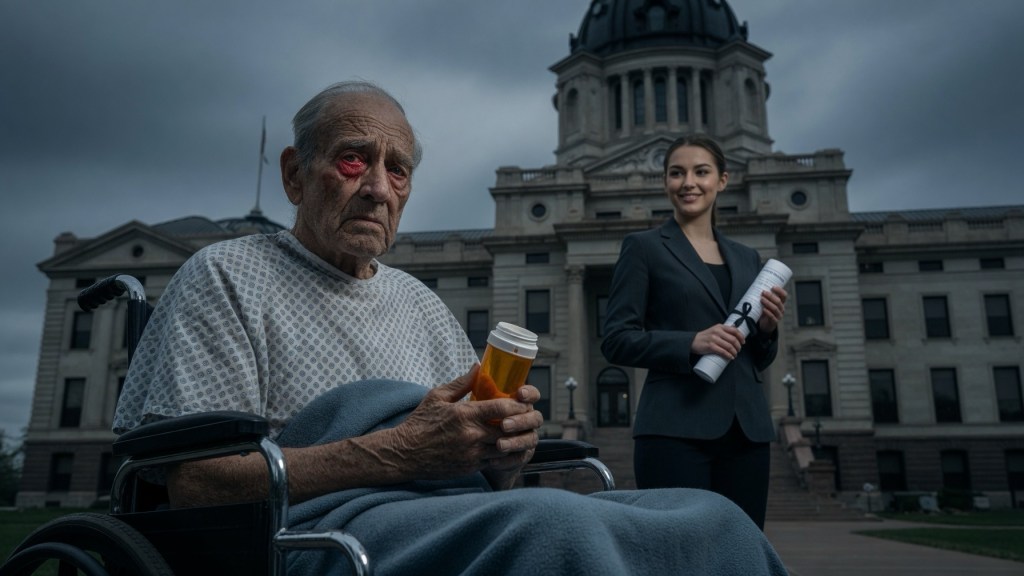
South Dakota’s Nursing Home Problem
South Dakota’s medical cannabis statute and its implementation have historically allowed or encouraged facilities to ban or heavily restrict cannabis use, often citing federal funding, licensing, or “drug-free” policies. The practical effect is that residents with qualifying conditions — many of them elderly or living with serious disabilities — are forced into an impossible choice: stop using the only medicine that works for them, or risk losing their housing and care.
This mirrors the dynamic described in Virginia, where patients were forced to choose between their medicine and their housing.² My own prior reporting on nursing home and long-term care issues in South Dakota documented how these restrictions disproportionately harm the most vulnerable patients — those least able to advocate for themselves or relocate.³
The ADA Requires Accommodation
Title II of the ADA applies to public entities and programs receiving federal financial assistance. Title III covers public accommodations, which includes many nursing homes and assisted living facilities. Both titles require reasonable modifications to policies and practices when necessary to avoid discrimination against individuals with disabilities.
A person whose physician has recommended medical cannabis for a qualifying condition has a disability under the ADA. After rescheduling, treating their state-legal medicine differently from other prescribed medications (such as opioids or other controlled substances used in facilities) is difficult to justify. Blanket bans or severe restrictions that effectively deny access to medically necessary treatment look less like neutral policy and more like disability-based discrimination.
Analogous situations involving medication-assisted treatment for opioid use disorder have already produced clear DOJ guidance and enforcement actions: facilities cannot categorically deny admission or services based on a patient’s lawful use of prescribed medication for a disability.⁴ The same logic now applies with even greater force to medical cannabis.
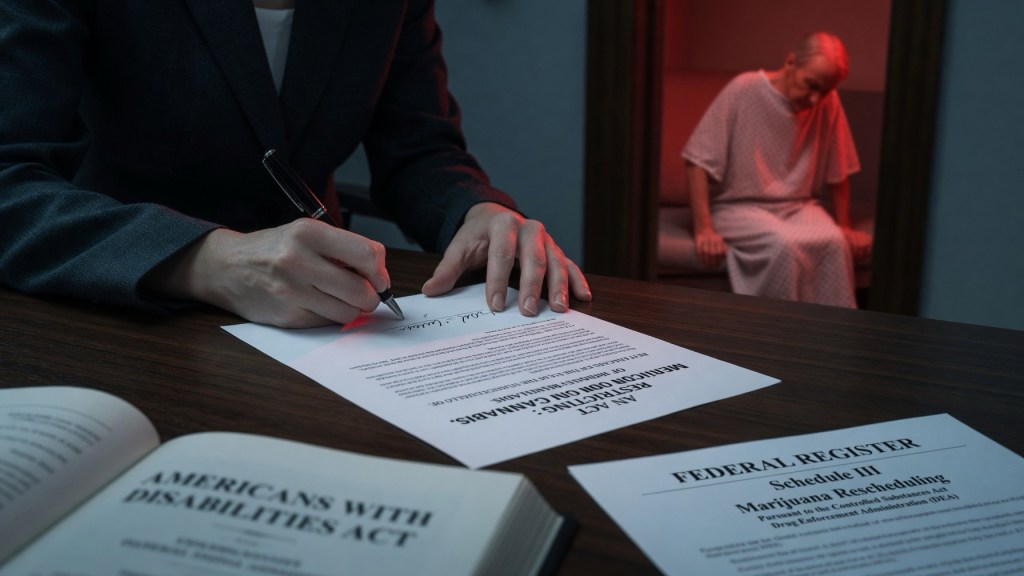
Legal Support Is Growing
Scholars and practitioners have long argued that medical cannabis accommodations implicate core civil rights protections. Post-rescheduling analyses have accelerated this view. One detailed examination concluded that federal policies denying services or accommodations to medical cannabis patients in hospitals, hospices, assisted living facilities, and nursing homes “may now be in violation of the Americans with Disabilities Act (ADA) and the Fair Housing Act (FHA).”⁵
Law review scholarship on the evolving federal-state marijuana conflict has emphasized that as federal recognition of medical value increases, state and institutional barriers face heightened scrutiny under anti-discrimination laws.⁶
Courts evaluating ADA claims involving controlled substances have increasingly focused on whether the substance has accepted medical use and whether the individual is using it pursuant to a valid recommendation or prescription. Schedule III status strengthens both prongs for medical cannabis patients.⁷
South Dakota Is Out of Step
Other states have begun updating their long-term care policies to protect medical cannabis patients. Minnesota, for example, has moved toward allowing use in healthcare facilities with reasonable restrictions rather than outright bans.⁸ South Dakota’s approach — permitting or enabling facilities to effectively ban the medicine — now stands in tension with both federal civil rights law and the emerging national recognition of cannabis as legitimate medicine.
When a state’s licensing or regulatory framework allows (or requires) facilities to deny residents access to their doctor-recommended treatment solely because that treatment is cannabis, the state is facilitating discrimination. That is precisely what the ADA prohibits.

The Human Cost
Behind the legal analysis are real people: grandparents in pain who can no longer eat or sleep without cannabis; veterans with PTSD or chronic pain whose only effective relief is now treated as contraband in their care facility; disabled individuals who fought for years to get into a decent nursing home only to be told their medicine makes them unwelcome.
This is not compassion. It is not patient-centered care. It is discrimination dressed up as regulatory caution, and the federal rescheduling has stripped away its last credible legal cover.
What Must Happen Next
South Dakota should immediately clarify that nursing homes and long-term care facilities may not unreasonably prohibit or restrict the use of medical cannabis by residents who hold valid registry identification cards, absent a specific, documented safety or clinical concern that cannot be addressed through reasonable accommodation.
Facilities should be required to engage in the interactive process under the ADA when a resident requests accommodation for medical cannabis use.
Patients and advocates should document denials and consider ADA complaints or litigation. The legal terrain has shifted in their favor.
South Dakota’s medical cannabis law, as applied to nursing home and long-term care residents, now violates the Americans with Disabilities Act. The state can either update its policies voluntarily or wait for the courts and federal enforcement agencies to force the issue. Either way, the days of forcing disabled residents to choose between their medicine and their home are numbered.

Footnotes
1. U.S. Department of Justice; Drug Enforcement Administration, Final Rule: Rescheduling of Food and Drug Administration Approved Products Containing Marijuana From Schedule I to Schedule III (Apr. 28, 2026); see also DEA, Notice of Proposed Rulemaking regarding broader marijuana rescheduling.
2. Paul Armentano, New Virginia Law Forces Medical Cannabis Patients to Choose Between Their Medicine and Their Housing, Marijuana Moment (2026).
3. Jason Karimi, The Patients Left Behind: How South Dakota’s Medical Cannabis Law Still Punishes the Sickest Among Us, https://weedpress.org/2026/06/26/the-patients-left-behind-how-south-dakotas-medical-cannabis-law-still-punishes-the-sickest-among-us/.
4. U.S. Dep’t of Justice, U.S. Attorney Reminds Rest Homes About ADA Compliance Requirements for Patients with Disabilities (Oct. 6, 2024).
5. Paul Armentano, Federal Marijuana Rescheduling Will End Discrimination in Housing, Healthcare, and Employment for Medical Cannabis Patients, https://www.marijuanamoment.net/federal-marijuana-rescheduling-will-end-discrimination-in-housing-healthcare-and-employment-for-medical-cannabis-patients-op-ed/
6. Robert A. Mikos, appropriate published work discussing federalism and marijuana law l.
7. Jones Walker LLP, ADA Implications of Potential Marijuana Rescheduling (Jan. 28, 2026).
8. Minnesota Department of Health, Frequently Asked Questions About Cannabis Use in Nursing Homes (updated Feb. 18, 2025).
9. Supra note 5.
10. See, e.g., U.S. Dep’t of Justice, U.S. Attorney Reminds Rest Homes About ADA Compliance Requirements for Patients with Disabilities (Oct. 6, 2024) (addressing categorical denials of admission or services based on lawful medication use for a disability).
11. Supra note 6.
12. 42 U.S.C. § 12132 (Title II); 42 U.S.C. § 12182 (Title III).
13. Supra note 4.
14. See also U.S. Dep’t of Justice, U.S. Attorney Reminds Rest Homes About ADA Compliance Requirements for Patients with Disabilities (Oct. 6, 2024).
 WeedPress: The Paper Trail
Leave a comment