Public policy debates should be resolved by evidence, not by assumptions about the motives of the people participating in them. Yet it is common for substantive criticism to be met with claims that the critic is motivated by jealousy, a desire for power, or some other personal grievance rather than by the merits of the issues being raised.¹
Recently, last week a public statement loudly asserted that my criticism of institutional cannabis policy issues was driven by jealousy because I supposedly “lacked power.” Whether one agrees or disagrees with my reporting, that characterization presents a broader question worth examining: Should public policy criticism be evaluated on the evidence presented, or dismissed based on speculation about the critic’s motives?
The answer has significant implications far beyond mere cannabis policy.
Arguments Rise or Fall on Their Own Merits
American law has long reflected a preference for objective evidence over speculation about subjective motives. Courts routinely decide questions by examining statutes, regulations, documentary evidence, testimony, and established legal standards—not by assuming why a litigant, witness, journalist, or advocate chose to raise a particular issue.²
Public discourse should operate similarly.
Whether an article concerns cannabis regulation, constitutional rights, administrative law, or government transparency, the central question is straightforward: Are the factual assertions supported? If the answer is yes, then the reader benefits regardless of why the author chose to investigate the subject. If the answer is no, the reporting should be criticized on that basis.
Personal motive is not a substitute for factual analysis.
The Motive Fallacy
Logicians and rhetoricians have long recognized a common error sometimes described as the ad hominem circumstantial or “motive” fallacy.³ Instead of addressing the substance of an argument, the response attributes an alleged personal motive to the speaker.
For example:
- “You’re only saying this because you’re jealous.”
- “You just want attention.”
- “You only care because you want power.”
Even if such assertions were true, they do not establish whether the underlying factual claims are accurate.
A regulatory interpretation is either correct or incorrect.
A court filing either accurately quotes the record or it does not.
A statute either says what the author claims or it does not.
The truth of those propositions does not depend on the emotional state or personal ambitions of the person presenting them.
Readers Should Examine the Evidence
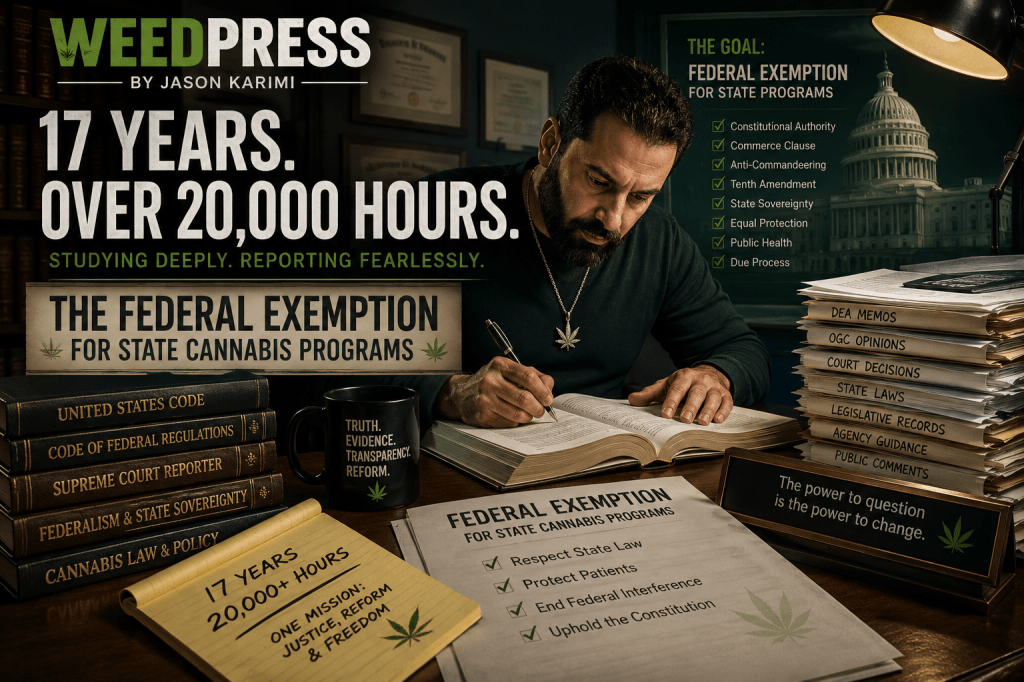
Throughout my reporting, I have attempted to ground articles in publicly available materials, including statutes, agency guidance, court filings, administrative records, and published judicial decisions.⁴ Readers remain free to disagree with my legal conclusions. Indeed, disagreement is an essential part of public discourse.
But disagreement is most productive when it engages the evidence itself.
If an article misquotes a statute, the statute should be cited.
If an article misunderstands a regulation, the regulation should be explained.
If an article omits contrary authority, that authority should be presented.
Those responses improve the public conversation because they address the merits rather than the messenger.
Institutional Power and Public Accountability
Independent journalists, bloggers, and citizen advocates frequently operate with far fewer institutional resources than established organizations. That disparity is not unique to cannabis policy; it exists across countless areas of public advocacy.
The proper response to criticism from a smaller publication is not determined by the size of the publication, but by the quality of the reporting.
Organizations strengthen public confidence when they answer documented criticism with documented responses.
Conversely, public discussion becomes less informative when attention shifts away from the underlying evidence and toward speculation about personalities or motives.
Why This Principle Matters
This principle extends beyond any disagreement between particular individuals.
Every field—including government, journalism, nonprofit advocacy, business, and law—benefits when public claims are evaluated on their evidentiary support rather than assumptions about why someone chose to make them.
Citizens should not have to prove they are free from personal motives before asking difficult questions. Public participation would become impossible if every criticism could be dismissed merely by alleging an improper motive.
Instead, evidence should remain the central measure of credibility.
Let the Record Speak
Reasonable people will disagree over policy, legislation, and legal interpretation. That disagreement is healthy.
What matters is that competing claims remain anchored to verifiable facts.
Readers should examine the statutes, agency guidance, court records, and other primary sources for themselves. They should evaluate whether reporting accurately reflects those materials. They should reject arguments that are unsupported and accept those that withstand scrutiny.
Public confidence is strengthened when criticism is answered with evidence rather than assumptions about the motives of the person raising it.
Footnotes
- See generally John Stuart Mill, On Liberty ch. II (1859) (arguing that open debate permits truth to emerge through the testing of competing ideas).
- See, e.g., Daubert v. Merrell Dow Pharmaceuticals, Inc., 509 U.S. 579, 589–97 (1993) (discussing the role of reliable evidence in judicial decision-making); Fed. R. Evid. 401–403.
- See Douglas N. Walton, Ad Hominem Arguments 18–27 (1998) (discussing circumstantial and motive-based ad hominem arguments).
- WeedPress, since 2009, has cited statutes, administrative regulations, judicial opinions, agency bulletins, and other public records in its reporting concerning cannabis policy and related legal issues, with an explicit focus and main goal on effectuating federal schedule one change and state-forced compliance with federal exemption remedies; today, both goals were met by Trump, and states are now recognized as exempt from federal law. This federal approval was inevitable, but needed documented carefully – which was the sole purpose WeedPress was established 17 years ago. 10,000 hours of research into this singular topic of discussion is the origin of WeedPress reportings and deserves substantive replies, from qualified individuals. Unqualified individuals resorting to public performance to avoid policy discussions are easily tossed out of political circles. If you don’t believe me now, just wait til you see the future court documents cited here as WeedPress does weekly updates on state responses to federal change on a legal – believe me, let me tell you – you won’t see anywhere else. Preparation for fun, due to an intellectual curiosity questioning when, not if, federal exemption for state medical cannabis would be codified. Now that it is – I’m going to laugh at the bewildered while openly talking curiously about the developments. Sports got boring; this is truly a ball game worth commenting on. Thanks for being here.
 WeedPress: The Paper Trail
Leave a comment