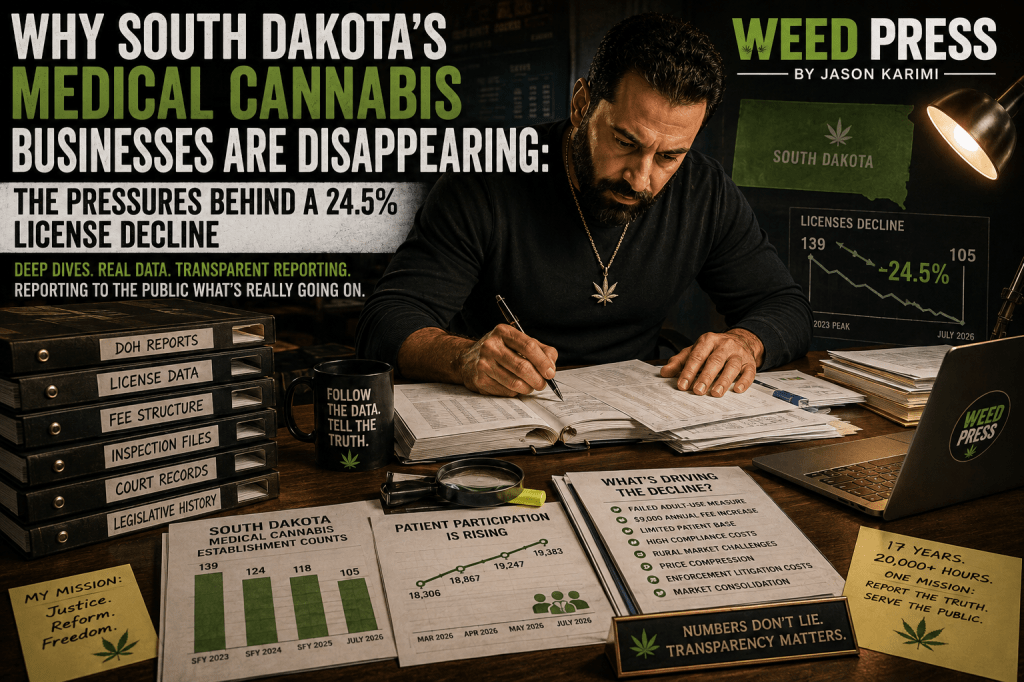
South Dakota’s medical cannabis industry has lost nearly one-quarter of its licensed establishments since reaching its high point three years ago. The state reported 139 certified medical cannabis establishments in state fiscal year 2023, including 79 dispensaries. By July 14, 2026, only 105 establishments remained: 60 dispensaries, 30 cultivation facilities, 14 manufacturing facilities, and one testing facility.¹
That represents a decline of approximately 24.5% from the 2023 peak. The number of dispensaries alone fell by roughly 24%, from 79 to 60.²
The contraction did not occur because South Dakota’s medical cannabis program simply ran out of patients. Patient participation has recently moved in the opposite direction. The Department of Health reported 19,383 approved patients in June 2026, up from 19,247 in May.³
The more persuasive explanation is structural.
South Dakota appears to have initially licensed more medical cannabis businesses than its comparatively small medical-only market could sustain. The state then increased the annual cost of remaining licensed, while voters’ rejection of adult-use legalization foreclosed the larger customer base that many businesses hoped would eventually emerge. Those pressures were compounded by regulatory expenses, uneven population density, competition from other cannabis sources, and the broader financial difficulties affecting cannabis businesses nationally.
The result is a market consolidation in which stronger, better-capitalized, vertically integrated, or strategically located operators are positioned to capture a growing share of patient spending while smaller or less efficient businesses leave the program.
South Dakota Built a Larger Industry Than Its Medical Market Could Sustain
South Dakota’s medical cannabis program expanded quickly after voter approval in 2020. By state fiscal year 2023, the program had reached 139 certified establishments, including 79 dispensaries. The following year, the total fell to 124 establishments, including 68 dispensaries. Fiscal year 2025 ended with 118 establishments, and the Department’s July 14, 2026, public list contained only 105.⁴
The downward pattern is now unmistakable:
- SFY 2023: 139 total establishments, including 79 dispensaries.
- SFY 2024: 124 total establishments, including 68 dispensaries.
- FY 2025: 118 total establishments.
- July 2026: 105 total establishments, including 60 dispensaries.⁵
The program therefore lost 15 establishments between fiscal years 2023 and 2024, another six by the end of fiscal year 2025, and another 13 between the fiscal year 2025 count and the July 2026 public list.
The decline is consistent with a market that licensed substantial capacity during an early period of optimism before actual patient demand, retail spending, wholesale prices, and operating costs had become clear.
Initial cannabis licensing periods commonly attract businesses anticipating rapid market growth. Operators invest in facilities, equipment, inventory, employees, security systems, and regulatory compliance before anyone knows how many patients will participate regularly, how much each patient will purchase, or how many competing businesses the market can support.
South Dakota’s early industry also developed under the continuing possibility that medical cannabis businesses might eventually gain access to a larger adult-use market. That possibility did not materialize.
The Failure of Adult-Use Legalization Left Businesses Competing for a Limited Patient Pool
South Dakota voters rejected Initiated Measure 29 in November 2024. The proposal would have legalized personal possession and use of cannabis by adults but received only approximately 44.5% support, with about 55.5% voting against it.⁶
That outcome was economically significant for the existing medical cannabis industry.
A medical-only dispensary may generally serve only registered patients and other customers specifically authorized by state law. An adult-use market, by comparison, potentially opens retail sales to nearly all adults over 21, including occasional consumers and visitors.
For an operator that entered South Dakota expecting eventual adult-use legalization, the rejection of Measure 29 meant that the potential customer base remained restricted to a comparatively small group of registered medical patients.
The difference between those two markets is substantial. A dispensary serving a medical registry must divide a limited number of patients with every competing dispensary in its trade area. An adult-use dispensary may reach a far larger percentage of the adult population.
South Dakota Searchlight reported in December 2024 that at least eight medical dispensaries had closed amid concerns involving competition, regulation, falling cardholder numbers, and the rejection of recreational legalization.⁷ Industry participants quoted in that reporting anticipated further consolidation.
The 2024 election did not independently cause every subsequent closure. Some businesses may have been undercapitalized, poorly located, inefficient, or struggling before the election. But the result eliminated the most obvious path to a dramatic expansion of retail demand.
Businesses that had endured thin medical-market margins while anticipating adult-use sales were forced to reassess whether remaining open made economic sense.
The failure of adult-use legalization is therefore one of the strongest documented explanations for the ongoing contraction.
The $9,000 Annual State Fee Intensified the Pressure
South Dakota also substantially increased the annual state registration fee imposed on medical cannabis establishments.
The fee rose from $5,310 to $9,000—an increase of $3,690, or nearly 70%.⁸ Senate Bill 43, enacted during the 2024 legislative session, provided the basis for the increase, which was later finalized through the administrative-rules process.⁹
A $9,000 annual fee may not appear decisive when viewed in isolation. But the fee applies to each establishment registration, not merely to each company.
An operator with separate cultivation, manufacturing, and dispensary registrations may therefore owe $27,000 annually in state establishment fees before paying for:
- municipal licenses;
- rent or mortgage expenses;
- employee wages;
- utilities;
- security systems;
- surveillance storage;
- seed-to-sale tracking;
- product testing;
- transportation;
- packaging and labeling;
- insurance;
- legal advice;
- accounting;
- inventory;
- taxes;
- equipment maintenance;
- and ordinary business overhead.
The effect is especially severe because the fee is fixed rather than tied to revenue.
A dispensary with $2 million in annual revenue pays a $9,000 state fee equal to approximately 0.45% of its gross revenue. A dispensary generating only $300,000 annually pays a fee equal to 3% of gross revenue. Neither calculation includes local fees or any other compliance expense.
The same nominal charge therefore imposes radically different burdens depending on a business’s sales volume.
A successful urban dispensary may absorb the fee as a relatively modest cost of doing business. A rural or low-volume dispensary may view the fee as the final reason not to renew.
The fee structure consequently rewards scale. High-volume businesses can spread the cost across more transactions. Vertically integrated operators can potentially capture revenue at multiple points in the supply chain. Small independent businesses must absorb the same fixed government charge from a much smaller revenue base.
The timing also matters. The fee increase was finalized in August 2024, shortly before the reported wave of dispensary closures in late 2024 and early 2025.¹⁰ That timing does not prove that the increase caused each closure, but it supports the conclusion that the new fee accelerated the exit of establishments already operating near the margin.
Enforcement Litigation May Have Added Costs Ultimately Borne by the Industry
The timing of the fee increase also followed costly enforcement litigation involving 605 Cannabis Cultivation and Badlands Products. In 2023, those companies sued the South Dakota Department of Health after an inspection resulted in an emergency suspension, product recall, and allegations of numerous regulatory violations. The companies sought approximately $1.3 million and asserted that the Department had misapplied its rules and conducted the inspection under improper circumstances.¹¹
The Department was consequently required to devote state personnel, attorneys, administrative resources, and litigation expenses to defending its inspection and enforcement decisions. The publicly available record reviewed for this article does not disclose the Department’s total legal costs, so the amount cannot responsibly be stated as hundreds of thousands of dollars without further records. Nevertheless, extended litigation necessarily consumes resources within a program funded substantially through fees imposed on participating patients and establishments.
That creates a significant policy concern. When a regulated company responds to an inspection and sanctions through prolonged litigation, the resulting administrative and legal expenses may become part of the program’s overall operating cost. If the Department then raises annual establishment fees to recover the cost of administering the program, compliant dispensaries, cultivators, manufacturers, and testing facilities collectively bear the increased burden.
The practical effect may be that businesses that were not parties to the enforcement dispute are required to subsidize the government’s defense of litigation arising from another operator’s inspection history.
605 Cannabis maintained that the Department treated it unfairly and that the litigation was necessary to protect patients and the industry. The Department’s inspection findings and enforcement response presented the opposite institutional position.¹² The legal merits of that dispute should be evaluated from the complete inspection record, administrative proceedings, and court filings rather than from either side’s public characterization.
What can be said is that the dispute illustrates another hidden cost of an enforcement-heavy regulatory system. Inspections, recalls, emergency orders, administrative proceedings, and civil litigation all require public resources. When the medical cannabis program is expected to remain largely fee-supported, those costs can ultimately be passed through to the broader licensed industry—even when most operators had nothing to do with the conduct that triggered the dispute.
The Department should therefore disclose:
- the total staff and legal expenses incurred in litigation involving medical cannabis establishments;
- whether those expenses were included when calculating the $9,000 annual fee;
- how much was spent specifically defending the 605 Cannabis litigation;
- whether outside counsel or special assistant attorneys general were used;
- and whether compliant businesses were effectively charged more because of enforcement disputes involving other licensees.
Without that disclosure, it remains impossible to quantify the lawsuit’s contribution to the fee increase. But the issue deserves scrutiny because the state should not quietly transfer extraordinary enforcement and litigation costs to every licensed operator without explaining which disputes generated those costs and how the new fee was calculated.
The fee increase is particularly notable because legislative budget materials reported that the medical cannabis program generated approximately $1.9 million in fiscal year 2024 revenue, including about $774,770 from establishment fees and $1.1 million from cardholder fees, against approximately $1.2 million in operating expenses.¹³ Those figures reportedly produced a program surplus of more than $700,000 for that period.
That financial context raises a legitimate policy question: whether a nearly 70% establishment-fee increase was necessary to operate the program, or whether the state shifted additional program costs onto an industry already entering a consolidation period.
Patient Enrollment Is Recovering, but the Market Remains Small
South Dakota’s patient population has recently grown.
The Department of Health reported:
- 18,306 approved patients in March 2026;
- 18,867 in April 2026;
- 19,247 in May 2026; and
- 19,383 in June 2026.¹⁴
That recovery is important because it shows that declining establishment numbers do not necessarily mean that the medical cannabis program itself is collapsing.
Instead, South Dakota may now have fewer businesses serving more registered patients.
Even so, 19,383 patients do not constitute a large retail market when divided across a statewide cannabis supply chain.
With 60 dispensaries, South Dakota has an average of approximately 323 registered patients for each dispensary. That calculation assumes an even distribution that does not exist in practice.
Patient density is greater in Sioux Falls, Rapid City, Aberdeen, Watertown, Pierre, and other population centers. Some dispensaries have stronger brand recognition, better locations, broader product selections, lower prices, or more extensive marketing. Others operate in small communities with limited patient populations.
The statewide average therefore conceals substantial inequality among stores. A successful operator may serve thousands of patients, while a marginal dispensary may attract only a small fraction of the theoretical average.
Registered patients also do not automatically translate into regular retail customers.
Some patients may:
- purchase only occasionally;
- grow cannabis at home when authorized;
- obtain cannabis through a designated caregiver;
- use low quantities;
- travel to a preferred dispensary outside their immediate area;
- temporarily stop purchasing;
- allow their cards to lapse;
- or maintain registration principally for legal protection.
South Dakota’s Geography Creates a Conflict Between Access and Profitability
South Dakota is geographically large and sparsely populated. That creates a market-design conflict.
Patients need dispensaries distributed across the state to avoid driving long distances for medicine. But many communities may not contain enough registered patients to support a full-time cannabis establishment under the existing fee and compliance structure.
A rural dispensary may face:
- a small local population;
- low patient density;
- long distances between communities;
- limited transaction volume;
- difficulty recruiting employees;
- higher transportation costs;
- inventory requirements that exceed local demand;
- and the same $9,000 state fee imposed on a high-volume urban store.
A dispensary may therefore be socially valuable to patients in a remote area while remaining economically unsustainable for its owner.
This distinction matters.
A reduction in licenses may look efficient from a conventional business perspective because weak operators leave and sales consolidate among stronger businesses. But the same contraction may create longer travel distances, reduced product choice, and weaker competition for patients.
South Dakota could simultaneously have too many dispensaries to make every business profitable and too few dispensaries to guarantee convenient statewide patient access.
That possibility cannot be evaluated from statewide license totals alone. A true access analysis would require the Department of Health to publish the geographic distribution of active patients and compare that distribution with the location of remaining dispensaries.
If closures are concentrated in rural communities, the policy consequences are different from a situation in which several competing stores close within the same urban market.
Cannabis Businesses Carry Regulatory Costs Ordinary Retailers Do Not
South Dakota medical cannabis establishments operate within a tightly regulated system.
The program requires inventory tracking, establishment inspections, security controls, employee registration, product testing, packaging and labeling compliance, transportation procedures, recordkeeping, and other safeguards. The Department publishes inspection reports for cultivation facilities, manufacturers, dispensaries, and testing facilities.¹⁵
The state also uses a seed-to-sale tracking system to monitor cannabis and cannabis products as they move through the regulated supply chain.¹⁶
Many of those requirements serve legitimate public-health, product-safety, and diversion-prevention purposes. The problem for small businesses is cumulative cost.
A cannabis dispensary is not merely a conventional retail store selling an ordinary product. It must often maintain specialized surveillance systems, restricted-access areas, detailed inventory records, compliant packaging, trained employees, and documentation capable of satisfying government inspection.
Cultivation and manufacturing facilities face additional expenses involving environmental controls, electricity, testing, waste, sanitation, equipment, product loss, and agricultural or manufacturing risk.
A small operator may be able to absorb any one of those requirements. The economic pressure arises when annual fees, local fees, taxes, rent, wages, inventory, testing, security, tracking, professional services, and other costs accumulate while the available customer base remains limited.
Compliance costs also tend to reward scale.
A large operator can divide the cost of attorneys, accountants, compliance personnel, surveillance systems, and software among multiple facilities or greater sales volume. A single-location business must absorb many of the same expenses without comparable revenue.
That dynamic encourages consolidation even when the regulatory requirements themselves are reasonable.
Vertical Integration Can Give Larger Operators an Advantage
South Dakota’s July 2026 establishment list contained 60 dispensaries, 30 cultivation facilities, and 14 manufacturing facilities.¹⁷ Those categories do not necessarily represent 104 independent companies. One company may hold multiple establishment registrations or participate at several levels of the supply chain.
Vertical integration may provide important advantages.
An operator controlling cultivation, manufacturing, and retail can potentially:
- capture margins at multiple stages;
- secure a dependable product supply;
- reduce reliance on outside wholesalers;
- coordinate inventory more efficiently;
- develop exclusive products;
- respond more quickly to demand;
- and spread administrative costs among related facilities.
An independent dispensary must purchase inventory from outside producers and may have less control over wholesale price, availability, and product differentiation. An independent cultivator or manufacturer may likewise depend on other businesses to carry its products.
Vertical integration does not guarantee profitability. It also increases capital requirements and exposes a company to risks at multiple stages. But in a shrinking market, integrated operators may be better positioned to survive than businesses dependent on a single source of revenue.
The contraction may therefore involve not only fewer licenses but increasing concentration of ownership and market influence.
The Department’s public establishment totals do not, standing alone, reveal how many separate owners control the remaining licenses. That is another important transparency gap.
Competition Extends Beyond Other Licensed Dispensaries
Licensed dispensaries do not compete solely against one another.
Potential substitutes include:
- patient home cultivation;
- caregiver-supplied cannabis;
- hemp-derived intoxicating or psychoactive products;
- cannabis obtained from an unlicensed market;
- cannabis purchased while traveling;
- and non-cannabis treatments that reduce a patient’s purchasing frequency.
South Dakota law allows a registered qualifying patient to cultivate cannabis when the patient’s registration card permits cultivation.¹⁸ A patient who produces cannabis at home may still purchase certain products from dispensaries but may buy substantially less flower.
Hemp-derived products have also created competition in cannabis markets nationally. South Dakota enacted restrictions on certain chemically modified or intoxicating hemp-derived products, but alternative products have remained a complicated and evolving part of the marketplace.¹⁹
The illegal market presents another potential source of competition. Licensed businesses must include compliance, testing, taxation, security, and licensing costs in their prices. Unlicensed sellers do not bear those costs.
South Dakota does not appear to publish sufficiently detailed data to quantify how much licensed medical cannabis revenue is displaced by home cultivation, hemp products, out-of-state purchases, or illegal-market sales.
Broader Cannabis Economics Are Working Against Small Operators
South Dakota’s contraction is part of a broader national licensing decline.
National cannabis-license counts have fallen across multiple mature and developing markets as operators confront oversupply, falling wholesale prices, retail price compression, elevated taxes, regulatory expenses, financing difficulties, and competition from illicit or substitute markets.
In many states, unit sales have remained stable or increased while dollar revenue has weakened because consumers are paying less per unit. That dynamic is good for consumers but difficult for businesses carrying high fixed costs.
Price compression affects every level of the supply chain.
Cultivators receive less for flower or biomass. Manufacturers face pressure to reduce wholesale prices. Retailers may sell more products but earn less revenue or profit on each transaction.
Small operators are particularly vulnerable because they generally have less access to capital and less ability to survive prolonged periods of low margins.
The national contraction does not prove that South Dakota’s decline has the same causes as Colorado, California, Michigan, or Oklahoma. Each state has different licensing rules, taxes, market sizes, and regulatory structures.
But the underlying economic pattern is recognizable:
- A new market initially attracts substantial investment.
- More businesses enter than long-term demand can support.
- Production and retail capacity exceed actual demand.
- Prices and margins decline.
- Operating and compliance costs remain high.
- Weaker or undercapitalized businesses close or decline to renew.
- Sales become concentrated among fewer surviving operators.
South Dakota appears to be moving through that process within the narrower boundaries of a medical-only market.
Federal Restrictions Have Historically Added Financial Pressure
Cannabis businesses have also historically operated under federal restrictions that do not apply to conventional state-licensed companies.
Federal cannabis prohibition complicated access to banking, credit, insurance, investment, bankruptcy relief, ordinary interstate commerce, and federal tax deductions. Section 280E of the Internal Revenue Code has historically prevented businesses trafficking in Schedule I or Schedule II controlled substances from deducting ordinary business expenses other than the cost of goods sold.²⁰
Changes in federal scheduling may alter some of those burdens for qualifying medical cannabis activity, but the practical effect depends on the scope and implementation of federal action, federal registration requirements, tax treatment, and whether particular state-licensed conduct falls within the applicable federal framework.
South Dakota businesses therefore cannot automatically be treated as though they operate under the same financial rules as pharmacies, liquor stores, or other regulated retailers.
Even where federal policy becomes more favorable, years of restricted financing and punitive tax treatment may have already weakened smaller operators and limited their ability to endure state-level market consolidation.
Some Closures May Represent Normal Market Maturation
Not every closure should be interpreted as evidence of regulatory failure.
Newly established industries often experience an early expansion followed by consolidation. Businesses make inaccurate demand projections. Some locations prove unworkable. Some management teams lack experience. Some investors withdraw. Some companies merge, sell assets, or focus on more profitable facilities.
South Dakota’s early establishment count may simply have exceeded the number of businesses necessary to serve the medical patient population efficiently.
But that conclusion cannot be assumed.
A market may become more economically efficient while becoming less competitive or less accessible. Fewer businesses may produce:
- longer patient travel distances;
- reduced price competition;
- fewer locally owned operators;
- greater market concentration;
- reduced product diversity;
- and increased dependence on a small number of companies.
Whether the contraction is healthy maturation or damaging concentration depends on where the closures occurred, who controls the remaining establishments, how prices have changed, and whether patients still have meaningful access.
The Department’s aggregate totals do not answer those questions.
Ranking the Most Likely Causes
Based on currently available evidence, the probable causes can be separated according to the strength of the supporting record.
Strongly Supported Factors
The strongest explanations are:
- The failure of adult-use legalization, which left businesses competing within a limited medical-only customer base.
- An initially large number of establishments relative to the registered patient population.
- The increase in annual establishment fees from $5,310 to $9,000.
- Competition and consolidation among surviving operators.
- Documented closures following concerns about regulation, competition, cardholder participation, and the failed 2024 adult-use measure.
Moderately Supported Factors
Additional factors with substantial economic plausibility include:
- High cumulative regulatory and compliance costs.
- South Dakota’s rural geography and uneven patient density.
- Variability in patient enrollment and purchasing frequency.
- Price compression throughout the cannabis supply chain.
- Advantages available to larger or vertically integrated operators.
- Limited access to conventional financing and professional financial services.
- Enforcement and litigation expenses that may increase the costs of administering a fee-supported regulatory program.
Plausible but Not Yet Quantified
Other potential pressures remain difficult to measure:
- Competition from hemp-derived products.
- Competition from unlicensed cannabis sales.
- Reduced retail purchasing because of home cultivation.
- Out-of-state purchases.
- Local zoning restrictions or municipal license limits.
- Ownership transfers or voluntary business restructuring.
- Federal tax and banking burdens affecting individual operators differently.
- The precise contribution of the 605 Cannabis litigation to the establishment-fee increase.
The public record does not permit an exact allocation of closures among those causes.
The State Does Not Explain Why Individual Licenses Disappeared
The Department of Health publishes establishment lists and annual totals, but it has not published a comprehensive explanation identifying which registrations were:
- voluntarily surrendered;
- allowed to expire;
- denied renewal;
- revoked;
- transferred;
- consolidated;
- associated with a closed physical location;
- or removed for another reason.
That distinction matters.
A voluntary closure caused by low sales is economically different from a revocation based on noncompliance. A company surrendering one redundant license while continuing to operate elsewhere is different from an independent business leaving the industry entirely.
Without establishment-level status information, the public cannot determine whether the 24.5% decline reflects business failures, strategic consolidation, regulatory enforcement, ownership transfers, or some combination.
The Department also does not publicly provide all of the data needed for a full market analysis, including:
- monthly dispensary sales;
- sales by county or region;
- average wholesale prices;
- average retail prices;
- transaction counts;
- active purchasing patients;
- patient distribution by geography;
- establishment market share;
- ownership concentration;
- renewal and surrender counts;
- or reported reasons for nonrenewal.
Those omissions prevent policymakers, patients, journalists, and operators from distinguishing a healthy market correction from a developing access or competition problem.
Questions the Department of Health Should Answer
The Department should release, or be asked to release, the following information for the period from July 1, 2023, through July 31, 2026:
- The name, registration type, and municipality of each establishment removed from the active list.
- The date each registration expired, was surrendered, was revoked, or otherwise became inactive.
- Whether the departure represented a voluntary nonrenewal, enforcement action, transfer, consolidation, or physical closure.
- The annual number of establishment applications, renewals, withdrawals, denials, suspensions, revocations, and surrenders.
- Annual establishment-fee revenue by license category.
- The number of separate ownership groups controlling active registrations.
- Aggregated monthly medical cannabis sales.
- Aggregated transaction counts.
- Average wholesale and retail prices by product category.
- The geographic distribution of registered patients and active dispensaries.
- Whether the Department collects stated reasons for nonrenewal.
- Whether any counties or municipalities have lost their only dispensary.
- Whether ownership transfers are counted as license losses or reflected elsewhere in the public data.
- Whether the Department has assessed the effect of the $9,000 annual fee on small or rural establishments.
- The total amount spent on staff time, outside counsel, administrative proceedings, and litigation involving licensed medical cannabis establishments.
- Whether expenses from the 605 Cannabis dispute were considered when the $9,000 annual establishment fee was calculated.
Publishing those data would allow a more informed discussion of whether South Dakota has reached a sustainable equilibrium or is moving toward excessive concentration.
The Most Defensible Explanation
The decline cannot responsibly be attributed to a single cause.
The strongest conclusion supported by the available evidence is that South Dakota established more cannabis businesses than its medical-only patient market could sustain over the long term. The rejection of adult-use legalization prevented a major expansion of the customer base. The state then imposed a nearly 70% annual fee increase while businesses continued to carry substantial regulatory and operating costs.
Enforcement disputes may also have contributed to the cost of administering the program. The 605 Cannabis litigation required the Department to defend its inspection and sanctioning decisions, but the state has not publicly disclosed how much that dispute cost or whether those expenses influenced the establishment-fee increase.
Patient participation has since recovered, but a growing registry does not guarantee that every dispensary can survive. Existing operators can serve additional patients, particularly when sales become concentrated among established brands and higher-volume locations.
South Dakota’s market is therefore contracting even while the underlying medical program remains active.
That is not necessarily a contradiction. It is what market consolidation looks like.
Conclusion
South Dakota’s medical cannabis establishment count has fallen from 139 in fiscal year 2023 to 105 in July 2026. The 24.5% decline is too large and too sustained to dismiss as ordinary monthly variation.
The contraction appears to reflect the combined effects of an initially overbuilt market, the failure of adult-use legalization, a limited registered-patient base, a $9,000 annual state fee, substantial compliance costs, geographic challenges, price pressure, enforcement expenses, and increasing advantages for larger or integrated operators.
Some consolidation may have been inevitable. It remains unclear, however, whether the market is settling at a sustainable level or moving toward reduced access and excessive concentration.
The state possesses information capable of answering that question. It should publish it.
Until then, the most accurate assessment is this:
South Dakota’s medical cannabis businesses are not disappearing because patients have abandoned the program. They are disappearing because a limited medical-only market is being asked to support a costly statewide industry under conditions that increasingly favor scale, efficiency, and consolidation.

Footnotes
- South Dakota Department of Health, Medical Cannabis Establishments List (updated July 14, 2026); Jason Karimi, South Dakota Medical Cannabis Establishments Drop 11% as National License Counts Continue Multi-Year Decline, WeedPress (July 31, 2026).
- Karimi, supra note 1.
- South Dakota Department of Health, Medical Cannabis Data, June 2026 (July 1, 2026); South Dakota Department of Health, Medical Cannabis Data, May 2026 (June 2, 2026).
- South Dakota Department of Health, Medical Cannabis Program Annual Reports, SFY 2023–FY 2025; Karimi, supra note 1.
- Karimi, supra note 1.
- South Dakota Secretary of State, Official Results, 2024 General Election, Initiated Measure 29; Associated Press, South Dakota Rejects Recreational Marijuana Measure (Nov. 2024); see also Initiated Measure 29—South Dakota 2024, MultiState (reporting 189,916 votes in favor and 237,228 votes against).
- John Hult, Medical Dispensaries Are Closing After SD’s Rejection of Recreational Marijuana, S.D. Searchlight (Dec. 27, 2024).
- Joshua Haiar, South Dakota Medical Marijuana Businesses Are Facing a $3,690 Fee Increase, S.D. Searchlight (July 29, 2024).
- S.B. 43, 99th Leg., Reg. Sess. (S.D. 2024); South Dakota Legislature, 2024 Interim Committee Final Reports (describing administrative rule revisions increasing medical cannabis establishment fees from $5,310 to $9,000).
- John Hult, Lawmakers Make It Official: Annual Fees for Medical Marijuana Businesses Will Jump 70 Percent, S.D. Searchlight (Aug. 20, 2024); Hult, supra note 7.
- Beth Warden, 605 Cannabis Sues State over Inspection Report, Dakota News Now (Mar. 29, 2023) (reporting that 605 Cannabis Cultivation and Badlands Products filed an action seeking approximately $1.3 million and challenging the Department’s inspection and enforcement response).
- Id.; see also South Dakota Department of Health, inspection and enforcement records concerning 605 Cannabis Cultivation and Badlands Products.
- South Dakota Legislative Research Council, Calculating the Dollars Needed to Reduce Property Taxes (reporting approximately $1.9 million in fiscal year 2024 medical cannabis program revenue, approximately $1.2 million in expenses, and a $722,936 surplus).
- South Dakota Department of Health, Medical Cannabis Program Data Reports, Mar.–June 2026.
- South Dakota Department of Health, Medical Cannabis Inspection Reports (2026).
- South Dakota Department of Health, Medical Cannabis Program Annual Report; see also S.D. Admin. R. ch. 44:90.
- South Dakota Department of Health, Medical Cannabis Establishments List (updated July 14, 2026).
- S.D. Codified Laws §§ 34-20G-1, 34-20G-2, 34-20G-4 (2026).
- See John Hult, Law Banning Sale of Some Near-Pot Products Takes Effect, but Won’t Prevent Every Legal High, S.D. Searchlight (July 1, 2024).
- I.R.C. § 280E (2018); see also Californians Helping to Alleviate Medical Problems, Inc. v. Commissioner, 128 T.C. 173, 182–83 (2007).


Leave a Reply