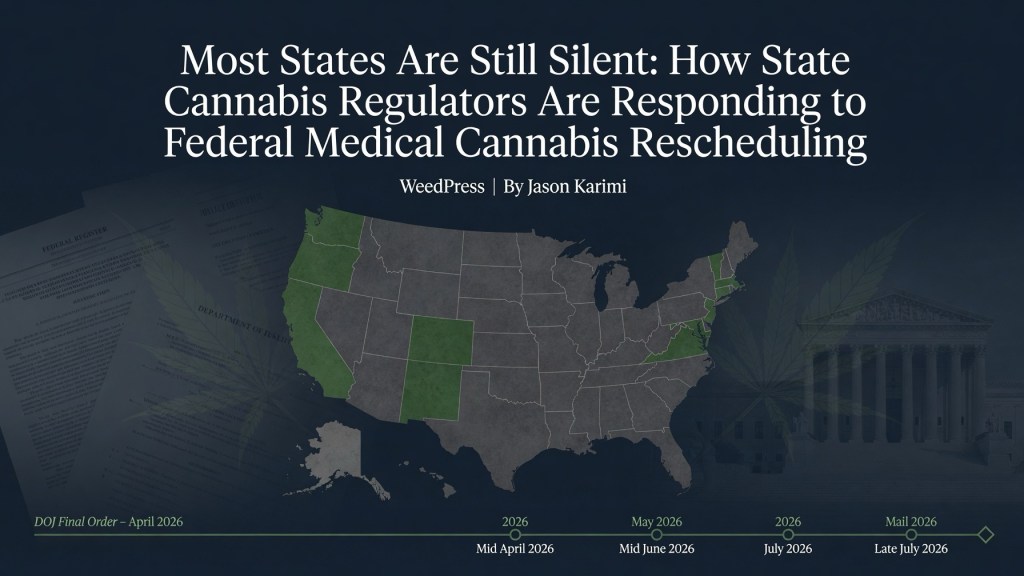
Three months after the Department of Justice issued its final order placing qualifying state-licensed medical cannabis into Schedule III, state cannabis regulators remain far from unified. A review of official guidance issued through late July 2026 reveals a fragmented national response: only a handful of agencies have formally interpreted the federal change, while most have issued little or no public guidance.
This analysis focuses on formal public guidance issued by state cannabis regulatory agencies and does not attempt to assess internal agency deliberations or unpublished enforcement policies.
For licensees, patients, attorneys, and regulators, lack of public guidance creates uncertainty about how federal changes interact with existing state licensing systems and compliance obligations.
Key Takeaway:
Federal medical cannabis rescheduling has not produced a single national regulatory model. Instead, states are interpreting and implementing the federal change through distinct regulatory approaches shaped by their own statutory frameworks.
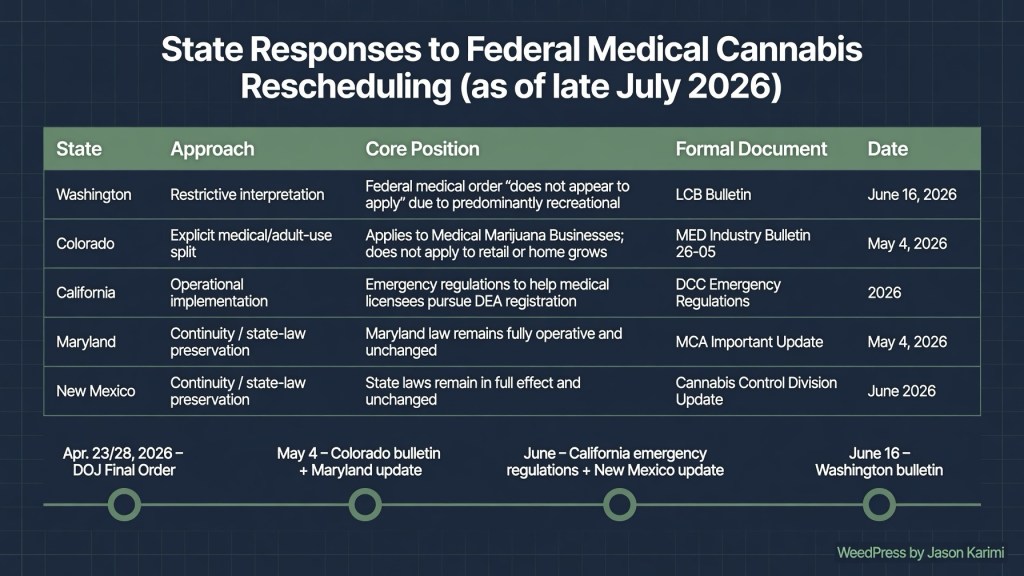
The clearest responses so far fall into distinct regulatory approaches. Washington has taken a restrictive interpretation of the order’s applicability. Colorado has drawn an explicit line between medical and adult-use markets. California has moved toward operational implementation through emergency rulemaking. Maryland and New Mexico have emphasized regulatory continuity and the preservation of state law.
Together, these responses reveal how state agencies are beginning to position themselves in the absence of uniform federal-state coordination.
Five Emerging Approaches to Federal Medical Cannabis Rescheduling
Washington: Restrictive Interpretation
On June 16, 2026, the Washington State Liquor and Cannabis Board issued a formal bulletin stating that the federal medical rescheduling order “does not appear to apply to Washington’s cannabis licensees, due to the statutory framework predominantly regulating recreational cannabis.”
Among states with both medical and adult-use cannabis programs, Washington has issued one of the clearest public statements limiting the apparent reach of the federal order. Its position rests on the structure of its own regulatory system rather than a direct challenge to federal authority.
Colorado: Explicit Medical/Adult-Use Distinction
Colorado’s Marijuana Enforcement Division published Industry Bulletin 26-05 on May 4, 2026. The bulletin states that the federal order applies to Medical Marijuana Business licensees but does not apply to retail (adult-use) marijuana or personal home grows under Amendment 64.
Colorado’s bulletin remains one of the most precise agency interpretations issued to date.
California: Operational Implementation
California’s Department of Cannabis Control adopted emergency regulations designed to help medical licensees restructure their licenses and pursue the new DEA registration pathway created by the federal order. California’s response stands out for emphasizing operational implementation through emergency rulemaking.
Maryland and New Mexico: Regulatory Continuity
The Maryland Cannabis Administration published an official update on May 4, 2026, stating that “Maryland law remains fully operative and unchanged.” New Mexico’s Cannabis Control Division issued a similar position in June 2026, affirming that state laws “remain in full effect and unchanged.”
Both states have chosen continuity of state regulation as their primary public message.
The Emerging National Pattern
State cannabis regulators appear to be falling into five broad categories. The categories below are descriptive rather than evaluative and are intended to summarize each agency’s publicly stated approach based on documents available through late July 2026. While these categories are not mutually exclusive, they provide a useful framework for understanding the different ways agencies have responded to the federal rescheduling order:
1. Interpretive guidance — Washington and Colorado have issued formal positions defining the order’s reach within their existing statutory frameworks.
2. Operational implementation — California has used emergency rulemaking to facilitate compliance with the new federal pathway.
3. Continuity guidance — Maryland and New Mexico have affirmed that state law remains unchanged.
4. Acknowledgment without interpretation — Michigan’s Cannabis Regulatory Agency released a short press release stating it was reviewing the order but offered no substantive position.
5. No formal public guidance — Many states, including Arizona, Florida, Illinois, Massachusetts, New Jersey, Pennsylvania, Nevada, Missouri, Oklahoma, and others, have not issued substantive public interpretations of the federal order, even though internal review or informal discussions may be underway.
Conclusion
The emerging pattern suggests that federal rescheduling has not produced a uniform national regulatory response. Instead, state agencies are developing their own approaches based on existing statutory frameworks, administrative priorities, and market structure. Until additional states issue formal guidance—or courts clarify the interaction between federal Schedule III status and state cannabis laws—the regulatory landscape will likely remain fragmented.
As additional states eventually publish guidance, these early bulletins are likely to become important reference points. They illustrate the range of regulatory options available—from limiting the federal order’s reach, to facilitating compliance, to preserving existing state frameworks—and may influence how other agencies approach future implementation.
Because additional states may issue guidance as implementation progresses, this framework reflects the public regulatory landscape as it existed through late July 2026 rather than a final or complete national consensus. Until further guidance emerges, these early agency bulletins provide the clearest publicly available reference points for understanding how states are interpreting—and implementing—the most significant federal cannabis scheduling change in more than half a century.
Footnotes
1. Washington State Liquor and Cannabis Board, Industry Bulletin on Federal Medical Marijuana Rescheduling (June 16, 2026).
2. Colorado Marijuana Enforcement Division, Industry Bulletin 26-05: Attorney General Rescheduling Order (May 4, 2026).
3. California Department of Cannabis Control, Emergency Regulations and Federal Rescheduling Resources (2026).
4. Maryland Cannabis Administration, Important Update: Medical Cannabis Rescheduling Final Order (May 4, 2026).
5. New Mexico Cannabis Control Division, official update stating state laws remain unchanged (June 2026).
6. Michigan Cannabis Regulatory Agency, Press Release: Federal Order Rescheduling Cannabis (April 23, 2026).
I like being underestimated, and now, I get to watch these lawmaker idiots, who haven’t done any serious legal research, (excepting a handful of Senators who went to Portugal) set themselves up for failure.
You folks do get this issue is about constitutional/basic civil fucking rights? Don’t you? Jesus said woe to the lawyers for a reason…people are still in prison doing decades for this plant while others are trying to get….ah, the moral tells itself. Just reminding.
Since nobody else is tracking state responses and compiling/tracking/combobulating the state responses to rescheduling, I guess I’ll take first shot at commentary on it. Seems like I should since I know more about federal scheduling legal issues than anyone else in the country except at most one other person.
So if any state anywhere files any bulletin, hearing notice, or report on federal rescheduling impacting state scheduling or medical cannabis laws, I’ll find out first and report on it.
See you all back in the field next Monday.
We aren’t going anywhere.


Leave a Reply